7,655 ransomware victims in 12 months (based on leak site tracking). One organization every 71 minutes. The dominant attack vector is not a vulnerability: it’s a valid login.
From March 2025 to March 2026, ransomware groups posted 7,655 victim claims. That is one new organization posted every 71 minutes, every hour of every day for an entire year. Fifty-three ransomware groups claimed US victims in January and February 2026 alone. Qilin alone claimed 1,179 victims across 74 countries, averaging 3.1 new victims every single day.
These numbers are striking. What is more striking is how the attacks actually begin. Ransomware is no longer primarily a story about exploiting technical vulnerabilities. The dominant shift in 2026 is identity-first attack: attackers prioritize credential theft, session token hijacking, and federated access abuse to achieve initial access. They do not break in through a zero-day. They log in with a valid credential.
This rewrite of the ransomware playbook has profound implications for threat models that are organized around perimeter defense and vulnerability management. If the attacker already has valid credentials, your firewall sees a legitimate login. Your SIEM records an authenticated session. Your EDR agent sees a credentialed user executing commands. The threat is inside the perimeter from the first moment, and it looks like a trusted user.
This post maps how credential-first ransomware works in 2026, why the identity perimeter is now the last line of defense, and what detection controls actually catch these attacks before encryption begins.
What Is Credential-First Ransomware?
Credential-first ransomware is a ransomware attack methodology that prioritizes obtaining valid authentication credentials as the first phase of the attack chain, rather than exploiting a technical vulnerability for initial access. This includes phishing-based credential theft, session token hijacking (including AiTM techniques), dark web purchase of previously stolen credentials, and insider recruitment.
Once inside with valid credentials, attackers move methodically: they discover the environment, elevate privileges, disable security tooling, destroy backups, and stage data for exfiltration before deploying encryption. The credential is the key. Everything else follows from having it.
The 2026 Ransomware Landscape: Who Is Attacking
The credential theft ransomware identity attack landscape in 2026 is characterized by a maturing ecosystem of specialized groups with distinct operating patterns.
Qilin leads by volume with 1,179 claims across 74 countries in the past 12 months. Akira targets mid-market organizations in manufacturing and professional services. Clop specializes in large-scale data theft from enterprise networks. INC Ransom and Play focus on critical infrastructure and healthcare. DragonForce and Sinobi represent newer entrants with rapidly growing victim counts.
Across these groups, several structural trends define 2026 operations: faster rebranding cycles when heat increases, cross-platform encryption capability that operates across Windows, Linux, and VMware ESXi simultaneously, and double extortion as the baseline: data exfiltration before encryption, with two separate leverage points for payment.
Perhaps most concerning: ransomware groups are actively recruiting native English speakers to approach corporate insiders as recruitment targets. A BBC reporter was contacted in 2026 by a group attempting to recruit insiders to plant ransomware in exchange for a share of the ransom. The attack surface now includes your employees as potential threat vectors.
The Credential-First Attack Chain
Phase 1: Credential Acquisition
Attackers acquire credentials through multiple channels operating in parallel. Phishing campaigns deliver credential-harvesting pages or info-stealers. Dark web credential markets sell previously stolen credentials from historical breaches. Session tokens are harvested through AiTM phishing proxies that bypass MFA. Federated identity vulnerabilities allow credential reuse across cloud environments.
Nation-state actors using AI to forge synthetic identities and deepfake personas have also been observed successfully passing recruitment and verification processes, establishing insider positions in targeted organizations. The acquisition phase is patient and multi-channel.
Phase 2: Persistent Access Establishment
With valid credentials, the attacker establishes persistent access using legitimate mechanisms: creating new accounts, adding MFA methods to existing accounts, registering new devices for trusted access, and installing remote management tools that are indistinguishable from legitimate IT infrastructure.
This phase is where dwell time accumulates. Attackers may maintain persistent access for weeks before proceeding, gathering intelligence on network topology, backup architecture, and security tooling.
Phase 3: Privilege Escalation and Lateral Movement
Using the persistent access, attackers escalate privileges by exploiting misconfigured access controls, over-privileged service accounts, and legacy systems that lack modern authentication requirements. Lateral movement uses legitimate tools: RDP, WMI, PowerShell, and network file shares — activities that are difficult to distinguish from normal IT operations without behavioral context.
Phase 4: Defense Evasion and Backup Destruction
Before encryption, attackers systematically disable or evade security controls: stopping EDR agents, clearing logs, disabling backup processes, and staging data exfiltration. Backup destruction is completed before ransomware deployment to remove the recovery option. This phase is the critical window for detection: the behavioral patterns of backup access and deletion, logging changes, and security tool manipulation are detectable anomalies that precede encryption.
Phase 5: Encryption and Double Extortion
With defenses disabled and backups destroyed, encryption is deployed. Simultaneously, the exfiltrated data creates a second extortion lever: pay or the data is published. In 2026, the encryption phase is often the first moment organizations realize an attack is underway: by then, the damage is largely done.
What Happens When Teams Miss the Early Phases
Ransomware groups have adapted to detection at the encryption phase: they simply rebuild with a different tool and re-enter. The organizations that successfully reduce breach impact are those that detect the attack during credential acquisition, persistence establishment, or the lateral movement phase — before backup destruction begins. Peris.ai’s platform reduces breach impact by 53% and cost by 47% in documented deployments: that reduction comes from early-phase detection, not post-encryption response.
Why Traditional Threat Models Miss Credential-First Ransomware
The credential-first ransomware playbook is not a new tactic: it is the maturation of an approach that has been growing in prevalence for years, driven by the increasing availability of stolen credentials, the effectiveness of session token hijacking, and the reality that most organizations have stronger perimeter defenses than identity security.
The threat model that treats network perimeter defense as the primary control is the wrong threat model for 2026. Identity security, behavioral analytics that surface anomalous credential use, and automated response speed are the controls that matter. Peris.ai’s XDR, BrahmaFusion, and IRP give SOC teams the identity-layer visibility, early-phase detection, and automated response capability to catch ransomware attacks before they reach the encryption phase.
Because in 2026, the most dangerous actor in your environment is not breaking in. They are already logged in. And the clock is running.
Learn how Peris.ai’s agentic AI platform empowers security teams to detect and stop credential-first ransomware before backup destruction begins. Want more insights? Visit Peris.ai.
Frequently Asked Questions
What is credential-first ransomware?
Credential-first ransomware prioritizes obtaining valid authentication credentials as the first phase of the attack chain, using credential theft, session token hijacking, or dark web credential purchases to gain access, rather than exploiting technical vulnerabilities.
How many ransomware attacks happened in 2025-2026?
Ransomware groups posted 7,655 victim claims from March 2025 to March 2026 (based on leak site tracking), representing one new organization every 71 minutes.
Who is Qilin ransomware?
Qilin is the most prolific ransomware group in the 12-month period ending March 2026, claiming 1,179 victims across 74 countries at an average rate of 3.1 victims per day.
Why does MFA no longer fully protect against ransomware?
AiTM phishing techniques proxy the authentication flow, capturing the session token after MFA completes. Attackers replay the token to gain authenticated access without ever having the user’s credentials or MFA device.
How does Peris.ai detect credential-first ransomware attacks?
Peris.ai’s XDR correlates identity signals across endpoint, network, cloud, and authentication layers to detect anomalous credential use in the early attack phases. BrahmaFusion executes automated response playbooks to contain compromise before lateral movement or backup destruction occurs.
Bayangkan toko Anda (fisik maupun digital) dibiarkan terbuka tanpa kunci setiap malam. Tidak ada gembok, tidak ada alarm, tidak ada kamera. Siapa pun bisa masuk, mengambil apa yang mereka mau, dan pergi tanpa jejak. Itulah kondisi keamanan siber sebagian besar startup dan UKM digital di Indonesia hari ini.
Banyak pemilik bisnis dan pendiri startup masih beranggapan: “Saya bukan target. Hacker hanya mengincar bank besar, perusahaan multinasional, atau pemerintah.” Anggapan ini bukan hanya salah, ini berbahaya. Dan ini tepatnya yang membuat bisnis kecil dan menengah menjadi target yang lebih menarik bagi sebagian besar pelaku kejahatan siber.
Faktanya: Indonesia adalah negara yang paling banyak diserang serangan siber di Asia Tenggara pada 2026. Rata-rata, organisasi di Indonesia menerima ribuan serangan siber setiap minggu. Dan mayoritas korbannya bukan Fortune 500, melainkan bisnis seperti milik Anda.
Mengapa Startup dan UKM Justru Lebih Menarik bagi Pelaku Kejahatan Siber?
Logikanya sederhana: hacker mencari keuntungan maksimal dengan risiko minimal. Perusahaan besar memiliki tim keamanan siber penuh waktu, sistem monitoring canggih, dan prosedur respons insiden yang matang. Startup dan UKM, di sisi lain, sering kali:
Tidak memiliki tim IT keamanan khusus
Menggunakan password yang sama di banyak akun
Belum mengaktifkan autentikasi dua faktor (2FA)
Menyimpan data pelanggan tanpa enkripsi yang memadai
Menggunakan software bajakan atau tidak diperbarui
60% target ransomware global adalah UKM, bukan korporasi besar. Alasannya: UKM memiliki data berharga (data pelanggan, rekening bisnis, sistem kasir), tetapi jarang memiliki backup yang memadai atau tim respons insiden. Artinya, tekanan untuk membayar tebusan jauh lebih besar.
Biaya rata-rata satu insiden siber terhadap UKM: $25.000 sampai $50.000, atau setara ratusan juta rupiah — cukup untuk menutup bisnis yang baru berjalan beberapa tahun.
5 Ancaman Siber Paling Umum yang Mengancam Startup Indonesia di 2026
1️⃣ Ransomware via Email Phishing
Ransomware adalah jenis malware yang mengenkripsi semua file di komputer Anda, lalu meminta tebusan agar Anda bisa mengaksesnya kembali. Cara masuknya paling sering melalui email yang terlihat sah, seolah dari kurir, bank, atau mitra bisnis, tetapi mengandung lampiran berbahaya.
Bayangkan: seluruh data pelanggan Tokopedia seller Anda, laporan keuangan, database GoPay merchant semua terkunci. Anda tidak bisa operasional. Setiap jam, kerugian bertambah.
2️⃣ Pencurian Data Pelanggan
Data pelanggan seperti nama, email, nomor telepon, alamat, riwayat transaksi yang memiliki nilai tinggi di pasar gelap. Hacker yang berhasil mengakses database bisnis Anda bisa menjual data tersebut, menggunakannya untuk penipuan, atau mengancam untuk mempublikasikannya kecuali Anda membayar.
Di bawah UU Perlindungan Data Pribadi (UU PDP) yang berlaku sejak 2024, kebocoran data pelanggan wajib dilaporkan dan dapat mengakibatkan sanksi, tidak ada pengecualian untuk UKM.
Hacker meretas atau meniru akun email pimpinan perusahaan, lalu mengirimkan instruksi transfer ke tim keuangan. Email terlihat sah, menggunakan nama dan gaya penulisan yang familiar, dan mendesak tindakan segera.
Korban BEC di Indonesia meningkat signifikan seiring adopsi email bisnis yang meluas. WhatsApp Business dan email Google Workspace yang tidak dilindungi 2FA adalah target utama.
4️⃣ Cryptomining via Server Cloud yang Salah Konfigurasi
Startup yang menggunakan layanan cloud (AWS, Google Cloud, DigitalOcean) sering kali salah mengkonfigurasi pengaturan akses, tanpa disadari membuka akses ke server mereka untuk publik. Hacker memanfaatkan ini bukan untuk mencuri data, tetapi untuk menjalankan program penambangan cryptocurrency menggunakan sumber daya komputasi Anda, yang berarti tagihan cloud Anda melonjak drastis.
5️⃣ Serangan Rantai Pasokan Digital
Plugin WordPress, ekstensi browser, aplikasi pihak ketiga yang terintegrasi dengan sistem Anda, semuanya adalah potensi pintu masuk. Kelompok APT Lotus Blossom, yang aktif di Asia Tenggara, telah menargetkan startup teknologi regional melalui software populer yang sudah dikompromikan.
Apa yang Terjadi Jika Bisnis Anda Terkena Serangan Siber?
Mari kita bicara nyata. Ketika bisnis kecil terkena serangan siber:
Operasional berhenti. Tidak bisa mengakses sistem POS, database pelanggan, atau platform e-commerce.
Kehilangan kepercayaan pelanggan. Berita kebocoran data menyebar cepat, terutama di era media sosial.
Sanksi regulasi. UU PDP dan regulasi BSSN No. 1/2024 mengharuskan pelaporan insiden siber, kegagalan melapor menambah masalah hukum.
Dampak jangka panjang. Reputasi bisnis yang rusak butuh waktu lama untuk dipulihkan, bahkan setelah sistem teknis kembali normal.
✅ Checklist 5 Langkah Praktis yang Bisa Dilakukan Hari Ini
Kabar baiknya: ada langkah-langkah dasar yang tidak membutuhkan anggaran besar tetapi memberikan perlindungan signifikan.
Langkah 1: Aktifkan Autentikasi Dua Faktor (2FA) di Semua Akun Penting
Email bisnis (Gmail/Google Workspace), akun Tokopedia Seller, OVO bisnis, GoPay merchant, internet banking, dan platform cloud, semua harus dilindungi 2FA. Ini adalah satu langkah yang paling efektif mencegah pengambilalihan akun, meskipun password Anda bocor.
Cara: Masuk ke pengaturan keamanan masing-masing platform dan aktifkan “Two-Step Verification” atau “Autentikasi 2 Langkah.” Gunakan aplikasi Google Authenticator atau SMS OTP.
Langkah 2: Backup Data Secara Otomatis Setiap Hari
Ransomware kehilangan kekuatannya jika Anda memiliki backup terbaru. Atur backup otomatis harian ke lokasi yang terpisah dari sistem utama: cloud storage (Google Drive, Dropbox bisnis) ATAU hard drive eksternal yang tidak selalu terhubung ke komputer.
Aturan 3-2-1: 3 salinan data, di 2 media berbeda, dengan 1 salinan di lokasi berbeda (offsite atau cloud).
Langkah 3: Latih Semua Karyawan Mengenali Email Phishing
Satu karyawan yang mengklik lampiran berbahaya bisa menghancurkan seluruh sistem. Pelatihan singkat 1 jam per tahun terbukti mengurangi risiko phishing lebih dari 60%. Ajarkan tim Anda untuk:
Selalu periksa alamat email pengirim dengan teliti (bukan hanya nama tampilan)
Jangan pernah mengklik lampiran dari pengirim yang tidak dikenal
Hubungi pengirim melalui saluran lain jika menerima instruksi transfer yang mencurigakan
Laporkan email mencurigakan ke tim IT atau pimpinan
Langkah 4: Perbarui Semua Software Secara Rutin
Software yang tidak diperbarui mengandung kelemahan keamanan yang sudah diketahui publik, dan oleh hacker. Aktifkan pembaruan otomatis untuk sistem operasi, browser, aplikasi bisnis, dan plugin website.
Jika menggunakan WordPress, perbarui plugin dan tema secara berkala. Plugin WordPress yang usang adalah salah satu vektor serangan paling umum untuk website UKM Indonesia.
Langkah 5: Gunakan Password yang Kuat dan Unik untuk Setiap Akun
Password seperti “toko123” atau “namabisnis2024” dapat diretas dalam hitungan detik. Gunakan password manager seperti Bitwarden (gratis) atau 1Password untuk membuat dan menyimpan password yang kuat dan unik untuk setiap akun. Jangan pernah menggunakan password yang sama di lebih dari satu akun.
Seberapa Besar Biaya Keamanan Siber vs. Biaya Insiden?
Ini perbandingan yang perlu dipertimbangkan setiap pemilik bisnis:
Biaya Perlindungan
Biaya Jika Tidak Terlindungi
Layanan monitoring keamanan dasar: mulai dari jutaan rupiah/bulan
Rata-rata kerugian ransomware UKM: ratusan juta rupiah
Downtime operasional: ratusan juta rupiah per hari
Investasinya kecil. Konsekuensi tidak berinvestasi bisa fatal untuk bisnis.
Bagaimana Peris.ai Membantu Startup dan UKM Indonesia?
Peris.ai adalah perusahaan keamanan siber berbasis agentic AI yang berkantor di Singapura, Indonesia (Jakarta), dan UAE. Kami memahami bahwa tidak semua bisnis memiliki tim SOC internal yang lengkap, itulah mengapa solusi kami dirancang untuk berbagai skala bisnis, termasuk startup dan UKM yang baru membangun fondasi keamanan digitalnya.
Pandava adalah layanan penetration testing (uji penetrasi) Peris.ai, langkah penting bagi startup yang ingin tahu seberapa aman sistem mereka sebelum hacker menemukannya lebih dulu. Pandava mensimulasikan serangan nyata terhadap website, aplikasi mobile, dan infrastruktur cloud Anda, lalu menghasilkan laporan lengkap tentang celah yang ditemukan beserta rekomendasi perbaikannya. Seperti memanggil “pencuri profesional” untuk menguji keamanan toko Anda, lebih baik tahu sekarang daripada setelah kejadian.
Korava adalah platform bug bounty Peris.ai yang memungkinkan bisnis Anda memanfaatkan komunitas peneliti keamanan siber untuk menemukan kerentanan di sistem Anda secara berkelanjutan. Alih-alih mengandalkan satu tim internal, Korava menghubungkan Anda dengan ratusan ethical hacker yang dibayar hanya ketika mereka berhasil menemukan bug nyata, model yang efisien secara biaya untuk UKM yang ingin keamanan berlapis tanpa anggaran besar. Ini adalah cara startup-startup teknologi terkemuka dunia menjaga keamanan produk mereka secara proaktif.
Layanan Konsultasi 1-1 Peris.ai tersedia bagi startup yang membutuhkan panduan keamanan siber yang disesuaikan dengan kebutuhan dan anggaran spesifik mereka. Tim Peris.ai terdiri dari praktisi dengan pengalaman lebih dari 10 tahun di red team dan operasional SOC.
Peris.ai juga terdaftar di BSSN (Badan Siber dan Sandi Negara), memberikan keyakinan tambahan bahwa layanan yang Anda dapatkan memenuhi standar keamanan siber nasional Indonesia.
Tidak Ada “Terlalu Kecil untuk Diserang”
Setiap bisnis yang memiliki data pelanggan, rekening bisnis, atau sistem digital adalah target potensial. Semakin besar adopsi digital, semakin Anda mengandalkan GoPay, Tokopedia, WhatsApp Business, Google Workspace, dan layanan cloud semakin besar pula permukaan serangan yang perlu dilindungi.
Pernyataan “saya terlalu kecil untuk diserang” adalah yang paling diharapkan oleh pelaku kejahatan siber untuk terus Anda percayai.
Indonesia mencatat rata-rata ribuan serangan siber per minggu per organisasi. Serangan berikutnya mungkin mengincar bisnis Anda dan pertanyaannya bukan jika, tapi kapan. Persiapan hari ini menentukan dampaknya saat itu terjadi.
Kunjungi Peris.ai dan temukan solusi keamanan siber berbasis AI yang akan memperkuat pertahanan digital Anda dari ancaman modern. Mulai dengan konsultasi gratis dan pahami apa saja yang perlu dilindungi dalam bisnis Anda!
Pertanyaan yang Sering Diajukan
Apakah bisnis kecil benar-benar menjadi target hacker?
Ya, dan sangat sering. 60% target ransomware global adalah UKM karena mereka memiliki data berharga tetapi pertahanan yang lebih lemah. Indonesia adalah negara paling banyak diserang di Asia Tenggara pada 2026.
Apa langkah pertama yang harus dilakukan untuk melindungi bisnis dari serangan siber?
Aktifkan autentikasi dua faktor (2FA) di semua akun penting, email bisnis, perbankan digital, platform e-commerce, dan layanan cloud. Ini adalah langkah paling efektif dengan biaya nol.
Apakah UU PDP berlaku untuk UKM dan startup?
Ya. UU Perlindungan Data Pribadi Indonesia yang berlaku sejak 2024 tidak memiliki pengecualian berdasarkan ukuran bisnis. Setiap bisnis yang memproses data pribadi pelanggan wajib mematuhi ketentuan perlindungan data, termasuk kewajiban pelaporan kebocoran.
Berapa biaya rata-rata serangan siber terhadap UKM?
Biaya rata-rata insiden siber terhadap UKM berkisar $25.000 hingga $50.000 (atau setara ratusan juta rupiah) menurut data FBI IC3 2024. Ini belum termasuk kerugian operasional, kerusakan reputasi, dan potensi sanksi regulasi.
Bagaimana cara mengetahui apakah bisnis saya sudah jadi target serangan siber?
Tanda-tanda umum: kecepatan sistem yang tiba-tiba melambat, tagihan cloud yang melonjak tidak wajar, akun yang mengirim email tanpa sepengetahuan Anda, atau pelanggan melaporkan menerima pesan mencurigakan dari akun bisnis Anda. Jika Anda mencurigai adanya insiden, segera hubungi tenaga ahli keamanan siber.
Meta lede: A ransomware gang operated inside enterprise firewalls for 36 days before a patch existed — here’s why zero-day gaps are now your most dangerous blind spot.
When Cisco disclosed CVE-2026-20131 in early March 2026, the security community’s reaction wasn’t relief — it was alarm. The critical flaw in Cisco Secure Firewall Management Center had already been weaponized. The Interlock ransomware gang had been exploiting it since January 26, a full 36 days before a patch was made available. During that window, they had unauthenticated remote access and could execute arbitrary code with root privileges on affected devices.
The breach didn’t happen because defenders were careless. It happened because the vulnerability didn’t officially exist yet. No CVE. No patch. No alert. Just silence — while attackers moved freely through enterprise networks.
This is the zero-day paradox: the most dangerous threats are the ones your security tools aren’t configured to detect because, by definition, no one knows they exist yet. And in 2026, this isn’t an edge case. It’s a growing pattern that every security leader needs to plan for.
Why Zero-Day Vulnerabilities Are Now a Primary Ransomware Vector
The Exploitation Window Is Getting Longer
The Interlock-Cisco case is not an isolated incident. In 2025 and into 2026, threat actors — including nation-state APTs and financially motivated ransomware groups — have increasingly shifted to zero-day exploitation as a first point of entry.
What makes the zero-day gap so dangerous:
No signature exists yet. Traditional EDR and SIEM tools rely on known threat signatures. A zero-day bypasses this entirely.
Patch windows are shrinking but never reach zero. Even the most agile security teams face days-to-weeks between vendor disclosure and full enterprise patch deployment.
Attackers share intelligence faster than defenders. Dark web forums and ransomware affiliate networks circulate exploit code rapidly.
Critical infrastructure is the target. Firewalls, VPNs, and network management tools are now the highest-value targets for zero-day exploitation.
What Happens When You Miss the Window
Data exfiltration before encryption. Modern ransomware groups like Interlock, Qilin, and DragonForce don’t just encrypt — they steal first, enabling double extortion.
Persistence mechanisms planted. Threat actors establish multiple backdoors during the exploitation window.
Mean time to detect remains catastrophically high. The average enterprise takes 241 days to identify and contain a breach.
Regulatory and reputational fallout. PDPA, OJK, and MAS regulations impose strict breach notification requirements.
The Zero-Day Landscape in 2026: By the Numbers
Metric
Value
CVE-2026-20131 exploitation window
36 days before patch
Average eCrime breakout time
29 minutes (CrowdStrike 2026)
Average breach detection and containment
241 days
Average cost of a data breach
$4.88M (IBM 2024)
Ransomware attacks targeting weekends/holidays
86%
Ransomware groups active in Jan-Feb 2026
53+ groups
What Does Proactive Zero-Day Defense Actually Look Like?
How INDRA CTI and Peris.ai’s Platform Close the Gap
INDRA CTI, Peris.ai’s Cyber Threat Intelligence engine, continuously monitors dark web forums, threat actor TTPs against MITRE ATT&CK, real-time IOCs, and behavioral anomalies — surfacing signals often days before a CVE is formally published.
This is paired with Peris.ai’s NVM (Network Visibility Monitor) for packet-level network telemetry, and BrahmaFusion for automated correlation and response playbook execution.
Scenario: Catching the Next Zero-Day Before It Has a Name
A finance company in Jakarta: INDRA CTI flags Cisco FMC exploit chatter on January 26. NVM is tasked to increase telemetry. Three days later, an anomalous deserialization payload is detected. BrahmaFusion isolates the interface, preserves forensics, and opens an IRP case with MITRE ATT&CK mapping automatically. Exploitation caught on day 3, not day 36. Ransomware never deploys.
Benefits of Proactive Zero-Day Defense with Peris.ai
Benefit
Outcome
Dark web monitoring via INDRA CTI
Early warning before CVE publication
Packet-level detection via NVM
Catches exploitation invisible to log-based tools
BrahmaFusion automated playbooks
Containment in minutes, not hours
IRP unified case management
Full forensic record with MITRE ATT&CK mapping
Reduced breach detection time
From 241-day average toward single-digit days
Compliance preservation
Evidence chain for PDPA, OJK, MAS requirements
Conclusion
Zero-day vulnerabilities don’t announce themselves. The 36-day Interlock window wasn’t a failure of patching — it was a failure of intelligence and visibility. Don’t wait for the CVE to know you’re under attack. Stay Secure with Peris.ai.
FAQ
Q: What is a zero-day vulnerability?
A: A zero-day is a software flaw exploited before a vendor patch exists. Traditional signature-based tools cannot detect these attacks.
Q: How did Interlock exploit CVE-2026-20131?
A: Via insecure deserialization in Cisco FMC, granting unauthenticated root code execution — 36 days before disclosure.
Q: How can organizations defend against zero-day threats?
A: Through behavioral detection, proactive CTI monitoring upstream of public disclosure, and packet-level network visibility — exactly what Peris.ai’s INDRA CTI, NVM, and BrahmaFusion provide.
Q: What is agentic AI cybersecurity?
A: AI systems that autonomously execute multi-step detection and response. Peris.ai’s BrahmaFusion reduces analyst workload by 35% while compressing response times dramatically.
Q: How does INDRA CTI differ from standard threat feeds?
A: INDRA CTI monitors dark web forums and threat actor TTPs in real time, surfacing warnings before CVEs are assigned — shifting from reactive patching to proactive threat hunting.
Keamanan siber bukan lagi sekadar pilihan, tetapi investasi yang harus diperhitungkan dengan serius. Setiap organisasi kini menghadapi kenyataan bahwa serangan siber bukan lagi kemungkinan, melainkan kepastian. Dengan ancaman yang terus berkembang, perusahaan harus memilih antara investasi dalam pencegahan atau menghadapi konsekuensi dari kebocoran data yang dapat berdampak pada keuangan dan reputasi mereka.
Mengapa Keamanan Siber Sangat Penting?
Setiap bisnis, tanpa memandang skala dan industrinya, berisiko menjadi target serangan siber. Pemulihan dari serangan siber sering kali jauh lebih mahal dibandingkan langkah-langkah pencegahan yang bisa diterapkan sejak awal. Selain itu, kebocoran data dapat merusak kepercayaan pelanggan, menyebabkan gangguan operasional, dan mengakibatkan kerugian hukum yang signifikan.
Meningkatnya regulasi terkait keamanan data juga menjadikan kepatuhan sebagai aspek yang tidak bisa diabaikan. Pelanggaran terhadap standar keamanan yang berlaku dapat berujung pada denda serta sanksi yang merugikan perusahaan dalam jangka panjang.
Dampak Serangan Siber terhadap Keuangan Bisnis
Serangan siber tidak hanya mengancam infrastruktur teknologi, tetapi juga membawa dampak besar terhadap keuangan dan stabilitas bisnis. Banyak organisasi yang mengabaikan pentingnya perlindungan hanya menyadari konsekuensinya setelah mengalami insiden.
Beberapa dampak finansial dari serangan siber meliputi:
Kerugian finansial langsung, termasuk pencurian dana, pembayaran tebusan ransomware, dan biaya investigasi forensik.
Denda dan sanksi regulasi akibat pelanggaran terhadap standar keamanan data yang berlaku.
Kehilangan pelanggan dan reputasi bisnis, karena konsumen cenderung menghindari perusahaan yang gagal melindungi informasi mereka.
Downtime dan biaya pemulihan sistem, yang dapat menyebabkan gangguan produksi dan kehilangan pendapatan selama berminggu-minggu atau lebih.
Investasi dalam Keamanan Siber: Apakah Terlalu Mahal?
Meskipun banyak bisnis menganggap investasi dalam keamanan siber sebagai pengeluaran besar, kenyataannya biaya untuk mencegah serangan jauh lebih kecil dibandingkan dengan biaya pemulihan pasca-insiden.
Komponen utama investasi keamanan siber mencakup:
Perangkat lunak dan alat keamanan, seperti firewall, antivirus, serta sistem deteksi intrusi.
Rencana tanggap insiden, yang mencakup prosedur untuk memitigasi dampak serangan.
Pelatihan karyawan, karena kesalahan manusia merupakan salah satu faktor utama dalam keberhasilan serangan siber.
Audit dan penilaian risiko berkala, guna mengidentifikasi kelemahan sebelum dapat dieksploitasi oleh peretas.
Pemantauan dan intelijen ancaman, untuk mendeteksi serta merespons ancaman secara real-time.
Investasi ini tidak hanya membantu mengurangi risiko serangan tetapi juga meningkatkan ketahanan bisnis dalam jangka panjang.
Pencegahan vs. Pemulihan: Mana yang Lebih Efektif?
Banyak perusahaan keliru menganggap bahwa keamanan siber hanyalah biaya tambahan. Namun, ketika membandingkan biaya pencegahan dengan biaya pemulihan akibat serangan, perbedaannya sangat mencolok.
Perusahaan yang tidak memiliki langkah-langkah keamanan yang kuat cenderung mengalami waktu pemulihan yang lebih lama dan kerugian yang lebih besar. Sebaliknya, organisasi yang telah menerapkan sistem keamanan proaktif dapat menangani ancaman dengan lebih cepat dan efektif.
Strategi Keamanan Siber yang Efektif
Agar investasi dalam keamanan siber dapat memberikan hasil optimal, bisnis harus mengadopsi pendekatan strategis yang mencakup berbagai aspek perlindungan.
Langkah-langkah utama dalam membangun sistem keamanan yang efektif meliputi:
Evaluasi risiko secara berkala, untuk mengidentifikasi potensi kelemahan dalam sistem.
Penerapan teknologi perlindungan utama, termasuk keamanan endpoint, proteksi jaringan, dan otentikasi multi-faktor.
Pemanfaatan kecerdasan buatan dan otomatisasi, untuk mendeteksi dan merespons ancaman dengan cepat.
Pelatihan karyawan tentang keamanan siber, agar mereka lebih waspada terhadap teknik serangan seperti phishing dan social engineering.
Pembuatan rencana tanggap insiden, sehingga organisasi dapat segera bertindak saat terjadi pelanggaran keamanan.
Pendekatan ini dapat secara signifikan mengurangi kemungkinan serangan dan meminimalkan dampak jika insiden terjadi.
Kesimpulan: Pencegahan adalah Keputusan Bisnis yang Cerdas
Meskipun investasi keamanan siber membutuhkan biaya di awal, manfaat jangka panjangnya jauh lebih besar dibandingkan dengan konsekuensi dari pelanggaran keamanan. Dengan mengutamakan pencegahan, perusahaan dapat menghindari risiko kerugian finansial, menjaga reputasi, serta memastikan kepatuhan terhadap regulasi yang berlaku.
Keamanan siber bukan hanya tentang menghindari serangan, tetapi juga tentang membangun fondasi yang kuat untuk pertumbuhan bisnis di masa depan.
Lindungi Bisnis Anda Sekarang!
Jangan tunggu hingga serangan terjadi! Lindungi aset digital Anda dengan solusi keamanan siber yang tepat.
Kunjungi Peris.ai untuk menemukan solusi terbaik yang disesuaikan dengan kebutuhan bisnis Anda.
Open Source Intelligence (OSINT) is a powerful tool for gathering, analyzing, and reporting data from publicly available sources. It involves collecting and interpreting information to extract valuable insights and intelligence. OSINT techniques are used to acquire information from various online sources and enhance decision-making processes. It serves as an unseen cyber informant by providing valuable intelligence on security threats, market research, and competitive intelligence.
Key Takeaways:
Open Source Intelligence (OSINT) is a valuable tool for gathering intelligence from publicly available sources.
OSINT techniques are used to acquire information from various online sources.
OSINT serves as an unseen cyber informant by providing valuable intelligence on security threats, market research, and competitive intelligence.
OSINT enhances decision-making processes by offering valuable insights and intelligence.
OSINT plays a crucial role in risk mitigation and intelligence gathering.
Understanding Open Source Intelligence (OSINT)
Open Source Intelligence (OSINT) is a crucial component in gathering, evaluating, and analyzing publicly available information to produce intelligence. Through the process of locating, processing, and interpreting data, OSINT aims to provide answers to specific intelligence questions. This valuable form of intelligence can be acquired from a wide range of sources, including public records, news media, social media platforms, websites, and even the dark web.
OSINT is utilized by various entities, such as government agencies, law enforcement, military organizations, investigative journalists, and private investigators. Its applications extend to investigations, intelligence gathering, and information analysis. By harnessing the power of OSINT, these entities can gain insights, uncover hidden connections, and make informed decisions based on the analyzed information.
Let’s explore some examples of OSINT:
Monitoring social media platforms to gather information related to security threats or criminal activities.
Researching publicly available financial records to analyze the financial stability of a company before a merger or investment.
Examining news articles and reports to gather intelligence on regional conflicts and geopolitical trends.
Scanning online forums and discussion boards to identify potential threats or risks.
What is Open Source Intelligence (OSINT) Investigation?
Open Source Intelligence investigation involves the systematic collection and analysis of publicly available information to uncover valuable insights and intelligence. Investigators use OSINT techniques to access and evaluate information from diverse sources and piece together a comprehensive understanding of a subject or target.
The process of OSINT investigation typically includes:
Identifying the objective of the investigation and the specific intelligence requirements.
Gathering information from various open sources, utilizing techniques such as web scraping and data mining.
Validating and verifying the collected information to ensure its accuracy and reliability.
Organizing and analyzing the gathered data to extract meaningful patterns, relationships, and insights.
Presenting the findings in a clear and concise manner, often in the form of intelligence reports or visualizations.
Overall, open source intelligence plays a crucial role in modern-day investigations, intelligence analysis, and decision-making processes. Its accessibility, versatility, and effectiveness make it an invaluable tool for organizations and individuals alike.
Edit imageMinimize imageDelete image
The Intelligence Cycle in Open Source Intelligence (OSINT)
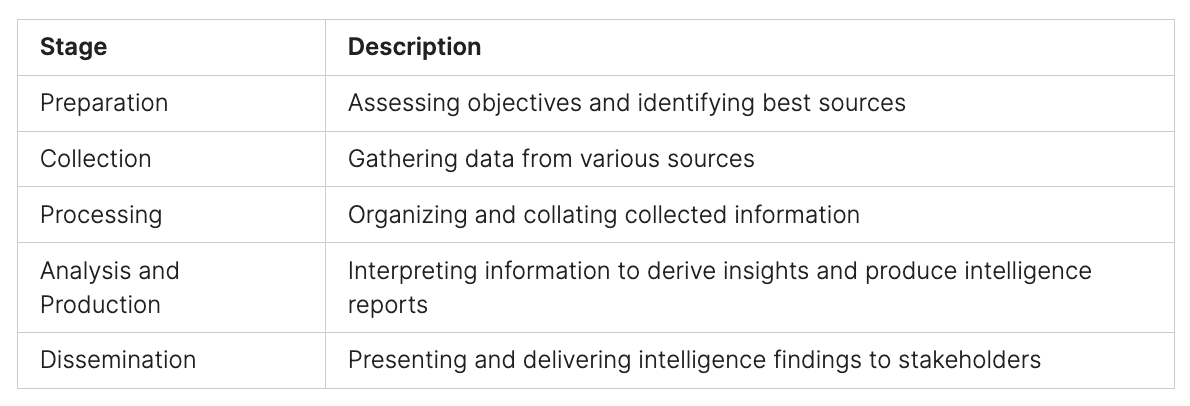
The Intelligence Cycle is a crucial framework that drives the process of intelligence gathering and analysis in Open Source Intelligence (OSINT). This cycle consists of several distinct stages, each playing a vital role in extracting valuable insights and intelligence from publicly available sources. Understanding and effectively implementing the Intelligence Cycle is essential for a successful OSINT workflow.
1. Preparation
During the preparation stage, the objectives of the tasking are carefully assessed, and the best sources of information are identified. This stage sets the foundation for the entire OSINT workflow and ensures that the gathering and analysis processes align with the intended goals.
2. Collection
The collection stage involves gathering data and information from a diverse range of sources. These sources can include public records, social media platforms, news articles, websites, and more. The collection process requires meticulous attention to detail to ensure the completeness and accuracy of the gathered information.
3. Processing
In the processing stage, the collected information is organized, structured, and collated for further analysis. This involves extracting relevant data, removing duplicates, and ensuring data integrity. Effective processing techniques streamline the subsequent analysis phase.
4. Analysis and Production
The analysis and production stage is where the true value of OSINT shines. Here, the collected and processed information is analyzed to derive meaningful insights and actionable intelligence. Advanced techniques such as data visualization, natural language processing, and pattern recognition are utilized to uncover hidden connections, trends, and potential risks.
5. Dissemination
The final stage of the Intelligence Cycle involves presenting the findings and intelligence reports to stakeholders. A clear and concise delivery of the analyzed information ensures effective decision-making based on the intelligence gathered. Proper dissemination ensures that the right people receive the right information at the right time.
Creating an effective OSINT workflow is crucial to harness the power of intelligence gathering and information analysis. By following the Intelligence Cycle, organizations can maximize the value derived from open source intelligence, resulting in enhanced situational awareness, improved decision-making, and a proactive approach to risk managemen.
Delete imageEdit imageMinimize image
Delete imageEdit imageMinimize image
Passive versus Active OSINT Research
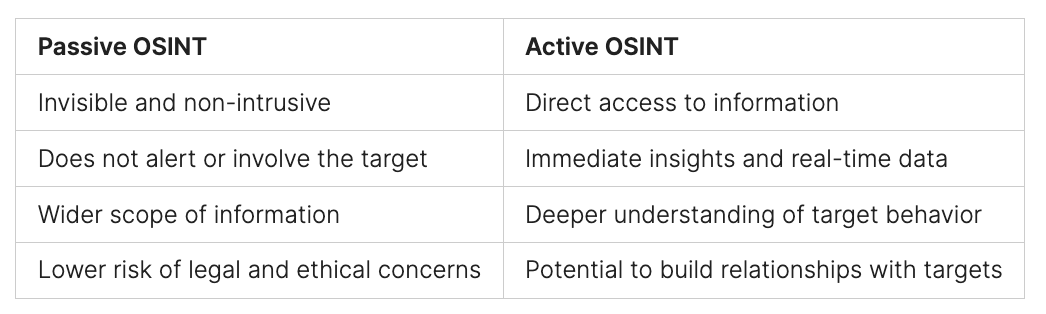
When conducting Open Source Intelligence (OSINT) research, there are two main approaches to consider: passive and active. Each approach has its own distinct characteristics and purpose, making them suitable for different scenarios.
Passive OSINT
In passive OSINT, the focus is on gathering information about a target without directly engaging with them. This approach involves collecting publicly available information from sources such as websites, social media, news articles, and public records. Researchers rely on existing data without interacting with individuals online or leaving any visible traces. Passive OSINT is valuable for collecting a wide range of information about a target without alerting them to your presence or intentions.
Active OSINT
Active OSINT involves engaging directly with a target by interacting with them online. This can include commenting on their posts, messaging them, or following their social media accounts. The goal is to gather information by blending in with the target group and appearing as a genuine user. Active OSINT requires more involvement and effort, as you need to be actively present and participate in the online communities related to your research. It allows for more direct and immediate access to information but also carries the risk of alerting the target to your presence.
Organizations that utilize OSINT research need to establish clear policies and guidelines regarding passive and active engagement. Ethical considerations, legal boundaries, and the potential impact on targets should be carefully evaluated. Striking a balance between collecting valuable intelligence and respecting privacy and ethical boundaries is crucial.
Minimize imageDelete imageEdit image
The Benefits of Passive and Active Engagement
Minimize imageDelete imageEdit image
Ultimately, the choice between passive and active OSINT research depends on the specific goals, resources, and ethical considerations of each organization. Both approaches have their merits and limitations, and understanding how to effectively deploy each in the intelligence gathering process is crucial for achieving successful outcomes.
The Benefits of Open Source Intelligence (OSINT)
Open Source Intelligence (OSINT) provides numerous benefits and advantages over other forms of intelligence collection. By utilizing publicly available information, OSINT eliminates the need for accessing classified or restricted sources, making it a cost-effective and efficient solution for gathering intelligence.
One of the key advantages of OSINT is its ability to gather information from a wide range of sources. Organizations can tap into diverse platforms such as social media, news articles, research papers, and websites to gather insights on various topics from multiple perspectives. This comprehensive approach allows for a more holistic understanding of the subject matter.
Another benefit of OSINT is its transparency and verifiability. The information collected through OSINT can be easily validated, ensuring its accuracy and reliability. This level of confidence empowers organizations to make informed decisions based on the intelligence gathered.
Moreover, OSINT offers timeliness and agility. With the vast amount of publicly available information, OSINT enables real-time intelligence gathering, enabling organizations to stay ahead of emerging trends, potential risks, and ever-evolving situations. This dynamic nature of OSINT makes it a valuable tool for decision-making processes.
“Open Source Intelligence (OSINT) eliminates the need for classified or restricted sources, making it a cost-effective and efficient solution for gathering intelligence.”
Furthermore, OSINT provides a wide range of sources to gather information from, ensuring a comprehensive view of the subject matter:
Social media platforms
News articles
Research papers
Government reports
Academic publications
These various sources contribute to the richness and diversity of the information gathered through OSINT, enhancing the quality of intelligence and facilitating better decision-making.
Overall, the benefits of Open Source Intelligence (OSINT) make it an invaluable tool for organizations across different sectors. It offers access to publicly available information, cost-effectiveness, transparency, verifiability, timeliness, and a wide range of sources for intelligence gathering. Embracing OSINT can significantly enhance an organization’s intelligence capabilities and ultimately drive better outcomes.
Open Source Intelligence (OSINT) Benefits:
Access to publicly available information
Cost-effectiveness
Transparency and verifiability
Real-time intelligence gathering
Diverse sources for comprehensive insights
Delete imageEdit imageMinimize image
How Open Source Intelligence (OSINT) Works
Open Source Intelligence (OSINT) involves a series of processes to collect, process, and analyze publicly available information. The goal is to extract valuable insights and intelligence that can inform decision-making and provide actionable intelligence.
The Collection Stage
During the collection stage, OSINT professionals gather information from various sources, including but not limited to:
Social media platforms
News articles
Government reports
Academic papers
This broad range of sources ensures a comprehensive and diverse dataset for analysis.
The Processing Stage
Once the information is collected, it goes through a processing stage. This involves organizing and structuring the data to make it easily interpretable and digestible. Data cleaning techniques are applied to remove any irrelevant or redundant information, ensuring data accuracy.
The Analysis Stage
The processed data is then subjected to various analysis techniques to identify patterns, trends, and relationships. Advanced tools and techniques, such as data visualization and natural language processing, are used to aid in this analysis. The goal is to gain deeper insights into the information collected and extract intelligence that can support decision-making processes.
Providing Actionable Intelligence
The ultimate objective of OSINT is to provide actionable intelligence based on the information collected, processed, and analyzed. This intelligence can be used for a variety of purposes, including:
“The key to OSINT success lies in the ability to transform raw data into meaningful insights that contribute to effective decision-making.”
By leveraging OSINT collection, processing, and analysis, organizations and individuals can gain valuable intelligence that can guide their strategies and actions.
Image: Keywords related to the current section: osint collection, osint processing, osint analysis.
Applications of Open Source Intelligence (OSINT)
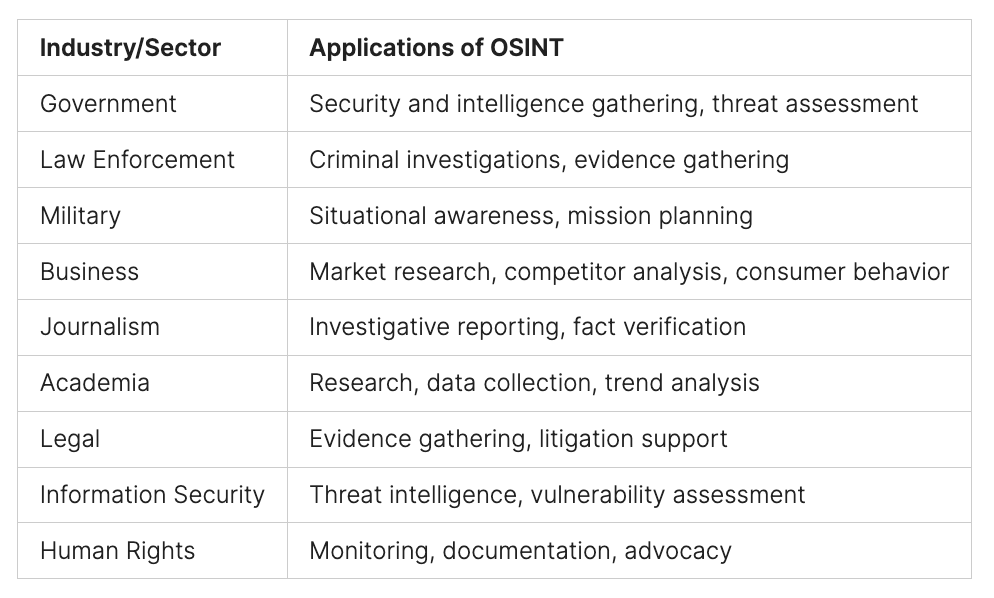
Open Source Intelligence (OSINT) is a versatile tool with a wide range of applications across various industries and sectors. Let’s explore some of the key uses of OSINT:
1. Security and Intelligence:
OSINT is extensively used by governments, law enforcement agencies, and the military for security and intelligence purposes. It plays a crucial role in gathering valuable information on potential threats, risks, and emerging security trends.
2. Business and Market Research:
OSINT provides valuable insights for businesses by facilitating competitor analysis, monitoring industry trends, and conducting market research. It helps organizations understand consumer behavior, market dynamics, and identify new business opportunities.
3. Investigative Journalism:
Investigative journalists rely on OSINT to gather information for their investigations. It helps uncover hidden connections, verify facts, and expose wrongdoing. OSINT tools and techniques are essential for conducting in-depth research and reporting accurate stories.
4. Academic Research:
OSINT plays a significant role in academic research, enabling scholars to access publicly available data. It is particularly useful in fields such as social sciences, criminology, and political science, helping researchers gather information and analyze trends.
5. Legal Proceedings:
OSINT is increasingly being used in legal proceedings to gather evidence, support litigation, and strengthen cases. It provides lawyers and investigators with valuable information from public sources that can be admissible in court.
6. Information Security:
Information security professionals utilize OSINT to identify vulnerabilities, assess risks, and protect against cyber threats. It helps in understanding the tactics, techniques, and procedures employed by potential attackers.
7. Human Rights Investigations:
OSINT plays a crucial role in human rights investigations, providing organizations with the ability to track and document human rights abuses. It helps shine a light on violations and hold perpetrators accountable.
Industries and Sectors Benefiting from OSINT
Minimize imageDelete imageEdit image
As evident from the table above, OSINT finds significant applications across various industries and sectors, making it an invaluable tool for gathering information, enhancing decision-making processes, and driving positive outcomes.
The Open Source Intelligence (OSINT) Market Overview
Several factors contribute to the growth of the OSINT market. Firstly, the rising number of cyber threats and security breaches has created a pressing need for advanced intelligence gathering techniques. Organizations across various industries are leveraging OSINT to gather crucial insights and stay ahead of potential risks.
The government’s initiatives and regulations also play a significant role in propelling the OSINT market forward. With a growing emphasis on national security, governments around the world are investing in OSINT capabilities to enhance their intelligence gathering and analysis efforts.
Furthermore, technological advancements are driving the expansion of the OSINT market. As technology evolves, new tools and techniques are being developed to collect, process, and analyze data from a variety of sources. This allows organizations to extract valuable intelligence and make informed decisions.
Key Players in the OSINT Market
A number of key players dominate the OSINT market, each contributing to its overall growth and development. These companies are at the forefront of providing innovative OSINT solutions and services, empowering organizations with advanced intelligence capabilities:
These companies have established themselves as leaders in the field, offering cutting-edge technologies and expertise to clients across various industries.
The growing OSINT market presents numerous opportunities for organizations and industries to harness the power of open source intelligence. By leveraging OSINT capabilities and partnering with key players, businesses can gain a competitive edge, mitigate risks, and make well-informed decisions in an increasingly complex digital landscape.
Conclusion
In the digital age, Open Source Intelligence (OSINT) has become an indispensable asset for organizations aiming to navigate the complexities of cybersecurity threats and vulnerabilities. OSINT platforms, like the one offered by Peris.ai Cybersecurity, harness the wealth of information available in public domains to deliver actionable intelligence that can protect businesses from potential cyber threats.
Our OSINT platform stands out in the market by providing comprehensive insights into the latest hacking techniques, malware trends, phishing campaigns, and more, drawing from a diverse array of open and closed sources, including social media, forums, and underground marketplaces. Our dedicated team of experts ensures that our clients have access to the most current information, enabling them to make informed decisions about their cybersecurity strategies.
Potential Threat Alerts: Customize alerts to receive timely notifications about threats pertinent to your business. This feature allows you to stay ahead of potential risks, ensuring quick and effective response measures.
Multi Sources Analytics: Our platform’s strength lies in its ability to aggregate and analyze data from multiple sources, including social media, blockchains, messaging platforms, and even the dark web. This comprehensive approach facilitates thorough investigations and the discovery of crucial insights and connections, making it invaluable for various organizations seeking to bolster their cybersecurity measures.
Integration with SIEM systems is seamless, consolidating all security data in one place for a holistic view of your security posture. This integration enhances your ability to swiftly identify and react to emerging threats, fortifying your defenses against the dynamic challenges of the cyber landscape.
As the demand for OSINT grows, driven by the escalating need for sophisticated intelligence gathering and cybersecurity measures, Peris.ai Pandava positions itself as a key player in this evolving market. Our OSINT solution not only offers a competitive edge but also fosters a safer digital environment for businesses across industries.
Embrace the advanced capabilities of Peris.ai Pandava’s OSINT platform to elevate your organization’s intelligence gathering and cybersecurity strategies. Visit Peris.ai Cybersecurity to explore how our OSINT platform can empower your organization to mitigate risks, make well-informed decisions, and thrive in the increasingly complex digital world. Join us in harnessing the full potential of open source intelligence for a secure and informed future.
FAQ
What is Open Source Intelligence (OSINT)?
Open Source Intelligence (OSINT) is the practice of gathering, analyzing, and reporting intelligence from publicly available sources. It involves collecting and interpreting information to extract valuable insights and intelligence.
How is OSINT used in investigations?
OSINT is used in investigations by government agencies, law enforcement, and private investigators to gather information and intelligence. It helps uncover valuable insights, patterns, and relationships to aid in decision-making and solving cases.
What is the Intelligence Cycle in OSINT?
The Intelligence Cycle in OSINT is a framework that guides the process of collecting and analyzing intelligence. It consists of stages such as preparation, collection, processing, analysis and production, and dissemination. Each stage contributes to the overall effectiveness of the OSINT workflow.
What is the difference between passive and active OSINT research?
Passive OSINT research involves gathering information about a target without engaging with them directly. Active OSINT research, on the other hand, involves engaging with a target by commenting, messaging, or following them on social media platforms. Both approaches have different ethical considerations and advantages depending on the research goals.
What are the benefits of using Open Source Intelligence (OSINT)?
OSINT provides access to publicly available information, allowing organizations to gather information on diverse topics from different perspectives. It is cost-effective, transparent, and easily verifiable. OSINT also offers timeliness and a wide range of sources, making it a valuable tool for intelligence gathering and decision-making.
How does Open Source Intelligence (OSINT) work?
OSINT works by collecting publicly available information from various sources, processing and organizing the collected data, and analyzing it to extract insights and intelligence. The information is gathered from online sources such as social media, news articles, government reports, and academic papers.
What are the applications of Open Source Intelligence (OSINT)?
OSINT has applications in various industries and sectors. It is used for security and intelligence gathering, business and market research, investigative journalism, academic research, and legal proceedings. OSINT provides valuable insights and information for decision-making processes.
How does Open Source Intelligence (OSINT) contribute to decision-making?
OSINT provides valuable intelligence and insights that can inform decision-making processes. By gathering information from publicly available sources, organizations can assess potential risks, understand market trends, identify competitors, and make informed decisions based on accurate and reliable data.
Kesadaran akan keamanan siber menjadi faktor kunci dalam menjaga kelangsungan bisnis dan melindungi data perusahaan. Serangan siber semakin canggih, dan tanpa pemahaman yang memadai, karyawan bisa menjadi titik lemah dalam sistem keamanan perusahaan.
Organisasi yang memprioritaskan pelatihan keamanan siber tidak hanya mengurangi risiko serangan tetapi juga membangun budaya keamanan yang lebih kuat. Berikut adalah lima pelajaran penting yang harus dipahami setiap karyawan untuk menjaga keamanan data dan mencegah ancaman siber.
1️⃣ Mengelola Password dengan Aman
Password yang kuat adalah garis pertahanan pertama terhadap ancaman siber. Sayangnya, penggunaan kata sandi yang lemah dan berulang menjadi penyebab utama kebocoran data.
Cara Meningkatkan Keamanan Password:
Gunakan kombinasi huruf besar, kecil, angka, dan simbol dengan panjang minimal 14 karakter.
Hindari menggunakan informasi pribadi seperti tanggal lahir atau nama dalam kata sandi.
Gunakan password manager untuk menyimpan dan mengelola kata sandi dengan aman.
Aktifkan Multi-Factor Authentication (MFA) untuk memberikan lapisan keamanan tambahan.
Sebuah password yang kuat dapat membuat peretas berpikir dua kali sebelum mencoba membobol akun Anda.
2️⃣ Mengenali dan Mencegah Serangan Phishing
Phishing adalah salah satu metode serangan siber paling umum yang menipu pengguna agar membocorkan informasi sensitif.
Cara Mengenali Phishing:
Waspadai email atau pesan yang meminta informasi login atau data pribadi.
Periksa alamat email pengirim dan hindari mengklik tautan yang mencurigakan.
Gunakan software keamanan yang dapat mendeteksi dan menyaring phishing secara otomatis.
Pelatihan yang berkelanjutan dan simulasi phishing dapat membantu karyawan lebih waspada terhadap serangan ini.
3️⃣ Keamanan Data di Tempat Kerja
Data perusahaan adalah aset berharga yang harus dijaga keamanannya. Kesalahan kecil, seperti mengakses informasi sensitif dari perangkat pribadi atau jaringan publik, bisa berakibat fatal.
Cara Melindungi Data Perusahaan:
Gunakan enkripsi untuk melindungi informasi sensitif.
Batasi akses data hanya untuk karyawan yang membutuhkannya.
Hindari menyimpan atau mengunduh data penting ke perangkat pribadi.
Selalu gunakan jaringan yang aman dan hindari Wi-Fi publik tanpa VPN.
Keamanan data bukan hanya tanggung jawab tim IT—setiap karyawan memiliki peran penting dalam menjaganya.
4️⃣ Membangun Kebiasaan Keamanan Siber Sehari-hari
Kebiasaan sederhana dalam aktivitas sehari-hari dapat meningkatkan keamanan sistem secara signifikan.
Praktik Keamanan yang Harus Diterapkan:
Selalu kunci layar perangkat saat tidak digunakan.
Hindari berbagi akun atau kata sandi dengan rekan kerja.
Rutin perbarui sistem operasi dan perangkat lunak untuk menutup celah keamanan.
Laporkan aktivitas mencurigakan atau potensi ancaman kepada tim IT secepatnya.
Kedisiplinan dalam menerapkan kebiasaan keamanan siber dapat membantu mencegah insiden keamanan sebelum terjadi.
5️⃣ Keamanan dalam Kolaborasi Tim
Kolaborasi dalam tim membutuhkan protokol keamanan yang tepat untuk memastikan bahwa informasi yang dibagikan tetap aman.
Cara Berbagi Data dengan Aman:
Gunakan platform komunikasi yang terenkripsi untuk berbagi dokumen dan informasi sensitif.
Hindari berbagi data sensitif melalui email biasa atau aplikasi pesan yang tidak aman.
Pastikan setiap alat kolaborasi yang digunakan memenuhi standar keamanan dan regulasi industri.
Dalam dunia kerja yang semakin digital, keamanan dalam kolaborasi menjadi aspek penting dalam perlindungan data perusahaan.
Kesimpulan: Jadilah Garda Terdepan dalam Keamanan Siber!
Keamanan siber bukan hanya tanggung jawab tim IT—setiap karyawan memiliki peran penting dalam menjaga keamanan perusahaan. Dengan menerapkan lima pelajaran keamanan siber ini, organisasi dapat memperkuat pertahanan mereka dan meminimalkan risiko serangan siber.
✔ Kelola password dengan baik dan gunakan MFA. ✔ Kenali dan cegah serangan phishing. ✔ Pastikan keamanan data dalam lingkungan kerja. ✔ Terapkan kebiasaan keamanan siber setiap hari. ✔ Gunakan protokol keamanan dalam kolaborasi tim.
Keamanan dimulai dari kesadaran. Jadi, apakah tim Anda sudah siap menghadapi ancaman siber?
Kunjungi Peris.ai untuk solusi keamanan siber yang cerdas dan efektif!
In today’s rapidly evolving digital world, cyber threats are no longer a question of “if”—but “when.” Businesses must stay ready with a structured incident response plan to avoid operational disruptions and reputational damage. Without preparation, organizations risk prolonged downtime, data loss, and missed opportunities.
Why Cyber Resilience Matters
A cyber incident can compromise systems, leak sensitive data, or halt business operations. These crises are complex, often involving external attacks or internal mistakes. Quick response and clear processes are critical to minimize damage.
Key reasons to improve your incident response:
Reduce system downtime and business disruption
Safeguard sensitive information
Maintain client and stakeholder trust
Ensure regulatory compliance
Strengthen long-term cybersecurity posture
What Makes an Effective Response Plan?
An incident response plan outlines how your team detects, contains, and recovers from cyber threats. It’s not just about technology—it’s about communication, accountability, and practice.
Components of a Strong Plan:
Defined Roles & Responsibilities: Assign who does what before an incident occurs
Clear Communication Protocols: Internal alignment and external transparency
Response Team Readiness: Technical experts, legal advisors, and trained spokespeople
Regular Testing & Drills: Simulations help uncover gaps and sharpen response times
Post-Incident Review: Lessons learned are fuel for continuous improvement
Common Threats to Watch For
Understanding the types of cyber threats can help your team respond faster and more effectively:
Phishing and Social Engineering
Malware and Ransomware
Insider Misuse or Negligence
DDoS Attacks
Credential Theft or Account Compromise
Each threat demands a tailored approach. Organizations that continuously evaluate their defenses are better prepared to act swiftly.
Communication Is Everything
In the middle of a cyber crisis, information flows fast—and misinformation spreads faster. A predefined communication strategy is essential for internal coordination and public reassurance.
Best Practices:
Use approved messaging templates
Designate a trained media spokesperson
Align crisis messaging across platforms
Regularly audit and improve communication channels
Evaluate and Improve Your Readiness
How quickly could your team respond to a breach today? Without regular assessments, it’s impossible to know.
✅ Key practices for readiness:
Conduct incident simulations
Benchmark response times
Align risk strategy with business priorities
Perform access reviews and threat hunting
The best response plans evolve. Incident response isn’t a checklist—it’s a living process that improves with experience and reflection.
Don’t Go It Alone: Partner with Experts
Internal teams may be limited by time, tools, or expertise. Working with cybersecurity partners like Peris.ai can strengthen your response capabilities, enhance monitoring, and reduce time to recovery.
A proactive, tested, and well-communicated incident response plan could be the difference between recovery and crisis. The time to prepare isn’t when a breach happens—it’s now.
Ready to build a stronger incident response strategy?
Visit Peris.ai to access expert insights, real-time threat defense solutions, and strategic support tailored to your business.
Pernahkah Anda berpikir bahwa ancaman terbesar bagi keamanan siber bisa datang dari dalam? Ethical hackers, atau peretas etis, memainkan peran penting dalam menemukan celah keamanan sebelum dieksploitasi oleh peretas jahat.
Di era digital yang penuh dengan ancaman siber, pendekatan reaktif terhadap keamanan tidak lagi cukup. Perusahaan perlu mengadopsi metode proaktif dengan menguji kelemahan sistem secara teratur—dan di sinilah ethical hackers berperan. Dengan mensimulasikan serangan dunia nyata, mereka membantu organisasi mengidentifikasi dan memperbaiki celah sebelum menjadi bencana.
Peran Ethical Hackers dalam Keamanan Siber
Ethical hackers memiliki tanggung jawab untuk mengidentifikasi, menguji, dan melaporkan kelemahan keamanan tanpa membahayakan organisasi. Dengan izin resmi, mereka menggunakan berbagai teknik untuk mengamankan sistem:
Pemindaian jaringan untuk mengidentifikasi titik masuk yang rentan.
Pengujian penetrasi (penetration testing) untuk mensimulasikan serangan siber.
Rekayasa sosial (social engineering) untuk menguji kelemahan manusia dalam sistem keamanan.
Perbedaannya dengan peretas jahat? Ethical hackers beroperasi dengan transparansi dan dalam batasan hukum yang jelas, dengan tujuan memperkuat keamanan organisasi, bukan mengeksploitasinya.
Lima Tahapan dalam Ethical Hacking
Ethical hacking bukan sekadar menguji sistem secara acak, melainkan mengikuti pendekatan yang terstruktur seperti berikut:
1️⃣ Reconnaissance (Pengumpulan Informasi)
Mengidentifikasi potensi celah keamanan melalui pemindaian jaringan.
Mengumpulkan data publik yang dapat dimanfaatkan dalam serangan.
2️⃣ Scanning & Enumeration
Menggunakan alat pemindaian untuk mengidentifikasi sistem yang rentan.
Menguji apakah layanan yang berjalan memiliki kelemahan yang dapat dieksploitasi.
3️⃣ Gaining Access (Mendapatkan Akses ke Sistem)
Menggunakan teknik eksploitasi untuk menguji apakah celah dapat dimanfaatkan.
Mengidentifikasi kemungkinan peningkatan hak akses untuk mendapatkan kendali lebih besar.
4️⃣ Maintaining Access (Mempertahankan Akses)
Menganalisis seberapa lama seorang penyerang dapat bertahan dalam sistem tanpa terdeteksi.
Menguji apakah jejak akses dapat disembunyikan atau dideteksi oleh sistem keamanan.
Melaporkan kelemahan yang ditemukan kepada tim keamanan perusahaan.
Memberikan rekomendasi perbaikan agar celah yang sama tidak dapat dieksploitasi di masa depan.
Metodologi ini memastikan bahwa setiap celah diperiksa secara menyeluruh, sehingga organisasi dapat segera mengambil langkah mitigasi.
Jenis Kerentanan yang Sering Ditemukan Ethical Hackers
Ethical hackers sering mengidentifikasi berbagai kelemahan yang berpotensi menjadi celah bagi peretas jahat. Beberapa yang paling umum meliputi:
Password Lemah: Penggunaan kata sandi sederhana atau berulang yang mudah ditebak.
Konfigurasi Cloud yang Tidak Aman: Kesalahan dalam pengaturan layanan cloud yang membuka akses tidak sah.
Zero-Day Vulnerabilities: Celah keamanan yang belum diketahui atau belum diperbaiki oleh vendor perangkat lunak.
Tanpa pengujian yang memadai, kelemahan ini bisa menjadi pintu masuk bagi serangan siber yang menyebabkan pencurian data atau gangguan operasional.
Teknologi dan Alat yang Digunakan Ethical Hackers
Untuk mendeteksi celah keamanan, ethical hackers menggunakan berbagai alat canggih, termasuk:
Network Mapping Tools seperti Nmap untuk mengidentifikasi perangkat dan layanan dalam jaringan.
Vulnerability Scanners seperti Nessus untuk mendeteksi kelemahan dalam sistem.
Password Cracking Tools seperti John the Ripper untuk menguji kekuatan kata sandi.
Dengan alat-alat ini, ethical hackers dapat memberikan gambaran yang jelas tentang tingkat risiko dalam suatu sistem dan memberikan rekomendasi yang lebih efektif.
Strategi Ethical Hacking untuk Keamanan Perusahaan
Ethical hacking bukan hanya tentang menemukan celah keamanan, tetapi juga tentang membangun strategi pertahanan yang lebih baik. Perusahaan dapat mengadopsi langkah-langkah berikut untuk meningkatkan keamanan:
Melakukan pengujian penetrasi secara berkala untuk mengidentifikasi kelemahan sebelum peretas jahat menemukannya.
Mengimplementasikan kebijakan kata sandi yang kuat dan multi-factor authentication (MFA) untuk mencegah akses tidak sah.
Melakukan audit keamanan cloud dan enkripsi data untuk melindungi informasi sensitif.
Memberikan pelatihan keamanan siber kepada karyawan untuk mengurangi risiko serangan berbasis rekayasa sosial.
Dengan mengadopsi pendekatan proaktif ini, perusahaan dapat memperkuat sistem keamanan mereka dan mengurangi kemungkinan kebocoran data.
Perkuat Keamanan Siber Anda dengan Ethical Hackers dari Peris.ai
Tidak ada sistem yang benar-benar kebal terhadap serangan, tetapi ethical hackers dapat membantu membuka mata Anda terhadap potensi risiko sebelum peretas jahat melakukannya.
Jangan tunggu sampai terjadi insiden! Pastikan sistem Anda diuji oleh ethical hackers profesional yang siap mengidentifikasi kelemahan sebelum menjadi ancaman nyata.
Cari tahu bagaimana ethical hacking bisa memperkuat keamanan bisnis Anda di Peris.ai!
What happens when a single phone call disrupts an entire airline’s customer trust? The recent Qantas breach wasn’t some exotic zero-day exploit. It was a human failing, a voice phishing (vishing) attack that unraveled layers of tech protection with nothing more than carefully chosen words.
If a digitally mature country like Australia can fall prey to such tactics, what does this mean for developing nations rushing headlong into digital transformation? Welcome to the cybersecurity paradox of the Global South, where digital innovation races ahead while human-centric security lags dangerously behind.
This isn’t just a tech problem. It’s a human challenge. One that requires new strategies, local resilience, and collective awareness. And the time to act? Now.
The Digital Transformation Tipping Point
Digital Progress, Real-World Impact
Across Africa, Southeast Asia, and Latin America, digital technologies are accelerating socio-economic transformation:
Mobile banking continues to reach unbanked populations. In Sub-Saharan Africa alone, mobile broadband connections surpassed 500 million by 2023, enabling rapid financial inclusion.
E‑governance is streamlining bureaucracy and boosting transparency. In early 2025, Sri Lanka launched GovPay, a national digital payment system for public services, with plans to scale it across dozens of government agencies.
Smart agriculture powered by IoT and AI is helping farmers monitor soil, weather, and yields more effectively—particularly in Asia and parts of Africa.
These systems are no longer just convenient, they’ve become critical infrastructure.
But with progress comes risk. According to a June 2025 INTERPOL report, two-thirds of African countries now rank cybercrime, including phishing, ransomware, BEC fraud, and sextortion, as one of their top three criminal threats. Attacks on public infrastructure have increased, with incidents like the breach of Nigeria’s public service database and cyberattacks targeting government platforms in Kenya.
Growth Breeds Vulnerability
Every new digital touchpoint becomes a potential entry point for cyber threats. And unlike physical infrastructure, cybersecurity isn’t immediately visible until it fails.
Analogy: Building a smart city without cybersecurity is like constructing skyscrapers without elevators that lock: accessible, efficient… and wide open to theft.
The Triple Bind: Why the Global South Faces Unique Cyber Challenges
1. Insufficient Cybersecurity Infrastructure
Many small businesses and public agencies continue to rely on outdated systems:
Unsupported operating systems
Free (and often inadequate) antivirus tools
Basic or shared password policies
Real-world result (2024): A detailed study published in January 2025 found Nigeria lost nearly $500 million due to ransomware linked to weak cybersecurity, poor password policies, and organizational gaps, highlighting vulnerabilities in both businesses and public agencies.
2. Public Unawareness of Digital Threats
What’s the harm in clicking that SMS link? In many cases, the public isn’t taught to question digital interactions:
Identity theft via Facebook messages
Fake loan apps stealing banking credentials
WhatsApp scams posing as relatives in distress
3. Underfunded Regulatory Ecosystems
Even when laws exist, enforcement is often weak:
Cybercrime units lack tools and training
International cooperation is limited
Data protection laws are vague or outdated
Calculation: According to the World Economic Forum, cybercrime is now the world’s third-largest ‘economy’, causing roughly $9 trillion in annual damages in 2024—and projected to hit $10.5 trillion by the end of 2025.
The Psychology of Social Engineering: The Breach That Bypasses Code
How a Phone Call Outsmarts Firewalls
The Qantas breach relied on vishing: a fake internal call that tricked an employee into revealing credentials. No malware. No hacking tools. Just trust manipulation.
This is why social engineering remains so effective:
Fear: “Your account has been compromised. Act now!”
Urgency: “We need this data in the next 5 minutes.”
Authority: “I’m from the IT department.”
Why the Global South Is at Higher Risk
Digital newcomers often:
Trust official-looking messages
Share devices among family members
Lack awareness of threat patterns
Example: In rural Indonesia, a government-issued health app was mimicked by a phishing campaign, compromising patient data across multiple provinces.
Reframing Cybersecurity as a Development Issue
It’s Not a Luxury. It’s a Foundation.
Cybersecurity is often seen as a “nice to have” rather than a development essential. But here’s what’s at stake:
Digital identity fraud halts access to services
Financial scams bankrupt small businesses
Infrastructure breaches compromise public trust
Rhetorical question: Can we truly call a nation “digitally developed” if it can’t defend its own data?
Four Human-Centric Strategies for Resilience
1. Human-Centered Security Education
It’s not about teaching people to use software. It’s about teaching them to question it.
A. Recognizing Phishing Attempts
Watch for poor grammar, strange URLs, urgency cues
Always verify requests for personal information
B. Understanding Privacy Basics
What data apps collect and why it matters
How to enable 2FA and manage account permissions
C. Knowing When to Report
Create simple, well-publicized reporting pathways
Incentivize communities to share suspicious activities
Real-world analogy: Just as communities learn to spot fake bills, they can learn to detect digital scams.
2. Public-Private Cyber Partnerships
Government and business must join forces. Why?
Telcos can block known phishing domains
Fintechs can implement stronger identity verification
Startups can innovate local security tools
3. Regionally-Relevant Cyber Policies
Global copy-paste laws don’t work.
What’s Needed:
Data protection tailored to informal economies
Language-accessible rights documentation
Legal frameworks for reporting and remediation
Provocative point: In many rural communities, WhatsApp isn’t just a chat app, it’s the primary marketplace. For example, a 2024 Meta‑GWI survey found that 55% of small-town consumers in India used WhatsApp during their purchase journey, with over 95% of them being active users, demonstrating how vital messaging apps have become for commerce. A generic GDPR-style policy means little in places where “a village’s economy lives in WhatsApp groups.” These platforms often lack formal oversight and consumer protection mechanisms, creating friction between legal frameworks and everyday reality.
4. Investing in Cyber Talent Locally
Bootcamps, Scholarships, and Mentorships
Train ethical hackers and analysts within the community
Reduce brain drain by creating local opportunities
Programs powered by AI-driven orchestration platforms like Brahma Fusion by Peris.ai can reduce response times and streamline triage workflows—even for lean security teams.
Cybersecurity and Sustainable Development: A Link Too Vital to Miss
Trust Fuels Digital Progress
If users don’t trust a platform, they won’t use it. No users means no adoption, which means development stalls.
Breaches Affect More Than Data
A single breach in a mobile agriculture app can:
Wipe out crop forecasts
Disrupt entire supply chains
Leave smallholder farmers in crisis
Cybersecurity is no longer optional, it’s humanitarian.
Frequently Asked Questions (FAQ)
What Is a Human Firewall?
A human firewall refers to the education, awareness, and behavior of individuals that serve as the first line of defense against cyber threats like phishing, social engineering, and scams.
Why Is the Global South More Vulnerable?
Due to rapid digitization, limited infrastructure, low digital literacy, and lack of funding for cybersecurity initiatives, countries in the Global South face disproportionate risks.
Can Local Governments Afford Cybersecurity?
Yes, especially with scalable and cost-efficient platforms like Brahma Fusion by Peris.ai, which uses automation and AI to reduce costs while increasing incident response capabilities.
How Can Individuals Protect Themselves?
Learn to identify suspicious links and messages
Use strong, unique passwords with 2FA
Report cyber incidents to official channels
What Role Do Private Companies Play?
Private firms have both a responsibility and opportunity to:
Secure their platforms
Partner with governments on awareness campaigns
Innovate solutions tailored for local contexts
Conclusion: Toward a Digitally Safe Future for All
The Global South isn’t waiting for transformation, it’s already here. From digital payments to smart farming, the region is poised to leapfrog traditional development paths. But that leap must land on secure ground.
Cybersecurity is not just a technical discipline. It’s a societal one. It’s a developmental one. And most importantly, it’s a human one.
Let us treat it that way.
Learn how platforms like Brahma Fusion by Peris.ai empower lean security teams in emerging markets to automate triage, scale incident response, and build trust where it matters most.
Want more insights? Visit Peris.ai for real-world cybersecurity solutions built for today’s digital frontline.
Today’s enterprise cybersecurity landscape is fractured. Security Operations Centers (SOCs) focus on detecting and responding to incidents. DevSecOps, meanwhile, integrates security into every phase of the development lifecycle. They both serve the same mission of protecting the business but operate with different tools, workflows, and KPIs.
The result? Silos. Delayed responses. Alert fatigue. And worst of all—missed opportunities to stop threats before they escalate.
This article dives into how Peris.ai’s AI-powered Automation Layer unifies these two critical functions, enabling faster response times, smarter prioritization, and true cross-functional collaboration.
Despite overlapping goals, these teams often duplicate efforts, speak different “security languages,” and rely on disjointed tools.
What Happens When They Don’t Sync?
1. Delayed Remediation
SOCs detect an issue, but getting DevSecOps to fix it—whether in code or infrastructure, can take weeks. This increases threat dwell time.
2. Fragmented Context
Threat intel, indicators of compromise (IOCs), and asset criticality are interpreted differently by each team, slowing down decisions.
3. Tool Overload
Multiple dashboards, redundant scans, and a lack of shared visibility compound inefficiencies and create inconsistent security postures.
4. Team Fatigue
SOC analysts face noisy alerts. DevSecOps engineers face a firehose of compliance demands. Both suffer, neither wins.
Why a Shared Automation Layer Changes EverythingConnects Disparate Tools
Connects Disparate Tools
Integrates SOC tools (EDR, XDR, NVM) with DevOps systems (CI/CD pipelines, Git, Jira, K8s), transforming detection into action.
Enables Real-Time Feedback Loops
When SOC identifies a misconfiguration, a contextual task is instantly pushed into the developer’s backlog, mapped to the actual repo, pipeline, or resource.
Unifies Visibility
Cross-team dashboards surface incident timelines, asset ownership, risk scores, and patch status, aligned to business context.
Prioritizes What Matters
Peris.ai’s automation filters noise, enriches alerts, and scores incidents based on impact—reducing unnecessary escalation and alert fatigue.
How Peris.ai Bridges SOC & DevSecOps
Peris.ai’s Automation Layer uses agentic AI to automate decision-making, streamline collaboration, and eliminate silos.
AI-Driven Case Management
Unifies SOC tools (XDR, EDR, NVM) into one intelligent system that reduces analyst workloads and routes alerts contextually.
Native CI/CD & Issue Tracker Integration
Auto-assigns vulnerabilities to developers in GitHub, GitLab, or Jira, mapped to specific builds, IaC files, or containers.
Central Asset Intelligence
Maintains a real-time asset knowledge base, tying IOCs and incidents to specific business-critical systems.
Smart Automation Playbooks
Orchestrates detection → triage → remediation with fully customizable workflows that adapt across functions.
If your security and development teams still operate in silos, you’re leaving your business exposed. Peris.ai enables:
Seamless cross-team workflows
AI-augmented threat detection and triage
Context-aware alert routing
DevSecOps collaboration with minimal friction
You don’t need another tool. You need the intelligence layer that connects everything.
Final Thought: Secure Together, Not Alone
In cybersecurity, speed matters but alignment matters more.
By implementing a unified automation layer powered by Peris.ai, organizations eliminate wasted time, reduce alert fatigue, and foster a culture where security is everyone’s job.
Let your teams do what they do best while Peris.ai orchestrates the rest.
Explore the Peris.ai Automation Layer → https://brahma.peris.ai/The fastest way to bridge your cybersecurity and development functions before the next breach hits.