A recent report from Kaspersky has highlighted a significant uptick in cyberattacks across Southeast Asia, with more than 61 million bruteforce attacks blocked in 2023. These attacks predominantly targeted businesses, exploiting vulnerabilities in Remote Desktop Protocol (RDP) connections.
Regional Impact
The distribution of these attacks varied significantly across the region:
Vietnam experienced the highest number of attacks, with approximately 25.9 million incidents.
Indonesia followed with about 11.7 million attacks.
Thailand saw 10.2 million attempts.
Other notable figures include Singapore with over six million incidents, the Philippines with nearly five million, and Malaysia, which recorded the lowest in the region at nearly three million attempts.
Implications and Risks
Successful bruteforce attacks via RDP can allow attackers to gain remote access to targeted computers, leading to potential data breaches, system disruptions, and other malicious activities. This highlights the need for enhanced security measures, particularly for systems that utilize RDP for remote access.
Proactive Measures and Recommendations
In response to the growing threat, businesses and individuals in Southeast Asia are urged to strengthen their cybersecurity defenses. This includes:
Implementing strong, complex passwords that are difficult to bruteforce.
Regularly updating software and systems to patch vulnerabilities that could be exploited via RDP.
Employing multi-factor authentication (MFA) to add an additional layer of security beyond just passwords.
Utilizing advanced security solutions that can detect and block potential bruteforce attempts.
Stay Protected with Peris.ai Cybersecurity
As cyber threats continue to evolve, staying informed and prepared is crucial. Peris.ai Cybersecurity provides the expertise and solutions needed to safeguard your digital environments. Visit our website to learn more about protecting your business from cyber threats like bruteforce attacks and to stay up-to-date with the latest cybersecurity trends and defenses.
Enhance your cybersecurity posture and ensure your operations are shielded against increasingly sophisticated cyberattacks with Peris.ai Cybersecurity, your trusted partner in digital security.
In today’s rapidly evolving cybersecurity landscape, organizations face increasing challenges in defending against cyber threats. To effectively safeguard their data and systems, businesses need to adopt advanced security measures that streamline their operations and enhance their incident response capabilities. One such solution that has gained significant attention is SOAR (Security Orchestration, Automation, and Response), a powerful tool that combines security orchestration, automation, and response to optimize security operations.
SOAR enables organizations to achieve higher cybersecurity efficiency by integrating security tools, automating repetitive tasks, and optimizing incident response processes. By streamlining security operations, SOAR improves productivity, empowers security analysts, and ensures a more rapid and effective response to cyber incidents. With the ability to standardize communication, automate reporting, and integrate with various security technologies, SOAR offers a comprehensive solution for organizations looking to enhance their security posture.
Key Takeaways:
SOAR (Security Orchestration, Automation, and Response) is a powerful tool for streamlining security operations and improving incident response.
By integrating security tools, automating repetitive tasks, and optimizing incident response processes, SOAR enables organizations to achieve higher cybersecurity efficiency.
The benefits of using SOAR include increased productivity, improved threat intelligence, reduced manual operations, streamlined operations, reduced cyberattack impact, easy technology and tools integration, lowered costs, automated reporting, and standardized communication during incident response.
SOAR improves incident response by integrating security tools, automating tasks, and enabling quicker alert handling.
Security orchestration, a key component of SOAR, brings efficiency to security operations by aggregating data from various security and network tools.
How SOAR Improves Incident Response
SOAR, or Security Orchestration, Automation, and Response, plays a crucial role in enhancing incident response capabilities. By integrating security tools and automating tasks, SOAR enables organizations to respond more effectively and efficiently to incidents. Let’s explore how SOAR improves incident response:
Integration of Security Tools
SOAR allows for the seamless integration of various security tools, bringing together data from multiple sources into a centralized platform. This integration enables the correlation of alerts from disparate systems, merging them into a single incident. By consolidating relevant information, SOAR saves valuable time and facilitates quicker alert handling.
Real-time Correlation with Threat Intelligence
Another key feature of SOAR is its ability to correlate real-time threat intelligence with events. By automatically analyzing threat intelligence feeds and correlating them with ongoing incidents, SOAR provides actionable information to incident response teams. This real-time correlation empowers organizations to make informed decisions and respond swiftly to emerging threats.
Standardization through Playbooks
SOAR employs playbooks, which are predefined workflows that outline the steps of the incident response process. These playbooks automate repetitive and manual tasks, ensuring consistency and efficiency in incident handling. By following the standardized procedures outlined in playbooks, organizations can reduce human error and respond to incidents in a more structured and effective manner.
Reduction of Manual Operations
SOAR significantly reduces the reliance on manual operations in incident response. Through automation, repetitive tasks such as data gathering, alert enrichment, and incident triage can be handled automatically, freeing up valuable time for security analysts. This reduction in manual operations allows analysts to focus on higher-priority tasks that require human expertise and critical thinking.
By leveraging the power of security orchestration, automation, and playbooks, SOAR enhances incident response capabilities and enables organizations to effectively combat cyber threats. The table below summarizes how SOAR improves incident response:
Benefits of SOAR in Incident Response
Integration of security tools for consolidated incident management
Real-time correlation of threat intelligence and events
Standardized incident response through playbooks
Reduction of manual operations and automation of repetitive tasks
By harnessing the capabilities of SOAR, organizations can strengthen their incident response posture and effectively defend against cyber threats.
The Benefits of Security Orchestration
Security orchestration, a vital component of Security Orchestration, Automation, and Response (SOAR), brings efficiency to security operations in organizations. By aggregating data from various security and network tools, it provides a centralized view and actionable context for alerts, empowering security teams to respond effectively to threats. The benefits of security orchestration encompass improved efficiency, enhanced incident response, and streamlined security operations.
One of the primary advantages of security orchestration is its ability to automate the handling of low-priority and repetitive tasks. By automating these tasks, security orchestration frees up Security Operations Center (SOC) analysts to focus on more critical and value-adding work. This optimization of resources improves incident response capabilities and allows analysts to devote their expertise to tasks that require human intervention, such as analyzing complex threats and devising effective mitigation strategies.
“Security orchestration streamlines security operations by automating low-priority and repetitive tasks, enabling SOC analysts to focus on higher-value work that improves incident response.”
Furthermore, security orchestration minimizes the mean time to detect (MTTD) and mean time to respond (MTTR) cyberattacks. By aggregating data and providing a centralized view of security events, organizations can swiftly detect and respond to threats, reducing the impact of cyberattacks. This accelerated incident response time ensures that potential security breaches are addressed promptly, minimizing the potential damage and mitigating risks.
Overall, security orchestration enhances the efficiency and effectiveness of incident response in the SOC. By automating tasks, prioritizing high-value work, and expediting response times, security orchestration empowers security teams to better safeguard organizations against cyber threats.
Benefits of Security Orchestration
Improved efficiency in security operations
Enhanced incident response capabilities
Streamlined security operations
The Role of Security Automation in SOAR
Security automation plays a critical role in the effectiveness of a Security Orchestration, Automation, and Response (SOAR) platform. By automating repetitive tasks and alerts, security automation reduces the burden on SOC analysts, allowing them to focus on more complex and critical tasks. This ultimately enhances incident response capabilities and improves overall security posture.
With the power of security automation, SOAR platforms can build workflows that require minimal human intervention. By automating low-priority alerts and incidents, analysts are freed up to dedicate their time and resources to investigating and resolving more pressing issues. This streamlined approach enables SOC analysts to respond swiftly and efficiently, minimizing the impact of potential security breaches.
Benefits of Security Automation in Incident Response
1. Time Savings: Automating repetitive tasks eliminates the need for manual intervention, saving valuable time and increasing operational efficiency. SOC analysts can focus on critical tasks that require their expertise, rather than being consumed by repetitive and mundane activities.
2. Consistency: Security automation ensures consistent and standardized processes throughout incident response. This reduces the risk of human error and ensures that every incident is handled in a reliable and repeatable manner.
3. Efficiency: By automating incident response workflows, security automation streamlines the entire process. SOC analysts can follow a predefined set of steps and actions, ensuring consistent and efficient incident handling. This results in faster response times and improved incident resolution.
Automating repetitive tasks and alerts in incident response allows SOC analysts to focus on higher-value work, improves response times, and enhances the overall efficiency of security operations. – John Smith, Senior SOC Analyst at ABC Corporation
4. Scalability: Security automation allows organizations to handle a greater volume of incidents without the need to scale their SOC staff proportionally. Automated workflows can handle multiple incidents simultaneously, ensuring efficient and effective incident response even during periods of high activity.
5. Improved Decision-Making: Security automation provides SOC analysts with valuable insights and context by aggregating and correlating data from various sources. This enables analysts to make more informed decisions during incident response, resulting in more accurate threat identification and mitigation.
6. Reduced Burnout: By automating repetitive tasks, security automation relieves SOC analysts from the monotony of routine activities. This helps prevent burnout, allowing analysts to maintain focus and perform at their best when handling more critical and complex incidents
Streamlined Operations with SOAR
SOAR (Security Orchestration, Automation, and Response) plays a crucial role in streamlining operations and enhancing efficiency in incident handling. Through the integration of data from various sources and the automation of low-priority alerts and incidents, SOAR eliminates manual tasks and optimizes the incident response process.
One of the key components of SOAR is security orchestration, which consolidates data from disparate systems into a centralized view. This integration allows for better visibility and context when responding to incidents, enabling security teams to make informed decisions and take swift action.
Additionally, SOAR leverages security automation to handle low-priority alerts and incidents. By automating these routine tasks, security teams can focus their efforts on more critical and complex issues. This reduces the need for manual intervention and accelerates incident response, minimizing cyberattack dwell time and improving overall efficiency.
By streamlining operations, SOAR enables security teams to respond more effectively to incidents, reducing response times and minimizing the impact of potential threats. This streamlined approach eliminates guesswork and enhances incident handling through standardized and automated processes.
“SOAR enables security teams to respond more effectively to incidents, reducing response times and minimizing the impact of potential threats.”
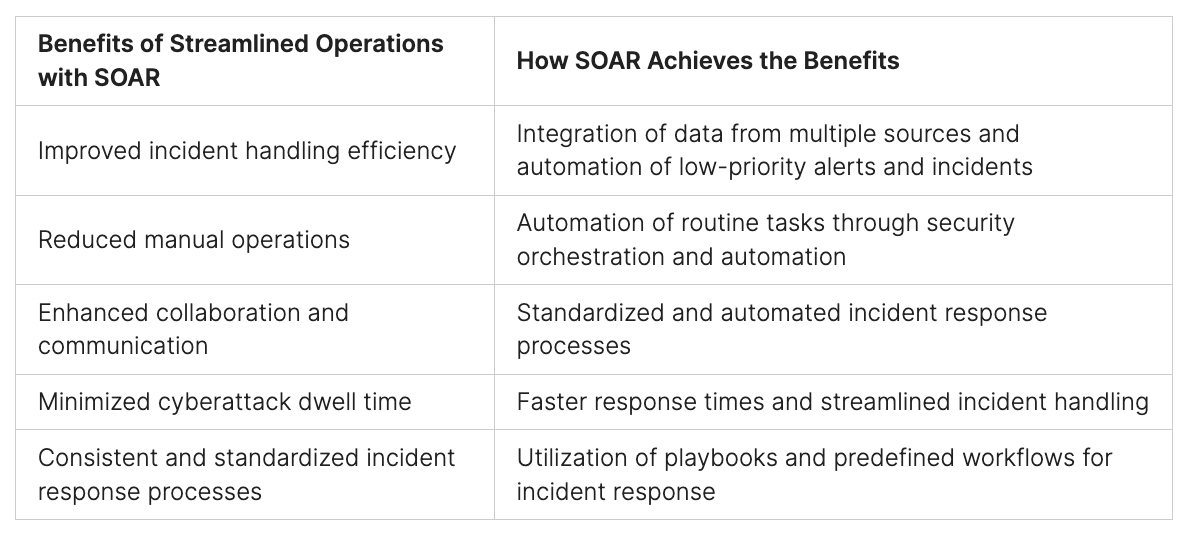
Organizations that implement SOAR can benefit from:
Improved incident handling efficiency
Reduced manual operations
Enhanced collaboration and communication
Minimized cyberattack dwell time
Consistent and standardized incident response processes
Implementing security orchestration and automation with SOAR not only streamlines operations but also empowers security teams to proactively tackle cybersecurity challenges and stay ahead of evolving threats.
Easy Integration of Technology and Tools with SOAR
One of the standout benefits of implementing a SOAR platform is its seamless integration with a wide range of security technologies and tools. SOAR platforms excel in their ability to effectively integrate with various security domains, ensuring a unified and comprehensive approach to incident response.
When it comes to technology integration, SOAR platforms enable the correlation of alerts from different products, spanning a multitude of security domains. This integration empowers organizations to aggregate data from diverse sources, including cloud security, email security, endpoint security, network security, and more.
This comprehensive integration of security technologies and tools is made easy with self-service marketplaces and simple button-click integration options. Organizations can quickly and effortlessly connect their existing security infrastructure to the SOAR platform, without the need for complex configurations or extensive technical expertise.
By leveraging the power of SOAR, organizations can optimize their incident response capabilities by harnessing the strength of their security technologies and tools. This integration allows for a more precise and efficient detection of threats, enabling faster response times and improved incident resolution.
Benefits of Technology and Tools Integration with SOAR:
Enhanced Visibility: The integration of security technologies and tools provides a centralized view of incidents, allowing for a comprehensive understanding of the security landscape.
Efficient Incident Response: Seamless integration allows for the automation of incident response processes, enabling faster and more efficient incident handling.
Improved Threat Detection: By correlating alerts from various security products, organizations can better identify and respond to complex threats in real-time.
Streamlined Workflows: Integration with existing security technologies streamlines workflows, eliminating manual tasks and optimizing resource allocation.
The easy integration of technology and tools with SOAR enables organizations to leverage their existing investments and maximize the effectiveness of their security operation.
Cost Savings with SOAR Implementation
Implementing a SOAR platform can result in significant cost savings for organizations. By automating reporting and metrics capabilities, SOAR eliminates the need for manual reporting and reduces the time and effort spent on creating reports. This directly translates to cost savings, as fewer resources are required to generate and distribute reports, allowing security teams to focus on more critical tasks.
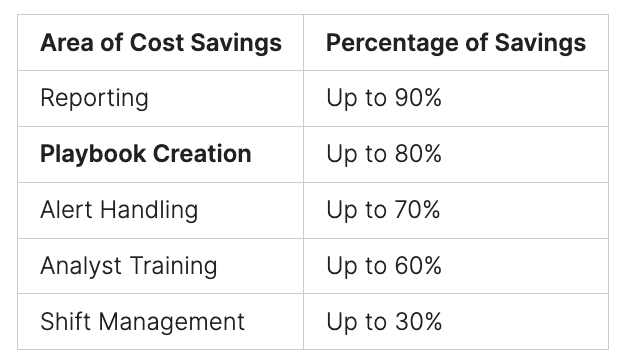
Furthermore, SOAR enables organizations to achieve cost savings in various areas of incident response:
Reporting: Implementing a SOAR platform can lead to savings of up to 90% on reporting. Automated reporting capabilities streamline the process and eliminate the need for manual production of metrics and customized reports.
Playbook Creation: SOAR enables savings of up to 80% on playbook creation. By leveraging pre-built playbooks and automation capabilities, organizations can significantly reduce the time and effort required to develop and maintain incident response processes.
Alert Handling: With SOAR, organizations can achieve savings of up to 70% on alert handling. The automation of low-priority alerts allows security analysts to efficiently manage their workload and focus on more critical incidents.
Analyst Training:SOAR implementation can result in savings of up to 60% on analyst training. By automating repetitive tasks and standardizing incident response processes, SOC analysts can onboard faster and spend less time on training exercises.
Shift Management: SOAR can lead to savings of up to 30% on shift management. The automation of routine tasks reduces the reliance on manual shift handovers and allows for a smoother transition between security teams.
Standardized communication during incident response is another area where cost savings can be achieved. Effective collaboration facilitated by SOAR minimizes the impact of cyberattacks and prevents monetary losses associated with extended incident response and recovery timelines.
In summary, organizations that implement a SOAR platform can significantly reduce costs related to reporting, playbook creation, alert handling, analyst training, and shift management. By streamlining operations and automating repetitive tasks, SOAR improves efficiency while minimizing financial resources spent on incident response.
Automating Reporting and Metrics with SOAR
SOAR platforms offer automated reporting and metrics capabilities that significantly streamline the process of generating reports for security teams. With the ability to pull reports on demand or schedule them for automatic generation, SOC staff can ensure reliable and timely reporting without the need for manual intervention.
SOAR tools provide reporting templates and the flexibility to create custom reports, allowing security teams to tailor the reporting process to their specific requirements. This simplifies the reporting workflow, making it more efficient and accurate.
By automating reporting and metrics, SOAR eliminates the need for manual production of metrics, saving valuable time and effort for security analysts. Instead of spending hours compiling data and generating reports, analysts can focus on analyzing insights and making data-driven decisions to enhance incident response efforts.
With automated reporting and metrics capabilities, SOAR empowers organizations to effectively track and measure their incident response performance. By leveraging these capabilities, security teams can gain valuable insights into the effectiveness of their incident response processes, identify areas for improvement, and make data-backed adjustments to optimize their overall security posture.
“Automating reporting and metrics with SOAR has revolutionized the way security teams generate reports. It has significantly reduced the manual effort required, allowing us to focus on more critical tasks. The ability to create custom reports also allows us to tailor our reporting to specific stakeholders, ensuring they receive the information they need in a digestible format.”
Standardized Communication in Incident Response with SOAR
Effective communication is crucial during incident response, especially when dealing with major incidents. To facilitate standardized communication, organizations often establish a mission control hub or virtual war room. SOAR platforms play a vital role in ensuring critical information is shared consistently among team members, preventing any lapses or miscommunication.
When major incidents occur, a mission control hub or virtual war room becomes the command center for incident response. This centralized environment enables teams to collaborate effectively and make informed decisions in real-time. SOAR platforms provide features that support standardized communication within these dedicated spaces, ensuring that all incident response stakeholders have access to critical information.
The standardized communication flow in a mission control hub or virtual war room involves various stakeholders, both from within and outside the Security Operations Center (SOC). This includes representatives from Public Relations (PR), Human Resources (HR), Legal, and the C-suite. By involving these stakeholders, organizations can align their incident response efforts with overarching business goals and ensure consistent information dissemination across departments.
By establishing reliable and repeatable communication processes, SOAR enhances the overall effectiveness of incident response. It enables teams to collaborate seamlessly, make informed decisions based on real-time insights, and execute response plans efficiently. With standardized communication, organizations can minimize response times, improve coordination, and mitigate the impact of security incidents.
“Standardized communication is the backbone of effective incident response. It ensures that all team members have access to critical information in real-time, enabling them to respond swiftly and accurately. SOAR platforms help organizations establish reliable and repeatable communication processes, enhancing overall incident response capabilities.”
Benefits of Standardized Communication in Incident Response
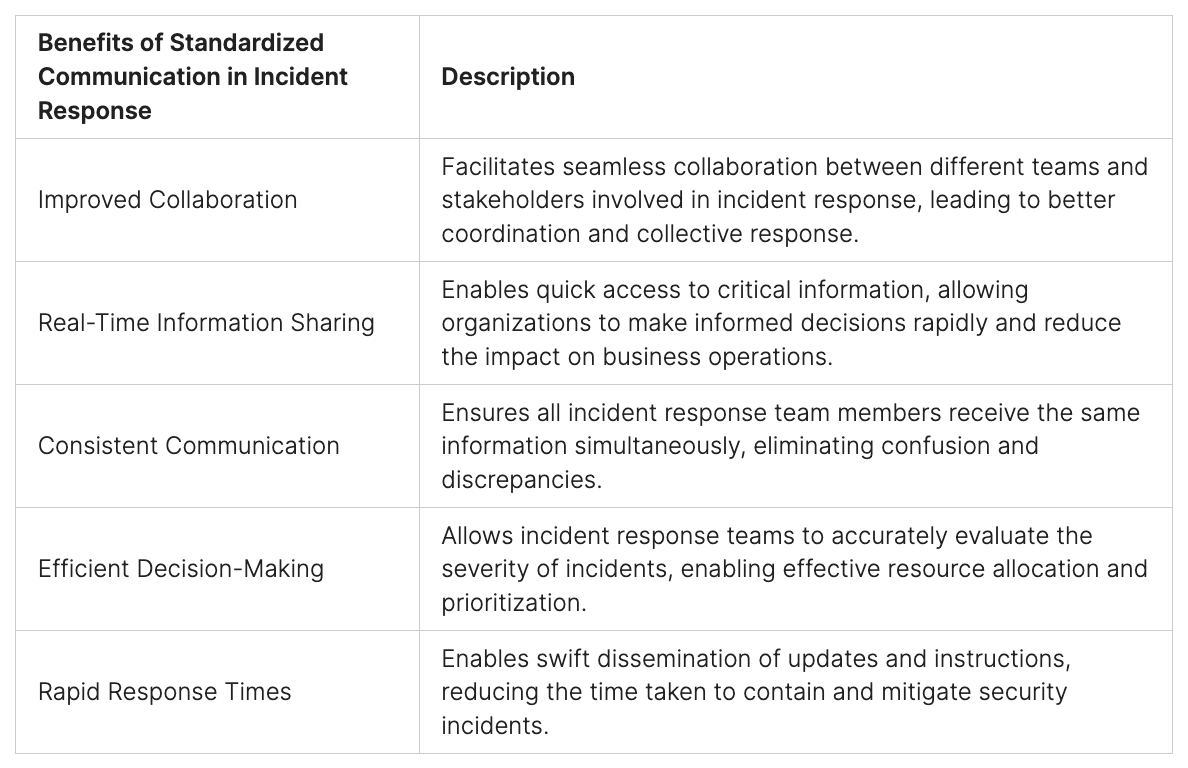
Implementing standardized communication in incident response with SOAR platforms offers several key benefits:
Improved Collaboration: Standardized communication facilitates seamless collaboration between different teams and stakeholders involved in incident response. This enables better coordination and the ability to respond collectively to security incidents.
Real-Time Information Sharing: By centralizing communication and ensuring all team members have access to critical information in real-time, organizations can make informed decisions quickly. This leads to faster incident resolution and a reduced impact on business operations.
Consistent Communication: Standardized communication processes ensure that all incident response team members receive the same information simultaneously. This eliminates any confusion or discrepancies that may arise from inconsistent communication practices.
Efficient Decision-Making: Access to standardized communication channels allows incident response teams to evaluate the severity of incidents accurately. This enables them to prioritize their response efforts and allocate resources effectively.
Rapid Response Times: Standardized communication enables incident response teams to quickly disseminate updates and instructions. This facilitates swift action and minimizes the time taken to contain and mitigate security incidents.
Through standardized communication, organizations can optimize their incident response capabilities and minimize the impact of security incidents. By leveraging SOAR platforms, teams can establish reliable and effective communication processes that enhance collaboration, enable rapid decision-making, and improve overall incident response effectiveness.
Conclusion
The adoption of a SOAR (Security Orchestration, Automation, and Response) platform stands as a strategic decision in advancing security operations, automating routine tasks, and enhancing incident response mechanisms. In an era marked by an escalating number of cyber threats, the necessity for organizations to boost their cybersecurity efficacy has never been more pressing. SOAR offers a holistic solution by integrating diverse security tools, standardizing operational processes, and fostering improved collaborative efforts.
By embracing the principles of security orchestration, automation, and response, organizations are empowered to fortify their capabilities in managing cybersecurity incidents. SOAR not only facilitates the amalgamation of various alerts for streamlined handling but also automates tasks deemed low-priority. This automation allows security teams to dedicate their focus to more critical and complex issues. The result is a tangible reduction in the impact of cyberattacks and a notable enhancement in the organization’s overall security framework.
The Peris.ai Brahma SOAR platform, a crucial component of Peris.ai Cybersecurity’s offerings, exemplifies the power of SOAR. It enables organizations to automate security processes, coordinate diverse security tools and systems, and respond to security incidents with increased efficiency and effectiveness. Key features of Peris.ai Brahma SOAR include Task Automation, Security Tool Integration, Playbooks, and Investigative and Remediation capabilities. This functionality not only streamlines security operations but also provides a centralized viewpoint for incident management, thereby eliminating inefficiencies and improving response strategies.
In essence, organizations that integrate the Peris.ai Brahma SOAR platform into their cybersecurity strategy are positioned to excel in the cyber landscape. This platform not only streamlines security operations and automates routine tasks but also optimizes the entire incident response process. As a result, organizations can significantly elevate their security posture, respond more effectively to cyber threats, and achieve a higher level of cybersecurity efficiency.
To explore how the Peris.ai Brahma SOAR platform can transform your organization’s approach to cybersecurity, visit Peris.ai Cybersecurity. Discover how our innovative solutions can elevate your cybersecurity capabilities and provide you with the tools needed to successfully navigate and overcome the challenges of the modern cyber environment.
FAQ
What is SOAR?
SOAR stands for Security Orchestration, Automation, and Response. It is a powerful tool for streamlining security operations and improving incident response in the face of increasing cyber threats.
How does SOAR improve incident response?
SOAR improves incident response by integrating security tools and automating tasks. It allows for the correlation of alerts from disparate systems into a single incident, saving time and enabling quicker alert handling. It also reduces manual operations and standardizes processes through the use of playbooks, which outline the steps of incident response and automate repetitive tasks.
What are the benefits of security orchestration?
Security orchestration brings efficiency to security operations by aggregating data from various security and network tools, providing a centralized view and actionable context for alerts. It automates the handling of low-priority and repetitive tasks, allowing SOC analysts to focus on higher-value work that improves incident response. It also reduces cyberattack impact by minimizing mean time to detect (MTTD) and mean time to respond (MTTR).
What is the role of security automation in SOAR?
Security automation reduces the need for human intervention in handling repetitive tasks and alerts. By automating low-priority alerts and incidents, it frees up SOC analysts to focus on more critical and complex tasks. This improves incident response by allowing analysts to dedicate more time and resources to investigating and resolving alerts.
How does SOAR contribute to streamlined operations?
SOAR integrates data from various sources and automates low-priority alerts and incidents, streamlining security operations. It gathers data from disparate systems, providing a centralized view and context for incidents. It handles low-priority alerts and incidents, reducing the need for manual intervention. Incident response in SOAR eliminates guesswork and minimizes cyberattack dwell time, resulting in more efficient and effective event handling.
Can SOAR integrate with different security technologies and tools?
Yes, SOAR platforms can easily correlate alerts from different products across various security domains. They facilitate the aggregation of data from cloud security, email security, endpoint security, network security, and more. The integration process is made easy with self-service marketplaces and simple button-click integration.
How does implementing a SOAR platform result in cost savings?
Implementing a SOAR platform enables savings on reporting, playbook creation, alert handling, analyst training, and shift management. By automating reporting and metrics capabilities, SOAR eliminates the need for manual reporting and reduces the time and effort spent on creating reports. Standardized communication during incident response also lowers costs by ensuring effective collaboration and minimizing the impact of cyberattacks.
Can SOAR platforms automate reporting and metrics?
Yes, SOAR platforms offer automated reporting and metrics capabilities. SOC staff can pull reports on demand or schedule them to be generated automatically. SOAR tools provide reporting templates and the ability to generate custom reports, simplifying the reporting process.
How does SOAR facilitate standardized communication in incident response?
SOAR platforms ensure standardized communication during incident response, particularly for major incidents. They provide features that ensure critical communication is standardized, preventing any team member from missing critical information. This standardized communication flow includes stakeholders from within and outside the SOC, such as PR, HR, legal, and the C-suite.
What are the key benefits of implementing a SOAR platform?
Implementing a SOAR platform streamlines security operations, automates repetitive tasks, and optimizes incident response. It enables organizations to achieve higher cybersecurity efficiency by integrating security tools, standardizing processes, and improving collaboration. It also reduces cyberattack impact, improves overall incident handling, and lowers costs.
A Security Operations Center (SOC) serves as the nerve center of an organization’s cybersecurity strategy, actively monitoring and managing security incidents. SOC teams utilize SIEM (Security Information and Event Management) tools to enhance threat detection and security intelligence. SIEM allows for the proactive identification and response to potential cybersecurity incidents by analyzing network activities, access attempts, and malware infections. This centralized hub employs advanced technologies, skilled personnel, and robust processes to maintain information systems’ confidentiality, integrity, and availability.
Key Takeaways:
SIEM is a vital tool used by SOC teams to enhance threat detection and security intelligence.
SIEM allows for proactive identification and response to potential cybersecurity incidents.
SIEM employs advanced technologies, skilled personnel, and robust processes to maintain information system security.
SIEM plays a crucial role in maintaining the confidentiality, integrity, and availability of information systems.
SIEM serves as the central hub for monitoring and managing security incidents.
The Importance of a Strong SOC in Cybersecurity
In the face of increasing cyber threats, a strong Security Operations Center (SOC) plays a critical role in minimizing the impact of these threats. By adopting a proactive stance, SOC teams can detect and mitigate potential cybersecurity incidents before they escalate. A robust SOC enhances an organization’s security posture, prevents data breaches, and ensures the resilience of its digital infrastructure. With the ever-evolving and sophisticated nature of cyber threats, a strong SOC is essential to maintaining a secure environment.
“A strong SOC acts as a shield, identifying and neutralizing threats before they cause damage. It is the foundation of a robust cybersecurity strategy.”
By establishing a comprehensive SOC, organizations can centralize their threat monitoring and incident response capabilities. This proactive approach empowers SOC teams to stay one step ahead of potential threats, enabling them to understand the tactics, techniques, and procedures employed by adversaries.
The Role of a Strong SOC
A strong SOC provides several key benefits:
Threat Detection and Prevention: SOC teams leverage advanced technologies and intelligence to identify and prevent potential cyber threats, improving an organization’s overall security posture.
Incident Response: A well-equipped SOC allows for swift and efficient incident response, minimizing the impact of security breaches and ensuring business continuity.
Proactive Monitoring: SOC teams constantly monitor network activities, access attempts, and emerging threats to identify and address vulnerabilities before they can be exploited.
Risk Mitigation: By implementing robust security measures, a strong SOC decreases the likelihood of successful attacks, reducing the potential financial and reputational damage to an organization.
With the ever-increasing frequency and sophistication of cyber threats, organizations must invest in building and maintaining a strong SOC. By doing so, they can safeguard their valuable assets, protect customer data, and maintain trust in an increasingly digital world.
Build Your Own SOC vs. Managed SOC Services
Organizations have the option to either build their own in-house SOC or opt for Managed SOC Services. Building an in-house SOC requires a significant investment in technology, personnel, and ongoing maintenance. It is recommended for large enterprises with specific compliance requirements and the financial capacity to make substantial upfront investments. On the other hand, Managed SOC Services offer a cost-effective solution for small to mid-sized enterprises with budget constraints or limited in-house expertise. It provides scalability, flexibility, and the ability to focus on core business functions while leveraging the expertise of a third-party provider.
Advantages of Managed SOC Services
Managed SOC Services offer several advantages for organizations. It enhances the security posture and provides enhanced protection against cyber threats. With dedicated teams of cybersecurity professionals equipped with advanced tools and threat intelligence, organizations can benefit from expert knowledge and experience without the need for extensive recruitment and training efforts. Managed SOC Services adopt a proactive approach to threat management, identifying and mitigating potential threats before they escalate.
By leveraging the expertise of Managed SOC Services, organizations can focus on their core competencies while ensuring robust security measures. The round-the-clock monitoring and analysis provided by Managed SOC Services improve incident response times, enabling swift and effective action. This proactive approach helps organizations stay one step ahead of cybercriminals, safeguarding critical data and infrastructure.
Furthermore, Managed SOC Services offer scalability and flexibility, allowing organizations to adjust their security measures according to their needs. As threats evolve and new security challenges arise, Managed SOC Services can quickly adapt and provide the necessary expertise and solutions. This flexibility ensures that organizations always have access to the latest security technologies and strategies.
Overall, Managed SOC Services offer enhanced security, expertise, and peace of mind. By entrusting their cybersecurity operations to experienced professionals, organizations can focus on their business objectives while knowing that their digital assets are well-protected.
Benefits of Managed SOC Services:
Enhanced security posture
Dedicated teams of cybersecurity professionals
Advanced tools and threat intelligence
Proactive threat management
Immediate access to expertise
Round-the-clock monitoring and analysis
Improved incident response times
Scalability and flexibility
Access to the latest security technologies and strategies
“Managed SOC Services provide organizations with the expertise and tools necessary to defend against ever-evolving cyber threats. By outsourcing their security operations, organizations can leverage the knowledge and experience of dedicated cybersecurity professionals, enhance their security posture, and focus on their core business functions.”
With Managed SOC Services, organizations can stay ahead of cyber threats, confidently protect their valuable assets, and ensure the continuity of their operations.
Key Differences between In-House SOC and Managed SOC Services
The decision to choose between an in-house SOC or Managed SOC Services depends on the unique requirements and resources of each organization. Both options offer distinct advantages and considerations in optimizing cybersecurity operations.
In-House SOC: Complete Control and Customization
An in-house SOC allows organizations to have complete control and customization over their cybersecurity infrastructure. With an in-house SOC, organizations can tailor their security strategy to meet specific needs, compliance requirements, and industry standards. They can choose and deploy security tools, configure them according to their preferences, and have full visibility and control over all security operations.
However, building and maintaining an in-house SOC requires substantial upfront investments and ongoing maintenance costs. Organizations need to invest in advanced security technologies, hire and train skilled cybersecurity professionals, and regularly update and upgrade their infrastructure. It can be an expensive endeavor, particularly for smaller organizations with limited financial resources.
Managed SOC Services: Scalability, Cost-effectiveness, and Third-party Expertise
On the other hand, organizations can opt for Managed SOC Services that offer several advantages. Managed SOC Services provide scalability, allowing organizations to easily adjust their security capabilities as their needs evolve. They offer flexible pricing models, allowing organizations to pay for the services they require without the burden of investing in expensive infrastructure.
Managed SOC Services also bring the expertise and experience of a dedicated third-party provider. They have teams of cybersecurity professionals who specialize in threat detection, incident response, and overall security management. These experts are up-to-date with the latest cybersecurity trends and technologies, ensuring that organizations benefit from the best practices and industry standards.
Additionally, Managed SOC Services allow organizations to focus on their core business functions while leaving the cybersecurity responsibilities to the experts. This frees up internal resources, enabling them to concentrate on strategic initiatives rather than day-to-day security operations.
Choosing the Right Approach
The choice between an in-house SOC and Managed SOC Services depends on several factors. Organizations need to assess their security needs, compliance requirements, and available resources.
If an organization has specific security requirements or compliance regulations that demand complete control over its infrastructure, an in-house SOC may be the preferred option.
For organizations with limited budgets or expertise in cybersecurity, Managed SOC Services can provide a cost-effective solution with access to specialized resources and technologies.
Ultimately, the decision should align with the organization’s overall strategic objectives and business priorities. Both options have their merits, and organizations must choose the one that best suits their unique circumstances.
Log Collection and Aggregation in SIEM
Log collection and aggregation are essential components of SIEM. SIEM, which stands for Security Information and Event Management, acts as the nerve center by gathering logs from various sources such as firewalls, servers, applications, and endpoints.
These logs are then normalized and securely stored for analysis, providing a holistic view of network activity. By analyzing these logs, SIEM can detect patterns and irregularities that may indicate potential threats.
SIEM plays a crucial role in accurate threat detection and provides a foundation for effective incident response. Let’s take a closer look at the process of log collection and aggregation in SIEM:
Gathering logs from multiple sources: SIEM collects logs from various sources within the network, including firewalls, servers, applications, and endpoints. This comprehensive collection ensures that all relevant data is captured for analysis.
Normalizing and storing logs: After gathering the logs, SIEM normalizes them to a consistent format, making it easier to analyze and correlate events. The logs are then securely stored in a centralized repository, ensuring data integrity and accessibility.
Analyzing logs for threat detection: SIEM utilizes advanced algorithms to analyze the collected logs and identify potential threats. By correlating events and analyzing patterns, SIEM can detect suspicious activities or anomalies that may indicate a security breach.
Providing a holistic view of network activity: With log collection and aggregation, SIEM provides a comprehensive view of network activity. This visibility allows security teams to monitor and investigate potential threats effectively.
Log collection and aggregation are vital components of SIEM that enable accurate threat detection and enhance an organization’s cybersecurity operations. By centralizing and analyzing logs, SIEM empowers security teams to proactively identify and respond to potential threats, safeguarding the organization’s digital assets.
Benefits of Log Collection and Aggregation in SIEM
Improved threat detection and incident response
Enhanced visibility in network activities
Identifying patterns and anomalies for proactive security measures
Simplified compliance with regulatory requirements
Efficient log management for forensic investigations
Log collection and aggregation in SIEM empower organizations to detect and mitigate potential cyber threats by analyzing network activities and identifying patterns and anomalies. It forms a critical foundation for effective incident response and proactive security measures.
Event Correlation and Analysis in SIEM
SIEM (Security Information and Event Management) employs sophisticated algorithms to correlate seemingly distinct events and identify potential threats. By analyzing the collected logs, SIEM can paint a clearer picture of security incidents and detect malicious activity. This enables security teams to proactively respond to threats and protect the organization’s digital assets.
One of the key functionalities of SIEM is event correlation. SIEM tools gather log data from various sources within the organization’s infrastructure, such as firewalls, servers, applications, and endpoints. It then analyzes this data to identify patterns and anomalies that may indicate a potential threat. By connecting the dots between seemingly unrelated events, SIEM helps security teams uncover covert tactics used by threat actors and respond effectively.
SIEM also leverages advanced technologies such as user and entity behavior analytics (UEBA) to identify deviations from established user baselines. This allows organizations to detect insider threats and sophisticated attacks that traditional security measures may not detect. By monitoring user behavior and identifying deviations, SIEM enhances threat detection and enables proactive incident response.
The Importance of Event Correlation and Analysis
Event correlation and analysis are integral to the effectiveness of SIEM in enhancing threat detection. By correlating events and analyzing their impact, SIEM helps security teams prioritize alerts and focus on critical threats. Through this process, SIEM augments the organization’s overall security posture and strengthens its defenses against cyber threats.
“Event correlation and analysis in SIEM enable security teams to identify the ‘needle in the haystack’ – the critical security events that require immediate attention. Without this capability, organizations risk missing crucial indicators of compromise and leaving their infrastructure vulnerable to advanced threats.”
Moreover, event correlation and analysis in SIEM contribute to the efficiency of incident response efforts. By providing a comprehensive view of event chains and their impact, SIEM enables security teams to streamline their incident response workflows. This reduces response time, minimizes the impact of security incidents, and helps organizations meet their regulatory compliance requirements.
Benefits of Event Correlation and Analysis in SIEM
Identification of complex attack patterns
Proactive identification of threats
Improved incident response capabilities
Enhanced regulatory compliance
Reduction in false positives
Incident Response and Remediation with SIEM
SIEM (Security Information and Event Management) surpasses its role of alerting organizations to potential threats by enabling swift and effective incident response. The real-time alerting mechanisms of SIEM notify security teams of suspicious activity, ensuring immediate action. Alongside these alerts, SIEM provides predefined incident response workflows that serve as a guide for security teams, leading them through containment and mitigation actions.
One of the significant advantages of SIEM is its ability to automate responses based on predefined rules. This automation can include isolating compromised systems or blocking malicious IP addresses, reducing the potential damage caused by cyberattacks. By automating these actions, SIEM minimizes response time and streamlines incident handling, empowering organizations to effectively combat security breaches.
Incident response and remediation capabilities are vital in minimizing the impact of security breaches and ensuring business continuity. SIEM acts as a central hub for incident management, equipping cybersecurity teams with the necessary tools and workflows to respond to incidents efficiently and mitigate the associated risks.
Automated Incident Response Workflows
SIEM’s incident response capabilities are enhanced through the automation of predefined workflows. These workflows streamline the incident response process, ensuring consistent and efficient actions are taken for different types of security incidents.
“With SIEM’s automated incident response workflows, organizations can minimize response time and ensure a consistent approach to incident handling.”
By automating incident response, SIEM helps organizations reduce the burden on their security teams, allowing them to focus on more complex and critical tasks. Through automated workflows, SIEM ensures that incidents are promptly contained, investigated, and remediated, preventing them from escalating into major security breaches.
Real-Time Alerting and Threat Intelligence
One of the core functionalities of SIEM is its ability to provide real-time alerts. SIEM continuously monitors network activities, log data, and security events, promptly detecting any suspicious behavior that may indicate a potential security incident.
Real-time alerting mechanisms notify security teams immediately, allowing them to initiate the incident response processes without delay.
By providing actionable information in real-time, SIEM enables security teams to respond quickly and effectively to potential threats.
Furthermore, SIEM leverages threat intelligence, combining it with real-time data analysis to identify new and emerging threats. This proactive approach helps organizations stay ahead of cybercriminals and implement the necessary countermeasures to prevent successful attacks.
How Software Solutions Improve Cybersecurity Teams
Software solutions are instrumental in enhancing the effectiveness of cybersecurity teams, providing them with tools and capabilities to tackle modern challenges. By leveraging automation, these solutions streamline processes, optimize resource allocation, and enable teams to focus on critical activities. Let’s explore the key ways in which software solutions improve cyber defense operations.
1. Automation of Routine Tasks
Software solutions play a pivotal role in automating repetitive and time-consuming tasks within cybersecurity teams. By automating routine activities such as log analysis, vulnerability scanning, and threat detection, these solutions free up valuable human resources. Cybersecurity professionals can then allocate their time and expertise to more complex and strategic initiatives, improving overall team productivity and efficiency.
2. Optimized Resource Allocation
With the help of software solutions, cybersecurity teams can effectively allocate their resources based on real-time data and analysis. These solutions provide insights into resource utilization, enabling teams to identify areas of improvement and make informed decisions. By optimizing resource allocation, organizations can better respond to emerging threats, minimize the risk of vulnerabilities going unnoticed, and ensure a robust cyber defense posture.
3. Cost-efficiencies through Automation and AI
Software solutions leverage automation and artificial intelligence (AI) technologies to drive cost-efficiencies within cybersecurity teams. By automating processes and utilizing AI algorithms, these solutions reduce the manual effort required for various tasks. This, in turn, leads to significant cost savings by minimizing the need for additional personnel and reducing operational expenses. Organizations can achieve a higher return on investment while maintaining a high level of security.
4. Rapid Data Analysis and Threat Detection
Software solutions, such as SIEM (Security Information and Event Management), provide cybersecurity teams with powerful tools for rapid data analysis and real-time threat detection. These solutions aggregate and analyze vast amounts of security data from multiple sources, allowing teams to identify patterns and anomalies that may indicate potential threats. By detecting threats early, teams can respond swiftly and effectively, minimizing the impact of security incidents.
5. Streamlined Cybersecurity Practices
Software solutions enable cybersecurity teams to implement streamlined practices and workflows, ensuring consistent and efficient operations. These solutions offer standardized processes and predefined workflows for incident response, ensuring that teams follow best practices and minimize response times. By implementing these streamlined practices, organizations can enhance their overall cyber defense capabilities and reduce the risk of security breaches.
Overall, software solutions are instrumental in improving the effectiveness of cybersecurity teams. Through automation, optimized resource allocation, cost-efficiencies, rapid data analysis, and streamlined practices, these solutions empower teams to mitigate threats more effectively and protect their digital assets.
Benefits of Software Solutions for Cybersecurity Teams:
Automation of routine tasks
Optimized resource allocation
Cost-efficiencies through automation and AI
Rapid data analysis and threat detection
Streamlined cybersecurity practices
Software solutions empower cybersecurity teams to stay ahead of evolving threats and effectively protect valuable assets.
Building an MSP Cybersecurity Solutions Suite
Managed Service Providers (MSPs) play a crucial role in helping organizations protect their digital infrastructure from evolving cyber threats. To meet the diverse needs of their clients, MSPs can build a comprehensive cybersecurity solutions suite. This suite encompasses a range of tools and services specifically designed to address the challenges faced by organizations in today’s cyber landscape. By offering this suite, MSPs can enhance their clients’ security posture and safeguard their sensitive data.
Components of an MSP Cybersecurity Solutions Suite
An MSPCybersecurity Solutions Suite typically includes the following components:
Business Continuity and Disaster Recovery (BCDR): Ensures the organization’s ability to recover critical data and resume operations in the event of a cyber incident or natural disaster.
Cloud Security: Secures cloud-based applications and infrastructure to protect against unauthorized access and data breaches.
Endpoint Detection and Response (EDR): Monitors and detects threats on endpoints, such as laptops, desktops, and mobile devices, providing real-time visibility and rapid response capabilities.
Identity Management: Manages user identities, permissions, and access to ensure only authorized individuals can access sensitive data and systems.
Incident Response: Establishes structured processes and procedures to effectively respond to and mitigate cybersecurity incidents, minimizing the impact on the organization.
Network Security: Protects the organization’s network infrastructure from unauthorized access, malicious activities, and potential data breaches.
By integrating these components into their cybersecurity solutions suite, MSPs can provide holistic protection and support to their clients, addressing different aspects of their cybersecurity needs.
The Value of an MSP Cybersecurity Solutions Suite
Building an MSP Cybersecurity Solutions Suite brings numerous benefits to both MSPs and their clients. For MSPs, offering a comprehensive suite demonstrates their commitment to providing top-notch cybersecurity services, elevating their reputation in the market. It also opens up opportunities for recurring revenue streams and long-term partnerships with clients.
For clients, an MSP Cybersecurity Solutions Suite offers peace of mind, knowing that their digital assets are safeguarded by a comprehensive and expertly-designed security framework. They can rely on their MSP to deliver robust protection, proactive threat detection, and rapid incident response, freeing up internal resources to focus on core business activities.
As advancements in technology and cyber threats continue to evolve, MSPs must stay at the forefront of cybersecurity by continuously innovating and enhancing their solutions suite. By providing comprehensive cybersecurity services, MSPs can help organizations navigate the complex and ever-changing cybersecurity landscape, ensuring their digital assets are protected from emerging threats.
Conclusion
In the rapidly evolving digital landscape, the strategic implementation of Security Information and Event Management (SIEM) systems is critical for enhancing an organization’s cybersecurity defenses. SIEM technology serves as the central hub for monitoring, analyzing, and responding to security events, thereby providing organizations with the advanced threat detection and intelligence needed to preemptively address potential cybersecurity challenges.
Peris.ai Bima stands out in the realm of SIEM solutions by offering a comprehensive suite designed to empower organizations with real-time security visibility. Our advanced agent not only detects malicious behavior but also ensures that security rules are regularly updated to reflect emerging vulnerabilities. Customizable security alerts, real-time monitoring of log data from a myriad of sources, and sophisticated analysis using correlation rules and machine learning algorithms are among the key features that make Peris.ai Bima an invaluable asset for any organization seeking to fortify its cybersecurity posture.
Moreover, the option of deploying Peris.ai Bima as a managed service provides organizations with the flexibility to outsource the complex management and maintenance of their SIEM system. This allows businesses to concentrate on their core operations while ensuring their digital environments are protected against threats.
Integration with third-party tools and automation of incident response actions based on the organization’s predefined response plan further enhance the efficacy of Peris.ai Bima. With features like detailed reporting for compliance and forensic purposes, and the ability to perform in-depth analysis of past security incidents, our solution equips security teams with the tools necessary for comprehensive security incident management.
As the cybersecurity threat landscape continues to grow in complexity, the adoption of robust SIEM solutions like Peris.ai Bima is paramount for organizations aiming to stay ahead of threats and safeguard their digital assets. By enhancing the efficiency of cybersecurity teams through automation and providing a holistic view of an organization’s security posture, Peris.ai Bima plays a pivotal role in the modern cybersecurity strategy.
Discover the advanced capabilities of Peris.ai Bima and how it can transform your organization’s approach to cybersecurity. Visit Peris.ai Cybersecurity to learn more about our SIEM solution and how we can help you achieve enhanced threat detection, intelligent security analysis, and proactive incident response to protect your business in the face of evolving cyber threats.
FAQ
What is the role of SIEM in cybersecurity operations?
SIEM serves as the nerve center of cybersecurity operations, enhancing threat detection and security intelligence. It collects and analyzes logs from various sources to detect potential threats and provides a foundation for effective incident response.
Why is a strong SOC important in cybersecurity?
A strong Security Operations Center (SOC) plays a critical role in minimizing the impact of cyber threats. By adopting a proactive stance, SOC teams can detect and mitigate potential cybersecurity incidents before they escalate, enhancing an organization’s security posture.
What are the differences between building an in-house SOC and using Managed SOC Services?
Building an in-house SOC requires significant investments in technology and personnel. It is recommended for large enterprises with specific compliance requirements. Managed SOC Services, on the other hand, provide a cost-effective solution for small to mid-sized enterprises, offering scalability and expertise from a third-party provider.
What are the advantages of using Managed SOC Services?
Managed SOC Services enhance an organization’s security posture by providing dedicated teams of cybersecurity professionals equipped with advanced tools and threat intelligence. They offer immediate access to expertise, a proactive approach to threat management, and allow organizations to focus on core business functions.
How does log collection and aggregation work in SIEM?
SIEM collects logs from various sources such as firewalls, servers, applications, and endpoints. It normalizes and securely stores these logs for analysis, providing a holistic view of network activity. Log analysis helps detect patterns and irregularities that may indicate potential threats.
What is event correlation and analysis in SIEM?
SIEM employs advanced algorithms to correlate seemingly distinct events and identify potential threats. By analyzing collected logs, SIEM can paint a clearer picture of security incidents and detect malicious activity. It utilizes technologies like user and entity behavior analytics (UEBA) to identify deviations from established user baselines.
How does SIEM contribute to incident response and remediation?
SIEM provides real-time alerting and predefined incident response workflows. It notifies security teams of suspicious activity and guides them through containment and mitigation actions. SIEM can automate responses, reducing the potential damage from cyberattacks and ensuring business continuity.
How do software solutions improve cybersecurity teams?
Software solutions automate routine tasks, freeing up human resources for more complex initiatives. They utilize automation and AI to optimize resource allocation, drive cost-efficiencies, and enhance team effectiveness. Software solutions like SIEM provide rapid data analysis, vulnerability identification, and real-time threat detection.
What is an MSP cybersecurity solutions suite?
Managed Service Providers (MSPs) can build a comprehensive suite of cybersecurity solutions to meet the needs of their clients. This suite includes tools and services like Business Continuity and Disaster Recovery (BCDR), Cloud Security, Endpoint Detection and Response (EDR), Identity Management, Incident Response, and Network Security. It enhances clients’ security posture against evolving threats.
Why is SIEM essential in cybersecurity operations?
SIEM serves as the nerve center of cybersecurity operations, enhancing threat detection and security intelligence. With the ever-evolving nature of cyber threats, SIEM remains essential in maintaining robust cybersecurity operations.
The relentless rise of cyber threats has cast a pervasive shadow over organizations, spanning industries and sizes. The imperative of fortifying cybersecurity measures has become an inescapable reality, with organizations acutely attuned to the vital importance of safeguarding their digital assets. Preserving sensitive data, ensuring seamless business operations, and protecting the reputation upon which trust is built have all vaulted to the forefront of organizational concerns. As the digital battleground becomes increasingly treacherous, many organizations have wisely turned to cybersecurity vendors to bolster their defenses against this growing onslaught.
Yet, amidst the labyrinth of cybersecurity solutions and service providers, choosing the ideal cybersecurity vendor has emerged as a complex and pivotal decision that demands meticulous consideration. The selection process is akin to navigating a labyrinth of options, each promising to be the guardian of your digital fortress. In this article, we’re going to begin a journey to decipher the key factors that should illuminate your path as you strive to select the cybersecurity partner best suited to fortify your organization’s defenses and preserve your digital sovereignty.
1. Assess Your Needs
Before embarking on the quest for the perfect cybersecurity vendor, it is vital to assess your organization’s needs thoroughly. Different organizations have distinct requirements based on their industry, size, and the type of data they handle. Start by conducting a comprehensive risk assessment to identify potential vulnerabilities and threats that your organization faces. This assessment should take into account current security measures, compliance requirements, and future growth projections.
2. Define Your Budget
Cybersecurity is an investment in the safety and stability of your organization, and your budget plays a pivotal role in the selection process. It’s crucial to clearly understand how much you are willing to spend on cybersecurity. Keep in mind that a well-balanced budget allows you to explore a broader range of cybersecurity vendors and solutions, increasing the likelihood of finding the perfect fit.
3. Evaluate Vendor Reputation and Experience
Experience and reputation should be among your top considerations when selecting a cybersecurity vendor. Look for vendors with a track record of success in your industry or a similar one. They should be able to provide references from satisfied clients and case studies showcasing their expertise in addressing cybersecurity challenges.
4. Compliance and Certification
Ensure that the cybersecurity vendor you choose is compliant with industry standards and regulations relevant to your organization. This is particularly critical for businesses in highly regulated sectors like healthcare or finance. Look for certifications such as ISO 27001, demonstrating a commitment to maintaining high-security standards.
5. Range of Services
Consider the range of services offered by the cybersecurity vendor. Do they provide a comprehensive suite of solutions or specialize in specific areas such as network security, endpoint protection, or threat detection? The ideal vendor should align with your organization’s needs, offering well-rounded services that cover your vulnerabilities.
6. Scalability
Cybersecurity needs can evolve rapidly, especially for growing organizations. Choose a vendor that can scale their services to accommodate your changing requirements. Discuss your growth projections with potential vendors to ensure they can adapt to your organization’s needs over time.
7. Technology Stack
Examine the technology stack used by the cybersecurity vendor. Is it up-to-date and equipped to handle emerging threats? The vendor should utilize cutting-edge technologies and continuously update their solutions to stay ahead of cyber adversaries.
8. Customization and Flexibility
Every organization is unique, and your cybersecurity needs may not fit neatly into a one-size-fits-all solution. Seek a vendor that is willing and capable of customizing their offerings to match your specific requirements. A flexible approach to cybersecurity is essential for addressing your organization’s unique challenges.
9. Response Time and Support
In the event of a security incident, swift response is critical. Inquire about the cybersecurity vendor’s incident response procedures and average response times. Choose a vendor that offers 24/7 support and a clear escalation path for handling emergencies.
10. User-Friendly Interfaces
Usability is often overlooked but can significantly impact the effectiveness of cybersecurity measures. Ensure that the vendor’s solutions come with user-friendly interfaces and provide adequate training to your team. Complex security tools that are challenging to use can lead to misconfigurations and security gaps.
11. Scalability and Future-Proofing
A successful cybersecurity strategy should address your current needs and be adaptable to future challenges. Choose a vendor with a roadmap for innovation and the ability to keep pace with evolving cyber threats.
12. Cyber Insurance Considerations
In some cases, it might be worthwhile to consult with your cyber insurance provider when selecting a cybersecurity vendor. They may have recommendations or requirements regarding the vendors you choose and the security measures you implement.
13. Transparent Pricing
Make sure the vendor provides transparent pricing that aligns with your budget. Hidden fees or unexpected costs can strain your cybersecurity budget and lead to dissatisfaction with your chosen vendor.
14. Client References and Case Studies
Ask for client references and case studies that demonstrate the vendor’s ability to deliver on their promises. Speaking with existing clients can provide valuable insights into the vendor’s performance and customer satisfaction.
15. Security Awareness Training
Consider whether the vendor offers security awareness training for your employees. Human error remains a significant cybersecurity risk, so educating your staff is valuable to a comprehensive security strategy.
Conclusion
Selecting the perfect cybersecurity vendor should always be timely and taken seriously. As we’ve explored, the challenges of safeguarding your organization’s digital infrastructure, sensitive data, and overall reputation are multifaceted and dynamic. Therefore, choosing a cybersecurity partner is not merely a transactional decision but a strategic commitment to your organization’s long-term resilience and security.
At Peris.ai, we understand this decision’s gravity and are here to offer comprehensive solutions that cater to your unique cybersecurity needs. Whether you require a rigorous Pentest & Assessment to unearth vulnerabilities within your digital infrastructure using advanced ethical hacking techniques through Pandava, seek to navigate the bug bounty landscape efficiently and effectively with Korava, simplify security management with our modular tools and scanners through Bima, or aspire to enhance your team’s cybersecurity prowess with Ganesha’s IT Security Training & Workshop, we have tailored solutions that can empower your organization in this relentless battle against cyber threats.
We invite you to explore our website to learn more about these innovative solutions and how Peris.ai can be your trusted cybersecurity partner. Visit us at https://www.peris.ai/ to discover how you can fortify your organization’s defenses, embrace the future of cybersecurity, and navigate the evolving digital landscape with confidence. Don’t leave the security of your digital assets to chance; let Peris.ai be your shield in this digital age.
In our digital age, APIs are vital for our growing digital economy. They are the backbone of internet connectivity and online services. With over 83% of web traffic going through APIs, keeping them secure is crucial. They are the main part of any strong cybersecurity plan. The effectiveness of our digital security depends on APIs’ ability to resist cyber attacks. This makes it very important to protect our digital assets from breaches.
The world of cybersecurity is full of warnings. Big breaches at Venmo, Facebook, and the US Post Office show how serious weak API security can be. These incidents reveal the risks to important systems and private data without the right protection. More than ever, keeping digital assets safe with strong and creative cybersecurity is essential for all businesses.
Key Takeaways
APIs are handling an increasing volume of web traffic, necessitating stronger API security strategies.
Adopting automated API testing tools is a significant advancement in the pursuit of better digital defense.
API-related cyberattacks pose a substantial threat to digital assets and operations.
Establishing regular and thorough testing routines is a cornerstone of comprehensive cybersecurity.
Effective digital defense is both preventative and responsive, integrating testing with real-time monitoring.
Businesses must remain vigilant and proactive to adapt to evolving cybersecurity threats targeting APIs.
Understanding the Importance of API Security in the Digital Landscape
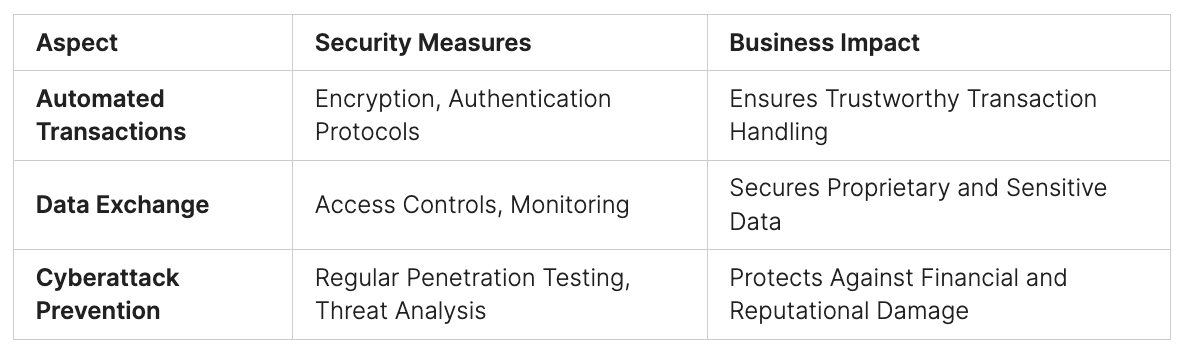
In our fast-growing API economy, knowing about API security is key. It’s not just a tech issue but a core part of a company’s strategy. With data exchange and automated transactions happening through APIs, top-notch cyberattack prevention is crucial.
What APIs Mean for Your Business
APIs are crucial for digital interaction, enhancing user experiences and integration. They allow efficient data sharing, reaching beyond a company to partners and clients.
The Rising Prominence of APIs in Web Traffic
The role of APIs is growing as web traffic from APIs increases. This highlights their importance in digital services. So, investing in strong API security is a must for businesses.
High-Profile API Breaches: A Lesson in Vulnerabilities
Big breaches show the risks of weak API security. They stress the need for better security. This includes regular checks and watching for weak spots.
Mixing in these security elements makes a business’s digital operations strong. It also helps keep the API economy healthy.
The API Security Checklist: Protecting Your Digital Assets
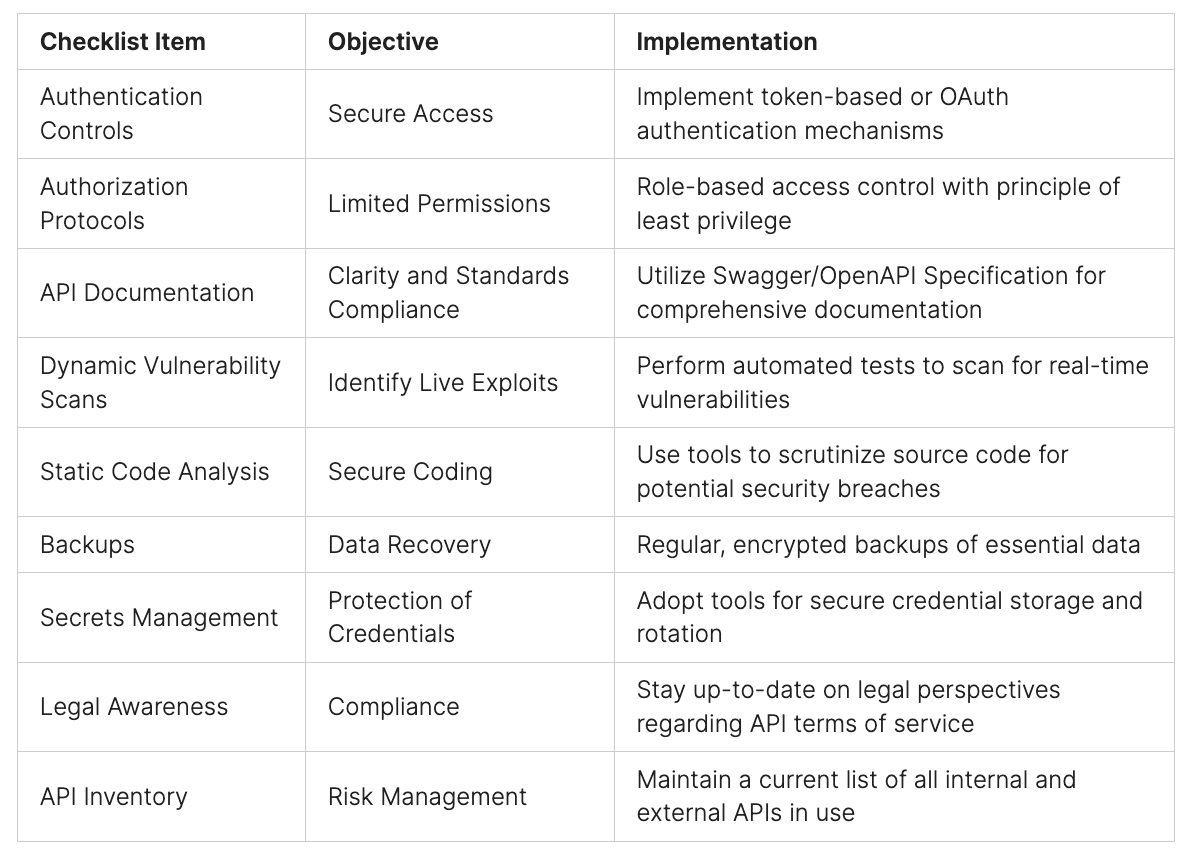
A strong security evaluation in an API security checklist is key to protecting digital assets. It ensures data safety and embeds secure API use in the system’s design. Here we outline the key points of a checklist aimed at improving your cybersecurity in today’s threat environment.
Starting with access control is crucial for data protection. Authentication and authorization check every API request. They make sure only approved users and services access your APIs. Also, well-kept documentation like Swagger/OpenAPI outlines your API’s details, use, and potential weak spots.
Being watchful at every stage of API development is vital. It involves both dynamic and static checks for vulnerabilities—thorough testing to find threats early. By doing this, you ensure your API practices meet modern security needs.
Ensuring the security of your digital assets means taking an inventory of all the APIs your business uses, including third-party APIs, which can present external risks to your applications’ stability and security.
Handling sensitive data with extreme care is also key, especially secrets and credentials. Avoiding mishaps prevents unauthorized access. Having backups protects against data loss, letting you restore your system after any problem.
Following this checklist is an ongoing effort. It’s about making cybersecurity measures central from start to finish in development. This approach builds a robust framework. It keeps your system safe today and ready for future threats and tech changes. Security evolves with your digital landscape, requiring your strategic commitment.
Navigating the Challenges: API Testing Versus Monitoring
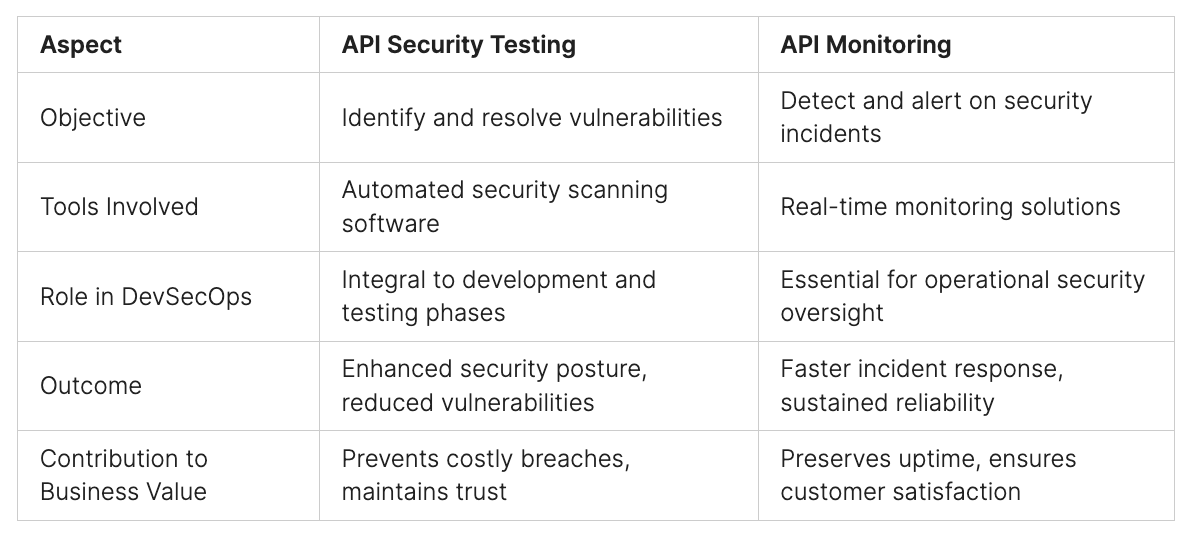
Securing API frameworks today is complex, needing both prevention and ongoing watchfulness. There’s a dual approach involved: API security testing and continuous API monitoring. Each plays a key role in protecting data integrity, but they’re distinct yet intertwined in cybersecurity.
API Testing: Locking Down Potential Threats
API security testing closely examines possible weaknesses that bad actors could use. Automated tools play a big part here. They inspect various aspects like endpoints with great detail.
Through imitating different attack types, these tools help organizations find and fix security flaws. This boosts their digital platforms’ performance reliability.
API Monitoring: The Cybersecurity Alarm System
API monitoring is like a watchful eye, alerting to unusual activities in real-time. It acts as a cybersecurity alarm, quickly notifying about threats for fast action and threat prevention. This ongoing vigilance is key in modern DevSecOps flow, catching breaches early for swift handling.
Understanding the Critical Role of Automated API Testing
Automated API testing does more than find problems. It keeps a constant watch in a world where threats always change. By including automated testing in the DevSecOps cycle, organizations stress security at every development stage. This builds a mindset where threat prevention and performance reliability are crucial for strong digital creations.
To show how API testing and monitoring work together, look at this table. It shows their roles side by side:
Using both security testing and monitoring helps businesses navigate digital challenges confidently. Their APIs are built resilient and watched for threats. This strategy is crucial for maintaining reliable and integrity-rich services in today’s API-driven world.
How to Take Control: Implementing API Security Measures
In today’s digital world, knowing how to secure your APIs is crucial. You must commit to security at every level to protect your systems. This involves everything from documenting your own APIs to handling third-party services. By actively scanning and analyzing, you can identify and strengthen weak spots in your API setup. This keeps your digital defenses strong against cyber attacks.
When dealing with external APIs, it’s important to check their security measures. Make sure to carefully manage access to sensitive information. Understanding the risks like data breaches and hacking attacks helps build a better defense. Inside your company, keeping detailed records of API use helps keep things safe. This creates a culture where every action is tracked, boosting your security.
Now, more than ever, it’s important to be aware of the legal and privacy risks with APIs. Following rules and carefully using third-party services is key. Taking charge of your cybersecurity strategies allows your business to safely innovate and connect. With a proactive approach, you can confidently face the digital world, knowing you’re protected against cyber threats.
FAQ
What Are the Essential API Security Strategies to Protect Digital Assets?
Key API security strategies include regular testing and strong authentication measures. Companies should also document their APIs clearly using standards like Swagger/OpenAPI. It’s vital to perform both dynamic and static security checks, and monitor APIs for any threats.
Building a cybersecurity-aware culture and having a detailed API security checklist are key. These steps ensure digital assets remain protected.
How Do APIs Contribute to the Digital Economy and Cyberattack Prevention?
APIs enable smooth data exchange, helping the digital economy grow. They make different systems work together, supporting scalable business models. Secure APIs are also crucial for stopping cyberattacks.
This ensures data is exchanged safely, without security risks.
What Can We Learn from High-Profile API Breaches?
High-profile API breaches teach us the value of strong security. They show how big data losses can happen, highlighting the need for solid protection measures.
These include continuous testing, monitoring, and quick action plans. Doing so helps prevent future attacks.
Why Is Regular Security Evaluation Important for API Protection?
Security checks find and fix new threats to APIs. They keep protection strong and ensure APIs meet security rules.
This helps react quickly to any issues, keeping digital assets safe.
How Does API Testing Differ from Monitoring, and Why Are Both Necessary?
API testing looks for weaknesses, checking APIs work right in all situations. Monitoring keeps an eye on API security, alerting to breaches.
Testing protects against known threats. Monitoring provides constant security checks and fast response to problems.
What Is the Critical Role of Automated API Testing in Maintaining Performance Reliability?
Automated API testing ensures APIs perform strongly and securely. It makes testing accurate and quick, finding problems early.
This keeps APIs ready for user demand and secure from attacks. It’s crucial for smooth digital activities.
What Are Some of the Best Practices for Implementing API Security Measures?
For strong API security, use good authentication and encrypt data. Keep API documentation up-to-date and follow secure coding rules.
Include security in the development process and have a plan for breaches. Keeping up with evolving cybersecurity trends is also a must.
In our hyper-connected world, are your digital assets truly safe? This question looms large as cybercrime escalates, threatening businesses and individuals alike. The digital landscape is fraught with evolving threats, making cybersecurity a critical priority for all.
Cyber attacks have surged by 38% in 2022, underscoring the urgent need for robust cybersecurity measures and awareness training. As we navigate this treacherous digital terrain, understanding the importance of cyber risk mitigation becomes paramount for safeguarding our valuable data and assets.
The stakes are high in this digital battleground. Cyber incidents can lead to significant business disruptions, operational downtime, and financial losses. Cyber insurance has emerged as a crucial tool, offering coverage for various costs associated with cyber incidents, including forensic investigations, data recovery, and legal fees.
To combat these threats, we must adopt a multi-faceted approach to data protection and risk management. This includes implementing strong encryption methods, utilizing two-factor authentication for identity theft prevention, and staying vigilant against phishing attempts. By embracing these cybersecurity best practices, we can build a robust defense against potential threats.
Key Takeaways
Cyber attacks increased by 38% in 2022, highlighting the growing threat landscape
Cybersecurity awareness training is crucial for protecting digital assets
Two-factor authentication is essential for preventing online identity theft
Cyber insurance provides financial coverage for various cyber incident costs
A multi-layered approach to cybersecurity is necessary for effective risk mitigation
Understanding the Current Cyber Threat Landscape
The cyber threat landscape is changing fast, posing new challenges for everyone. With technology advancing, cybercriminals’ tactics are getting smarter. This makes it crucial for businesses and individuals to have strong security plans.
Evolution of Cyber Threats in 2024
In 2024, cyber attacks are on the rise. Since the pandemic, cyber attacks have more than doubled, says the International Monetary Fund (IMF). Also, 75% of U.S. business leaders are very worried about cybersecurity and data privacy.
The use of AI and advanced tech has brought new risks. 52% of business leaders think AI and other tech will create new challenges. AI can expose sensitive info through large language models.
Common Attack Vectors and Vulnerabilities
Ransomware attacks are a big threat, causing financial and operational problems. Different types of malware keep coming, trying to disrupt or steal data. Advanced persistent threats are especially dangerous, often staying hidden for a long time.
To fight these threats, businesses need strong patch and vulnerability management. Training employees is key to avoid security mistakes. Having good incident response plans is vital for fighting cybercrime.
Impact of Cybercrime on Global Economy
Cybercrime’s economic impact is huge. In 2023, there were 2,365 cyber attacks with 343,338,964 victims, a 72% jump from 2021. The financial services sector saw “extreme losses” of $2.5 billion in one year.
These numbers show how important it is to manage cyber risks well. As threats grow, businesses must keep updating their strategies. This is to protect their digital assets and keep their operations safe.
Safeguarding Your Digital Assets: The Importance of Cyber Risk Mitigation
In today’s digital world, keeping your assets safe is key. Cybercrime threats are rising fast. Experts predict cybercrime will cost the world over $20 trillion by 2026, up from $13.2 trillion in 2022.
Protecting your digital world is now a must. As cyber threats grow, so must our defenses. The U.S. economy could lose over $350 billion to cyber theft in 2024.
Using a Network-Attached Storage (NAS) device is a smart move. NAS systems offer safe storage, backup, and encryption. They help control access and work remotely, key for today’s security.
Cyber insurance is also crucial. It covers costs for managing incidents, recovering data, legal fees, and fines. This safety net helps quickly recover from attacks and keeps operations running.
Protecting your digital world is a constant battle. Stay alert, invest in strong security, and keep improving your network’s defenses.
Essential Components of Digital Asset Protection
Protecting digital assets is key in today’s world. Companies use cyber assets to offer products and services. So, keeping data safe is a top goal. Let’s look at the main parts of a strong digital asset protection plan.
Data Encryption and Security Protocols
Data encryption is the base of good data protection. It keeps sensitive info safe, whether it’s stored or moving. It’s crucial to have strong security rules, as 92% of malware comes through email. This shows the need for good endpoint security to stop bad attacks.
Access Control and Authentication Measures
Strong access control and authentication are key for managing risks. These systems make sure only the right people can see sensitive data. Adding multi-factor authentication makes it even harder for unauthorized access.
Network Security Infrastructure
A strong network security setup is vital to stop cyber attacks. Firewalls, IDS, and encryption are the core of a safe system. Regular checks for risks and threats help protect cyber assets.
Adding these key parts can really help protect your digital assets. Remember, cyber threats are getting worse, especially as more businesses go online. By focusing on these areas, you can create a strong defense against cyber threats and keep your digital assets safe.
Implementing Robust Cybersecurity Measures
Protecting digital assets from theft and cyber attacks is key. With data breaches costing $4.88 million on average in 2024, it’s vital to focus on security.
Use strong, unique passwords and enable multi-factor authentication (MFA) for all accounts
Regularly update software to benefit from the latest security patches
Employ firewalls and encryption protocols like HTTPS and VPNs
Conduct frequent network audits to identify vulnerabilities
For those with cryptocurrency, using hardware wallets for offline storage is a good idea. Choose exchanges with strong security, encryption, and servers.
Be careful of phishing scams by checking emails and using filters. Regular audits keep your systems secure and compliant.
Cybersecurity breaches can lead to severe financial losses, legal liabilities, and damage to the company’s reputation.
Comprehensive cybersecurity protects your business from threats and keeps it stable. Investing in security is crucial for success and stability.
The Role of Network-Attached Storage in Asset Protection
In today’s digital world, keeping your data safe is key. Network-Attached Storage (NAS) is vital for protecting your data and keeping your network secure. With cyber-attacks up by 31% and companies facing 270 attacks last year, strong security is a must.
Centralized Storage Benefits
NAS makes data management easier and safer. It gives you one place to manage and secure your data. This is important since 50% of cyber-attacks take months to find out. NAS also has built-in encryption to keep your data safe while it’s moving or stored.
Backup and Recovery Solutions
Regular backups are key for disaster recovery. NAS devices make backups easy and automatic. This is especially important as ransomware attacks are on the rise, causing big problems for businesses. World Backup Day on March 31st reminds us to back up our data regularly to avoid losses from cyber attacks and hardware failures.
Remote Access Security
With more people working from home, secure remote access is more important than ever. NAS systems have VPNs, which create safe paths for data to travel. VPNs encrypt data, keeping it safe from hackers and unauthorized access. This is crucial as attacks through supply chains have jumped from 44% to 61%.
By using NAS with strong security, companies can greatly improve their data and network protection. This helps them stay safe against the growing number of cyber threats.
Risk Assessment and Management Strategies
In today’s digital world, keeping your organization safe is key. You need a plan to spot and deal with risks. This keeps your security strong.
Cybersecurity risk asset valuation helps figure out what digital assets are worth. It shows which ones might be at risk. This helps protect your digital valuables.
Managing risks means using tools like risk scoring and data analysis. These tools help you focus on what’s most important. They make your security better.
Regular risk checks are very important. In 2023, data breaches went up by 72% from 2021. This shows we always need to be watching out.
A good risk assessment includes several steps:
Defining what to check
Getting info about your IT setup
Finding risks and weak spots
Looking at threats
Coming up with plans to fix things
Writing down what you find
Putting in place new security steps
Keeping an eye on things and checking again
Penetration testing is also key. It shows you where your security might be weak. It helps you understand how to improve.
To make risk assessments better, consider using automated tools. Also, focus on the most important things first. Make sure your team is trained well. And, sometimes, get outside help for a fresh look.
By making risk assessments part of your business plan, you can stay safe. This is very important. About 60% of small businesses close after a cyberattack.
Cryptocurrency and Digital Asset Security
The world of digital assets needs strong cybersecurity. As the cryptocurrency market grows, so do threats. In October, investors lost $129 million to hacks and scams, showing the need for better protection.
Wallet Security Best Practices
Keeping your digital wallet safe is key. Use hardware wallets for top security. These devices keep your private keys offline, making them safer from cyber attacks. Make strong, unique passwords and turn on two-factor authentication (2FA) for extra security.
Exchange Protection Measures
Cryptocurrency exchanges are often targeted by hackers. Pick platforms that focus on security. Look for exchanges that store most funds in cold storage and have strict access controls. Regular security checks help find and fix vulnerabilities before they’re used.
Transaction Security Protocols
Every transaction has risks. Always check addresses before sending money. Use multi-signature wallets for big transactions. These need more than one approval, making unauthorized transfers less likely. Watch out for phishing scams that try to get your login details or private keys.
The cryptocurrency world lacks the oversight of traditional finance. Keep up with new rules, especially on anti-money laundering (AML) and know-your-customer (KYC) practices. Your alertness is crucial for safeguarding your digital assets in this fast-changing world.
Employee Training and Security Awareness
In today’s digital world, teaching employees about cybersecurity is key. The fact that 95% of breaches come from human mistakes shows how vital it is. Companies must focus on building a culture that values security to safeguard their digital assets.
Phishing attacks are a big problem, with 88% of companies facing them in 2020. For example, in 2021, a US city’s government fell to a phishing attack, leading to data loss and high costs. These cases show the need for thorough training to fight cyber threats.
Starting a cybersecurity training program can bring big benefits. It makes employees more alert and helps them respond faster to threats. By teaching employees to handle information safely, companies can lower the chance of security breaches.
To create a strong cybersecurity training program, organizations should:
Check what employees know and what risks they face
Set clear goals for the training
Make the training fit the company’s specific needs and threats
Use tools like KnowBe4, Cofense, and LastPass for hands-on learning
Practice safe password use and multi-factor authentication
By focusing on security training, companies can show they are secure and reliable. This can give them an edge in their field. This dedication to protecting data through training can boost customer trust and help companies succeed in a digital age.
Incident Response and Recovery Planning
In today’s digital world, a strong incident response plan is key to protecting your organization. A good plan can cut down on financial losses from cyber attacks. It also helps follow industry rules.
Creating Response Protocols
Good incident response starts with clear steps. Companies should check their security often to find weak spots. This helps make plans that fit the specific risks they face.
Business Continuity Measures
Quick response and recovery mean less lost time. This keeps operations running smoothly. Using extra security checks and changing passwords often are key steps in managing risks. These steps help keep business going, even when threats come up.
Disaster Recovery Strategies
A solid disaster recovery plan is crucial for staying strong. Having plans for data backup and recovery is key to keeping things running after an attack. Keeping software and systems up to date, and training employees, are the core of good disaster recovery.
By adding these parts to your incident response and recovery plans, you build a strong system. This system helps manage cyber risks and keeps your digital assets safe.
The Role of Cyber Insurance in Risk Mitigation
Cyber insurance is key for businesses to manage risks. As cyber threats grow, companies need financial protection against data breaches and network attacks. This insurance helps reduce the financial hit of cyber attacks, letting businesses recover and keep running.
Coverage Types and Benefits
Cyber insurance policies cover many cybersecurity risks. They protect against losses from data breaches and third-party attacks. The main benefits are:
Data breach response costs
Business interruption expenses
Legal fees and settlements
Ransomware attack payments
Data recovery expenses
The healthcare sector benefits a lot from cyber insurance. Breaches in this field cost an average of $10 million a year. Big companies like Sony have also faced huge costs from cyber attacks, with one breach costing over $171 million.
Policy Selection Considerations
Choosing the right cyber insurance policy is important. It depends on your business’s unique risks and threats. The global cyber insurance market is growing fast, valued at $7.8 billion in 2020 and expected to hit $20 billion by 2025. Key things to think about are:
Cyberattacks have jumped by 125% worldwide in 2021 compared to 2020. The average cost of data breaches has also risen to $4.35 million in 2022. Cyber insurance is now a vital part of managing corporate risks. By picking the right coverage, businesses can safeguard their digital and financial health against rising threats.
Conclusion
In today’s fast-evolving digital landscape, safeguarding our digital assets is more crucial than ever. Events like Fraud Prevention Month and World Backup Day remind us to stay vigilant against cyber threats by adopting proactive measures. Regularly backing up data, using strong passwords, updating software, and encrypting sensitive information are essential steps in protecting against cyberattacks and hardware failures.
Cybersecurity awareness among employees is equally vital. Educating teams about phishing scams and insider threats empowers organizations to minimize risks and maintain a secure digital environment. Continuous learning and vigilance are key to staying one step ahead of cybercriminals.
By combining advanced technical solutions, comprehensive training, and consistent risk monitoring, businesses can fortify their defenses and ensure the safety of their valuable digital assets.
Stay ahead of cyber threats. Visit Peris.ai to explore our cutting-edge cybersecurity products and services designed to protect your digital world.
FAQ
What are the key components of digital asset protection?
Digital asset protection includes data encryption and strong authentication. It also has access controls and a secure network. These elements protect digital assets from cyber threats and unauthorized access.
How can Network-Attached Storage (NAS) enhance cybersecurity?
NAS enhances cybersecurity with centralized storage and advanced security. It offers data encryption, access control, and secure remote access. For example, Ciphertex Data Security’s SecureNAS® has FIPS 140-2 level 3 encryption and tamper-proof designs.
What are some best practices for cryptocurrency security?
For cryptocurrency security, use hardware wallets and multi-factor authentication. Be cautious of phishing and follow secure transaction protocols. Update software regularly, use strong passwords, and keep private keys offline.
Why is employee training important in cybersecurity?
Employee training is key because human error often leads to breaches. Educating employees about risks and data protection creates a security-conscious culture. This helps defend against cyber threats.
What should be included in an incident response plan?
An incident response plan should have clear protocols and business continuity measures. It should outline roles, communication, and steps for threat containment. Regular testing and updates are crucial for effectiveness.
How does cyber insurance contribute to risk mitigation?
Cyber insurance provides financial protection against cyber incidents. It covers data breaches, business interruption, and legal liabilities. Choose a policy that fits your risk profile and needs.
What are some common attack vectors in cybersecurity?
Common attacks include phishing, malware, and ransomware. Social engineering and DDoS attacks are also common. Credential stuffing and IoT vulnerabilities are increasing threats.
How can organizations assess and manage cyber risks?
Organizations can manage cyber risks through security audits and vulnerability assessments. Identify vulnerabilities, assess their impact, and implement mitigation measures. Cybersecurity experts can provide valuable insights.
In the contemporary digital world, not even the largest tech firms like CrowdStrike are immune to significant operational disruptions. The recent CrowdStrike outage exemplifies the widespread impact such events can have, leading to canceled flights, delayed medical procedures, and considerable financial repercussions. This highlights the essential need for robust strategies to safeguard businesses against similar future incidents.
Understanding the Impact of Major Outages
Significant Financial Impact: The CrowdStrike incident led to a staggering $16 billion drop in valuation and a $23 billion decrease in Microsoft’s share price, illustrating the profound market implications of such disruptions. Human Error: With 95% of cybersecurity incidents attributable to human mistakes, there’s a pronounced need for in-depth training and stringent protocols to mitigate these risks. Economic Toll: The global average cost of a data breach climbed to $4.45 million in 2023, marking a 15% increase from the prior year, further underscoring the financial stakes at play.
Strategies to Fortify Your Business Against Outages
Vendor Due Diligence: Before implementing any new systems or partnerships:
Assess how vendors manage and secure data.
Examine their approaches to software updates and risk mitigation.
Inquire about their security testing frequency and their incident response strategies during outages.
Proactive Risk Management:
Develop a sweeping risk assessment and management framework that utilizes AI and cloud computing for early detection and real-time automated responses.
Continuously monitor and refine your risk management protocols to ensure readiness for potential disruptions.
Employee Training and Policy Enforcement:
Conduct regular training focused on governance, risk, and compliance (GRC) to equip your team for effective incident responses.
Define clear roles and responsibilities within your organization for managing digital resilience, reinforcing the importance of security at all organizational levels.
Reinforcing Digital Resilience
The ramifications of the CrowdStrike outage serve as a crucial reminder of the vulnerabilities inherent in today’s digital-first business environment. Implementing comprehensive due diligence, maintaining vigilant risk assessments, and cultivating a security-centric corporate culture are vital measures to mitigate the effects of future outages. Strong digital resilience not only protects your data but also preserves customer trust and ensures sustained business operations.
Proactive Measures to Prevent Future Disruptions
Routine Risk Management Practices:
Evaluate vendors thoroughly to ensure they meet security benchmarks.
Stay proactive in your risk management efforts by regularly updating your strategies and training your employees.
Adopt clear and stringent security policies to maintain consistent security practices across all your operations.
In an era where even minor disruptions can lead to significant losses, taking proactive steps to safeguard your operations is more crucial than ever. By staying informed and prepared, you can protect your business from the next major outage and ensure resilience in the face of digital threats.
For further guidance and detailed insights into effective cybersecurity practices, visit our website at Peris.ai.
Stay vigilant, stay protected.
Your Peris.ai Cybersecurity Team #YouBuild #WeGuard
Organizations face a constant battle against cyber threats. They must protect their digital assets to keep operations running smoothly. Threat Exposure Management (TEM) is a key strategy to help them stay safe. It gives them a clear view of their security and helps them spot and deal with threats quickly.
Managing assets well is at the heart of TEM. It boosts threat detection and mitigation, and improves overall cybersecurity. A detailed asset list is vital for understanding what needs protection. It helps in managing risks and responding to security incidents.
A good asset management system makes it easier to manage risks and assess vulnerabilities. It helps in focusing security efforts on the most critical areas. It also ensures that all assets meet strict data protection and cybersecurity standards.
Asset management helps in planning and using resources wisely. It gives insights into how assets are performing and when they need updates or replacements. IT asset discovery tools are key in this process. They automatically find and list all network-connected assets, from hardware to IoT devices.
With a full list of IT assets, administrators can better manage risks. They can do precise vulnerability checks and focus on the most critical security efforts. This control over the IT environment leads to better resource use. It makes operations more efficient and strengthens cybersecurity.
Key Takeaways
Effective asset management enhances threat detection, mitigation, and overall cybersecurity by providing visibility and managing risks.
A comprehensive asset inventory offers crucial insights into what is being protected, essential for effective threat detection and asset risk management.
Effective asset risk management and vulnerability assessment are facilitated by a well-maintained asset inventory, enabling targeted mitigation measures.
Asset management aids in resource planning and optimization, informing decisions about resource allocation, upgrades, and replacements.
IT asset discovery tools provide the comprehensive visibility essential for effective threat detection and mitigation.
Understanding Threat Exposure Management (TEM)
Threat Exposure Management (TEM) is key to a strong cybersecurity plan. It means always watching an organization’s outside attack surface for weaknesses. This helps spot vulnerabilities and understand the risks they pose.
This proactive method lets organizations focus on improving security. They can make plans to fix problems and get better at protecting themselves.
Continuous Monitoring
Continuous Monitoring is a big part of TEM. It’s about checking the outside attack surface often to find vulnerabilities and risks. This keeps organizations up-to-date with new threats and helps them adjust their defenses.
Vulnerability Prioritization
Vulnerability Prioritization is important in TEM. It’s about looking at security controls to see which need work or should be replaced. This helps organizations use their resources wisely and tackle the most urgent security issues first.
Mobilization & Remediation Planning
Mobilization and Remediation Planning in TEM means making plans to tackle risks. This includes fixing problems or taking steps to prevent attacks. It’s about being ready to act fast and lessen the damage from threats.
Risk Communication
Risk Communication is crucial in TEM. It makes sure everyone in an organization knows about threats and how they affect the attack surface. This knowledge helps everyone work together to keep security strong and makes better decisions about risk.
Using a full TEM approach helps organizations stay ahead of threats. It improves their security and makes them more resilient against cyber attacks. TEM helps lower the chance of being hit by cyber threats. It scans the whole attack surface to find weaknesses and risks, helping organizations focus on the most important security issues.
Good TEM strategies use many steps together. These include always watching, prioritizing vulnerabilities, planning to fix problems, and sharing risk information. With a TEM program, organizations can tackle vulnerabilities, spot and handle threats, and improve their security by making smart choices based on risk and impact.
The Importance of Threat Intelligence in TEM
Using the latest threat intelligence is key for good Threat Exposure Management (TEM). It helps by using data from reports, advisories, and online forums. This way, teams can spot new cybercrime methods and tech vulnerabilities early on.
This info lets security teams prepare for threats before they hit. It’s like knowing the enemy’s plan before they attack.
Combining threat intelligence with TEM strategies helps focus security efforts. It makes sure resources are used wisely to reduce risks. By 2026, Gartner says companies using Continuous Threat Exposure Management (CTEM) will face fewer breaches.
CTEM could save a company $1.12 million from a data breach, according to the 2022 report.
Threat intelligence systems can automatically block threats, easing the load on IT teams. Sharing threat info across industries makes detection and response better. Quick action in cyber threat intelligence can stop attacks and reduce downtime.
A good cyber threat intelligence system should fit into current security setups easily. It should offer quick access to threat data for fast responses. CTEM changes how we manage risks, moving from reactive to proactive.
It also improves Vendor Risk Management by keeping risks in check all the time.
By using threat intelligence in TEM, companies can stay one step ahead. They can prepare for threats and take steps to prevent them. This approach makes them stronger against cyber threats.
The Role of Continuous Monitoring in Effective TEM
Keeping your systems safe from cyber threats is a constant battle. Continuous monitoring is key to spotting and handling threats as they happen. This way, you can lower the chance of attacks succeeding. It means checking logs, network traffic, and threat data regularly.
It also helps you see how well your security controls are working. You can find out where you need to improve or add new security steps. By focusing on the most critical risks, you can use your resources wisely. This makes your security stronger.
Gartner introduced Continuous Threat Exposure Management (CTEM) in 2022. It’s a five-stage method for checking vulnerabilities in your systems and assets all the time. CTEM looks into why and how vulnerabilities happen, not just what they are.
High-maturity organizations that use CTEM have fewer security issues. Important tools for CTEM include digital risk protection, vulnerability checks, and simulated attacks.
CTEM moves you from just stopping threats to actively testing for security. Kroll helps with this by offering services like virtual CISOs and penetration testing.
Key Benefits of CTEM Description Reduction of blast radius and impact CTEM finds and fixes vulnerabilities before hackers can use them. This lessens the damage from attacks. Stronger security posture By always watching and fixing threats, you build a stronger defense. This makes you more resilient against cyber attacks. Cost reduction in case of breaches Being proactive with threat management saves money and reputation. CTEM is a smart way to spend on security.
To start a CTEM program, you need to tackle external threats and share goals clearly. You also need a good understanding of your current risks. By always monitoring and being proactive, you can protect your important assets better.
Gaining Visibility into Your Security Posture
To manage threats well, organizations need to see their security clearly. Security teams must understand the whole attack surface to protect against attacks. Techniques like vulnerability scanning and digital risk monitoring help achieve this.
Leveraging Attack Surface Management Platforms
Platforms like Anomali help find and watch external assets. They match found assets with known threats, helping to fix the most critical issues first. Tenable One focuses on seeing the whole attack surface and sharing cyber risk clearly.
Cymulate’s platform does advanced monitoring and simulates attacks. Seeing everything about an organization’s security is key to managing threats well.
Key Roles in Exposure Management Visibility Needs Security Practitioners Full visibility into the attack surface to prioritize software vulnerabilities, misconfigurations, and credential entitlements. Security Managers Insight and context about threats, assets, and privileges to focus resources effectively on security needs. CISOs, BISOs, and other Security Executives Accurate risk assessments to improve investment decisions and meet compliance requirements.
Exposure management platforms are getting better fast, making cybersecurity more about data and business goals. It’s important for organizations to keep their strategies up to date to fight off new cyber threats.
“Gaining comprehensive visibility into an organization’s security posture is a crucial aspect of effective threat exposure management, leading to more robust protection against cyber threats.”
Preventing Cyber Attacks Through Proactive Measures
Proactive cybersecurity is key for businesses to stay ahead of cyber threats. By focusing on threat exposure management (TEM), companies can find and fix vulnerabilities before hackers can use them.
Benefits of Proactive vs Reactive Approaches
A proactive TEM strategy helps detect threats early, lowering the chance of cyber attacks. It boosts an organization’s ability to respond, improves how resources are used, and aids in making smart choices. On the other hand, a reactive approach leaves companies open to attacks, leading to expensive data breaches and business disruptions.
Using advanced tools like threat intelligence platforms helps businesses see their security clearly. They can then focus on fixing the most critical vulnerabilities first. This proactive way lets security leaders make informed decisions, keeping their businesses safe from cyber threats.
Statistics show how crucial proactive cybersecurity is. Companies that focus on proactive TEM are more resilient and better protect their assets from cyber threats.
Risk Mitigation in Cybersecurity: The Role of Threat Exposure and Asset Discovery
Effective Threat Exposure Management (TEM) strategies are key to tackling cybersecurity risks. They help find, assess, and tackle threats early. This way, organizations can lower their risk exposure and boost their security posture.
Continuous monitoring is vital in TEM. It lets security teams spot and act on threats fast. This helps make smart decisions on where to focus cybersecurity efforts.
Using threat intelligence with TEM tools helps organizations focus on the most critical threats. This smart approach makes sure efforts are spent where they matter most.
Managing exposure means finding and fixing security risks in digital assets. This includes finding web apps, APIs, and cloud resources. It also means understanding their weaknesses.
Attack surface mapping is key in managing exposure. It helps spot open services and vulnerabilities. This way, organizations can focus on the most critical risks.
Keeping a close eye on systems and using automation are crucial. They help spot new risks and check if fixes work. Regular checks and training also help reduce digital risks.
With a solid TEM plan, organizations can tackle vulnerabilities and lower threat exposure. This boosts their cybersecurity overall.
“Effective threat exposure management is essential for addressing cybersecurity risks in today’s dynamic threat landscape.”
Communicating Risks Effectively Within Your Organization
Effective risk communication is key for keeping your organization safe from cyber threats. Security teams need to make sure everyone knows about threats and how they impact the company. This teamwork helps everyone play a part in keeping the organization secure.
Creating a culture where everyone is aware of cybersecurity is also vital. When employees can spot and report security issues, it leads to quicker and better responses. Good risk communication also helps CISOs meet compliance and understand risks better.
Measuring cyber risks is another important part of sharing information. Cyber risk quantification (CRQ) gives a number to risks, often in dollars, making it easier to manage. Tools like FAIR and NIST 800-30 help figure out the costs of threats and where to focus efforts.
Using visual tools like heat maps and cost-benefit analysis makes risk talk clearer. This way, everyone gets a better picture of the risks and how to tackle them. By mixing numbers and stories, organizations can share a strong message about cybersecurity risks.
“Effective risk communication is essential for building a culture of cybersecurity awareness and facilitating a collaborative approach to maintaining robust security practices.”
The Five Stages of TEM Implementation
Effective threat exposure management (TEM) needs a structured, cyclical approach with five key stages: Scoping, Discovery, Prioritization, Validation, and Mobilization. This approach includes important parts like External Attack Surface Management (EASM), Cyber Asset Attack Surface Management (CAASM), and Risk-Based Vulnerability Management (RBVM). It also covers Threat Intelligence Platform (TIP), Penetration Testing, Breach and Attack Simulation (BAS), and Security Rating Services (SRS).
The scoping stage sets the program’s limits, making sure the organization watches and manages risk across its digital attack surface. The discovery phase finds assets and risks, like vulnerabilities and misconfigurations. Then, the prioritization stage has the security team rank risks based on how easy they are to exploit and their impact. The validation stage uses penetration testing to see how well the organization protects against threats. Lastly, the mobilization phase tackles potential attack paths, creating workflows and using automation to fix the most critical vulnerabilities.
By using this structured method, organizations can manage their threat exposure well and boost their cybersecurity. It’s key to integrate these five stages smoothly. This helps organizations proactively find, prioritize, and tackle cybersecurity risks. It makes them more resilient against new threats.
“Implementing a comprehensive TEM program is essential for organizations to gain visibility into their security posture and effectively manage cybersecurity risks.” – Cybersecurity Expert
Cyber Risk Mitigation Strategies and Best Practices
Effective cyber risk mitigation needs a wide range of strategies and best practices. The National Security Agency (NSA) lists 12 key cybersecurity strategies. These include using multifactor authentication and enforcing signed software execution policies.
It’s important to regularly scan and inventory network devices and software. This helps reduce the attack surface and control the environment. Organizations should also assume insider threats and use a layered approach to address them. Implementing a zero-trust framework is key, limiting access based on user needs.
Cybersecurity risk mitigation aims to prevent cyber threats. It involves prevention, detection, and mitigation actions. A cybersecurity risk assessment is vital for identifying IT security gaps.
Continuous monitoring of IT infrastructure is essential. Developing an incident response plan (IRP) is also crucial for handling data breaches. Physical security measures and minimizing attack surfaces are key to reducing data theft risk.
By using a wide range of cyber risk mitigation strategies, organizations can protect their systems and data. This helps keep their brand reputation safe from threats.
Conclusion
Threat Exposure Management (TEM) is a critical component of modern cybersecurity. By identifying, prioritizing, and addressing vulnerabilities, TEM equips organizations with the tools to defend against emerging cyber threats. Combining real-time risk monitoring, actionable threat intelligence, and robust security measures, TEM creates a proactive shield against attackers.
With a data-driven TEM strategy, companies can make informed decisions about resource allocation, safeguarding critical assets, and maintaining their reputation. By staying vigilant and ready, businesses can confidently navigate the ever-changing digital landscape and achieve sustainable growth.
Take the proactive step today. Explore how Peris.ai can enhance your cybersecurity with cutting-edge TEM solutions. Visit Peris.ai to learn more and secure your digital future.
FAQ
What is Threat Exposure Management (TEM)?
Threat Exposure Management (TEM) helps reduce risk by giving clear insights into an organization’s security. It stops attacks and quickly shares threat info. A good TEM strategy keeps businesses and governments safe from cyber threats and makes the most of their security spending.
What are the key components of a TEM strategy?
A TEM strategy includes always watching for vulnerabilities, focusing on fixing them first, and taking proactive steps like simulated attacks. It also means sharing threat info well with everyone involved. Using the latest threat intelligence is key for a good TEM.
How does continuous monitoring contribute to effective TEM?
Continuous monitoring is vital for spotting and acting on threats quickly. It means checking logs, network traffic, and other data for signs of trouble. Staying up-to-date with the latest threats is also important.
What techniques can organizations use to gain visibility into their security posture?
To get a clear view of security, organizations can use vulnerability scanning, penetration testing, and digital risk monitoring. They can also use Attack Surface Management platforms to find and watch external assets. This helps focus on fixing the most critical vulnerabilities first.
What are the benefits of a proactive TEM strategy?
A proactive TEM strategy lets organizations spot threats early. This gives them time to set up the right security before an attack. It lowers risk, helps use resources better, and improves response times compared to reacting after an attack.
How can effective risk communication improve an organization’s cybersecurity?
Talking about cybersecurity risks and threats clearly is crucial for managing them well. Security teams need to tell all stakeholders about current threats. This helps everyone work together to keep the organization’s cybersecurity strong.
What are the key stages of a successful TEM program implementation?
A successful TEM program goes through five stages: Scoping, Discovery, Prioritization, Validation, and Mobilization. These stages help the organization watch and manage risks across its digital attack surface. They identify assets, prioritize fixes, and tackle potential attack paths.
What are the best practices for effective cyber risk mitigation?
Good cyber risk mitigation needs a full approach. This includes doing a risk assessment, setting up network access controls, and using firewalls and threat detection software. It also means keeping security patches up to date, training employees, using automated security tools, reducing the attack surface, and having a plan for incidents.
In the digital realm where VPNs are pivotal for safeguarding online privacy, recent research has unmasked a severe vulnerability known as NachoVPN. This flaw is currently being exploited to compromise well-known VPN clients like SonicWall NetExtender and Palo Alto Networks GlobalProtect, leading to unauthorized access and data theft.
Understanding NachoVPN
NachoVPN is a critical vulnerability found in popular VPN software that attackers are exploiting to infiltrate user systems and steal sensitive information.
Exploitation Techniques
Phishing and Social Engineering:
Attackers deceive users into connecting to rogue VPN servers via phishing or manipulated documents.
Once connected, these malicious servers mimic legitimate ones, allowing attackers to hijack the session.
Malicious Activities Include:
Credential Theft: Hackers steal user login credentials.
Malware Deployment: They install harmful software to compromise systems further.
Unauthorized Control: Attackers gain the ability to execute arbitrary code on the user’s device.
Highlighted Vulnerabilities
SonicWall NetExtender (CVE-2024-29014): Patched in July 2024. Users should update to version 10.2.341 to secure their systems.
Palo Alto Networks GlobalProtect (CVE-2024-5921): Addressed in November 2024 with the release of version 6.2.6, which includes enhanced protections in FIPS-CC mode.
How to Enhance Your Protection
Regular Software Updates: Continuously update your VPN client software to the latest version to mitigate vulnerabilities.
Vigilance Against Phishing: Always scrutinize emails and attachments, even those that appear to come from trusted sources, to avoid phishing traps.
Collaborative Security Enhancements: Utilize tools like NachoVPN, an open-source solution, to detect and address security weaknesses in VPN configurations.
Is Your Data at Risk?
The discovery of the NachoVPN vulnerability underscores the complexity of cyber threats and the critical need for proactive cybersecurity practices. Organizations and individuals must remain vigilant, updating their software regularly and staying educated on the latest cyber threat tactics.
For ongoing insights and advanced cybersecurity solutions that keep pace with evolving threats, visit Peris.ai.
Your Peris.ai Cybersecurity Team #YouBuild #WeGuard
In a concerning development for digital security, a sophisticated phishing kit, known as Tycoon 2FA, is making waves in the cybercrime underworld for its ability to circumvent the protective measures of two-factor authentication (2FA). The security community, led by insights from cybersecurity specialists at Sekoia, has raised alarms over this Phishing-as-a-Service (PhaaS) platform’s recent advancements.
Tycoon 2FA: A Growing Concern for Email Security
Initially detected in the latter half of 2023, Tycoon 2FA has undergone significant enhancements entering 2024. The toolkit now encompasses over 1,100 domains and has been implicated in numerous phishing campaigns targeting users of prominent email services like Gmail and Microsoft. This escalation in activity underscores the evolving threat landscape and the increasing sophistication of cybercriminal techniques.
The Financial Footprint and Sophistication of Tycoon 2FA
A closer look at the financial transactions associated with Tycoon 2FA reveals a disturbing trend. Since its inception in August of the previous year, the Bitcoin wallet connected to the phishing service has processed over 500 transactions. These transactions, typically amounting to about $120 for a 10-day phishing campaign access, highlight the commercial viability of phishing kits in the cybercriminal ecosystem. By March, the revenue generated from these activities had soared to nearly $400,000 in cryptocurrency.
Bypassing Two-Factor Authentication
The recent upgrades to Tycoon 2FA present significant challenges to cybersecurity efforts. Notably, the kit has been engineered to evade detection by security analysts through intricate modifications to its codebase and operational tactics. Enhanced script obfuscation, refined resource loading sequences, and advanced traffic filtering mechanisms make analysis and identification more arduous.
More alarmingly, Tycoon 2FA now boasts the capability to sidestep 2FA measures effectively. Leveraging a reverse proxy server to host phishing sites, the attackers can intercept and capture critical authentication data, including session cookies and 2FA codes, from unsuspecting victims. This interception occurs seamlessly as users navigate the authentication process, undermining the security assurances of multi-factor authentication.
Redefining the Security Paradigm Against Sophisticated Phishing Attacks
The emergence of phishing kits like Tycoon 2FA that can bypass additional authentication layers signifies a pivotal moment in cyber defense. The assumption that multi-factor authentication provides an impenetrable security layer is being challenged, necessitating a reevaluation of defense strategies.
Peris.ai Cybersecurity emphasizes the importance of continuous vigilance and the adoption of advanced security solutions capable of counteracting the evolving threats posed by sophisticated phishing operations. As the cybercriminal arsenal becomes more refined, so too must the cybersecurity measures deployed by individuals and organizations to protect sensitive information and maintain the integrity of digital infrastructures.
This situation underscores the urgent need for a concerted effort to enhance cybersecurity awareness and implement more robust protective mechanisms that can adapt to the complexities of modern phishing tactics.