Blog

  • Not Black and White: The What, Why, and How of Gray Box Penetration Testing

    Not Black and White: The What, Why, and How of Gray Box Penetration Testing

    In our connected world, keeping digital assets safe is key. As cyber threats grow, penetration testing is vital. It finds system weaknesses and helps boost defenses. This piece explores gray box testing. It’s a security check-up. Ethical hackers look for vulnerabilities without causing damage.

    Weaknesses can be hard to spot, like in system configurations and access control mechanisms. Penetration testing searches for these issues. It aims to see how well defenses block a cyber-attack. Both manual and automated checks happen, with hackers using different tools.

    What sets gray box testing apart from black and white box methods? How does it boost a company’s cybersecurity risk management and vulnerability remediation? This section will answer these questions.

    Key Takeaways

    • Gray box penetration testing combines elements of black box and white box testing to provide a balanced and effective security assessment approach.
    • It grants testers partial knowledge of the system’s internal workings, allowing for more targeted and user-like interactions compared to black box testing.
    • Gray box testing can uncover vulnerabilities that may be missed by a purely black box or white box approach, improving the overall security posture.
    • Techniques like matrix testing, regression testing, and orthogonal array testing are used in gray box testing to thoroughly assess the system.
    • Gray box penetration testing is particularly useful for evaluating web applications, APIs, and privileged access controls.

    Introduction to Penetration Testing

    In today’s world, cybersecurity is more important than ever. Penetration testing is a key method. It helps organizations check how well they are protected against attacks. This method uses ethical hackers, also called penetration testers or ethical hackers. They test systems or networks as if they are real bad actors. Their goal is to find weak spots that could be exploited.

    What is Penetration Testing?

    Penetration testing, or pen testing, is like a pretend cyberattack done in a safe way. Its purpose is to find security holes and fix them. Unlike harmful hackers, penetration testers work for the good. They look closely at systems, networks, or apps. They try to break in but follow strict rules to ensure no real damage is done.

    Types of Penetration Testing Techniques

    There are different penetration testing techniques to secure systems. They include:

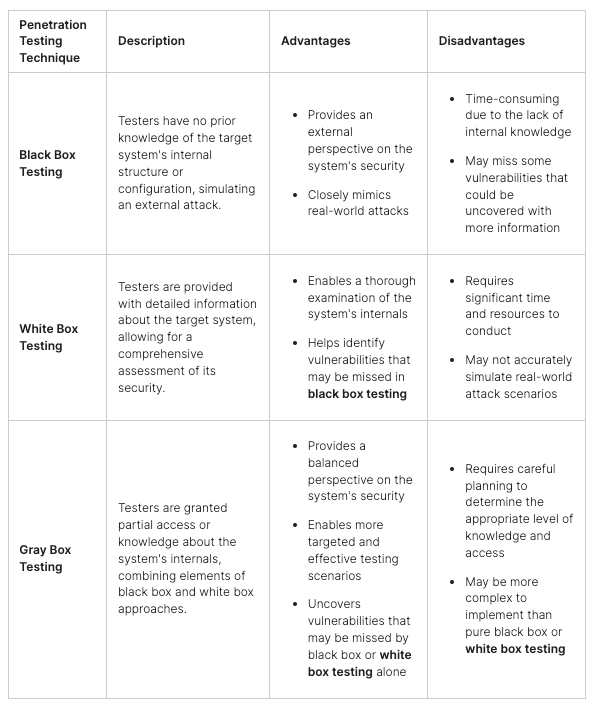
    • Black Box Testing: The tester doesn’t know anything about the target system’s inside. It’s like a surprise attack from the outside.
    • White Box Testing: The tester knows all about the target system. This allows for a deep check of its security.
    • Gray Box Testing: The tester has some but not complete knowledge of the system. This mixes the other two methods.

    Mixing these penetration testing techniques gives a thorough check of security. It helps find weaknesses that could be exploited by real threats.
    Demystifying Black Box Penetration Testing

    Black box testing, also known as external penetration testing, is like simulating a cyberattack. The tester has little information about the company’s IT or security. It’s like being blindfolded in a dark, unknown world, starting from outside the network. The aim is to find vulnerabilities just as a real hacker would. Even though it’s time-consuming, it gives key insights into a company’s external defense.

    In black box penetration testing, the tester knows very little about the system they are testing. They act like a real cybersecurity threat actor, trying to break in. Without inside info, the tester has to search for vulnerabilities in a detailed way, much like an ethical hacking mission. They use their skills, knowledge of the industry, and various vulnerability assessment tools to find weaknesses.

    Starting from the outside help test the organization’s defense against real cyberattacks. This method truly checks how effective the company’s security measures are. It points out areas that need more care or fixing. In the end, it provides a thorough look at the company’s security from an outsider’s view.

    Understanding White Box Penetration Testing

    White box testing is like getting a map to a treasure with all the clues. The tester knows everything about the network infrastructure and security systems. With this knowledge, they can fully check the organization’s defenses.

    Such tests do not copy real cyberattacks from the outside. Yet, they are great at finding weak spots in the network. They can even fake the danger of insider threats, showing how an attack from inside could harm the company. This kind of testing is fast and open, but big companies might still need to be patient for the full report.

    Gray Box Penetration Testing

    Gray box penetration testing blends black and white box testing’s best parts. Testers have some info on the network, not all of it. This lets them check things more like a regular user than just guessing.

    What is Gray Box Penetration Testing?

    It’s a method that mixes white and black box pen testing. Testers know some things about the system. This is unlike the total secrecy of black box testing or the full knowledge of white box testing.

    How Does Gray Box Testing Help Secure Your System?

    It gives testers a peek at the company’s network. This lets checks focus better on the system’s flaws. Testers can then look at how real users might use the system and find hidden weak spots.

    Critical Characteristics of Gray Box Testing

    Here are the main points of gray box penetration testing:

    • Partial knowledge of the system’s structure and functions
    • Allows simulation of real user tests
    • Finds hidden flaws not seen in black box tests
    • Uses time and resources well compared to white box testing
    • Looks into the system’s reaction after a breach and its effects

    Gray Box Penetration Testing Examples

    Gray box penetration testing digs deeper than just black box methods. It helps find and tackle specific problems. This type of testing uses a mix of white and black box methods. It gives a full check-up of a company’s cyber defenses.

    Website Form Testing

    For website form testing, a black box tester uses various email inputs. This is to see how the system handles email confirmations without knowing the system details. In a gray box test, the tester knows email checks are done with JavaScript. They can run tests with and without JavaScript. This finds more about the website’s form security.

    Login Functionality Testing

    Gray box testing is also useful for checking a system’s login security. Unlike black box testing, it doesn’t stop at just guessing passwords. It uses some system insight to create smarter tests. These tests can check how the system blocks wrong logins, the strength of password rules, and if multi-factor authentication works well. Gray box testing is a powerful mix. It can reveal hidden weak spots not found by other tests.

    Gray Box Testing Techniques

    Gray box penetration testing is a special kind of test that’s very powerful. It’s between white box testing and black box testing in terms of perspective. Testers know some internal details of the system, helping them find more vulnerabilities effectively. This approach catches security flaws that other methods might miss.

    Matrix Testing

    Matrix testing looks at different input combos to find edge cases and weaknesses. Testers use what they know about the system to create detailed test plans. They check how the system reacts to different inputs.

    Regression Testing

    Regression testing is key to make sure old functions still work after updates. In gray box testing, testers use their inside knowledge to focus on these checks. They ensure security measures are still working and find any new problems quickly.

    Pattern Testing

    Pattern testing focuses on common system sequences. Gray box testers use this to create tests. They look for any mistakes, flaws, or strange actions that attackers might use.

    Orthogonal Array Testing (OAT)

    OAT is a smart way to test many system inputs efficiently. Testers create tests that cover a lot but with fewer actual tests. This leads to quicker and cheaper security checks.

    Authenticated Testing

    Authenticated testing is essential in gray box approaches. Testers act like they’re authorized to see how secure the system really is. This lets them find issues that internal attackers or hacked accounts might exploit.

    Combining these techniques with inside knowledge makes gray box testing effective. It gives a deep view of system security, helping companies fix issues and improve their defenses.

    API Penetration Testing

    APIs are often targeted by attackers because they’re open and handle sensitive info. It’s crucial to put up strong security barriers and not just assume they’ll work. To check on these barriers, API penetration testing is key.

    Scope of an API Penetration Test

    An API penetration test checks all the key security points of an API. This includes how it identifies users, allows use, checks data, and manages its whole life cycle. Looking for weak spots helps make the API security stronger and lowers the risk of bad access or data leaks.

    Black Box Penetration Testing of an API

    In black box API testing, the tester acts like someone outside trying to break-in. They don’t know how the API works inside. This simulates a real attack. The tester uses things like tips from OWASP and tools to check for flaws in the API’s use, security checks, and how it filters information.

    Gray Box Penetration Testing of an API

    Gray box API testing mixes both black box and white box testing. Testers get some info about how the API works. This lets them dig deep in a more focused way. Knowing a bit inside and seeing from the outside, gray box penetration testing finds hidden flaws. These might be left out if only black box testing was done.

    Exploiting Vulnerabilities with Gray Box Testing

    Gray box penetration testing is a powerful method for finding and fixing security issues. It uses some knowledge about the system’s inner workings. This is more effective than black box testing because it’s like having a key to uncover hidden problems. By looking at the system from an insider perspective, testers can find security holes that outsiders might miss.

    Exploiting a Mass Assignment Vulnerability

    Mass assignment issues happen when a program doesn’t check user input correctly. This lets attackers change parts of the program they shouldn’t. In gray box testing, testers use their inside view of the system to send specific inputs. These can be used to access secret data or do things they’re not supposed to do.

    Manipulating Server Requests Using SSRF

    SSRF occurs when a web app downloads content from a URL without checking it. In gray box tests, testers’ knowledge helps them find ways to misuse this feature. They can make the app download from places it shouldn’t, leading to data leaks or deeper hacks.

    Exploiting a Broken Access Control Vulnerability on GraphQL

    Broken access control in a GraphQL app lets users get to data or actions they shouldn’t. Gray box tests leverage this by using a tester’s knowledge of the app’s data structure. They craft special requests to try and get around the security checks.

    These instances show the strength of gray box testing. It combines the best of both black and white box testing. This method can root out hidden flaws in a system’s security effectively. This mix gives a clearer look at how secure an organization really is.

    White Box Penetration Testing of an API

    White box testing gives testers full knowledge of how the system works. This approach, when used on an API, allows them to deeply check its security. They can find issues not seen with other testing methods.

    Exploiting an IDOR Vulnerability

    In this kind of testing, the tester knows everything about the API’s inside. They can spot IDOR vulnerabilities. These are where the API wrongly lets users access sensitive data without checking their permissions first.

    Exploiting a Command Injection

    When using a white box approach, the tester checks how the API handles inputs and outputs. They look for spots that might allow a command injection attack. With thorough knowledge of the API’s internal workings, they can create attacks to do things the system shouldn’t allow.

    Conclusion

    In our increasingly connected world, securing digital assets is paramount. As cyber threats evolve, penetration testing becomes essential in identifying system vulnerabilities and enhancing defenses. Gray box testing, in particular, offers a unique approach by providing a comprehensive security check-up where ethical hackers search for vulnerabilities without causing damage.

    Gray box penetration testing is crucial for uncovering hidden weaknesses, such as flaws in system configurations and access control mechanisms. This method assesses the effectiveness of existing defenses against potential cyber-attacks through a combination of manual and automated checks, utilizing various tools and techniques.

    What distinguishes gray box testing from black and white box methods? How does it enhance a company’s cybersecurity risk management and vulnerability remediation? By leveraging partial knowledge of the system, gray box testing provides a balanced perspective, combining the internal access of white box testing with the external view of black box testing. This approach allows for more accurate identification of security gaps and more effective remediation strategies.

    With Peris.ai Pandava, you can rest assured that your business will stay secure while gaining a competitive edge in the marketplace. Sleep better at night knowing your data is safe. Our ethical hackers will conduct thorough penetration testing and provide detailed reports—like a scene out of Mission Impossible. Identifying vulnerabilities before they’re exploited may sound daunting, but with Peris.ai Pandava Service, it’s something you can rest easy about.

    Visit Peris.ai Cybersecurity to learn more about how our comprehensive security solutions can protect your business and keep you ahead of cyber threats. Secure your digital world today with Peris.ai Pandava.

    FAQ

    What is penetration testing?

    Penetration testing checks computer systems or networks for security. Ethical hackers, like black hackers but safe, look for weak spots. The aim is to find vulnerabilities and boost defenses against cyber-attacks.

    What are the types of penetration testing techniques?

    Penetration testing has various types, including: – Black box testing: This mimics a real attack, knowing very little about the system. – White box testing: The tester knows everything about the network and its security. – Gray box testing: Testers are partially informed, highlighting a mix of black and white methods.

    What is gray box penetration testing?

    Gray box penetration testing blends both white and black box methods. Testers understand some internal system details, making tests more user-representative than black box tests alone.

    How does gray box testing help secure a system?

    Gray box testing helps find weaknesses by knowing some system internals. This targeted approach finds vulnerabilities that might be overlooked in black or white box tests.

    What are the critical characteristics of gray box testing?

    Gray box testing’s key features are: – Knowing part of the network’s information – Deeper testing than black box – Focusing on specific concerns – Mimicking user interactions

    What are some examples of gray box penetration testing?

    Examples of gray box tests are: – Checking website forms with partial email validation process insight – Testing logins with basic knowledge of the system’s structure

    What are the techniques used in gray box testing?

    Gray box test methods include: – Matrix testingRegression testingPattern testingOrthogonal array testing (OAT) – Authenticated testing

    How is gray box penetration testing applied to API security?

    In API security, gray box testing means testers know some of the API’s workings. This deep knowledge lets them pinpoint vulnerabilities effectively. It’s better than black box because testers have insight into the API’s structure.

    What are some vulnerabilities that can be exploited with gray box testing?

    Gray box testing can find issues like: – Mass assignment problems – Server-side request forgery (SSRF) – GraphQL API’s broken access controls

    How does white box penetration testing differ from gray box testing for APIs?

    White box testing knows all about the API system, unlike gray box, which only has some knowledge. This makes white box testing more thorough, but gray box testing balances insight with testing efficiency from both black and white methods.


  • New Sign1 Malware Campaign Targets Thousands of WordPress Websites

    New Sign1 Malware Campaign Targets Thousands of WordPress Websites

    A sophisticated malware, known as Sign1, has been identified as the culprit behind a series of unauthorized redirects and popup ads on numerous WordPress sites. This alarming cybersecurity breach was uncovered by the team at Sucuri, following a report from a client experiencing unusual website behavior, according to BleepingComputer.

    Innovative Attack Strategies and Wide Impact

    Unlike traditional WordPress attacks that often involve tampering with site files, the perpetrators behind Sign1 opted for a more clandestine approach. They gained initial access through brute-force attacks, tirelessly testing username and password combinations until successful. Subsequently, the malware was either directly injected into existing HTML widgets and plugins or facilitated via the installation of the Simple Custom CSS and JS plugin, allowing attackers to embed malicious JavaScript code seamlessly.

    This method of attack has proven effective on a grand scale, with over 39,000 websites reported to be afflicted by the same malware. The exact method of compromise for these sites remains speculative, with Sucuri suggesting a mix of brute-force entry and exploitation of vulnerabilities within various plugins and themes as the likely tactics.

    Evasive Measures and Ongoing Development

    Sign1 exhibits sophisticated evasion techniques to remain under the radar. One notable method is its use of time-based randomization, which generates dynamic URLs that refresh every 10 minutes. This ensures that the malicious domains remain unlisted by blocklists. Moreover, by hosting these domains on services like HETZNER and Cloudflare, the attackers effectively mask both the hosting and IP addresses. The malware further complicates detection through XOR encoding and the use of randomly generated variable names.

    The campaign, identified to have been active for approximately six months, is characterized by its continuous evolution. Sucuri’s findings indicate that the malware is still in development, with new versions leading to a spike in infections. The most recent wave of attacks commenced in January 2024, compromising around 2,500 websites to date.

    Preventive Measures for Website Owners

    In light of these findings, cybersecurity experts stress the importance of robust security practices to mitigate the risk of compromise. Website owners are urged to employ strong username and password combinations to thwart brute-force attacks effectively. Additionally, conducting regular audits to remove or update any unnecessary or outdated plugins and themes is essential for minimizing vulnerabilities that could serve as gateways for attackers.

    Peris.ai Cybersecurity remains committed to providing the latest insights and recommendations to protect against such sophisticated threats. Staying informed and proactive in cybersecurity hygiene is key to safeguarding your online presence against the evolving landscape of cyber threats.

  • New Gmail Cyber Attack Confirmed— Encryption Key Hackers Strike

    New Gmail Cyber Attack Confirmed— Encryption Key Hackers Strike

    In an unsettling development, Gmail, a platform trusted globally, has become a vector for cybercriminals aiming to steal private keys from Solana crypto wallets. A detailed report reveals how attackers are exploiting Gmail to bypass traditional security measures, posing a significant risk to cryptocurrency security.

    Understanding the Gmail Cyber Attack

    Cybercriminals have cleverly utilized Gmail’s SMTP servers to exfiltrate private keys discreetly. This technique leverages the inherent trust users and security systems place in Gmail, allowing malicious activities to fly under the radar.

    How the Attack Operates:

    • Malicious npm Packages: Hackers embed malware within seemingly benign npm packages.
    • Private Key Interception: Once integrated, this malware siphons private keys during wallet transactions.
    • Exfiltration via Gmail: The stolen data is then sent through Gmail, exploiting its trusted status to avoid detection.

    The choice of Gmail for this purpose is strategic; many security tools perceive Gmail traffic as safe, thus not subjecting it to rigorous checks.

    The Rise of AI in Cybercrime

    AI technology, while a boon for cybersecurity defenses, is also enhancing the capabilities of cyber attackers:

    • AI-Generated Phishing: Cybercriminals use AI to create convincing phishing campaigns.
    • Automated Social Engineering: AI tools enable large-scale social engineering attacks, including sophisticated scam operations and deepfake frauds.
    • Malicious AI Summaries: In repositories like npm, attackers use AI-generated summaries to mask the nefarious nature of packages.

    The sophistication of AI-driven attacks presents a growing challenge to traditional cybersecurity measures, which are increasingly unable to detect such advanced threats effectively.

    Google’s Countermeasures

    In response to these threats, Google has implemented robust security measures:

    • Account Hijacking Protections: Google may prompt reauthentication in response to unusual activities, aiming to thwart unauthorized access.
    • Advanced Threat Detection: Google’s algorithms actively seek out and block suspicious exfiltration patterns and prevent improper email forwarding.
    • Continuous Security Enhancements: Google’s AI-driven security models are persistently updated to identify and mitigate emerging threats.

    Despite these efforts, the ingenuity of cyber attackers means that vigilance remains crucial.

    ️ Proactive Defense Strategies

    To safeguard against these sophisticated cyber threats, individuals and organizations must adopt proactive security practices:

    • Enhanced Authentication: Utilize Two-Factor Authentication (2FA) for all sensitive accounts, including email and cryptocurrency wallets.
    • Vigilance with npm Packages: Carefully verify the legitimacy of npm packages before their integration.
    • Email Traffic Monitoring: Regularly monitor for any signs of unauthorized email forwarding or other suspicious activities.
    • Advanced Threat Detection Tools: Implement AI-powered tools capable of detecting and responding to AI-driven threats.
    • Education on AI Threats: Continuously educate all team members about the nuances of AI-driven phishing and social engineering attacks.

    Adapting to AI-Driven Cybersecurity

    As AI shapes the future of both cyber threats and defenses, a dynamic approach is required:

    • Evolution of Cybercrime-as-a-Service (CaaS): CaaS platforms are enabling attackers to automate and scale their operations.
    • Development of AI-Driven Security: Security solutions must evolve rapidly to detect and neutralize AI-powered threats.
    • Investment in Advanced Cybersecurity: Organizations need to prioritize comprehensive, AI-responsive security frameworks to stay ahead of threats.

    Conclusion

    The integration of AI in cyber attacks like the Gmail-based private key thefts illustrates a critical pivot in cybercrime, necessitating equally advanced defensive strategies. As the landscape evolves, staying informed and prepared is more vital than ever.

    For the latest in AI-driven cybersecurity solutions and expert guidance, visit Peris.ai. Stay one step ahead of cyber threats.

    Your Peris.ai Cybersecurity Team #YouBuild #WeGuard

  • New Android Malware Alert: The BingoMod Threat

    New Android Malware Alert: The BingoMod Threat

    The emergence of a new Android malware known as BingoMod is causing alarm among cybersecurity experts. This malware is particularly dangerous as it has capabilities to drain bank accounts and completely wipe devices. Here’s an in-depth look at BingoMod and effective strategies to protect yourself.

    Understanding BingoMod Malware

    Origin and Discovery:

    • Detected by: Security researchers at Cleafy in May 2024.
    • Primary Function: Executes on-device fraud (ODF), drains bank accounts, and can wipe the device clean.

    Distribution Tactics

    BingoMod spreads through deceptive means to gain control over devices:

    • Phishing Messages: It is disseminated via text messages that mimic legitimate Android security software, tricking users into downloading harmful content.
    • Malicious Permissions: The malware requests broad permissions, notably to Android’s Accessibility Service, to gain extensive control over the device.

    Malware Capabilities

    BingoMod is equipped with sophisticated tools that enhance its malicious activities:

    • Data Theft and Control: Captures login credentials, takes screenshots, intercepts text messages, and allows real-time control of the infected device.
    • Fraud Techniques: Conducts manual overlay attacks using real-time screen content, effectively bypassing traditional anti-fraud systems.
    • Propagation: Spreads itself through text messages, infecting additional devices.

    Evasion Techniques

    To remain undetected, BingoMod employs several advanced evasion tactics:

    • Antivirus Evasion: Capable of removing Android antivirus applications and blocking certain app activities.
    • Detection Evasion: Uses code-flattening and string obfuscation to avoid detection by security services like VirusTotal.
    • Device Wiping: Features capabilities to remotely wipe a device’s external storage and reset the phone through system settings.

    How to Protect Against BingoMod

    Avoid Phishing Scams

    • Caution with Messages: Do not click on links or download attachments from unsolicited or suspicious messages.
    • Verify Authenticity: Exercise skepticism towards messages that appear to be from legitimate sources but have unusual requests or appearances.

    Enhance Device Security

    • Permissions Management: Be judicious in granting app permissions, particularly avoiding unnecessary access to critical services like Accessibility.
    • System Updates: Regularly update your device’s operating system and installed apps to benefit from the latest security patches.

    Monitor and Respond

    • Watch for Anomalies: Stay alert to any unusual device behavior, such as unexpected notifications or unfamiliar app activity.
    • Use Antivirus Solutions: While BingoMod can circumvent some antivirus tools, maintaining updated antivirus software and conducting regular scans remains beneficial.

    Backup Your Data

    • Data Safety: Regularly back up important data to external storage or cloud services to reduce potential damage in case of device wiping.

    ️ Conclusion: Stay Vigilant

    The BingoMod malware represents a severe threat to Android users, underscoring the need for heightened vigilance and proactive cybersecurity practices. By understanding the nature of this malware and adopting comprehensive security measures, you can better protect your digital life against such sophisticated threats.

    For ongoing updates and more cybersecurity tips, make sure to visit our website at peris.ai.

  • Navigating the Threat Landscape: The Role of Generative AI in Cybersecurity

    Navigating the Threat Landscape: The Role of Generative AI in Cybersecurity

    In the dynamic realm of cybersecurity, the integration of generative AI technologies like ChatGPT presents both remarkable opportunities and formidable challenges. OpenAI’s recent report illuminates the dual nature of these tools—serving both as advancements in cybersecurity defenses and as potent weapons in the hands of cybercriminals. This discussion explores the significant ways malicious actors exploit AI, focusing on malware creation, advanced phishing operations, and the overall impact on cyber threats.

    Generative AI: A Tool for Cybercriminals

    The exploitation of AI technologies such as ChatGPT by cybercriminals has introduced a new level of sophistication to their operations. Here’s how they are leveraging AI:

    • Malware Development: Cybercriminals use AI to write and debug malicious code, making it easier to create effective and evasive malware.
    • Phishing Campaigns: AI assists in crafting highly convincing phishing emails that are tailored to the recipients, increasing the chances of successful scams.
    • Evasion Techniques: AI tools are employed to develop methods that help malware evade detection by security software.

    Highlighted Threat Groups and Their Use of AI

    • SweetSpecter: This group uses AI to enhance its reconnaissance capabilities, automate the exploitation of vulnerabilities like Log4j, and streamline malicious script development.
    • CyberAv3ngers: An Iranian IRGC-affiliated group focusing on critical infrastructure, utilizing AI to inquire about industrial system exploits and methods for stealthy operations.
    • Storm-0817: Engages AI for comprehensive malware lifecycle management, from development to command and control operations.

    Strategic Implications for Cybersecurity

    The application of AI in cyberattacks represents a paradigm shift in how threats are constructed and executed. It democratizes complex attack methods, enabling even those with minimal technical skills to execute high-impact cyberattacks. This evolution necessitates a reevaluation of traditional cybersecurity strategies.

    Proactive Measures for Organizations

    • AI Awareness: Businesses must recognize the potential of AI as a threat vector and stay informed about the latest developments in AI-driven cyber tactics.
    • Advanced Defenses: Implementing state-of-the-art threat detection systems that can identify AI-generated malicious activities is crucial.
    • Robust Incident Response: Organizations should streamline their incident response strategies to react swiftly to AI-assisted cyber threats, minimizing potential damages.

    Adapting to AI-Driven Threats

    The landscape of cybersecurity is continually evolving with the advancement of AI technologies. While these tools offer significant benefits for security enhancement, their misuse by cyber adversaries poses new challenges. To safeguard against these emerging threats, organizations need to leverage advanced security solutions and maintain a proactive stance on cybersecurity practices.

    For comprehensive strategies and updates on mitigating AI-driven cybersecurity risks, visit our website at peris.ai.

    Stay vigilant, stay ahead of the curve.

    Your Peris.ai Cybersecurity Team #YouBuild #WeGuard

  • Navigating the Dangers of Spear Phishing: Insight and Prevention

    Navigating the Dangers of Spear Phishing: Insight and Prevention

    In the intricate landscape of cyber threats, spear phishing represents a particularly insidious type of attack. Unlike broad, scattergun phishing attacks, spear phishing is meticulously targeted, making it more dangerous and challenging to detect. Understanding the nuances of this threat is crucial for effective cybersecurity measures. Here’s a comprehensive breakdown of spear phishing, including real-world examples, the tactics employed by attackers, and strategies for protection.

    What is Spear Phishing?

    Definition: Spear phishing is a sophisticated form of phishing where the attacker targets specific individuals or organizations. These attacks are crafted to appear as if they’re coming from a trusted source, such as a colleague, a known organization, or a reputable third party.

    Objective: The primary goal of spear phishing is either to infect the recipient’s device with malware or deceive the recipient into divulging sensitive information or transferring money.

    Understanding Phishing Variants: Phishing vs. Spear Phishing vs. Whaling

    • Phishing: This is the most common form of phishing, involving unspecific, generic communications that are sent to a large number of recipients. The hope is that a few will respond to the fraudulent prompts.
    • Spear Phishing: Unlike generic phishing, spear phishing involves personalized attacks based on the victim’s known information, making the fraudulent communication seem more legitimate.
    • Whaling: This is a highly specialized type of spear phishing that targets high-profile individuals like senior executives, politicians, or celebrities. The stakes and potential payoffs in whaling are considerably higher, making it a significant threat for enterprises and high-value individuals.

    How Spear Phishing Attacks Are Conducted

    1. Infiltration: The attacker may begin by breaching an email system through phishing schemes or exploiting security vulnerabilities.
    2. Reconnaissance: The attacker gathers personal or organizational information from various sources, including the compromised email system or publicly available data (Open Source Intelligence – OSINT).
    3. Exploitation: Leveraging the acquired information, the attacker crafts and sends convincing emails that appear legitimate, aiming to deceive the recipient into making security mistakes.

    Recognizing the Signs of Spear Phishing

    • Unusual Requests: Be wary of emails that ask for atypical actions or transactions, especially if they bypass standard procedures.
    • Sense of Urgency: Many spear phishing attempts create a sense of urgency, pressuring the recipient to act swiftly and without due diligence, often ignoring normal security protocols.

    Strategies to Prevent Spear Phishing

    • Technical Defenses: Implement robust security measures like two-factor authentication (2FA) and protect your email systems with standards such as DMARC, SPF, and DKIM. Utilize advanced anti-phishing tools to detect and block potential threats.
    • Educational Initiatives: Conduct regular training sessions and phishing simulations to help employees recognize and react appropriately to phishing attempts.

    Practical Tips to Combat Phishing

    • Healthy Skepticism: Always verify the authenticity of emails, particularly those that seem to come from high-ranking individuals or involve significant requests.
    • Caution with Attachments: Avoid opening attachments that are unexpected or cannot be verified, as they may contain malicious software.
    • Verify Urgent Requests: Independently confirm the legitimacy of any urgent requests through known contact methods.
    • Safe Link Practices: Hover over hyperlinks to preview the URL and ensure it directs to a legitimate site. Be cautious with links that appear unusual or unfamiliar.
    • Direct Verification: If in doubt, contact the supposed sender directly using a verified phone number to confirm the request’s legitimacy.

    Conclusion

    Staying informed and vigilant is your best defense against spear phishing. By understanding these attacks and implementing both technical safeguards and comprehensive training programs, you can significantly reduce the risk to your organization.

    Stay Protected with Peris.ai Cybersecurity At Peris.ai, we equip you with advanced tools and knowledge to safeguard against sophisticated cyber threats like spear phishing. Visit Peris.ai to explore our solutions and keep your digital environment secure. For more insights and timely updates on cybersecurity, follow us on our social media platforms.

  • MTTR vs. MTTD: Which SOC Metric Holds the Key to Cybersecurity Success?

    MTTR vs. MTTD: Which SOC Metric Holds the Key to Cybersecurity Success?

    In the world of cybersecurity, two important metrics stand out: mean time to detect (MTTD) and mean time to remediate (MTTR). MTTD shows how long it takes for a SOC team to spot an IT issue or security breach. MTTR is about how long it takes to fix an issue once it’s found.

    Focus on these metrics can really boost a company’s cybersecurity. By cutting down the time to detect and fix security problems, businesses can lessen the damage from security incidents and stop data breaches. But, if detection and fixing take too long, hackers can sneak around and steal important data.

    Key Takeaways

    • MTTD and MTTR are critical KPIs for measuring SOC effectiveness
    • Prioritizing these metrics can improve overall cybersecurity
    • Reducing MTTD and MTTR can minimize the impact of security incidents
    • Education, training, and the right security platform can enhance threat detection and response
    • Centralized security data and collaboration are key to optimizing MTTD and MTTR

    The Importance of Security Metrics

    Security metrics are key for cybersecurity teams and organizations. They offer insights into how well incident response and remediation efforts are doing. This helps teams focus on improving security. They also let organizations compare their security with others and make sure they follow the rules.

    Measuring Incident Management Effectiveness

    Metrics like Mean Time to Detect (MTTD) and Mean Time to Remediate (MTTR) show how well a SOC is doing. MTTD tells us how fast teams find security issues. This helps improve how quickly they respond. MTTR shows how reliable the systems are and helps with planning and analysis.

    Optimizing Teams and Talent

    Security metrics help make SOC teams better. Metrics like Mean Time to Acknowledge (MTTA) show how fast teams start dealing with threats. This helps improve training and make sure teams have the right skills to fight new threats.

    Ensuring Compliance

    In places like finance, security metrics prove that security controls work well. They look at how fast issues are found, how quickly they’re fixed, and more. This shows if a company is ready for cybersecurity challenges and follows the rules.

    “Cybersecurity metrics are crucial for managing vendor risks and demonstrating the seriousness of protecting sensitive information.”

    In short, security metrics are vital for SOC teams and organizations. They help measure incident management, find areas for improvement, compare with others, ensure rules are followed, and improve team performance. By using these metrics, organizations can boost their cybersecurity and protect against new threats.

    What is Mean Time to Detect (MTTD)?

    Mean time to detect (MTTD) is a key metric in cybersecurity. It shows how long it takes to spot a security threat. Knowing MTTD helps companies see how well they handle security incidents.

    To find MTTD, you add up the time to detect incidents and divide by the number of incidents. Better MTTD means faster response times, making incident handling more efficient.

    MTTD is important because it shows how good a company’s security monitoring is. For example, Team A might detect 10 incidents in a month, taking 1000 minutes. Their MTTD is 100 minutes. Team B might detect 8 incidents in 1500 minutes, with an MTTD of 187.5 minutes.

    By comparing these numbers, companies can see who’s doing better at finding threats.

    Keeping threats from staying too long is also key. Long dwell times make security incidents more costly. Good MTTD management helps keep response times low, which is important.

    Companies can use services like Arctic Wolf’s SOC for 24/7 monitoring. This helps lower MTTD and MTTR.

    Improving MTTD and other security metrics helps companies stay safe. It also cuts down on the cost of security incidents.

    What is Mean Time to Remediate (MTTR)?

    Mean time to remediate (MTTR) is how long it takes a security team to fix a security issue. It shows how fast a system can get back to normal. MTTR can be about fixing, recovering, responding, or solving a problem. It includes finding, fixing, and stopping problems from happening again.

    The Importance of MTTD and MTTR

    MTTD (mean time to detect) and MTTR are key to knowing if a company’s security is working. If a breach happens, finding and fixing it fast can lessen damage. These metrics help see how well a system works, how reliable it is, and how users feel.

    Quickly finding and fixing security issues builds trust with customers. To improve MTTD and MTTR, companies can learn about common threats, plan for incidents, scan for vulnerabilities, and use all-in-one security tools. Wiz CDR helps make monitoring, detection, and fixing faster in cloud settings.

    “In the event of a security breach, quick detection and resolution can minimize the impact, limit data exposure, and reduce business losses.”

    Common SOC Metrics

    Security Operations Centers (SOCs) use many metrics to check their work. These metrics show how well teams find, look into, and fix security problems. Some key metrics include:

    Mean Time to Investigate (MTTI)

    MTTI shows how long it takes to start looking into a security issue after it’s found. It helps see how well the team responds to incidents and where they can get better.

    Mean Time to Resolve (MTTR)

    MTTR is the average time to fix a security issue, from start to finish. It’s key to see how good a team is at handling security problems and keeping them from getting worse.

    Mean Time to Restore Service (MTRS)

    MTRS is about how long it takes to get back to normal after a security issue. It’s very important for groups that need their systems and services to work all the time. It shows how strong their security is.

    Number of Security Incidents

    Keeping track of security incidents is key to knowing how secure an organization is. It helps teams spot patterns, focus on fixing problems, and see if their security works.

    False Positive Rates (FPR) and False Negative Rates (FNR)

    FPR and FNR show how good security alerts are. False positives waste time and resources, while false negatives mean threats are missed, which can harm the organization.

    Cost of an Incident

    The cost of a security issue includes direct and indirect costs, like fixing problems, lost work time, fines, and damage to reputation. Knowing the cost helps organizations see the financial hit of security breaches and why they should invest in security.

    “Effective security operations rely on a comprehensive set of metrics to measure performance, identify areas for improvement, and demonstrate the value of security investments.”

    Improving Security & SOC Metrics

    Boosting security and SOC metrics is key for companies to get better at cybersecurity. They need to work on improving metrics like Mean Time to Detect (MTTD), Mean Time to Remediate (MTTR), and Mean Time to Attend and Analyze (MTTA&A). This helps them manage incidents better and cut down on security issues.

    How to Improve MTTD

    To better MTTD, companies should use strong monitoring and alerting systems. These systems can spot threats fast. Also, doing regular checks for vulnerabilities and training staff to spot and report odd activities helps. Making alerting more efficient and automating some steps can also speed up detection.

    How to Improve MTTR

    To improve MTTR, companies need to make their incident response smoother. This means better documentation, teamwork, and automating tasks. Using an operation-centric approach and looking at the whole malicious operation (MalOp) can also cut down on alerts needing human check.

    How to Improve MTTA&A

    To better MTTA&A, companies should have clear ways for reporting and analyzing incidents. Using automated tools for triage and analysis can quicken the investigation. Keeping incident response plans up to date and training security teams well are also key.

    How to Reduce the Number of Security Incidents

    To lower security incidents, start by checking for system vulnerabilities and fixing them fast. Teaching staff and customers about cyber threats and how to stay safe can also help. Being proactive in finding and fixing threats can also help reduce incidents.

    By working on these areas, companies can improve their security and protect against cyber threats.

    MTTR vs. MTTD: Which SOC Metric Holds the Key to Cybersecurity Success?

    MTTD (Mean Time To Detect) and MTTR (Mean Time To Respond) are key metrics for SOC managers and leaders. They show how fast and well a company’s security works. This affects how successful a company’s cybersecurity is.

    Both MTTD and MTTR are important, but finding the right balance is key. A low MTTD means threats are caught quickly, reducing risk. A low MTTR shows the security team acts fast, lessening damage from attacks.

    To get better at cybersecurity, companies should work on both MTTD and MTTR. They might use new threat detection tools, make incident response smoother, and improve teamwork in the SOC. By focusing on these areas, companies can protect more, avoid big losses, and succeed in cybersecurity.

    “Focusing on high-fidelity automated decisions is essential to improve SOC automation and efficiency.”

    Finding the right balance between MTTD and MTTR is tricky. Companies need to think about their risks, industry needs, and tech use to decide what to focus on. By focusing on these key areas, businesses can improve their security and succeed in the changing threat world.

    Establishing an Effective Measurement Framework

    To get the most out of your Security Operations Center (SOC), you need a strong measurement framework. This approach helps your SOC meet your organization’s goals. It lets you see how well your cybersecurity plans are working.

    Adopt a Proactive Approach

    Start by picking the right SOC reporting metrics for your company. Look at things like Mean Time to Detect (MTTD), Mean Time to Acknowledge (MTTA), Mean Time to Contain (MTTC), and Mean Time to Resolve (MTTR). These metrics help you understand how well your SOC is doing and improve your security.

    Agree on Measurable KPIs

    Work with key people to set clear, measurable KPIs that match your security goals. These KPIs should have specific targets and deadlines. This way, you can see how you’re doing and find ways to get better. Good KPIs might include how many critical systems are exposed, how well employees avoid phishing, and how well leaders support cyber safety.

    Choose the Right Tools

    It’s important to use the right tools for measuring your SOC. Use data analytics, SIEM systems, and other tools to track your SOC’s performance. These tools should help you see things like how many intrusion attempts you face, your security ratings, and your vendors’ ratings.

    Implement Regular Reporting

    Make sure to report on your SOC’s performance regularly. You might want to do this weekly, monthly, or quarterly. Your reports should show important metrics, trends, and areas for growth. Also, track how well your employee training and patching are working to see real results.

    By using a proactive, data-focused approach to measuring your SOC, you can gain valuable insights. This helps you improve your security operations and boost your overall cybersecurity.

    The Role of AI in Enhancing SOC Metrics

    AI has changed the game in Security Operations Centers (SOCs), making a big difference in key security metrics. With advanced AI and machine learning, SOCs can automate many security tasks. This leads to quicker detection of incidents, faster responses, and more accurate threat analysis.

    AI helps reduce the time it takes to detect and fix security issues. AI systems quickly go through lots of data, find oddities, and alert teams right away. This means threats are caught and handled faster, helping to reduce the damage and costs of cyber attacks.

    AI also makes it easier to see what’s happening with security incidents. It helps in making quick decisions and automates simple tasks like sorting and responding. This makes security work more efficient and lets people focus on important tasks.

    Using AI in SOCs leads to better metrics like how well threats are stopped and how quickly issues are solved. These improvements make security stronger and more responsive. This helps protect against cyber threats and reduces the damage from security incidents.

    As more cybersecurity jobs are needed, AI in SOCs becomes even more important. AI tools help automate security work. This helps fill the skills gap, makes security teams more efficient, and keeps up with new threats.

    “Unsupervised Machine Learning is highlighted as an effective tool in raising anomalous alerts and detecting potential compromises, contributing to improved security posture and incident response efficiency.”

    In summary, AI in SOCs is key to improving security metrics, managing incidents better, and making security stronger. As our world gets more connected and digital, using AI in SOCs is vital for protecting against new threats.

    Conclusion

    In today’s evolving threat landscape, reducing Mean Time to Detect (MTTD) and Mean Time to Remediate (MTTR) is essential for effective cybersecurity. Lower MTTD allows faster threat detection, while reducing MTTR ensures quicker incident responses, minimizing potential damage. With AI-driven automation and a strong measurement framework, security teams can streamline their response, making smarter, data-driven decisions to stay ahead of threats.

    Brahma Fusion combines cutting-edge AI capabilities with seamless integrations to provide a robust Security Orchestration solution. Its continuous asset monitoring, automated responses, and advanced threat detection and analysis are designed to keep your organization resilient and compliant.

    Strengthen your cybersecurity posture with Brahma Fusion. Visit Peris.ai to explore how our solutions can help you achieve faster detection, more efficient response times, and a proactive approach to digital defense.

    FAQ

    What are MTTD and MTTR and why are they important metrics for cybersecurity?

    MTTD (Mean Time to Detect) is how long it takes to find an IT problem. MTTR (Mean Time to Remediate) is how long it takes to fix it. These metrics show how well a company’s security works. They help measure how fast problems are found and fixed.

    How do SOC metrics enable security operations?

    SOC metrics help teams and companies in many ways. They check if security efforts are working well. They help find areas to get better, compare with others, follow rules, plan team sizes, and improve training.

    What is the significance of Mean Time to Detect (MTTD)?

    MTTD is how long it takes to find an IT problem. It’s a key measure for checking if monitoring tools work well. It shows how good a company is at finding problems early.

    What is the importance of Mean Time to Remediate (MTTR)?

    MTTR is how long it takes to fix an IT problem. It’s very important because the less time a problem is around, the less damage it causes. Getting better at finding and fixing problems quickly is key to reducing losses.

    What are some common SOC metrics used by security teams?

    SOC teams use many metrics to measure their work. These include how long it takes to investigate and fix problems, how often systems fail, and how many incidents happen. They also look at false alarms and the cost of problems.

    How can organizations improve MTTD, MTTR, and other SOC metrics?

    To get better at finding problems, companies should use strong monitoring and alert systems. They should also check for weaknesses and teach employees to spot and report issues. To fix problems faster, they can improve how they share information and automate tasks. To handle problems quickly, they should have clear communication channels and use tools for quick analysis. To prevent problems, they should check for weaknesses, teach people about threats, and find and fix security issues early.

    How can organizations establish an effective measurement framework for SOC metrics?

    To measure SOC metrics well, companies should be proactive. They should pick metrics that match their goals. They should agree on clear KPIs to measure their success. Choosing the right tools and reporting regularly is key to keeping everyone informed and improving.

    How can AI impact SOC metrics and operations?

    AI can greatly improve SOC metrics and operations. AI tools can reduce risks, speed up responses, and improve how problems are handled. This leads to faster fixes, better visibility, and more effective threat responses.

  • Mastering Cybersecurity: How Communicators Can Navigate Through Crises

    Mastering Cybersecurity: How Communicators Can Navigate Through Crises

    Keeping organizations secure in an increasingly digital world is a complex challenge, and cybersecurity incidents can have devastating consequences. In these times of crisis, communicators play a crucial role in helping organizations navigate through the storm. By mastering the art of crisis communication and developing effective strategies, communicators can help organizations weather the storm and emerge stronger.

    Strategies and principles for communicators to successfully navigate cybersecurity crises.

    This article will explore the key principles and strategies communicators can employ to navigate cybersecurity crises successfully. From crisis management and communication planning to reputation management, we will delve into the essential elements that can make a significant difference in effectively managing and mitigating the impact of cyber attacks and data breaches.

    Key Takeaways:

    • Communicators play a vital role in navigating organizations through cybersecurity crises.
    • Effective crisis management and communication planning are essential in mitigating the impact of cyber attacks and data breaches.
    • Reputation management is crucial before, during, and after a cybersecurity incident.
    • Collaboration with IT and security teams is essential for a comprehensive and coordinated response.
    • Continuous monitoring and intelligence gathering help in proactively identifying and mitigating cybersecurity risks.

    The Importance of Cybersecurity in Today’s Digital Landscape

    In today’s digital landscape, organizations face an ever-growing threat of cyber threats and attacks. The rise in data breaches and cyber attacks highlights the critical importance of cybersecurity in protecting sensitive information and maintaining stakeholders’ trust. As key players in crisis management and communication, Communicators play a vital role in navigating these cybersecurity crises.

    Cyber threats come in various forms, from sophisticated hacking attempts to malware and phishing attacks. Organizations need robust strategies to handle data breaches and effectively respond to and mitigate the impact of cyber attacks. Communicators must be prepared to navigate the complexities of managing public relations during a cyber crisis, ensuring transparency and maintaining the trust and confidence of stakeholders.

    As organizations increasingly rely on digital platforms and technologies, the potential consequences of a cybersecurity breach can be severe. The loss of customer data, financial implications, and reputational damage can be devastating. Therefore, communicators must be well-versed in navigating PR in a cyber crisis and be equipped with the necessary knowledge and skills to communicate effectively with various stakeholders during such incidents.

    Key Points

    • Cyber threats: Organizations face diverse cyber threats, necessitating robust cybersecurity measures.
    • Handling data breaches: Communicators must have strategies in place to handle data breaches effectively.
    • Navigating PR in a cyber crisis: Communicators play a crucial role in managing public relations during a cyber crisis, ensuring transparency, and maintaining stakeholder trust.

    By recognizing the importance of cybersecurity and building the necessary expertise in handling cyber threats and data breaches, communicators can effectively support organizations in navigating through crises and safeguarding their reputations. With proper crisis management plans, crisis communication strategies, and a focus on stakeholder engagement, communicators can contribute to minimizing the impact of cybersecurity incidents and maintaining trust in an increasingly vulnerable digital landscape.

    Developing a Comprehensive Crisis Management Plan

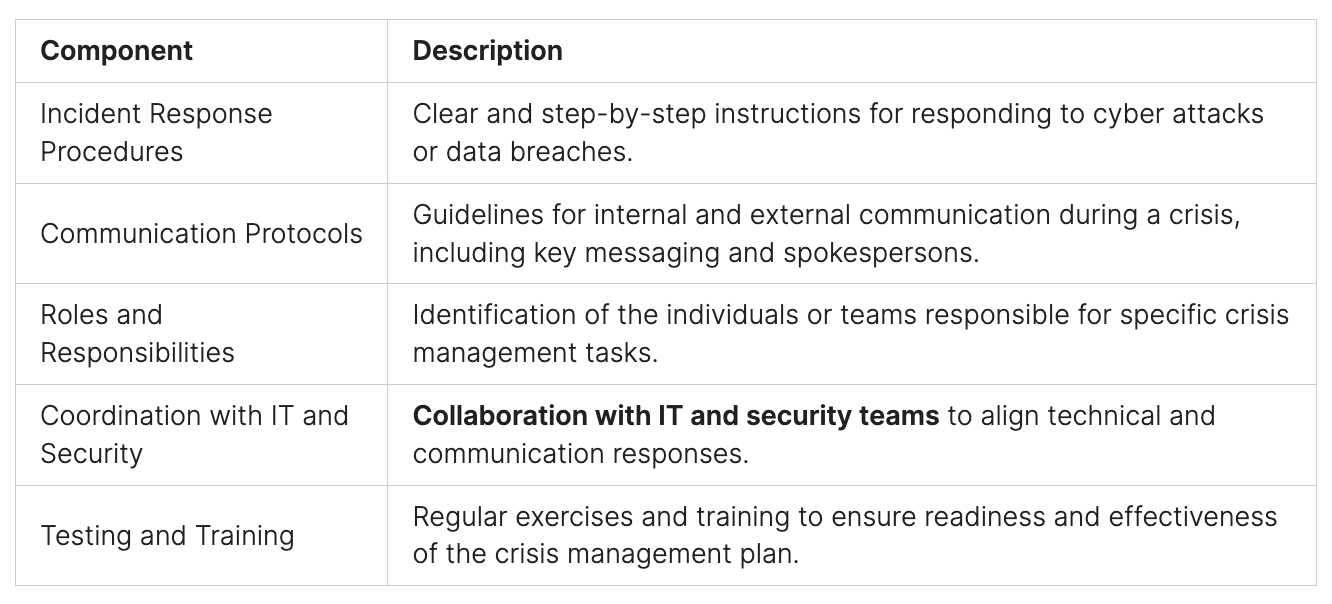
    When it comes to cybersecurity crises, having a comprehensive crisis management plan is essential. This plan should include clear protocols and procedures for responding to cyber attacks and data breaches, allowing organizations to navigate these crises effectively. Communicators play a crucial role in developing and implementing such plans, collaborating closely with IT and security teams to address the crisis’s technical and communication aspects.

    One key aspect of a comprehensive crisis management plan is cybersecurity incident response. This involves outlining the steps to be taken during a cyber attack or data breach, including how to contain the incident, investigate the cause, and restore systems or data. By having well-defined incident response procedures in place, organizations can minimize the impact of the crisis and ensure a swift recovery.

    Table: Key Components of a Comprehensive Crisis Management Plan

    In addition to incident response procedures, a comprehensive crisis management plan should include clear communication protocols. This involves defining the channels and methods of communication to be used during a crisis, as well as the key messaging and spokespersons. Communicators should work closely with internal stakeholders, such as executives and legal teams, to ensure consistent and timely communication that maintains stakeholder trust.

    Organizations can effectively navigate cybersecurity crises by developing a comprehensive crisis management plan, minimizing damage, and maintaining stakeholder trust. This plan should be regularly reviewed and updated to adapt to evolving cyber threats and industry best practices. Incorporating the insights gained from past incidents can strengthen their crisis management strategies and enhance cybersecurity readiness.

    Crisis Communication Planning: Navigating Public Relations During Cyber Attacks

    In today’s digital landscape, organizations face the constant threat of cyber attacks, making crisis communication planning a crucial aspect of cybersecurity preparedness. Effective communication becomes paramount in managing public relations and maintaining stakeholder trust when a cyber attack occurs. A well-developed crisis communication plan ensures that organizations can respond quickly and efficiently, mitigating the damage caused by cyber attacks and protecting their reputation.

    In a crisis communication plan, key messaging is critical in conveying accurate and transparent information to stakeholders. The plan should outline the specific messages to be delivered during a cyber attack and identify designated spokespersons responsible for disseminating information. Organizations can effectively manage public perception and minimize potential reputational damage by providing timely updates and addressing stakeholder concerns. Additionally, the plan should detail the various communication channels, such as press releases, social media, and website updates, ensuring consistent and coordinated messaging across all platforms.

    Amid a cyber attack, protecting sensitive information is of utmost importance. While transparency is crucial, organizations must balance providing necessary information and safeguarding sensitive data. The crisis communication plan should include protocols for handling data breaches, outlining measures to prevent further compromise of information. Organizations can instill confidence in stakeholders and preserve their reputation by prioritizing data protection and demonstrating a commitment to security.

    Benefits of Crisis Communication Planning

    1. Ensures timely and accurate information dissemination
    2. Provides a consistent and coordinated approach to communication
    3. Minimizes reputational damage through transparency and stakeholder engagement
    4. Protects sensitive information while maintaining a strong stance on cybersecurity

    By prioritizing crisis communication planning, organizations can effectively navigate public relations challenges during cyber attacks and safeguard their reputation. By establishing clear protocols, defining key messaging, and protecting sensitive information, communicators can play a vital role in managing the fallout of a cyber attack and instilling confidence in stakeholders.

    Building and Maintaining Reputation in Cybersecurity

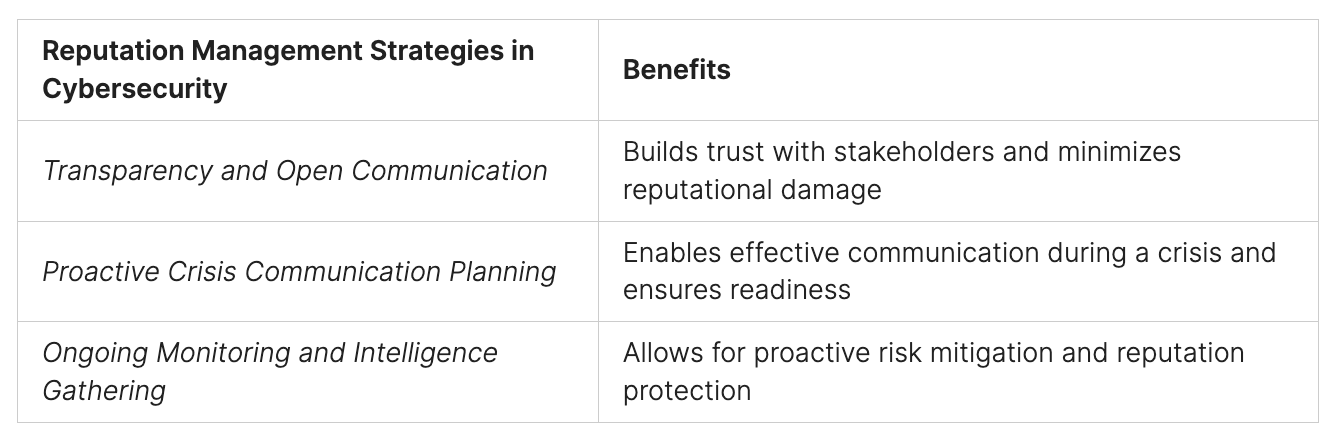
    Reputation management plays a critical role in navigating through cybersecurity crises. In the face of cyber attacks and data breaches, organizations must proactively manage and protect their reputation to maintain stakeholder trust. Communicators are at the forefront of these efforts, implementing crisis communication strategies that prioritize transparency, address stakeholder concerns, and demonstrate the organization’s commitment to resolving the crisis and preventing future incidents.

    One of the key challenges in reputation management during a cyber crisis is effectively navigating public relations. Communicators must strike a delicate balance between providing timely and transparent updates to stakeholders and ensuring that sensitive information is protected and not further compromised. By maintaining open lines of communication and consistently sharing accurate information, organizations can build trust with stakeholders and minimize reputational damage.

    Furthermore, reputation management in cybersecurity requires a proactive approach. Communicators should develop a comprehensive crisis communication plan that outlines key messaging, spokespersons, and communication channels for a crisis. This plan should be regularly tested and updated to ensure its effectiveness and relevance. Additionally, organizations should invest in ongoing monitoring and intelligence gathering to stay informed about the latest cyber threats and vulnerabilities. Organizations can proactively mitigate damage and protect their reputation by staying ahead of potential risks.

    In conclusion, building and maintaining a reputation in cybersecurity requires a proactive and strategic approach from communicators. By implementing effective reputation management strategies, navigating public relations during a cyber crisis, and staying ahead of potential risks, organizations can protect their reputation and mitigate the damage caused by cyber attacks and data breaches.

    Engaging Stakeholders and Managing Expectations

    Effective communication with stakeholders is essential in cybersecurity crises. As communicators, engaging with internal and external stakeholders, including employees, customers, partners, and regulators is crucial. By providing regular updates, addressing concerns, and managing expectations, communicators can maintain trust and confidence in the organization’s ability to navigate the crisis.

    Internally, communicators should ensure that employees are informed about the cyber crisis and its potential impact on the organization. Clear and transparent communication can help alleviate anxiety and foster a sense of unity and collaboration in addressing the situation. Providing employees with the necessary information and resources to support them during this challenging time is important.

    Externally, communicators must contact customers, partners, and regulators to address any concerns and provide reassurance. Efforts should be made to explain the steps to mitigate the crisis and prevent future incidents. By demonstrating transparency and a commitment to resolving the situation, communicators can help maintain positive relationships with key stakeholders.

    Key Strategies for Stakeholder Engagement:

    • Regular communication updates that provide accurate and timely information.
    • Addressing concerns and questions promptly to maintain stakeholder trust.
    • Proactively reaching out to stakeholders with relevant updates and reassurances.
    • Ensuring clear and consistent messaging across all communication channels.
    • Providing resources and support to internal stakeholders during the crisis.

    “Effective stakeholder engagement is crucial in cybersecurity crises. By maintaining open lines of communication and addressing concerns, organizations can foster trust and collaboration, ultimately overcoming the challenges presented by cyber threats and crises.”

    In conclusion, managing stakeholder expectations and engaging with key stakeholders is vital in navigating cybersecurity crises. By developing a comprehensive stakeholder communication strategy and implementing key strategies for engagement, communicators can contribute to the organization’s ability to manage the crisis and protect its reputation effectively.

    Coordinating with IT and Security Teams

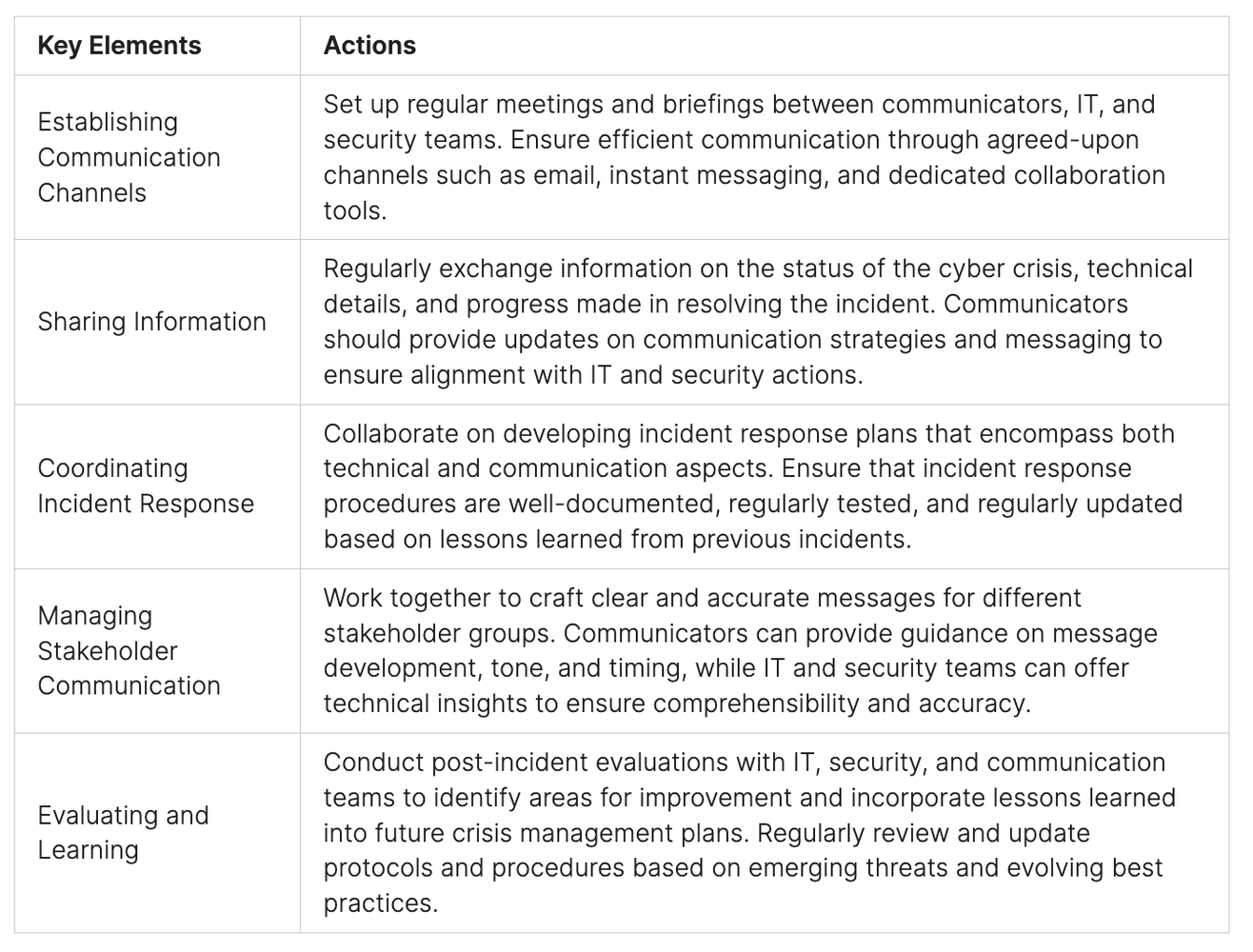
    Effective communication and collaboration with IT and security teams are crucial during a cybersecurity crisis. By working closely with these teams, communicators can ensure a coordinated and comprehensive response that addresses the crisis’s technical aspects and the communication strategies required to mitigate its impact.

    “Collaboration with IT and security teams is essential for understanding the technical aspects of the crisis, developing incident response procedures, and ensuring that communication is aligned with the actions being taken to address the cyber attack or data breach,” “By actively engaging with these teams, communicators can gain valuable insights into the nature of the incident, its potential implications, and the progress being made in resolving it.”

    “During a cyber crisis, the IT and security teams work tirelessly to investigate the breach, contain the damage, and restore systems,” “Collaboration with communicators helps us ensure that the right information is shared with stakeholders in a timely and accurate manner, which is crucial for maintaining trust and minimizing reputational damage.”

    Effective communication in a cyber crisis involves regular briefings and updates between communicators, IT, and security teams. It is essential to establish clear lines of communication, designate key points of contact, and ensure that roles and responsibilities are clearly defined. This collaborative approach allows for the timely dissemination of accurate information, helps manage stakeholder expectations, and ensures a unified effort to resolve the crisis.

    The crucial role of effective communication in cybersecurity crises.

    Table: Key Elements of Collaborating with IT and Security Teams

    Training and Preparedness for Cybersecurity Crises

    In today’s digital landscape, where cyber threats are becoming increasingly sophisticated and widespread, organizations must prioritize training and preparedness to navigate cybersecurity crises effectively. Communicators play a vital role in this process by ensuring they have the knowledge, skills, and resources to respond quickly and effectively to cyber attacks and data breaches.

    Training for cyber crises should be an ongoing effort, involving regular exercises and simulations to test response capabilities and identify areas for improvement. These exercises should encompass a range of scenarios, allowing communicators to practice crisis communication, incident response procedures, and coordination with IT and security teams. By regularly engaging in these training exercises, communicators can enhance their readiness and ability to mitigate the impact of cybersecurity incidents.

    Preparedness for cybersecurity incidents goes hand in hand with training. It involves staying current with the latest cybersecurity best practices, monitoring emerging threats, and gathering intelligence to anticipate potential risks. Communicators should also ensure they have comprehensive crisis management plans and crisis communication strategies, outlining clear protocols, messaging, and communication channels to use during a cyber crisis.

    Training and Preparedness Tips for Communicators:

    1. Conduct regular training exercises and simulations to practice crisis response and improve capabilities.
    2. Stay current with cybersecurity trends, best practices, and emerging threats.
    3. Develop comprehensive crisis management plans and crisis communication strategies.
    4. Collaborate with IT and security teams to align communication efforts with technical actions.
    5. Monitor cyber threats and gather intelligence to anticipate potential risks.

    By investing in training and preparedness, communicators can effectively navigate cybersecurity crises and help organizations protect their reputations, maintain stakeholder trust, and minimize the damage caused by cyber attacks and data breaches.

    Monitoring Cyber Threats and Gathering Intelligence in Cybersecurity

    In the ever-evolving landscape of cybersecurity, it is crucial for organizations to consistently monitor cyber threats and gather intelligence to stay one step ahead of potential risks. By proactively identifying and analyzing cyber threats, communicators can play a vital role in mitigating cybersecurity incidents and safeguarding the reputation and security of their organizations.

    Continuous Monitoring:

    Continuous monitoring of cyber threats allows for early detection of potential vulnerabilities and malicious activities. By leveraging advanced tools and technologies, organizations can gather real-time data on emerging threats like malware, phishing attacks, or data breaches. Communicators can work closely with IT and security teams to establish robust monitoring systems that provide valuable insights into potential risks and enable prompt responses to mitigate the impact of cybersecurity incidents.

    Gathering Intelligence:

    Gathering intelligence in cybersecurity involves collecting and analyzing relevant information to understand threat actors’ motives, techniques, and tactics. This includes monitoring online forums, dark web marketplaces, and other sources to identify potential threats and vulnerabilities specific to the organization’s industry or sector. Communicators can collaborate with intelligence experts and security professionals to gain valuable insights that inform strategic decision-making and enhance the organization’s overall cybersecurity posture.

    “Effective monitoring and intelligence gathering are integral components of a robust cybersecurity strategy. By staying informed about emerging threats and understanding the evolving tactics of cybercriminals, organizations can proactively protect their systems, data, and reputation.”

    Evaluating and Responding:

    Monitoring cyber threats and gathering intelligence is only valuable if organizations take appropriate action based on the insights gained. Communicators can work closely with IT and security teams to evaluate the severity and potential impact of identified threats, enabling them to prioritize response efforts accordingly. This may involve implementing security patches, strengthening defenses, or developing targeted communication strategies to address potential reputational risks arising from the specific threat.

    In conclusion, monitoring cyber threats and gathering intelligence is critical in maintaining effective cybersecurity. Organizations can better protect themselves from cyber attacks and safeguard their most valuable assets by continuously monitoring for potential risks, collecting relevant intelligence, and evaluating and responding to emerging threats. With their expertise in crisis management and communication strategies, communicators are well-positioned to collaborate with IT and security teams in these efforts, ensuring a comprehensive and proactive approach to cybersecurity.

    Learning from Past Cybersecurity Crises

    Communicators must examine past incidents and conduct post-crisis analysis to navigate these crises effectively. By closely analyzing these events, organizations can gain valuable insights and identify lessons learned to enhance their crisis management and communication strategies.

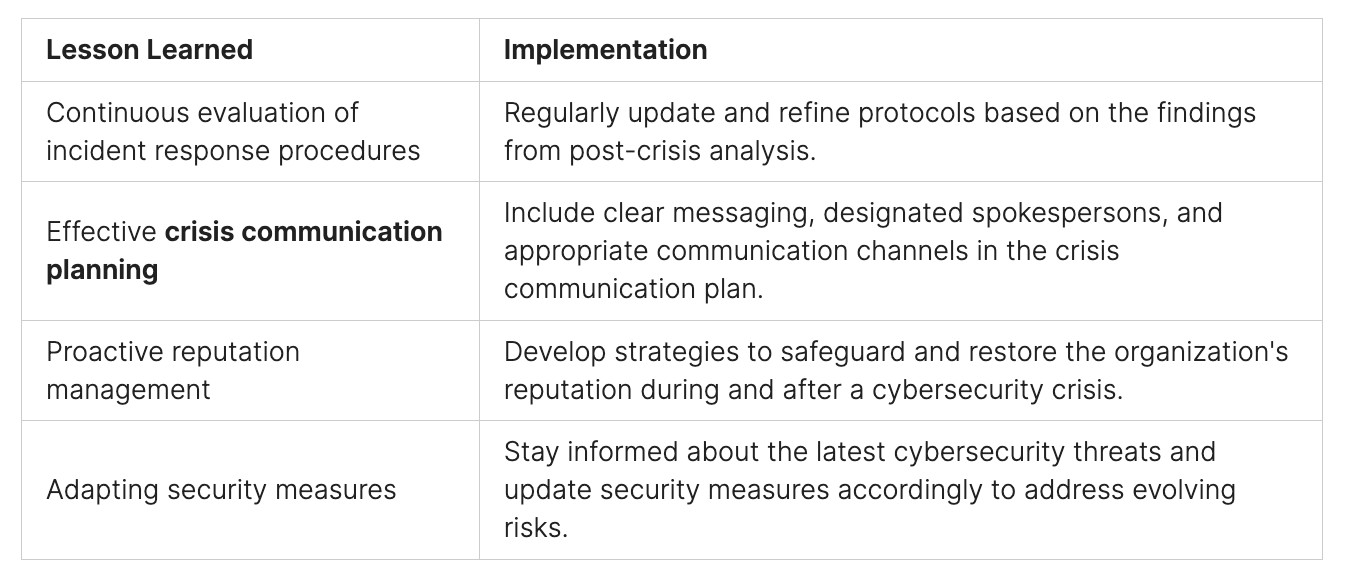
    Post-crisis analysis offers an opportunity to evaluate the effectiveness of incident response procedures, crisis communication plans, and reputation management efforts. This analysis comprehensively explains the organization’s strengths and weaknesses in dealing with cybersecurity incidents. It allows communicators to identify areas for improvement and implement necessary changes to enhance future cybersecurity readiness.

    Organizations can proactively address vulnerabilities and strengthen their defense against future attacks by learning from past cybersecurity crises. This includes refining incident response protocols, strengthening communication channels, and continuously updating security measures to adapt to evolving threats. Additionally, post-crisis analysis helps organizations demonstrate a commitment to improving cybersecurity practices, instilling confidence in stakeholders, and enhancing the organization’s reputation.

    Strengthening cybersecurity defenses through proactive measures and continuous improvement.

    Key Takeaways:

    • Post-crisis analysis allows organizations to learn from past cybersecurity incidents and improve crisis management and communication strategies.
    • Examining the effectiveness of incident response procedures, crisis communication plans, and reputation management efforts helps identify areas for improvement.
    • Learning from past crises strengthens an organization’s defense against future cyber attacks and enhances its cybersecurity readiness.
    • Post-crisis analysis demonstrates a commitment to cybersecurity improvement, instilling stakeholder confidence, and enhancing the organization’s reputation.

    Collaboration and Partnerships in Cybersecurity

    Collaboration and partnerships are critical in navigating crises in today’s complex and rapidly evolving cybersecurity landscape. By joining forces with industry peers, government agencies, law enforcement, and other stakeholders, organizations can leverage collective expertise and resources to strengthen their cybersecurity defenses and response capabilities. Collaborative efforts foster information

    Sharing, best practices exchange, and mutual learning enable organizations to stay one step ahead of cyber threats.

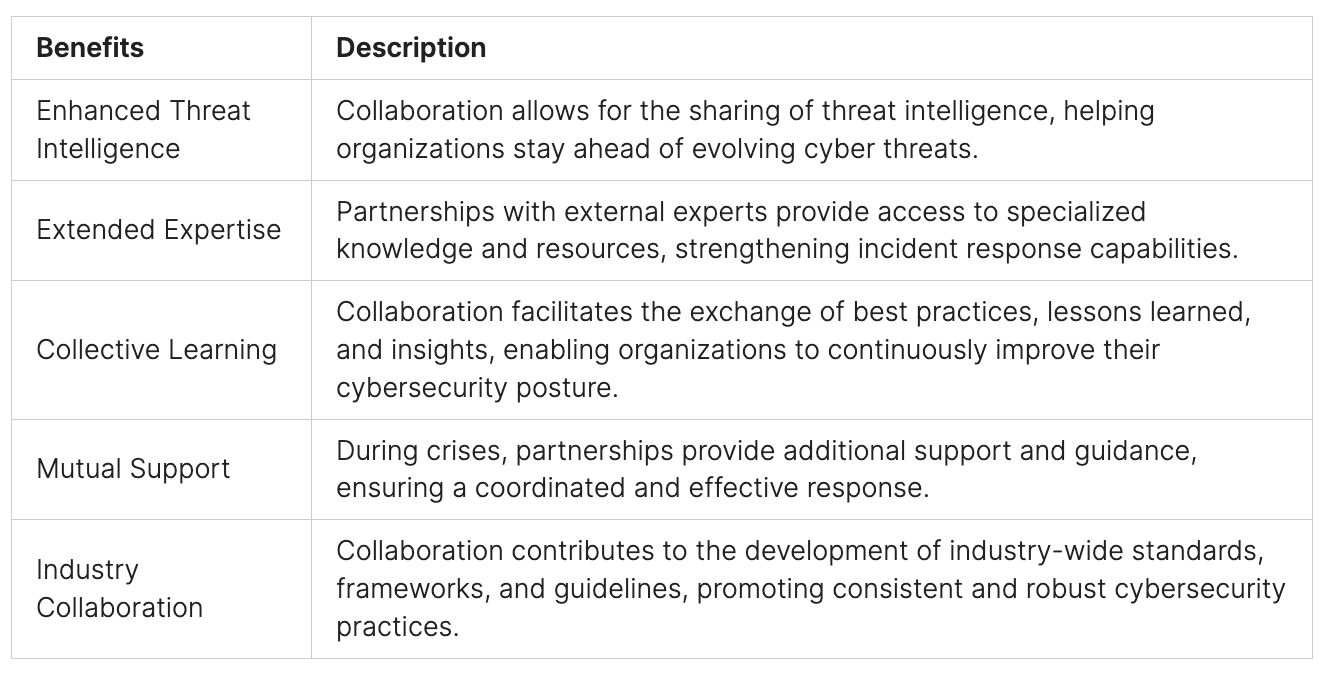
    Partnerships in crisis management are especially valuable when it comes to cyber incidents. Organizations can access specialized knowledge and guidance during crises by establishing relationships with external experts, such as incident response firms and forensic investigators. These partnerships provide a valuable extension to internal capabilities, ensuring a more comprehensive and effective response to cyber threats. Collaboration with communication and public relations professionals can also help navigate the complexities of crisis communication and reputation management.

    One of the key benefits of collaboration and partnerships in cybersecurity is the ability to share threat intelligence. Organizations can collectively enhance their understanding of the threat landscape by pooling information on emerging threats, attack patterns, and vulnerabilities. This shared intelligence enables proactive threat detection and response, allowing organizations to mitigate cyber risks and prevent potential breaches preemptively. Moreover, collaborative efforts contribute to developing industry-wide standards, frameworks, and guidelines that promote consistent and effective cybersecurity practices.

    In the face of sophisticated cyber threats, no organization can afford to work in isolation. Collaboration and partnerships foster resilience, enabling organizations to respond swiftly to cyber incidents, minimize damages, and protect critical assets. By building strong relationships and leveraging collective expertise, organizations can form a united front against cyber threats, ensuring a safer digital ecosystem for all.

    Table: Benefits of Collaboration and Partnerships in Cybersecurity

    Through collaboration and partnerships, organizations can harness the collective power of the cybersecurity community to protect their assets better, respond to incidents, and mitigate risks. By embracing a collaborative mindset and seeking meaningful partnerships, organizations can proactively defend against cyber threats and safeguard their digital infrastructure.

    Conclusion

    In conclusion, effective cybersecurity crisis management must be considered in today’s digitally driven environment. Communicators stand at the forefront of safeguarding organizational safety and reputation during such crises. Developing comprehensive crisis management plans encompassing incident response procedures and crisis communication strategies is paramount to proactively minimizing the repercussions of cyber attacks and data breaches.

    Communicators must emphasize reputation management by upholding transparency and addressing stakeholder concerns. Building trust and confidence amidst a cyber crisis requires active stakeholder engagement and effective collaboration with IT and security teams. Seamless communication and coordination are pivotal in mounting a thorough and cohesive response.

    Training and preparedness emerge as critical elements for successfully navigating cybersecurity crises. Communicators must possess the knowledge and skills to respond swiftly, staying abreast of the latest cybersecurity best practices. Continuous monitoring of cyber threats and gathering intelligence enables communicators to promptly anticipate and counter potential risks.

    In summary, implementing these strategies and a commitment to ongoing learning from past incidents empowers communicators to enhance their readiness and response to cybersecurity challenges. Through proactive and strategic communication, they become instrumental in helping organizations effectively manage and mitigate the impact of cyber attacks and data breaches, safeguarding the organization’s reputation and ensuring its enduring success.

    For a comprehensive solution tailored to your organization’s cybersecurity needs, we invite you to explore our website at Peris.ai Cybersecurity. Stay informed, stay secure.

    FAQ

    What is the role of communicators in cybersecurity crises?

    Communicators are vital in navigating cybersecurity crises by developing and implementing comprehensive crisis management plans and communication strategies.

    Why is cybersecurity a top priority for organizations?

    The digital landscape is becoming increasingly vulnerable to cyber threats, making cybersecurity a critical concern for organizations.

    What should be included in a comprehensive crisis management plan for cybersecurity crises?

    A comprehensive crisis management plan should include clear protocols and procedures for responding to cyber attacks and data breaches.

    How can communicators effectively manage communication during a cybersecurity crisis?

    Communicators can effectively manage communication during a cybersecurity crisis by developing a communication plan outlining key messaging, spokespersons, and communication channels.

    Why is reputation management important in cybersecurity crises?

    Reputation management is crucial in cybersecurity crises to maintain the trust and confidence of stakeholders and demonstrate the organization’s commitment to resolving the crisis.

    How can communicators engage with stakeholders during a cybersecurity crisis?

    Communicators can engage with stakeholders by providing timely updates, addressing concerns, and managing expectations.

    How should communicators collaborate with IT and security teams during a cybersecurity crisis?

    Communicators should work closely with IT and security teams to understand the technical aspects of the crisis and align communication with the actions being taken to address the cyber attack or data breach.

    What is the importance of training and preparedness in cybersecurity crises?

    Training and preparedness are key factors in effectively navigating cybersecurity crises, as communicators must have the knowledge, skills, and resources to respond quickly and effectively.

    Why is continuous monitoring of cyber threats important in cybersecurity?

    Continuous monitoring of cyber threats allows communicators to identify and mitigate cybersecurity risks proactively, minimizing potential damage and maintaining organizational reputation.

    How can organizations learn from past cybersecurity crises?

    Organizations can learn from past cybersecurity crises by conducting post-crisis analyses to identify strengths, weaknesses, and areas for improvement in their crisis management and communication strategies.

    Why are collaboration and partnerships important in cybersecurity?

    Collaboration and partnerships in cybersecurity allow for sharing information, best practices, and learning from each other’s experiences to improve the overall response to cyber-attacks and data breaches.

  • Many Faces: Understanding the 7 Popular Types of Ransomware

    Many Faces: Understanding the 7 Popular Types of Ransomware

    As ransomware continues to be a significant cybersecurity threat in 2024, it is crucial for individuals and organizations to understand the various types of ransomware. Last year, 59% of organizations reported being targeted by ransomware attacks, with recovery costs averaging a staggering $2.73 million, reflecting a 50% increase from the previous year, as reported by the World Economic Forum.

    What is Ransomware?

    Ransomware is a type of malicious software designed to block access to a computer system or data, typically by encrypting files, until a sum of money is paid. Often, ransomware spreads through phishing emails or by exploiting software vulnerabilities, with cybercriminals usually demanding payment in cryptocurrency. In 2024, these attacks have evolved to focus on data theft and employ more advanced encryption techniques, increasing their threat level.

    The Seven Main Types of Ransomware

    1. Crypto Ransomware Description: Encrypts files, rendering them inaccessible without a decryption key. Impact: Severely cripples access to critical data. Examples: Maze, Ryuk

    2. Locker Ransomware Description: Locks you out of your entire computer system, not just specific files. Impact: Prevents access to the device until a ransom is paid. Examples: LockerGoga, LockerPin

    3. Scareware Description: Uses fake warnings and alerts to trick users into thinking their system is infected with malware. Impact: Often tricks users into paying for non-existent threats or fake antivirus software. Examples: SpySheriff, XPAntivirus

    4. Doxware (Extortionware) Description: Threatens to publish the victim’s sensitive data unless a ransom is paid. Impact: This can lead to significant reputational damage by exposing sensitive personal or corporate information. Examples: REvil

    5. Ransomware-as-a-Service (RaaS) Description: Cybercriminals rent or sell ransomware tools to affiliates, enabling them to carry out attacks. Impact: Lowers the entry barrier for attackers, spreading the reach of ransomware campaigns. Examples: LockBit, BlackCat

    6. Wiper Malware Description: Focuses on permanently deleting data from the infected systems. Impact: Unlike typical ransomware, the goal is disruption rather than financial gain. Examples: NotPetya

    7. Specific Ransomware Strains

    Examples:

    • CryptoLocker: Uses strong RSA public-key cryptography to encrypt files.
    • WannaCry: Exploits a Windows vulnerability to cause widespread damage.
    • Petya/NotPetya: Encrypts files and spreads autonomously within networks.
    • Cerber: Employs advanced techniques to evade detection.
    • Bad Rabbit: Disguised as a fake Adobe Flash installer, it spreads through compromised websites.

    How to Protect Yourself from Ransomware

    • Regular Backups: Maintain up-to-date backups of your data, which are stored offline to avoid contamination.
    • Software Updates: Keep all systems and applications updated to close security loopholes.
    • Network Segmentation: Isolate critical segments of your network to limit the spread of ransomware.
    • Advanced Security Tools: Implement cutting-edge ransomware protection solutions.
    • Incident Response Plan: Develop a comprehensive plan for responding to ransomware incidents without succumbing to ransom demands.

    Immediate Actions If You Suspect a Ransomware Infection

    • Disconnect: Isolate the affected systems from the network to prevent the spread.
    • Secure Data: Safeguard any external drives and backups.
    • Stop Processes: Terminate any suspicious processes running on your systems.
    • Documentation: Capture evidence of the ransom note and any other pertinent details.
    • Report: Inform relevant authorities to get professional help and mitigate legal repercussions.
    • Security Measures: Change all passwords and consider wiping affected drives after backing up important data.

    Conclusion

    Understanding and preparing for ransomware is more critical than ever. By familiarizing yourself with the different types of ransomware and adopting proactive security measures, you can significantly enhance your defenses against these costly and disruptive threats.

    Stay informed, stay secure.

    Visit Peris.ai for more insights and up-to-date cybersecurity information.

  • Malware Threats Escalate for macOS Users via Deceptive Ads and Websites

    Malware Threats Escalate for macOS Users via Deceptive Ads and Websites

    Cybersecurity researchers have sounded the alarm over a sophisticated campaign deploying stealer malware, including Atomic Stealer, targeting Apple macOS users through malicious advertisements and counterfeit websites. The operation, aimed at pilfering sensitive data from unsuspecting victims, underscores the growing concerns over macOS security vulnerabilities.

    Sneaky Infection Methods and Malware Delivery

    The attack exploits users’ trust in search engines, directing them to fake ads that lead to look-alike websites crafted to distribute malware. One such instance involves individuals searching for Arc Browser, only to be misled by sponsored links to a malicious site (“airci[.]net”) that cannot be accessed directly, hinting at tactics designed to skirt detection mechanisms. This site is responsible for disseminating a disk image file (“ArcSetup.dmg”) that harbors the Atomic Stealer malware, tricking users into entering system passwords via a fraudulent prompt to facilitate data theft.

    Another vector identified by Jamf Threat Labs involves a bogus website (“meethub[.]gg”), purportedly offering free group meeting scheduling software. Instead, it deploys stealer malware capable of extracting keychain data, web browser credentials, and cryptocurrency wallet information. This malware, bearing similarities to the Realst Rust-based stealer family, employs AppleScript to deceive users into surrendering their macOS login credentials for malicious purposes.

    Exploiting Professional Engagements for Malware Spread

    The attackers have employed creative pretexts, such as job opportunity discussions or podcast interview invitations, to coax targets into downloading malicious applications under the guise of joining video conferences. This approach appears particularly aimed at individuals within the cryptocurrency sector, exploiting their public visibility to orchestrate high-reward attacks.

    Emerging Trends and Sophisticated Evasion Techniques

    Recent disclosures by Moonlock Lab, MacPaw’s cybersecurity division, reveal another method involving malicious DMG files (“App_v1.0.4.dmg”) that leverage obfuscated AppleScript and bash payloads fetched from a Russian IP. This technique deceives users into bypassing macOS’s Gatekeeper security, emphasizing the stealth and sophistication of these malware campaigns.

    Additionally, malvertising campaigns distributing the FakeBat loader (aka EugenLoader) and other information-stealing malware through decoy sites mimic popular software like Notion and PuTTY, further illustrating the expansive threat landscape.

    The Increasing Threat to macOS Environments

    These findings starkly illustrate that macOS environments are no longer immune to the rising tide of cyber threats. With stealer malware evolving to incorporate advanced anti-virtualization techniques and self-destruct mechanisms, the urgency for heightened vigilance and robust cybersecurity defenses has never been more pronounced.

    Peris.ai Cybersecurity advises macOS users to exercise extreme caution with online advertisements and downloads, especially from unverified sources. As the sophistication of cyberattacks continues to evolve, maintaining an informed and proactive stance is essential for safeguarding sensitive information against these insidious threats.

    via The Hacker News