Blog

  • Predictive Cybersecurity: Don’t Just Defend—Anticipate

    Predictive Cybersecurity: Don’t Just Defend—Anticipate

    Cybersecurity is undergoing a fundamental shift. Organizations once relied on reactive defenses to block known threats. But today’s attacks are stealthier, faster, and more dynamic than ever. Threat actors now leverage automation, artificial intelligence, and globally distributed infrastructure to launch campaigns that bypass conventional defenses within seconds.

    In this volatile environment, defending against yesterday’s threats is no longer sufficient. What organizations now need is predictive cybersecurity—a strategy focused on anticipating threats before they strike, identifying vulnerabilities before they are exploited, and automating defense mechanisms to stay ahead of adversaries.

    This article explores the persistent pain points in modern cybersecurity, highlights the limitations of reactive strategies, and demonstrates how predictive cybersecurity—when effectively implemented—transforms risk management from passive defense into proactive resilience. It also shows how Peris.ai’s focused and integrated solutions enable this evolution, without relying on a hard sell of its full product lineup.

    Pain Points: Why Traditional Cybersecurity Fails to Keep Up

    1. Alert Fatigue and Missed Threats

    Security teams are inundated with thousands of alerts daily from SIEMs, EDRs, and firewalls. Most are false positives or redundant. As a result, genuine threats are often overlooked, delayed, or ignored—making quick and accurate responses nearly impossible.

    2. Delayed Detection and Response

    In many cases, detection occurs after an attacker has already established a foothold in the system. In numerous sectors, average dwell time still exceeds 200 days. By the time a breach is discovered and investigated, the damage has often become irreversible.

    3. Lack of Context and Threat Intelligence

    Without real-time, contextual threat intelligence, alerts lack actionable meaning. Security analysts struggle to prioritize incidents or determine which threats pose an immediate and significant risk.

    4. Reactive Security Postures

    Most organizations maintain static security policies and controls that fail to adapt to evolving adversary tactics. Reactive postures focus on firewalls and traditional endpoints, offering little defense against social engineering, insider threats, or cloud misconfigurations.

    5. Limited Human Resources

    The global talent shortage in cybersecurity leaves many teams under-resourced. Most security operations centers (SOCs) don’t have enough analysts to monitor threats around the clock or investigate anomalies in real time.

    The Case for Predictive Cybersecurity

    From Indicators to Anticipation

    Predictive cybersecurity fundamentally changes how organizations approach threats. Instead of reacting post-breach, predictive strategies identify early indicators, model attacker behavior, and trigger preemptive actions to mitigate risk.

    This includes capabilities such as:

    • Behavioral analytics and anomaly detection
    • Threat hunting powered by machine learning
    • Continuous asset and vulnerability scanning
    • Real-time correlation with external threat intelligence
    • Simulation of likely attack paths before they’re exploited

    Strategic Benefits

    • Early Threat Containment: Stop threats before lateral movement begins
    • Faster Incident Response: Reduce the time between signal and action
    • Reduced False Positives: Improve alert fidelity and triage speed
    • Better Resource Allocation: Focus teams on high-impact tasks
    • Proactive Vulnerability Management: Prioritize exposures before exploitation

    Predictive cybersecurity is especially critical in hybrid environments, where the attack surface spans cloud infrastructure, mobile endpoints, on-premise systems, and third-party platforms.

    Key Capabilities for Predictive Defense

    To implement predictive cybersecurity effectively, organizations must build or adopt the following capabilities:

    1. Behavioral Detection and Baseline Analysis

    Machine learning algorithms establish baseline behavior for users, devices, and networks—then flag anomalies in real time. This allows organizations to detect threats such as credential misuse or insider attacks before they escalate.

    2. Continuous Asset Discovery and Risk Assessment

    A dynamic asset inventory, enriched with external scanning and internal telemetry, helps identify which systems are most exposed. Open ports, outdated configurations, and internet-facing services must be continuously monitored and assessed.

    3. Threat Intelligence Integration

    Aggregating threat data from global sources—including malware campaigns, dark web chatter, and APT activity—enables organizations to anticipate attacks targeted at their industry, geography, or tech stack.

    4. Automation Playbooks

    Standardized response workflows triggered by specific behavioral patterns (e.g., brute-force login attempts, beaconing activity) reduce response times and eliminate human delay in high-confidence scenarios.

    5. Red Team Simulation and Retesting

    Regular simulation of adversary techniques allows teams to validate their detection capabilities. Retesting ensures defensive improvements are effective and continuously aligned with evolving threat tactics.

    How Peris.ai Enables Predictive Cybersecurity

    Instead of offering a bloated array of disjointed tools, Peris.ai delivers targeted, deeply integrated solutions that empower predictive defense without overwhelming security teams.

    INDRA: Threat Intelligence Integration That Adds Context

    One of the biggest challenges in predictive cybersecurity is turning data into actionable insight. INDRA solves this by:

    • Correlating real-time threat data with internal activity patterns
    • Prioritizing alerts based on known attacker infrastructure and intent
    • Enriching detections with context from ongoing APT campaigns or malware families

    INDRA goes beyond collecting indicators—it helps organizations anticipate what’s coming next and prepare accordingly.

    BimaRed: Mapping the Most Probable Entry Points

    Visibility is foundational to prediction. BimaRed delivers this by:

    • Continuously scanning for exposed cloud, on-prem, IoT, and SaaS assets
    • Assigning adaptive risk scores based on attacker reconnaissance trends
    • Simulating the external view of attackers to identify where they’re most likely to strike

    This allows organizations to reinforce vulnerable points before they’re targeted.

    Brahma Fusion: Automating Pre-Incident Response

    Knowing a threat exists is only useful if you can respond in time. Brahma Fusion closes the gap by:

    • Auto-triaging alerts and suppressing benign patterns
    • Activating playbooks based on behavioral deviation or threat context
    • Simulating expert analyst decisions to reduce mean time to response (MTTR)

    Brahma Fusion empowers SOCs to act on early signals, not just react to confirmed breaches.

    Real-World Scenarios: Predictive Defense in Action

    Scenario 1: Anticipating a Credential Stuffing Attack

    Anomalous login attempts are detected across a public-facing portal. INDRA correlates this with a recently reported breach of a third-party service used by the client.

    Action: Brahma Fusion initiates conditional MFA, blocks risky IPs, and flags the accounts for verification—before any compromise occurs.

    Scenario 2: Preventing Cloud Exploitation

    BimaRed discovers a misconfigured S3 bucket with write permissions open to the public. Based on trending attack vectors in INDRA’s feed, this is flagged as a high-probability target.

    Action: The system preemptively restricts permissions and notifies the cloud security team—closing the gap before it’s weaponized.

    Scenario 3: Early Containment of Insider Threats

    A developer begins accessing large volumes of R&D files at abnormal hours. INDRA identifies that the access pattern resembles known espionage tactics.

    Action: Brahma Fusion temporarily limits access, initiates a full session audit, and Pandava launches a simulated exfiltration test. The threat is neutralized internally without user disruption.

    Key Outcomes of Predictive Cybersecurity with Peris.ai

    • Reduced Investigation Time: Alerts arrive enriched with relevant threat context, minimizing triage cycles
    • Early Warning: See patterns that predict attacks before payloads are delivered
    • Smarter Prioritization: Distinguish between anomalies and genuine threats quickly
    • Operational Efficiency: Automate early-stage detection and containment
    • Adaptive Resilience: Defenses improve over time by learning from every event, not just attacks

    Best Practices for Building a Predictive Cybersecurity Strategy

    1. Start with What You Know

    • Map all existing assets and user behaviors
    • Identify critical systems and data flows

    2. Integrate Threat Intelligence Early

    • Don’t just collect threat feeds—use them to drive risk scoring and automated actions

    3. Test Continuously

    • Simulate common attack scenarios such as phishing, credential stuffing, and API abuse regularly

    4. Use Machine Learning Thoughtfully

    • Focus on augmenting analysts—not replacing them—with predictive insights and baselines

    5. Automate with Confidence Thresholds

    • Set risk-based triggers for containment that balance speed with accuracy to avoid false flags or downtime

    Predictive Cybersecurity Isn’t a Luxury—It’s a Necessity

    Today’s threats move fast. Tomorrow’s will move faster.

    Predictive cybersecurity is how modern organizations stay ahead. It’s how they protect sensitive data, meet compliance mandates, reduce response times, and ensure business continuity in an ever-evolving threat landscape.

    Peris.ai makes this possible—not through a flood of tools, but through intelligence, automation, and integrated action embedded across critical defense layers.

    Conclusion: Don’t Just Defend—Anticipate

    Proactive organizations don’t just react to cyberattacks. They anticipate them. They prepare in advance. They disrupt the attack chain before it begins.

    Predictive cybersecurity with Peris.ai means:

    • Seeing beyond the immediate alert
    • Acting before an attacker makes a move
    • Building systems that learn, adapt, and respond on your behalf

    Start defending forward. Predict what’s coming. Secure what matters.

    Learn more at https://peris.ai/

  • Your Attack Surface Has Exploded — Have You Mapped It Yet?

    Your Attack Surface Has Exploded — Have You Mapped It Yet?

    In today’s digital-first economy, organizations have undergone massive transformation. From cloud migration and the adoption of remote work to third-party integrations and shadow IT, the digital surface organizations must defend has grown exponentially. Yet most security teams are still operating with yesterday’s visibility in today’s hyper-connected environment.

    The attack surface has exploded. But many organizations still lack a clear understanding of their full exposure. Unmanaged assets, forgotten subdomains, misconfigured APIs, exposed credentials, and third-party risks remain hidden—until a breach makes them painfully obvious.

    This article dives deep into the new dimensions of modern attack surfaces, uncovers common blind spots across industries, and outlines a strategic blueprint for regaining control. It also introduces how Peris.ai Cybersecurity, through solutions like BimaRed and Pandava, empowers organizations to continuously map, monitor, and reduce their attack surface in real time.

    What Is an Attack Surface, Really?

    The attack surface refers to the entire collection of potential entry points an attacker can exploit to gain unauthorized access to systems or sensitive data. Traditionally, this included:

    • On-premise servers
    • User devices
    • Web applications

    However, in the current landscape, it also encompasses:

    • Cloud infrastructure and misconfigured storage buckets
    • IoT devices and smart sensors
    • APIs and microservices
    • SaaS platforms
    • Mobile applications
    • Partner and vendor systems

    In essence, it’s no longer just about systems—it’s about anything connected, exposed, overlooked, or mismanaged across your organization’s digital ecosystem.

    The Problem: You Can’t Secure What You Can’t See

    1. Shadow IT

    Employees deploying cloud services or tools without IT’s approval.

    • Risks: These assets typically lack patching, logging, and monitoring.
    • Consequences: Creates unknown entry points easily exploitable by attackers.
    • Insight: Shadow IT often bypasses security policies and expands the attack surface beyond official oversight.

    2. Forgotten Assets

    Legacy systems or subdomains that remain active but unmanaged.

    • Risks: Often running outdated software or configurations.
    • Consequences: Pose significant security risks due to lack of visibility.
    • Insight: These systems often survive cloud migrations and personnel changes, making them prime targets.

    3. Misconfigured Services

    Examples include open S3 buckets, overly permissive IAM roles, and exposed GitHub repos.

    • Risks: Lead to data exposure, secret leakage, and access mismanagement.
    • Consequences: Common root causes for breaches and compliance failures.
    • Insight: These misconfigurations are often introduced by well-meaning developers under tight deadlines.

    4. Third-Party Risks

    Introduced via vendors, suppliers, contractors, and SaaS platforms.

    • Risks: Inherited vulnerabilities, weak links in the chain.
    • Consequences: Provide attackers indirect access to core systems.
    • Insight: Many major breaches originate from third-party compromises that are not continuously monitored.

    5. Credential Exposure

    Includes leaked passwords and hardcoded secrets in source code.

    • Risks: Credential stuffing, unauthorized access, privilege escalation.
    • Consequences: Allows attackers to bypass even robust perimeter defenses.
    • Insight: These exposures often result from poor DevSecOps practices and unsecured CI/CD pipelines.

    Sector-Specific Attack Surface Challenges

    Government & Public Sector

    • Aging infrastructure with limited asset visibility
    • Large volumes of public-facing services
    • Low maturity in third-party and vendor risk management

    Finance & Banking

    • Rapid digitization in services and user access
    • High exposure through third-party fintech APIs
    • Increasing regulatory demand for real-time visibility and risk mapping

    Retail & E-Commerce

    • Expansive customer interaction points (web, app, chat, API)
    • Inconsistent governance during rapid cloud adoption
    • High risk from diverse vendor and payment ecosystem integrations

    Education & Universities

    • BYOD policies and open campus networks
    • Thousands of unmanaged endpoints
    • Sensitive research and student data often left exposed on public-facing systems

    Healthcare

    • Proliferation of IoT and medical devices with weak security
    • Cloud-based EMRs, patient portals, and telemedicine services
    • Critical compliance pressures (e.g., HIPAA, GDPR) and high-value personal data

    Why Traditional Tools Fail

    Conventional security tools such as firewalls, antivirus software, and even SIEMs are limited in scope—they only protect what they can see and what is properly configured.

    They typically miss:

    • Exposed development or testing environments
    • Short-lived cloud instances that appear and vanish in hours
    • Dormant subdomains pointing to decommissioned infrastructure
    • Rogue IoT or mobile devices
    • APIs with outdated security configurations

    The modern attack surface is fluid, expansive, and constantly evolving. Relying on periodic scans or perimeter defense is no longer enough.

    Mapping the Attack Surface: The New Security Imperative

    Step 1: Asset Discovery

    • Leverage continuous scanning tools
    • Cover cloud infrastructure, SaaS apps, DNS records, source code, mobile apps, and internal devices
    • Automate discovery to detect newly spun-up resources

    Step 2: Classification & Ownership

    • Add business and technical context to each discovered asset
    • Identify and assign clear asset ownership to maintain accountability and upkeep

    Step 3: Vulnerability Assessment

    • Correlate known CVEs to exposed assets
    • Assess risk based on likelihood of exploitation and potential business impact

    Step 4: Threat Modeling

    • Visualize potential attacker pathways across your environment
    • Include both direct and third-party threat vectors

    Step 5: Continuous Monitoring

    • Real-time alerting for changes in asset status, misconfigurations, and exposure
    • Establish baselines for normal behavior and flag anomalies

    How Peris.ai Maps and Minimizes Your Attack Surface

    BimaRed: Automated Attack Surface Management

    • ASM Engine: Continuously scans for internet-facing assets, including shadow IT and overlooked systems
    • Security Posture Dashboard: Presents a real-time map of your organization’s exposure
    • Risk-Based Prioritization: Focuses efforts on the most critical and exploitable issues
    • Seamless Integrations: Connects with SIEM, ticketing, and cloud orchestration tools
    • Graph-Based Visualization: Enables users to trace asset relationships and track changes over time

    Pandava: Pentest-Driven Surface Validation

    • Simulated Attacks: Ethical hackers validate real-world exploitability of findings
    • Actionable Insights: Prioritized recommendations tailored to business context
    • Retesting Workflow: Ensures that once vulnerabilities are patched, they stay fixed
    • BimaRed Integration: Blends automated detection with hands-on validation for full-spectrum visibility

    Building an Attack Surface Reduction Program

    1. Make ASM a continuous, automated process, not a yearly audit
    2. Train developers and infrastructure teams on secure deployment and visibility standards
    3. Consolidate asset tracking across subsidiaries, departments, and environments
    4. Include offensive validation (e.g., red teaming, ethical hacking via Pandava) in your security program
    5. Incorporate findings into board-level dashboards — visibility is an executive responsibility, not just a technical task

    Why Visibility = Resilience

    Mapping the attack surface isn’t just another checkbox for compliance. It underpins all pillars of cybersecurity:

    • Detection: You can’t defend what you don’t know exists
    • Response: Rapid containment requires full context of what’s compromised
    • Governance: Effective risk management starts with visibility and accountability
    • Resilience: Secure organizations can grow confidently without sacrificing control

    Conclusion: You’re Already Exposed — The Question Is, Do You Know Where?

    The attack surface is now the first battleground. With every digital expansion—whether a cloud deployment, vendor API, or student login—your exposure grows.

    Organizations that fail to map, validate, and reduce their attack surface are flying blind in hostile territory.

    Peris.ai delivers the tools, strategies, and expertise to help you:

    • Discover what’s exposed
    • Validate what’s exploitable
    • Fix what’s urgent
    • Monitor what evolves

    With BimaRed and Pandava, you don’t just monitor your attack surface—you take command of it.

    Have you mapped yours yet? If not, the clock’s already ticking.

    Learn more at https://peris.ai

  • The Corporate Cost of Cybercrime—and How Peris.ai Helps You Fight Back

    The Corporate Cost of Cybercrime—and How Peris.ai Helps You Fight Back

    Cybercrime is no longer a distant threat; it is a present and rapidly escalating reality. Every sector—from finance to healthcare to government—is now a target. Cyberattacks have evolved from simple malware infections into highly sophisticated, multi-vector campaigns causing massive financial, operational, and reputational damage.

    Yet, despite increased cybersecurity spending, organizations continue to suffer costly breaches, ransomware attacks, insider threats, supply chain compromises, and regulatory penalties.

    This article delves deep into the true corporate cost of cybercrime, highlights the vulnerabilities companies face, and explains how Peris.ai Cybersecurity’s integrated, AI-driven approach empowers organizations to fight back and build resilient defenses.

    The Rising Financial Cost of Cybercrime

    According to Cybersecurity Ventures, the global cost of cybercrime is projected to reach $10.5 trillion annually by 2025—up from $3 trillion in 2015. For corporations, the impact is felt across multiple dimensions:

    1. Direct Financial Loss

    • Ransomware payments
    • Fraudulent fund transfers
    • Intellectual property theft

    2. Business Disruption

    • Downtime and lost productivity
    • Supply chain interruptions
    • Delayed service delivery

    3. Regulatory and Legal Penalties

    • Non-compliance fines (GDPR, HIPAA, PCI DSS)
    • Class action lawsuits
    • Breach notification costs

    4. Reputational Damage

    • Loss of customer trust
    • Stock price declines
    • Brand degradation and market erosion

    5. Long-Term Recovery Costs

    • Incident response consulting and post-breach investigations
    • System rebuilds and infrastructure upgrades
    • Increased insurance premiums and reduced coverage terms

    Insight: These financial impacts are often cumulative, meaning the total cost can multiply over months or even years after the initial breach.

    Pain Points: Why Organizations Struggle Against Cybercrime

    1. Fragmented Security Posture

    Organizations often deploy dozens of cybersecurity tools that operate in silos, resulting in alert fatigue, visibility gaps, inefficient workflows, and missed threats.

    2. Lack of Real-Time Visibility

    You cannot protect what you cannot see. Shadow IT, cloud misconfigurations, undocumented APIs, and unmanaged third-party access often go undetected, leaving critical vulnerabilities exposed.

    3. Resource Constraints

    The global shortage of skilled cybersecurity professionals leaves security teams overwhelmed, stretched thin, and unable to maintain proactive defense at scale.

    4. Slow Detection and Response

    The average time to detect a breach remains over 200 days in many industries. During this dwell time, attackers can escalate privileges, pivot laterally across networks, and exfiltrate sensitive data unnoticed.

    5. Third-Party and Supply Chain Risk

    Organizations increasingly rely on third-party services and vendors—each representing a potential backdoor for attackers to exploit, bypassing traditional perimeter defenses.

    Sector-Specific Impacts of Cybercrime

    Finance

    • Online banking fraud and credential stuffing attacks
    • Compliance violations under regulations
    • Growing exposure from third-party fintech providers

    Healthcare

    • Ransomware attacks locking critical Electronic Medical Records (EMR)
    • HIPAA violations stemming from data breaches
    • Vulnerabilities in connected medical devices

    Retail & E-commerce

    • Payment card data theft and Magecart attacks
    • Account takeover (ATO) attacks through credential leaks
    • Fraud targeting loyalty programs and rewards platforms

    Government

    • Nation-state espionage and cyber warfare operations
    • Citizen data breaches through vulnerable portals
    • Disruption of critical public infrastructure and services

    Education

    • Phishing attacks against students and faculty accounts
    • Theft of sensitive research or intellectual property
    • Attacks disrupting online learning platforms and systems

    Hidden Costs of Cybercrime: Beyond the Obvious

    While direct financial losses are highly visible, hidden costs often have a more enduring and corrosive impact:

    • Customer Churn: Post-breach, trust is hard to regain; many customers leave permanently.
    • Recruitment Challenges: Organizations with high-profile breaches struggle to attract top talent.
    • Operational Drag: Increased audit requirements, compliance reporting, and cybersecurity insurance demands.
    • Strategic Delays: Innovation projects and digital transformation initiatives are often paused or scaled back after breaches.

    Insight: Hidden costs can silently undermine competitiveness for years after a breach.

    How Peris.ai Helps Organizations Fight Back

    Peris.ai offers a holistic, AI-driven cybersecurity platform, combining automation, deep threat intelligence, hyperautomation, and human expertise into a seamless defense ecosystem.

    Brahma Fusion: Agentic-AI Hyperautomation for Cyber Defense

    • Playbook-Driven Automation: Recreates analyst workflows for faster threat detection and response
    • Agentic Decision-Making: Emulates experienced human reasoning to triage, prioritize, and act
    • Cross-Stack Integration: Seamlessly connects EDR, SIEM, NVM, cloud security, ticketing, and case management tools
    • Real-Time Orchestration: Automates containment, remediation, and documentation within minutes, not days

    Brahma IRP: Unified Incident Response Platform

    • Endpoint, Network, and Extended Detection: Holistic telemetry across infrastructure
    • Built-In Digital Forensics: Rapid evidence preservation, chain-of-custody management, and root cause analysis
    • Advanced Correlation Engine: Connects seemingly isolated events to reveal hidden attack paths

    INDRA: Cyber Threat Intelligence (CTI) Engine

    • Global Threat Feeds: Monitors dark web forums, malware campaigns, and APT activities
    • Contextual Enrichment: Adds threat actor motivations, TTPs (Tactics, Techniques, and Procedures) to alerts
    • Actionable Intelligence: Provides proactive detection indicators and hunting guides

    BimaRed: Attack Surface Management (ASM)

    • Continuous Asset Discovery: Maps all digital assets—known and unknown—across cloud, SaaS, IoT, and legacy environments
    • Prioritized Risk Views: Highlights exposures based on real-world attack likelihood
    • Shadow IT and Rogue Device Detection: Secures blind spots created by business units or partners

    Pandava: Penetration Testing Platform

    • Continuous Security Validation: Simulates active attacker behavior to uncover vulnerabilities
    • Remediation Playbooks: Guides technical teams on closing high-risk gaps
    • Retesting Workflows: Confirms the effectiveness of mitigation efforts through repeat validation

    Korava: Bug Bounty Management

    • Ethical Hacker Crowdsourcing: Expands vulnerability detection beyond internal resources
    • Streamlined Submission Evaluation: Prioritizes critical findings quickly and efficiently
    • Reward Management: Engages the cybersecurity community while controlling costs

    Best Practices for Fighting Cybercrime

    1. Adopt Continuous Monitoring: Static defenses are outdated; threats evolve daily.
    2. Automate Wherever Possible: Free human analysts for strategic decision-making.
    3. Invest in Threat Intelligence: Know your adversaries, anticipate their tactics.
    4. Validate Defenses Regularly: Test your systems with ethical hacking and penetration testing.
    5. Foster a Security-First Culture: Train every employee to be part of your cyber defense perimeter.

    The Strategic Value of Partnering with Peris.ai

    Partnering with Peris.ai means:

    • Achieving enterprise-grade cybersecurity through an integrated single-pane-of-glass platform
    • Empowering small teams to defend at massive scale
    • Adopting modular, AI-driven capabilities designed to evolve with future threats
    • Turning cybersecurity from a cost center into a business enabler and competitive advantage

    Conclusion: Cybercrime Is Inevitable—Impact Isn’t

    Cyberattacks will continue to evolve, becoming faster, stealthier, and more damaging. No organization is immune. However, the scale of the damage is not predetermined.

    With proactive monitoring, real-time response, continuous validation, and intelligent automation, the balance of power can shift in your favor.

    Peris.ai equips organizations with not just visibility, but active defense, resilience, and foresight—building cybersecurity ecosystems prepared for tomorrow’s threats.

    Cybercrime is costly. Resilience is priceless.

    Learn how to fortify your organization with Peris.ai: https://peris.ai/

  • Manual Remediation Is Failing You: Automate or Get Left Behind

    Manual Remediation Is Failing You: Automate or Get Left Behind

    Cybersecurity has rapidly evolved over the past decade, but many organizations are still clinging to legacy practices—especially when it comes to threat remediation. Despite investing in detection tools like SIEMs, EDRs, and XDRs, most security teams still rely heavily on manual processes to respond to threats. This outdated model introduces delays, drains resources, and increases the chances of missing critical alerts.

    In today’s cyber landscape, every second counts. Threat actors move fast, often exploiting vulnerabilities within minutes or even seconds. The reality is stark: if your organization still depends on manual remediation processes, you’re not just falling behind—you’re putting your entire operation at risk.

    This article explores why manual remediation is no longer viable and how intelligent automation, driven by Agentic-AI, can transform your Security Operations Center (SOC) into a resilient, efficient, and proactive defense force.

    Understanding the Manual Remediation Bottleneck

    Manual remediation refers to the traditional process of investigating and responding to security incidents through human intervention. While it worked in the past, it no longer meets the demands of the modern threat landscape.

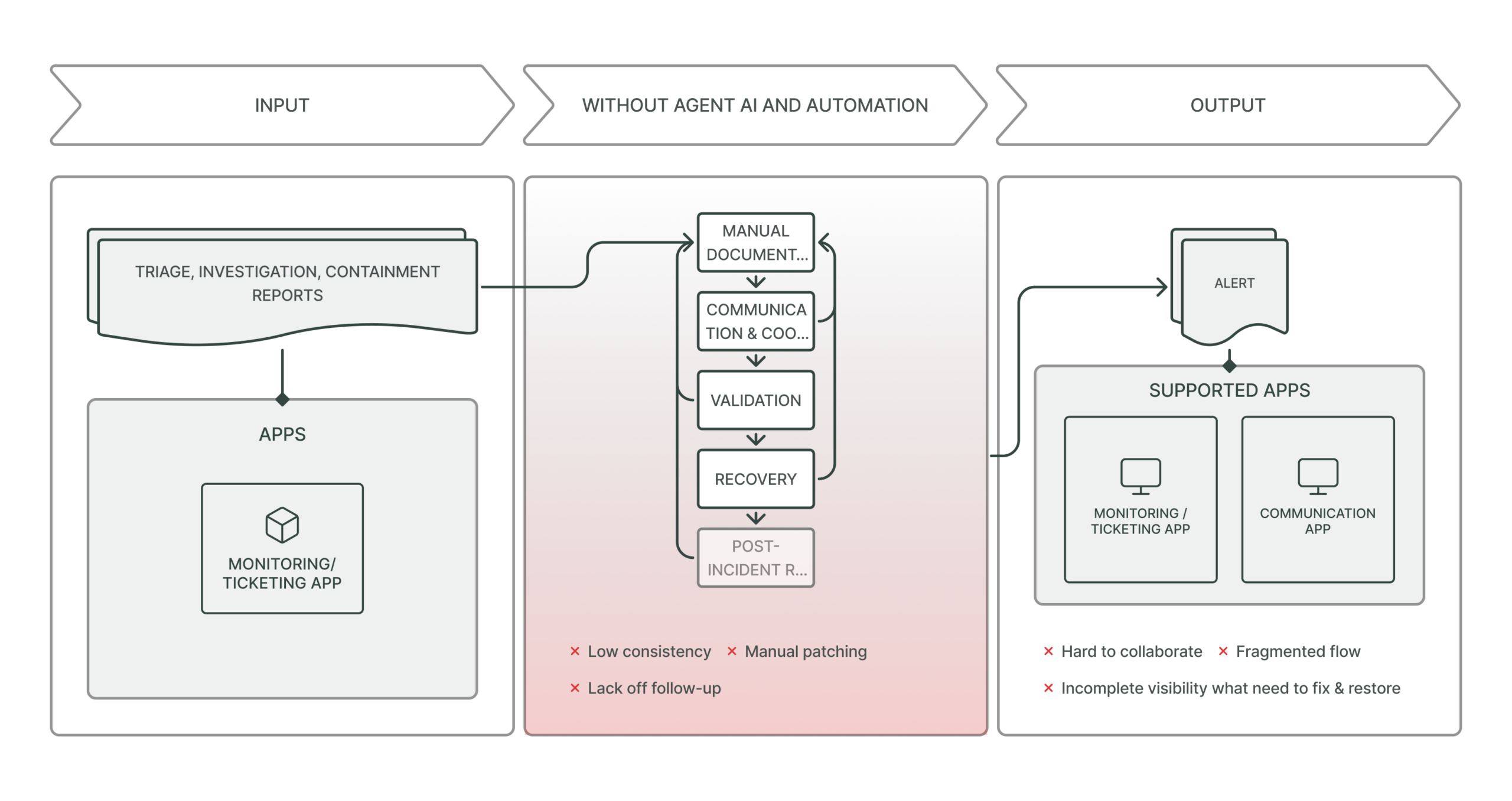
    Common Manual Remediation Workflow:

    • Alert generated by SIEM or endpoint detection tool
    • Analyst manually triages the alert
    • Investigation steps include log review, artifact analysis, and correlation with threat intel
    • Decision on response method (e.g., isolate endpoint, disable account, block IP)
    • Manual execution of containment and recovery actions
    • Documentation and communication through disparate tools

    The Problems:

    • High Mean Time To Detect (MTTD) and Mean Time To Respond (MTTR)
    • Alert fatigue and burnout among analysts
    • 80% of time wasted on false positives
    • Context switching across multiple apps and dashboards
    • Expensive staffing requirements for 24/7 coverage

    According to IBM’s Cost of a Data Breach Report, organizations that contain a breach in under 200 days save an average of $1.2 million. Yet manual workflows make this fast response nearly impossible.

    The Real-World Impact of Manual Remediation

    Case Study: The Cost of Delay

    Imagine a financial services company hit with a phishing-based credential theft. The alert is generated, but the analyst doesn’t respond for several hours due to a high workload. By the time the compromised account is disabled, threat actors have exfiltrated sensitive financial data and initiated fraudulent transactions. The aftermath? Regulatory fines, lost customer trust, and a six-figure financial hit.

    The Human Toll

    Security analysts face repetitive, high-stress tasks that rarely scale. Constant pressure to identify false positives, switch tools, and make high-stakes decisions quickly leads to:

    • Cognitive overload
    • Decision fatigue
    • High turnover rates

    Organizations are essentially burning out their most valuable defenders.

    Why Automation Is the Only Way Forward

    Manual remediation cannot keep pace with modern threats. Automation is no longer a luxury—it’s a strategic imperative.

    Key Advantages of Automated Remediation:

    • Speed: Automatically isolate infected endpoints, disable compromised accounts, and block malicious IPs in real time.
    • Scalability: A single automation playbook can handle thousands of alerts without additional headcount.
    • Accuracy: Reduces human error by relying on pre-tested workflows and logic.
    • Consistency: Ensures uniform responses across teams and time zones.
    • Integration: Connects with existing monitoring, ticketing, and communication tools to streamline operations.

    Enter Agentic-AI and Hyperautomation

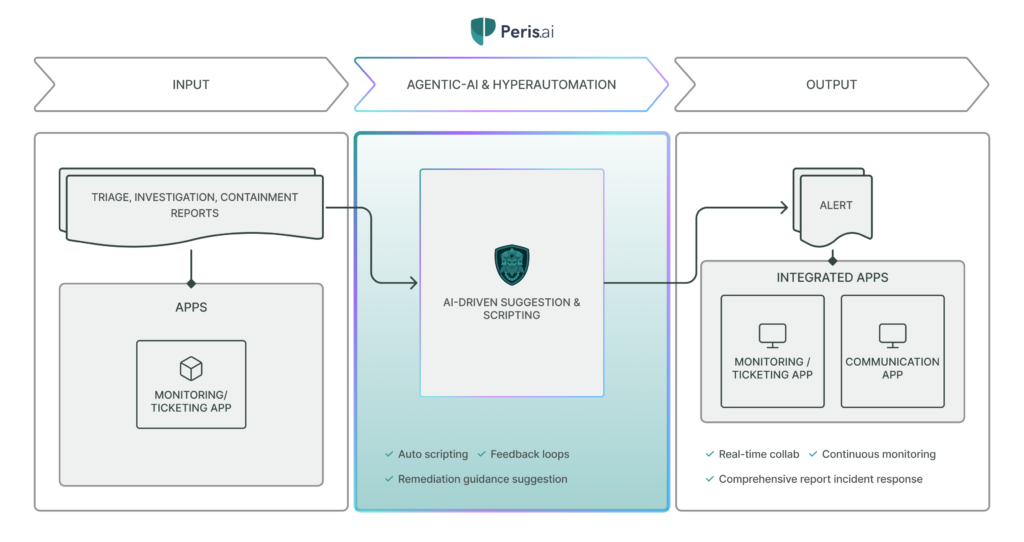
    Brahma Fusion by Peris.ai enables fast, precise, and automated investigation and remediation using Agentic-AI.

    Agentic-AI is the next evolution of automation. Unlike static playbooks, it mimics the cognitive workflow of human analysts and adapts to new threats in real-time.

    How It Works:

    1. Triage Reports are ingested and processed instantly.
    2. Deep Investigate Agent evaluates the root cause using: Threat Intelligence integration and Malware behavior analysis via sandboxing.
    3. Agent Tools auto-dismiss false positives and prioritize real threats.
    4. Automated Playbooks trigger remediation steps: Isolate affected devices, revoke session tokens, block malicious domains or IPs & notify stakeholders.
    5. Integrated Output is pushed into ticketing and communication systems for transparency.

    Key Outcomes:

    • 90% faster threat response
    • Near-zero missed alerts
    • Lower operational costs
    • Enhanced SOC analyst efficiency

    From Chaos to Control — A Side-by-Side Comparison

    Response Speed

    • Manual Remediation: Hours to days
    • Agentic-AI Remediation: Seconds to minutes

    Analyst Involvement

    • Manual Remediation: High
    • Agentic-AI Remediation: Minimal

    False Positive Impact

    • Manual Remediation: Very High
    • Agentic-AI Remediation: Auto-dismissed intelligently

    Tool Fragmentation

    • Manual Remediation: Severe
    • Agentic-AI Remediation: Fully integrated

    Scalability

    • Manual Remediation: Not scalable
    • Agentic-AI Remediation: Infinitely scalable

    MTTD/MTTR

    • Manual Remediation: Poor
    • Agentic-AI Remediation: Excellent

    Real Business Benefits

    Adopting automated remediation provides a measurable ROI:

    Financial:

    • Reduced breach cost and downtime
    • Lower personnel expenses
    • Less reliance on expensive incident response retainers

    Operational:

    • Consistent workflows across geographies
    • Streamlined compliance and audit trails
    • Easier onboarding of new analysts

    Strategic:

    • Free up analysts to focus on threat hunting
    • Boost resilience against complex attacks
    • Strengthen customer trust

    Conclusion: Automate or Get Left Behind

    The threat landscape is only getting faster, more complex, and more aggressive. Manual remediation is a relic of the past—an anchor that drags down your security posture and wastes your most valuable resource: time.

    It’s time to stop reacting and start anticipating. With Agentic-AI and hyperautomation, your organization can move from reactive firefighting to proactive defense.

    If you’re serious about securing your future, the path is clear:

    Automate. Optimize. Stay ahead.

    Ready to leave manual remediation behind? Visit https://www.peris.ai and discover how Brahma Fusion can transform your SOC into an AI-powered command center.

    #PerisAI #Cybersecurity #Hyperautomation #YouBuild #WeGuard

  • How Secure Is Your Password? A 2025 Cybersecurity Reality Check

    How Secure Is Your Password? A 2025 Cybersecurity Reality Check

    The massive RockYou2024 leak, exposing almost 10 billion passwords, might seem like a distant event. Yet, its repercussions continue to ripple through today’s digital world. The sheer volume of compromised credentials available online amplifies the risks of credential stuffing, identity theft, and unauthorized account access. If password reuse is still part of your daily habits, it’s time for a serious rethink. Ask yourself: How secure is your password really?

    Why Password Strength Isn’t Just “Nice to Have”—It’s Essential

    Weak passwords are often the lowest-hanging fruit for attackers. In an era where cyber threats evolve faster than ever, using “123456” or “password” isn’t just careless—it’s dangerous.

    Here’s why password strength matters:

    • Common passwords are cracked in seconds. Tools for brute-forcing are publicly available and frighteningly efficient.
    • Weak passwords multiply risk. Once hackers gain access to one of your accounts, they can often penetrate others using the same credentials.

    Creating strong, unique passwords for every account is not just good practice; it’s a non-negotiable defense line. It’s the cybersecurity equivalent of locking your front door — with reinforced steel instead of paper.

    The Most Hacked Passwords You Must Avoid (Seriously)

    Despite widespread awareness, millions still rely on ultra-weak passwords. These five culprits top the danger list:

    • 123456
    • 123456789
    • 12345678
    • password
    • Qwerty123

    If any of these look familiar, change them immediately. Reused or simple passwords are prime targets for automated hacking tools, putting your personal and professional life at risk.

    Password Strength Self-Check: 7 Essential Questions

    Evaluating your password strength takes only a minute but could save you from a future breach. Score 1 point for every “yes” below:

    • Is it at least 12 characters long?
    • Does it mix upper and lowercase letters?
    • Are numbers included?
    • Are special symbols used (!, @, #, etc.)?
    • Is the password unique to this account?
    • Does it avoid personal information like birthdays?
    • Has it been updated within the last 90 days?

    Scoring:

    • 0–2 Points: Extremely vulnerable. Immediate update required.
    • 3–4 Points: ⚠️ Exposed to moderate risk. Time for an upgrade.
    • 5–6 Points: Solid effort. Small improvements needed.
    • 7 Points: Cybersecure! Keep up the discipline.

    Strong passwords form the first—and often best—barrier between your data and cybercriminals.

    What to Do If Your Passwords Are Weak

    Finding out your passwords aren’t strong enough isn’t a reason to panic—it’s an opportunity to strengthen your defenses.

    Here’s your action plan:

    • Manually Create Strong Passwords Build passwords of 12+ characters, using upper/lowercase letters, numbers, and special characters. Avoid any names, birthdays, or easy-to-guess patterns.
    • Enable Two-Factor Authentication (2FA) Adding an extra verification step significantly reduces the chance of account compromise, even if your password is leaked.
    • Use a Password Generator Instead of trying to invent complex passwords yourself, use a password generator. These tools instantly produce random, highly secure combinations that are far stronger than anything humans typically create.

    Password Managers: Your Secret Weapon for Digital Safety

    Handling dozens of unique, complex passwords can feel overwhelming—that’s where password managers shine. A good password manager:

    • Creates unbreakable passwords instantly.
    • Stores and encrypts your credentials securely.
    • Auto-fills login details, saving time and reducing errors.
    • Monitors for data breaches and alerts you if your information is compromised.
    • Organizes everything neatly across all your devices.

    Instead of relying on memory or insecure spreadsheets, password managers streamline and protect your access across platforms—making cybersecurity easier and smarter.

    Conclusion: Protect Your Digital Identity Now

    One compromised password can undo years of personal and professional progress. But strengthening your security isn’t complex—it starts with taking control of your credentials.

    Here’s your next step checklist:

    • Audit your current passwords.
    • Replace weak ones with strong, unique passwords.
    • Implement a trusted password manager.
    • Activate 2FA wherever available.
    • Stay vigilant against new threats.

    At Peris.ai Cybersecurity, we believe digital safety starts at the human layer—with proactive habits that outsmart evolving threats.

    Visit peris.ai to explore our cybersecurity solutions, expert tips, and how we help individuals and organizations build digital resilience every day.

    #Cybersecurity #PasswordSecurity #DataProtection #CyberAwareness #StayProtected #DigitalDefense #YouBuild #WeGuard

  • Containment Bottlenecks: Why Most Breaches Escalate Before You Can Act

    Containment Bottlenecks: Why Most Breaches Escalate Before You Can Act

    In today’s cybersecurity landscape, organizations are investing heavily in detection systems. SIEMs, EDRs, NDRs, and advanced threat intelligence platforms promise to identify malicious activity as soon as it occurs. But even with this digital arsenal, breaches continue to happen. Why?

    Because detection alone is not enough. The real issue lies in what happens after detection: containment. And in most organizations, containment is where everything falls apart.

    This article explores one of the most overlooked vulnerabilities in modern cybersecurity operations: the delay between when a threat is detected and when it is actually contained. We’ll uncover the root causes of these containment bottlenecks, their real-world consequences, and how to fix them with intelligent automation.

    The Anatomy of Containment Bottlenecks

    1. Alert Fatigue and Prioritization Paralysis

    Security analysts are inundated with alerts every day. Studies show that over 80% of alerts are false positives. SOC teams spend countless hours triaging, correlating, and validating these alerts. In the meantime, real threats are buried in the noise.

    Even when a high-priority alert is recognized, determining the scope and severity of the incident takes time. Analysts must:

    • Review event logs
    • Correlate telemetry across tools
    • Investigate anomalies manually
    • Verify whether the alert is actionable

    This “detection-to-decision” gap is the first and most dangerous bottleneck.

    2. Fragmented Security Tools

    In many organizations, the tools used for detection, investigation, and containment are not integrated. An analyst may need to:

    • Investigate in the SIEM
    • Validate in an EDR console
    • Raise a ticket in a case management system
    • Send messages through Slack or email

    Each handoff introduces delay. Each manual step increases the chance for error or oversight.

    3. Manual Containment Is Too Slow

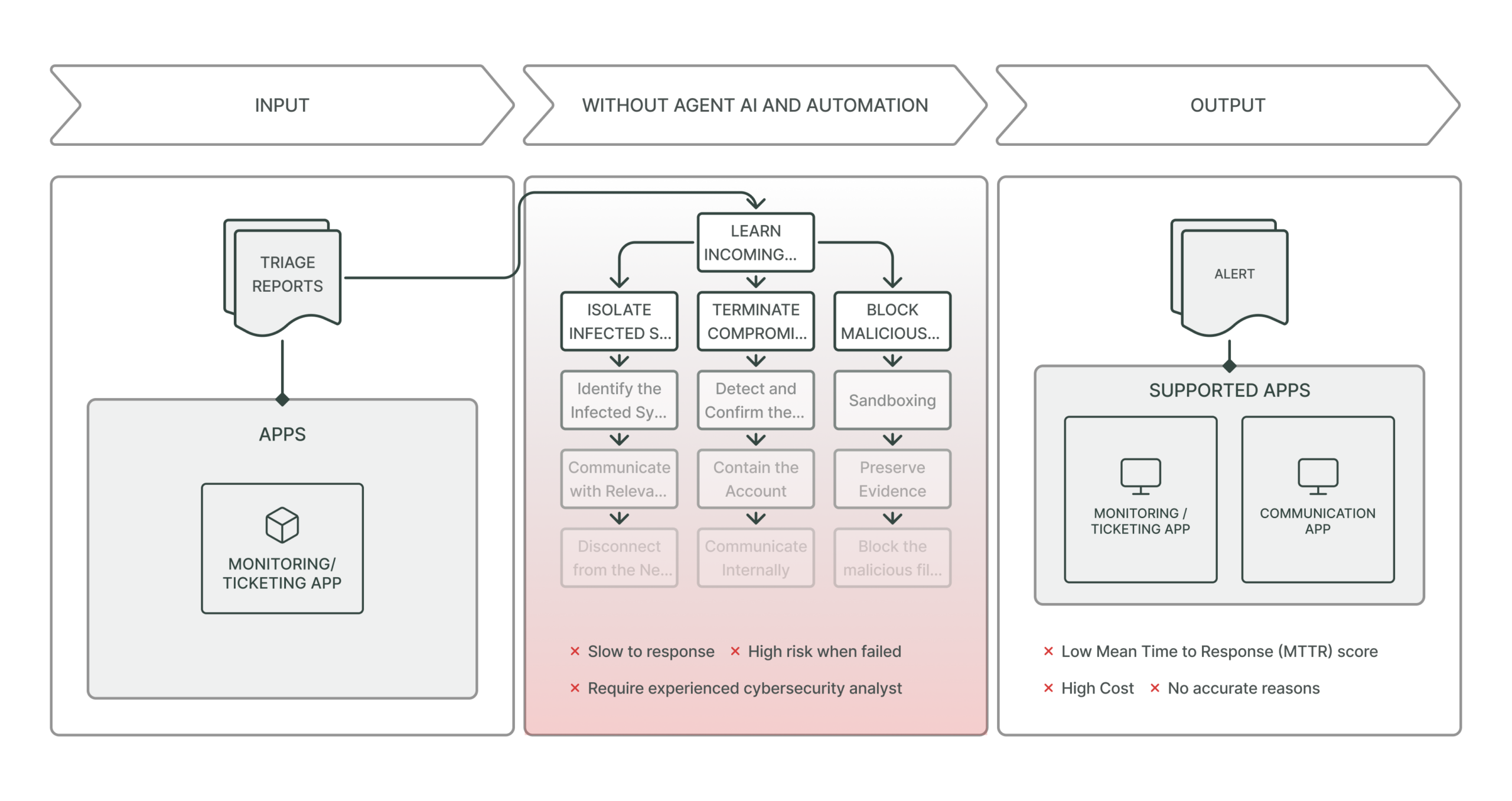
    Once a threat is confirmed, actions like isolating a system, disabling a user, or blocking a domain still require human intervention. The process typically involves:

    • Identifying the correct system or user
    • Communicating with stakeholders
    • Executing the action in the respective tool
    • Logging the incident and reporting the action

    These actions, when done manually, can take minutes to hours. In the time it takes to isolate a compromised device, malware could already have moved laterally across the network.

    4. Lack of Contextual Awareness

    Most SOC tools do not provide automated context about:

    • Who owns the compromised asset
    • What business process it supports
    • Whether it’s part of a critical application or system

    This lack of visibility creates hesitation. Security teams delay containment out of fear they might disrupt core operations, leading to escalated breaches.

    Real-World Consequences of Containment Delay

    • Ransomware Spreading Laterally: A single uncontained endpoint becomes a gateway for network-wide encryption.
    • Credential Stuffing Escalation: Delay in disabling compromised accounts results in unauthorized access to sensitive systems.
    • Data Exfiltration: Even seconds matter when a threat actor is actively stealing files. The longer the delay, the higher the data loss.
    • Brand Damage: News spreads fast. The public often learns of the breach before the internal team contains it.

    These scenarios are not hypothetical. They happen every day.

    Brahma Fusion by Peris.ai empowers SOCs with Agentic-AI and Hyperautomation to isolate threats instantly, reducing MTTR and breach risk.
    Brahma Fusion by Peris.ai empowers SOCs with Agentic-AI and Hyperautomation to isolate threats instantly, reducing MTTR and breach risk.

    The Way Forward: Intelligent, Automated Containment

    To fix containment bottlenecks, organizations must shift from manual containment to AI-driven hyperautomation. This involves:

    1. Introducing Agentic-AI in the SOC

    Agentic-AI systems are not just reactive. They actively learn from past incidents, adapt containment strategies, and make autonomous decisions in real time. This enables:

    • Instant detection-to-decision transitions
    • Autonomous triggering of response actions
    • Continuous optimization of playbooks

    2. Automated Playbook Execution

    Hyperautomation allows organizations to:

    • Automatically isolate endpoints once indicators match known threats
    • Disable user accounts based on behavior anomalies
    • Block domains or IPs across firewall, DNS, and proxy layers

    With minimal analyst input, containment becomes fast, consistent, and precise.

    3. Real-Time Contextual Awareness

    Solutions like Brahma Fusion integrate with business asset inventories, HR systems, and application dependency maps. This gives automated systems the confidence to:

    • Understand the business impact of containment
    • Prioritize assets based on criticality
    • Contain threats with reduced risk of operational disruption

    4. Unified Dashboards and Orchestration

    Instead of managing 5-10 separate tools, analysts can operate from a single pane of glass where:

    • Alerts are enriched automatically
    • Recommended actions are generated and executed
    • Full audit trails are logged

    This orchestration removes the friction of human handoffs and enables rapid containment at scale.

    Business Impact: Why Faster Containment Matters

    Reduced MTTR (Mean Time to Respond)

    • From hours to seconds
    • Improves threat containment before lateral movement occurs

    Lower Operational Costs

    • Fewer resources needed to manage incident response
    • Less downtime due to proactive isolation

    Enhanced Analyst Productivity

    • Analysts focus on strategic analysis instead of manual tasks
    • Reduced burnout and turnover

    Better Compliance and Audit Readiness

    • All containment actions are logged and justified
    • Reports are generated automatically for regulators

    Stronger Security Posture

    • Confidence in stopping breaches before they escalate
    • Demonstrated resilience to board members and stakeholders

    Final Thoughts: Containment Is the New Battleground

    As attackers become faster, stealthier, and more sophisticated, the old way of doing things simply doesn’t work. Companies can no longer afford to rely on manual processes and fragmented tools when every second counts.

    Containment is no longer just a technical task. It’s a strategic capability.

    Agentic-AI and hyperautomation aren’t just buzzwords—they are the only way forward.

    Platforms like Brahma Fusion by Peris.ai are proving that automated, intelligent containment is not only possible, but essential. With the ability to respond in real time, orchestrate actions across environments, and adapt over time, organizations can finally stop breaches before they spread.

    Learn More

    Explore how Brahma Fusion can help your organization accelerate containment, reduce risk, and build a truly modern SOC: Visit www.peris.ai

    #ContainmentAutomation #SOCTransformation #AgenticAI #BrahmaFusion #PerisAI #Cybersecurity #YouBuild #WeGuard

  • 80% False Positives, 0% Efficiency: The Real Problem Behind Alert Fatigue

    80% False Positives, 0% Efficiency: The Real Problem Behind Alert Fatigue

    In the modern cybersecurity landscape, organizations are investing more than ever in threat detection systems, yet breaches still happen — and often, they’re missed because the alert was there, but it got buried in the noise. This noise, largely composed of false positives, is at the heart of what’s known as alert fatigue.

    Security analysts are inundated daily with thousands of alerts. Yet, studies and field evidence suggest that up to 80% of these alerts are false positives — non-malicious events wrongly flagged as threats. These distractions not only waste time and resources, but also create dangerous blind spots where real threats slip through.

    This article dives deep into the true cost of alert fatigue — from analyst burnout to organizational risk — and explores the path forward with intelligent automation.

    The Anatomy of Alert Fatigue

    1. What Is Alert Fatigue?

    Alert fatigue occurs when security teams become desensitized to the overwhelming number of incoming alerts. With so many notifications — most of which are false or low-priority — it becomes nearly impossible to distinguish between genuine threats and background noise.

    2. Causes of Alert Fatigue

    • Excessive False Positives: Misconfigured tools or conservative detection thresholds.
    • Lack of Context: Alerts lacking actionable insights or threat correlation.
    • Siloed Tools: Disconnected systems force analysts to switch contexts frequently.
    • Manual Investigation: Human-only triage is slow, repetitive, and error-prone.

    3. Daily Impact on Analysts

    • Spending hours reviewing non-threat alerts
    • Increasing mental fatigue and cognitive load
    • Missing critical alerts due to information overload
    • Delayed incident response and elevated MTTD (Mean Time To Detect)

    Business Impact: The High Price of Noise

    1. Decreased SOC Efficiency

    Organizations think they’re investing in better security, but without automation, the manual triage model can’t scale. With 80% of alerts being false, the value of your security operations center (SOC) drops dramatically.

    2. Analyst Burnout & Attrition

    SOC analysts are burning out faster than ever. The psychological toll of constant firefighting, long hours, and lack of progress leads to high turnover, which further weakens security postures.

    3. Missed Real Threats

    False positives cause real threats to be ignored. Cyber attackers often hide in the noise, knowing that an overworked SOC team might never catch the anomaly.

    4. Operational Costs

    The financial impact is enormous:

    • Wasted man-hours on non-issues
    • Cost of breach due to missed real alerts
    • Hiring/training new analysts due to turnover
    • Productivity loss from internal investigations

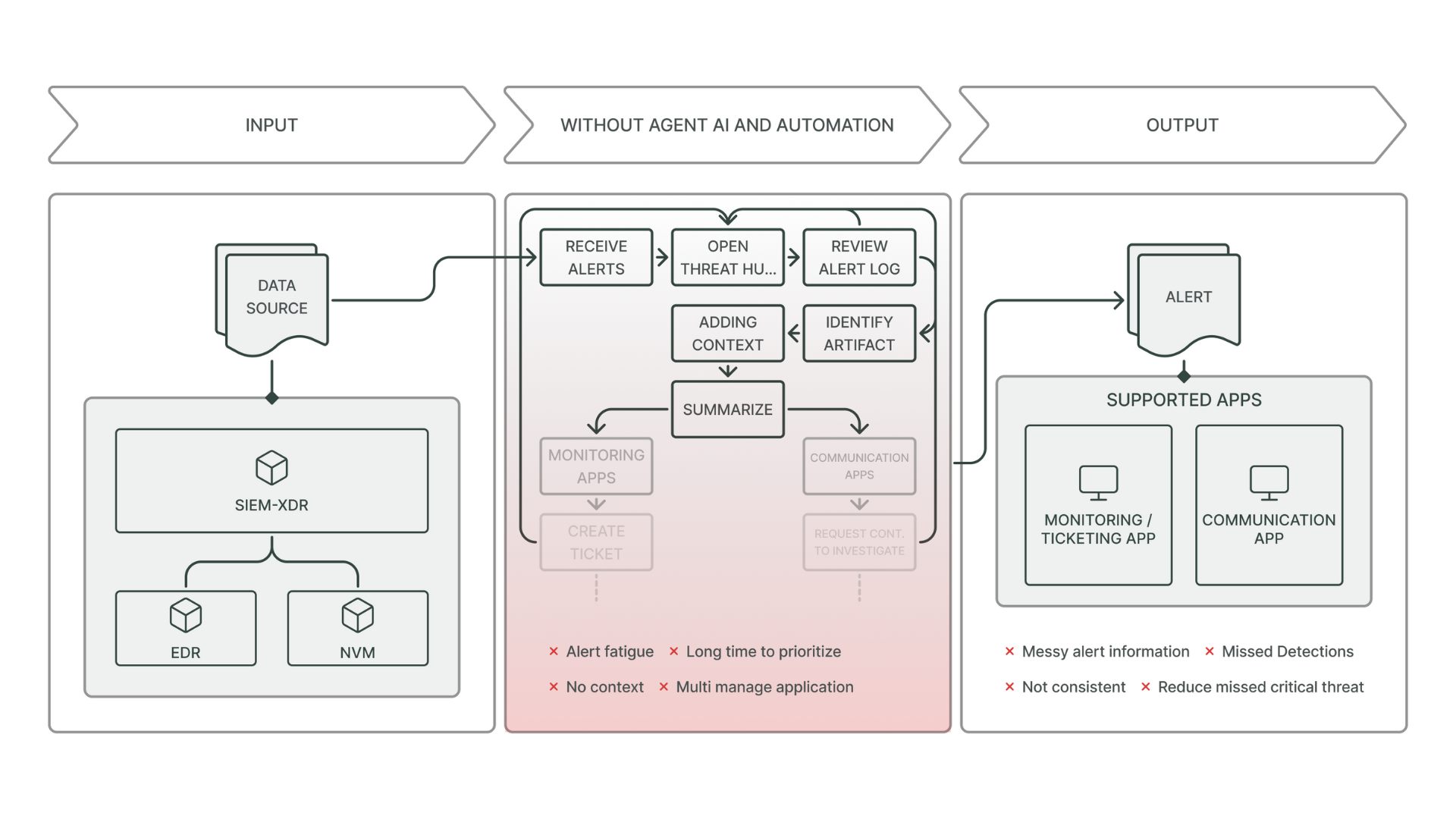
    Manual SOC Investigation Workflow: A Breakdown

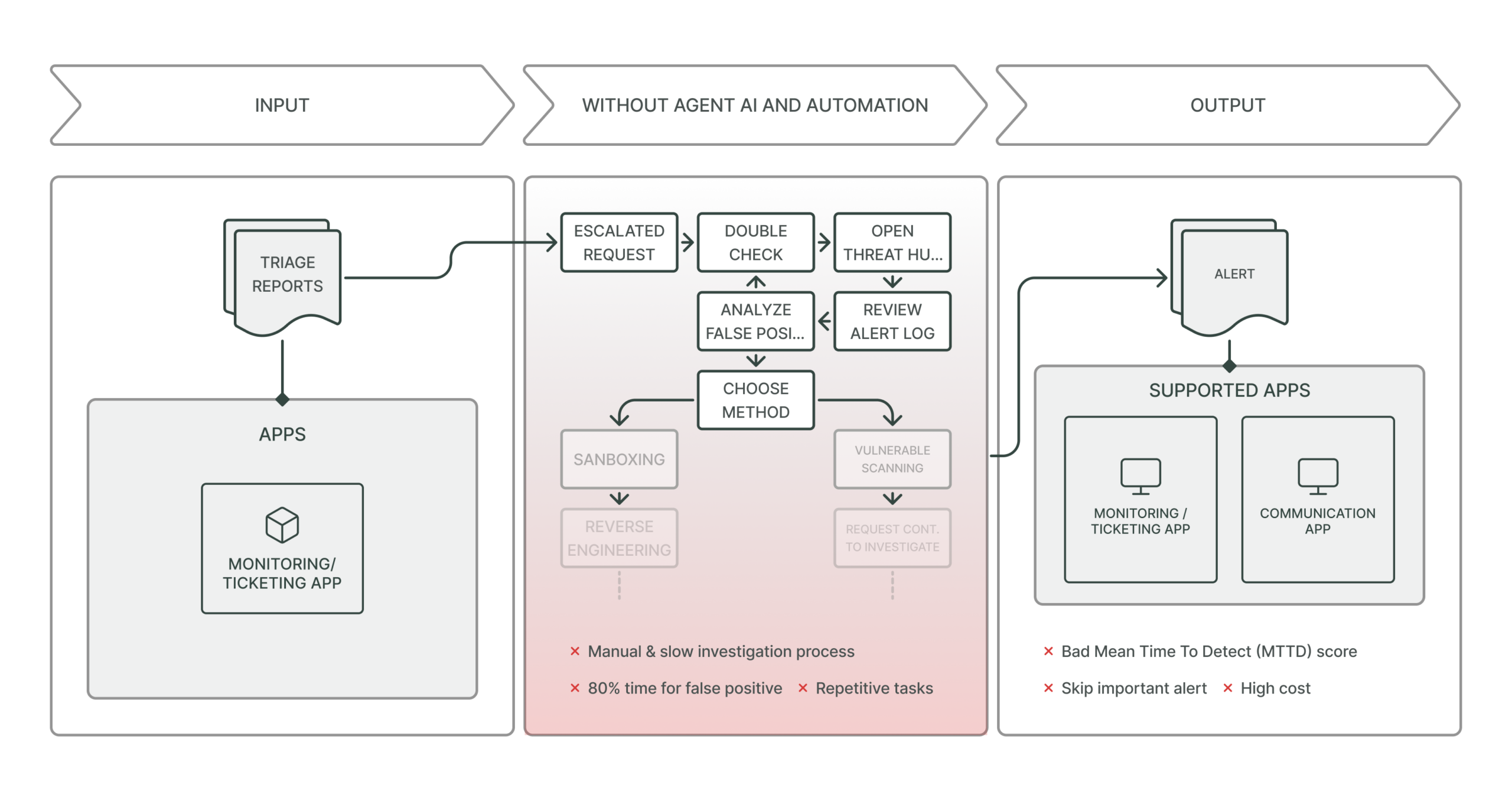
    Let’s visualize how manual investigation slows down response times and increases burnout.

    disjointed investigation workflows leading to analyst overload and missed threats
    Disjointed investigation workflows leading to analyst overload and missed threats

    Highlights from the image:

    • Triage Reports enter manually into apps
    • Analysts escalate and double-check each alert
    • Tools used in isolation: sandboxing, reverse engineering, threat hunting
    • Result: delayed detection, alert fatigue, high cost, missed threats

    This model simply doesn’t scale.

    Reframing the Solution: Agentic-AI and Hyperautomation

    The solution isn’t more tools — it’s better coordination and intelligence across your SOC workflow. Here’s where Agentic-AI and hyperautomation come in.

    Enter Brahma Fusion: Intelligent Investigation, Not More Alerts

    AI-powered investigation flow using Deep Investigate agents and automated threat intelligence tools

    What This Image Shows:

    • Same Triage Report input
    • AI-driven “Deep Investigate” module
    • Agent Tools: Threat Intelligence Apps & Malware Lab
    • Integrated apps for seamless alert output
    • Results: auto-dismiss false positives, reduce cost, faster detection

    How Agentic-AI Works:

    1. Dynamic Triage Paths

    AI agents mimic seasoned analysts by asking investigative questions, mapping relationships, and tracing anomalies.

    2. Threat Contextualization

    Cross-correlates internal logs with global threat intel to enrich alerts with deeper context.

    3. Auto-Dismiss False Positives

    Learns patterns and behaviors to suppress known benign activities, reducing noise.

    4. Human-In-The-Loop Optionality

    Analysts can supervise, confirm, or fine-tune AI decisions — blending speed with control.

    Tangible Benefits for the Organization

    1. Drastic MTTD Reduction

    Organizations using Agentic-AI solutions have reported up to 75% reduction in Mean Time To Detect.

    2. Analyst Empowerment

    Less burnout, better tooling, and more rewarding work keep your top talent engaged.

    3. Reduced Costs

    By cutting time spent on non-threats, orgs reallocate human effort to real risk response.

    4. Better Security Outcomes

    More real threats are caught early, reducing breach risk and financial losses.

    Conclusion: Cut Through the Noise Before It Cuts Into You

    The cybersecurity war isn’t just fought with firewalls and threat intel — it’s won with clarity. And right now, most organizations are drowning in alert noise. Alert fatigue isn’t just an IT problem — it’s a business risk.

    By shifting to intelligent, hyperautomated platforms like Brahma Fusion, you can eliminate the noise, protect your team, and gain the clarity your organization needs to stay secure.

    It’s not about seeing every alert. It’s about seeing the right ones — instantly.

    Explore how Peris.ai can help your SOC cut false positives, boost efficiency, and stop real threats faster. Visit www.peris.ai

  • The Risk You Don’t See: Inconsistent Alert Triage Is a Breach Waiting to Happen

    The Risk You Don’t See: Inconsistent Alert Triage Is a Breach Waiting to Happen

    Cybersecurity is no longer just about whether an organization will face threats—it’s about how quickly and effectively it can detect and respond to them. At the core of this defensive capability is one critical process: triage. Yet, in many Security Operations Centers (SOCs), triage remains inconsistent, reactive, and dangerously manual.

    Inconsistent alert triage is a silent vulnerability. While it doesn’t always make headlines like a data breach or ransomware attack, it sets the stage for these crises. Without a structured, context-aware system, even the most advanced tools can fail to deliver clarity, leaving even experienced analysts struggling to prioritize threats effectively.

    The Hidden Dangers of Inconsistent Triage

    Modern enterprises are hyper-connected ecosystems, continuously generating massive amounts of data. Within this data lie critical indicators of compromise—subtle signs of malicious activity that often appear as fragmented alerts.

    Key risks of inconsistent triage include:

    • Overwhelming Alert Volumes: Analysts must manually navigate multiple platforms (SIEMs, endpoint detection tools, network monitors, ticketing systems), creating confusion and delays.
    • Lack of Context: Alerts are frequently ambiguous, lacking sufficient context to determine urgency effectively.
    • Equal Priority for All Alerts: Traditional systems fail to assess risk contextually, forcing analysts to treat all alerts with equal urgency, regardless of their true threat level.
    • Wasted Time on False Positives: Hours spent investigating benign alerts allow genuine threats to go unnoticed, giving adversaries valuable time to act.
    • Strategic Vulnerability: Time lost isn’t just operational inefficiency—it represents strategic opportunities granted to attackers.

    The Breakdown of Manual Defense

    Manual triage creates isolated islands of information. Threat intelligence often remains detached from real-time detection. Playbooks are static, rigidly applied to dynamic threats. Analyst decisions become overly dependent on personal experience rather than systemic intelligence. This fragmentation leads to gaps that widen with every new alert.

    Human fatigue compounds the problem. Constant vigilance required for alert triage—without automation—leads inevitably to cognitive overload. Critical signals are missed, investigations stall, and overlooked alerts become breaches waiting to happen.

    Rethinking Triage with Brahma Fusion

    To break this cycle, organizations must reimagine triage not as a task but as an intelligent system—driven by intent, enriched by data, and empowered by continuous learning. This is precisely where Brahma Fusion by Peris.ai changes the game.

    Brahma Fusion is more than an orchestration platform; it’s an intelligent decision engine designed to interpret, analyze, and act upon alerts. With Agentic-AI at its core, Brahma Fusion processes every alert with deep contextual awareness. It understands relationships between events, extracts artifacts, assesses intent, and scores alerts based on actual impact, not theoretical severity.

    Intelligent Triage with Brahma Fusion

    Brahma Fusion Solution
    Brahma Fusion automates enrichment, scoring, and escalation—giving security teams clarity instead of chaos

    Brahma Fusion turns reactive responses into proactive defenses. It groups related alerts into coherent incidents, filters noise effectively, and presents analysts with high-confidence, fully contextualized threats. Brahma Fusion integrates seamlessly with existing tools—SIEMs, EDR, NVM, and others—to unify views and eliminate information silos.

    The transformation goes beyond speed. Analysts shift roles from reactive log-chasers to strategic defenders, containing threats before they escalate. Decisions become informed and precise rather than speculative.

    Beyond Efficiency: A Strategic Shift in Cyber Defense

    Security today requires more than coverage—it demands precision. With Brahma Fusion, organizations can:

    • Surface the most critical threats immediately.
    • Automate the entire detection-to-response pipeline.
    • Scale their SOC without endlessly hiring.
    • Maintain operational clarity during complex incidents.

    This approach isn’t about replacing human analysts—it’s about empowering them. Brahma Fusion provides analysts the time, context, and confidence to focus strategically, while automation handles routine noise.

    Conclusion: Seeing the Risk Before It Strikes

    The greatest risk isn’t the alert you can see—it’s the one you overlook. Inconsistent triage creates blind spots, delays action, and exposes businesses to avoidable threats.

    With Brahma Fusion, triage becomes a force multiplier, transforming alert chaos into actionable insight and reactive firefighting into intelligent orchestration. When the next threat emerges, your team will already be ahead.

    It’s time to see clearly. It’s time to triage intelligently.

    Explore how Brahma Fusion strengthens your defenses at peris.ai

  • Zero-Day Threats Are Real: What Netflix’s Zero Day Doesn’t Exaggerate

    Zero-Day Threats Are Real: What Netflix’s Zero Day Doesn’t Exaggerate

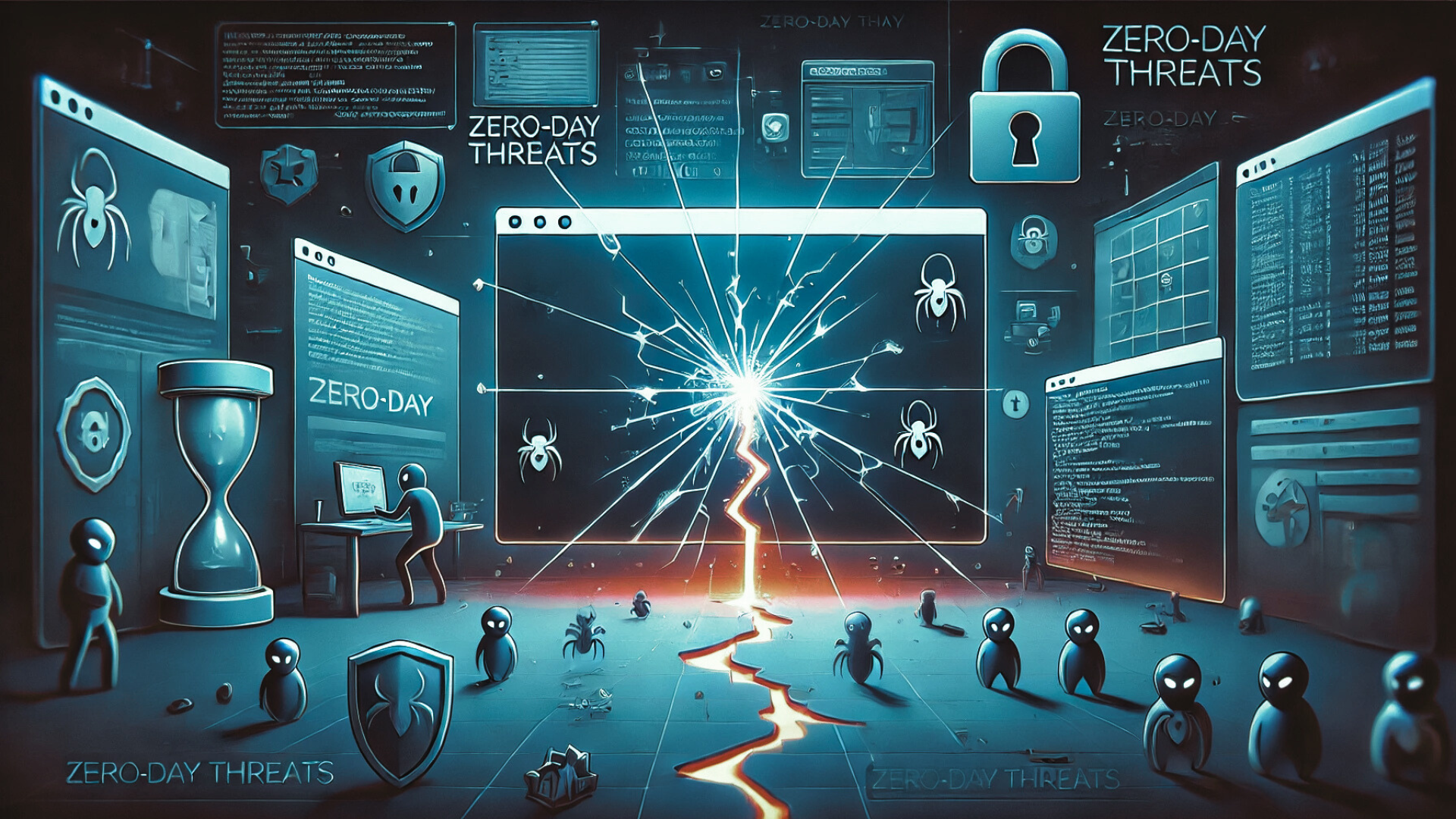
    Netflix’s Zero Day may feel like a gripping cyber-thriller, but the risks it highlights aren’t fiction. Zero-day vulnerabilities—unknown software flaws that hackers exploit before a patch exists—pose serious threats to everything from personal devices to national infrastructure.

    At Peris.ai Cybersecurity, we believe awareness is your first line of defense. Here’s what you need to know and how you can take action.

    ⚠️ What Is a Zero-Day Vulnerability?

    A zero-day flaw is a hidden security hole in software or hardware—discovered and exploited by attackers before the vendor knows it exists. Since there’s “zero” time to patch, threat actors can silently infiltrate systems, steal data, or deploy malware without detection.

    Real-World Zero-Day Attacks That Made Headlines

    • Stuxnet (2010): Targeted Iranian nuclear systems using multiple zero-day exploits
    • WannaCry (2017): Paralyzed hospitals and businesses worldwide with ransomware
    • Pegasus (2023): Used a zero-day in iMessage to spy on users via zero-click attacks
    • Kaseya (2021): A supply chain attack that spread ransomware through an IT management tool

    These weren’t just isolated cases—they caused global disruption, proving how serious zero-days can be.

    How You Can Protect Yourself from Zero-Day Threats

    You can’t always predict a zero-day, but you can make it harder for attackers to succeed. Here’s how:

    • Enable Automatic Updates: Patch software as soon as fixes are available. Delay gives attackers time.
    • Use Advanced Security Tools: Behavioral-based antivirus solutions catch unusual activity, not just known viruses.
    • Think Before You Click: Many zero-day attacks begin with a phishing email or a malicious link.
    • Turn on 2FA: Two-factor authentication protects your accounts even if passwords are stolen.
    • Back Up Data Frequently: Ransomware can lock you out—backups help you bounce back.
    • Avoid Suspicious Downloads: Only install software from trusted, official sources.

    What Zero Day Got Right—and Why It Matters

    While dramatized, Zero Day shines a spotlight on real threats. Critical systems like healthcare, energy, and finance are vulnerable. These aren’t just IT problems—they’re national and personal security risks.

    Your everyday decisions—whether you update your phone, enable 2FA, or click suspicious links—can make or break your defense.

    ✅ Final Word: Awareness + Action = Protection

    Zero-day threats are invisible, fast-moving, and increasingly common. But you don’t need to be defenseless. With the right tools, habits, and awareness, you can stay one step ahead.

    Visit Peris.ai to explore next-gen cybersecurity tools, real-time threat intelligence, and strategies to safeguard your data.

    #PerisAI #Cybersecurity #YouBuild #WeGuard Let’s secure your digital life—before the next zero day strikes.

  • How to Conduct an Access Control Audit: Key Metrics to Track

    How to Conduct an Access Control Audit: Key Metrics to Track

    In today’s digital-first environment, securing access to critical data and systems is a top priority for any organization. One of the most effective ways to protect sensitive information is by conducting a comprehensive access control audit. This process ensures that user permissions align with job roles, regulatory requirements are met, and security risks are minimized. At Peris.ai Cybersecurity, we emphasize the importance of proactive audits to bolster identity and access management (IAM) strategies.

    Understanding the Purpose of an Access Control Audit

    An access control audit is a structured evaluation of who has access to what within an organization’s IT ecosystem. It involves assessing user accounts, permissions, authentication mechanisms, and privileged roles to ensure compliance, eliminate risks, and reinforce internal controls. Rather than being a one-time activity, these audits should be integrated into an ongoing risk management program.

    Key goals include:

    • Verifying user permissions against current job responsibilities
    • Identifying orphaned or inactive accounts
    • Ensuring compliance with standards like ISO 27001, GDPR, and HIPAA
    • Detecting anomalies in access patterns

    Why Regular Reviews Are Critical

    Access rights can quickly become outdated as employees change roles, leave the organization, or gain unnecessary privileges over time. Regular reviews:

    • Prevent privilege creep by enforcing the principle of least privilege
    • Improve visibility into who has access to sensitive systems
    • Support operational efficiency through role-based access control (RBAC)

    Organizations that neglect this step risk not only security breaches but also regulatory penalties.

    Key Metrics to Track During an Audit

    To conduct an effective audit, monitoring the following metrics is crucial:

    • Authentication Success and Failure Rates: High failure rates may signal unauthorized access attempts or usability issues.
    • Number of Privileged Accounts: A high count of admin-level accounts increases your attack surface.
    • Inactive and Orphaned Accounts: Dormant accounts present unnecessary risk if not removed promptly.
    • Password Reset Requests: Frequent reset requests could highlight password fatigue or poor password policy.
    • Time to Provision/Deprovision Access: Delays in onboarding and offboarding users can lead to access inconsistencies.

    Steps to Conduct a Robust Access Audit

    1. Define Objectives and Scope
    2. Collect and Analyze Access Data
    3. Evaluate Access Against Role Requirements
    4. Detect Anomalies
    5. Implement Corrective Actions
    6. Document and Report

    IAM Tools That Support Auditing

    Modern cybersecurity frameworks rely on IAM tools that streamline the audit process:

    • Automated Reporting Dashboards for tracking access logs and audit results
    • Privileged Access Management (PAM) for managing elevated permissions
    • Role-Based Access Controls (RBAC) to align user access with roles
    • Multi-Factor Authentication (MFA) to enhance login security

    These tools allow teams to scale their auditing processes while maintaining accuracy and consistency.

    Addressing Access in Hybrid and Cloud Environments

    As organizations adopt hybrid and multi-cloud infrastructures, it becomes even more essential to apply consistent access policies across environments. Ensure your audit includes:

    • Cloud access logs (e.g., from AWS, Azure)
    • Integration of on-prem and cloud IAM systems
    • Centralized control panels for unified visibility

    Preparing Teams for Access Reviews

    Employee involvement is a key factor in successful audits. Educate teams on the importance of:

    • Adhering to the least privilege principle
    • Reporting access issues or suspicious activity
    • Following secure password practices and MFA usage

    Regular training improves both compliance and cybersecurity awareness across departments.

    Enhancing Security Through Continuous Monitoring

    An audit shouldn’t be a reactive task. Real-time monitoring of user activity can serve as an early warning system for potential threats. Implementing threshold alerts, session timeouts, and anomaly detection can significantly enhance your access control framework.

    Final Thoughts: Make Audits a Core Part of Cyber Hygiene

    Conducting regular access control audits is a foundational practice for any cybersecurity strategy. They reinforce trust, safeguard sensitive information, and help maintain compliance in a rapidly changing threat landscape.

    Take proactive steps today. At Peris.ai Cybersecurity, we help organizations build secure, auditable, and automated IAM systems. Whether you’re managing a growing team or securing hybrid environments, we offer real-time insights and advanced tools tailored to your access control needs.

    Learn more about improving your access control audits at Peris.ai.