In today’s rapidly evolving digital world, cyber threats are no longer a question of “if”—but “when.” Businesses must stay ready with a structured incident response plan to avoid operational disruptions and reputational damage. Without preparation, organizations risk prolonged downtime, data loss, and missed opportunities.
Why Cyber Resilience Matters
A cyber incident can compromise systems, leak sensitive data, or halt business operations. These crises are complex, often involving external attacks or internal mistakes. Quick response and clear processes are critical to minimize damage.
Key reasons to improve your incident response:
Reduce system downtime and business disruption
Safeguard sensitive information
Maintain client and stakeholder trust
Ensure regulatory compliance
Strengthen long-term cybersecurity posture
What Makes an Effective Response Plan?
An incident response plan outlines how your team detects, contains, and recovers from cyber threats. It’s not just about technology—it’s about communication, accountability, and practice.
Components of a Strong Plan:
Defined Roles & Responsibilities: Assign who does what before an incident occurs
Clear Communication Protocols: Internal alignment and external transparency
Response Team Readiness: Technical experts, legal advisors, and trained spokespeople
Regular Testing & Drills: Simulations help uncover gaps and sharpen response times
Post-Incident Review: Lessons learned are fuel for continuous improvement
Common Threats to Watch For
Understanding the types of cyber threats can help your team respond faster and more effectively:
Phishing and Social Engineering
Malware and Ransomware
Insider Misuse or Negligence
DDoS Attacks
Credential Theft or Account Compromise
Each threat demands a tailored approach. Organizations that continuously evaluate their defenses are better prepared to act swiftly.
Communication Is Everything
In the middle of a cyber crisis, information flows fast—and misinformation spreads faster. A predefined communication strategy is essential for internal coordination and public reassurance.
Best Practices:
Use approved messaging templates
Designate a trained media spokesperson
Align crisis messaging across platforms
Regularly audit and improve communication channels
Evaluate and Improve Your Readiness
How quickly could your team respond to a breach today? Without regular assessments, it’s impossible to know.
✅ Key practices for readiness:
Conduct incident simulations
Benchmark response times
Align risk strategy with business priorities
Perform access reviews and threat hunting
The best response plans evolve. Incident response isn’t a checklist—it’s a living process that improves with experience and reflection.
Don’t Go It Alone: Partner with Experts
Internal teams may be limited by time, tools, or expertise. Working with cybersecurity partners like Peris.ai can strengthen your response capabilities, enhance monitoring, and reduce time to recovery.
A proactive, tested, and well-communicated incident response plan could be the difference between recovery and crisis. The time to prepare isn’t when a breach happens—it’s now.
Ready to build a stronger incident response strategy?
Visit Peris.ai to access expert insights, real-time threat defense solutions, and strategic support tailored to your business.
Security Operations Centers (SOCs) today face a critical overload of data. Modern organizations rely on multiple cybersecurity tools—XDR for detection, EDR for endpoint telemetry, and NVM for deep network visibility. Each produces floods of alerts, logs, and indicators.
Yet these systems rarely speak the same language.
Most case management relies on disjointed dashboards, spreadsheet tracking, and generic SIEM alerts. The result? Security teams waste time switching tools, correlating alerts manually, and duplicating investigations. These fragmented workflows weaken your response and overburden your analysts.
SOC automation isn’t just a luxury—it’s a survival strategy.
How Poor Case Management Hurts Your SOC Efficiency and Security
Fragmented Workflows
Different tools for every security layer:
EDR handles endpoint behavior
NVM monitors traffic anomalies
XDR correlates user activity
Cloud and SaaS logs pile on separately
But they don’t unify incident tracking, triage, or collaboration.
No Unified Incident View
Analysts are forced to manually correlate:
IPs in NVM logs
File hashes from EDR
User logins from XDR …without asset priority or timeline clarity.
Context Gaps Lead to Missed Threats
Most cases lack:
Business asset classification
Threat actor profiles
MITRE mapping
Behavioral context
Slowed MTTR, Rising Burnout
Without centralized triage:
Triage is reactive and late
Escalation is inconsistent
Alert fatigue sets in
Case quality varies shift to shift
The Cost of Poor Case Handling
Security Risk: Missed threats, lateral movement undetected
Human Burnout: Alert fatigue, manual overload, low morale
The equation is simple: Detection without orchestration = chaos.
What Modern SOC Case Management Should Deliver
To address modern threats, a case management platform must:
Aggregate Multisource Alerts From XDR, EDR, NVM, Cloud, Email—into one intelligent queue.
Correlate + Enrich in Real-Time Auto-group related alerts by IPs, users, TTPs, and threat intel.
Provide a Unified Incident Timeline Show “what happened, when, and where” across all systems.
Enable Role-Based Collaboration Tiered workflows from L1 to IR, task tracking, and comment logs.
Offer Centralized Reporting Dashboards for MTTR, MTTD, case types, severity, and response outcomes.
Introducing Peris.ai IRP: AI-Powered Case Management for SOC Teams
Peris.ai IRP (Incident Response Platform) connects detection, investigation, and response across the cybersecurity stack—without requiring analysts to jump across platforms.
Integrated Modules:
BIMA XDR: Alerts from cloud, user, and endpoint behavior
Groups alerts by common asset, attack type, or IOC
Pre-populates case severity and tags
2. Context-Enriched Investigation Views
MITRE ATT&CK mapping
Asset & user risk scores
Threat actor attribution via INDRA CTI
Event timeline auto-generated
3. Unified Console Across Detection Tools
View endpoint telemetry, network logs, cloud events, and behavioral anomalies in one case
No more tab-switching between XDR, EDR, and NVM
4. AI-Generated Case Summaries
Instant answers to:
“What happened?”
“Who was affected?”
“What are the recommended actions?”
5. Tiered Analyst Collaboration
Tasks assigned to L1 → L2 → IR teams
Comments, evidence, and actions tracked in one audit trail
6. Trigger Playbooks Directly in IRP
Isolate endpoints, disable accounts, block IPs—with a click
Powered by BrahmaFusion’s hyperautomation engine
Curious how Peris.ai IRP works in action?
Request a demo and see how unified case management can simplify your SOC workflow.
Use Case: Detecting Lateral Movement with Unified IRP
Scenario: Suspicious access inside the finance department
Alert from XDR: Unusual RDP behavior
NVM detects: Abnormal traffic to a backup server
️ EDR flags: Malicious process chain
Peris.ai IRP Response:
Auto-correlation groups alerts into one case
Timeline + CTI enrichment generated instantly
IR playbook suggests containment steps
L2 picks up with full incident context
Containment executed within 15 minutes
SOC Analyst Workflow Before and After Peris.ai IRP
❌ Before IRP:
Analysts work in silos
High duplication, low insight
Every shift resets context
✅ After IRP:
One case = full context
AI summarizes incidents
Team collaboration = real-time and traceable
MTTR drops, morale rises
Benefits for the Entire Security Team
L1 Analysts
Smart triage
Fewer false positives
Clear escalation path
IR Leads
Active case overview
SLA tracking
Decision history
CISOs
Real-time reporting
Visibility into exposure
Compliance
Conclusion: Solve SOC Fragmentation with AI-Powered Case Management
The real failure point in modern SOCs isn’t detection—it’s disconnected response. Peris.ai IRP unifies your ecosystem across XDR, EDR, and NVM with:
Real-time ingestion
Context-rich investigation
AI-enhanced summaries
Human-AI collaboration
Workflow automation
Ready to eliminate alert silos and take control of your incident response? Explore how Peris.ai IRP unifies XDR, EDR, and NVM for real-time, reliable, and resilient case management at www.peris.ai.
A few minutes can be the difference between containing an incident and enduring a full-scale breach. Yet most organizations still rely on outdated playbooks stored in PDFs, tribal knowledge, or fragmented ticketing tools. These “playbooks” don’t act—they wait. And in today’s landscape, that’s a problem.
With threat actors automating their attack chains—from initial compromise to lateral movement—your defense must be equally fast, if not faster. Peris.ai’s AI-powered Playbooks, built into its hyperautomated BrahmaFusion platform, transform static checklists into dynamic responders. They don’t just tell you what to do—they do it.
This article explores how Peris.ai Playbooks are redefining cyber defense by becoming the first responder, not the last resort.
The Pain of Traditional Incident Response
Despite advances in cybersecurity tooling, incident response remains a weak point for many organizations. Here’s why:
1. Delayed Detection and Response
Manual alert triage, siloed teams, and long decision chains often delay containment and remediation—giving attackers more time to move laterally.
2. Static Documentation
Most IR plans live in static documents, PDFs, or outdated wikis. When an incident hits, teams scramble to find the right step or person.
3. Disjointed Toolsets
Organizations rely on a mix of SIEMs, firewalls, endpoint agents, email scanners, and cloud security tools—often with minimal integration. Response actions must be manually stitched together.
4. Human Dependency
Highly skilled analysts are expected to detect, investigate, and respond under pressure—leading to burnout, inconsistency, and human error.
5. Repetitive, Non-Scalable Tasks
Blocking IPs, isolating hosts, revoking credentials—these are repeatable tasks that waste analyst time if done manually.
Enter Peris.ai Playbooks—Your Cyber First Responder
Built within BrahmaFusion, Peris.ai Playbooks automate incident response actions across the entire lifecycle—from triage to remediation. Designed with AI and integrated context, they orchestrate fast, consistent, and scalable defenses.
What Makes Peris.ai Playbooks Different?
Feature: Format
Traditional IR Playbooks: PDF, Confluence Page
Peris.ai AI Playbooks: Live, Executable Logic
Feature: Execution
Traditional IR Playbooks: Manual
Peris.ai AI Playbooks: Automated or Semi-Automated
Feature: Context
Traditional IR Playbooks: Static
Peris.ai AI Playbooks: Dynamic via Threat Intelligence & ASM
Feature: Adaptability
Traditional IR Playbooks: Requires Manual Updates
Peris.ai AI Playbooks: AI-Supported Suggestions
Feature: Team Integration
Traditional IR Playbooks: Email/Slack ping
Peris.ai AI Playbooks: Native Multi-Tool Orchestration
The Lifecycle of an Automated Playbook
Let’s break down how Peris.ai Playbooks operate across the incident response lifecycle.
1. Detection & Triage
Suspicious event is flagged via EDR, SIEM, or NVM
Brahma Fusion uses AI to assess severity, context, and history
If criteria match, a Playbook is triggered (automatically or via analyst approval)
Example Trigger:
High number of failed logins + unusual geolocation + endpoint anomaly → “Credential Stuffing Response” playbook auto-executes
2. Investigation
Automatically enriches alert with threat intel from IndraCTI
Pulls asset risk scores from BimaRed (ASM)
Correlates with previous incidents to assess scope
Organizations using Peris.ai report a 44–62% reduction in Mean Time to Respond thanks to AI-led triage and playbook execution.
2. Reduced Analyst Burnout
Playbooks handle repetitive tasks, freeing human talent to focus on complex analysis and strategic decisions.
3. Higher Consistency
Every response is logged, repeatable, and auditable—reducing variance and compliance risk.
4. Scalable Across Teams
Playbooks can be triggered by SOC analysts, cloud teams, or compliance officers—creating a shared security language.
5. Built-in Compliance
Playbooks are mapped to security frameworks and compliance needs. Every action is logged and report-ready.
Customizing and Evolving Playbooks
Peris.ai Playbooks aren’t rigid.
Teams can:
Clone and modify templates
Add human approval stages
Integrate with custom scripts or APIs
Use the AI Builder to validate logic before publishing
Versioning, rollback, and audit logs are built-in—ensuring you stay compliant while adapting to new threats.
Why Peris.ai Playbooks Are the Future of Cyber Defense
In a world where threats move at machine speed, your defense must do the same. Peris.ai Playbooks:
Bridge security and operations
Integrate deeply with your infrastructure
Learn and evolve with your environment
Reduce cost, risk, and response time
This is not just automation. This is resilient, intelligent, first-response security at scale.
Ready to Let Your Defense Respond First?
If your security team still scrambles to find incident response checklists or waits for manual approvals while attackers move in seconds—it’s time to modernize.
For years, cybersecurity strategies have primarily focused on detecting and responding to threats after they occur. Organizations deploy SIEMs, EDRs, and firewalls that generate alerts once malicious activity is underway. But in today’s threat landscape—riddled with zero-day exploits, lateral movement, AI-generated malware, and stealthy reconnaissance—waiting for an alert is already too late.
“You can’t contain what you didn’t see coming.”
Security leaders are waking up to a new reality: the future of cybersecurity is predictive. It’s not enough to monitor events and respond. Enterprises need to anticipate and neutralize threats before they become incidents.
This article explores:
The limitations of reactive security
The real-world impact of detection delays
Why traditional tools fall short of early detection
How Peris.ai’s Brahma IRP helps organizations shift from reactive to proactive defense
And how to implement predictive detection in your enterprise without overwhelming your team
The Cost of Delayed Detection
According to IBM’s 2024 Cost of a Data Breach Report, the global average cost of a data breach has increased to $4.88 million, marking a 10% rise from the previous year. The average time to identify a breach remains at 204 days, with an additional 73 days to contain it, totaling a breach lifecycle of 277 days.
Key pain points for security teams include:
Slow Mean Time to Detect (MTTD)
Manual triage and alert correlation
Lack of threat context
Siloed visibility across endpoints, networks, and clouds
Inability to anticipate emerging threats
Attackers now operate faster than ever, often exploiting vulnerabilities within hours of their disclosure. Once inside, they move laterally, escalate privileges, and often go undetected for months.
The takeaway: If you’re only detecting threats once they’re active, you’ve already lost half the battle.
Why Most Security Architectures Remain Reactive
Traditional security operations centers (SOCs) rely on layers of detection tools—SIEMs, IDS/IPS, antivirus, EDRs. These tools typically:
Generate alerts after malicious activity
Depend on signatures or predefined rules
Require human correlation for triage
Lack business or threat context
The result?
Overwhelming alert volumes (most of them irrelevant)
Reactive incident response
Inability to spot “quiet” precursors like recon scans or misconfigurations
Analyst burnout due to sifting through irrelevant alerts while genuine threats go unnoticed
This is where the shift to predictive threat detection becomes urgent.
What Predictive Threat Detection Really Means
Predictive detection isn’t magic—it’s about combining visibility, intelligence, and automation to surface threats before they manifest as incidents.
Components of predictive security:
️ Visibility
Deep telemetry across endpoint, network, and cloud
Threat Intelligence
Contextual understanding of attacker behavior
Automation
Real-time correlation, triage, and playbook execution
Integration
Unified workflows across all data sources
Continuous Learning
Adaptive playbooks based on threat evolution
Brahma IRP leverages all these pillars to deliver truly proactive cybersecurity.
Introducing Brahma IRP: The Intelligent Nerve Center of Cyber Defense
Brahma IRP is the Incident Response Platform at the core of the Peris.ai ecosystem. But it’s far more than a response tool—it’s a predictive detection and decision-making engine built for modern threats.
Core Components:
Brahma Fusion (Automation & Orchestration) Intelligent AI agents analyze incoming data, launch playbooks, and reduce detection time from hours to minutes.
INDRA (Cyber Threat Intelligence) Enriches alerts with threat actor tactics, CVE exploitability, campaign data, and MITRE ATT&CK mapping.
Peris.ai NVM (Network Visibility Monitoring) Detects anomalous traffic, lateral movement, and unknown devices—even in encrypted traffic streams.
Peris.ai EDR Provides endpoint-level telemetry, behavior analytics, and process-level visibility.
BimaRed (Attack Surface Management) Identifies exposed assets and risks before attackers do—feeding early warnings into Brahma IRP.
Together, these systems create a 360° view of your environment—one that not only sees everything, but understands what to do with what it sees.
How Brahma IRP Detects Threats Before They Happen
Let’s explore how Peris.ai’s Brahma IRP transforms SOC operations from reactive to predictive through three critical capabilities:
A. Agentic AI for Proactive Triage
Traditional triage:
Requires analysts to manually pivot across SIEM, EDR, and CTI tools
Involves hours of log analysis, query writing, and cross-referencing
Is slow, inconsistent, and error-prone
With Brahma Fusion:
AI agents ingest alerts from multiple sources (e.g., failed login, DNS anomalies)
Automatically correlate telemetry across endpoints, network, and cloud
Cross-reference findings with threat intelligence from INDRA
Determine severity based on business context, exploitability, and asset criticality
Trigger containment or escalation playbooks automatically
The result: Level 1 and Level 2 analyst duties are performed in seconds, not hours.
B. Real-Time Visibility Across Every Layer
Brahma IRP connects data from:
EDR (endpoint behavior)
NVM (network traffic)
Cloud workloads
Threat intelligence feeds
Internet-exposed assets via BimaRed
This full-spectrum telemetry allows IRP to:
Detect lateral movement patterns
Monitor for unusual connections or traffic spikes
Flag new shadow assets as soon as they appear
Correlate emerging CVEs with your actual assets
Spot early-stage TTPs like phishing reconnaissance or domain fronting
This pre-breach visibility turns potential indicators into actionable intelligence.
C. Threat Context That Drives Priority
A traditional SIEM might show a port scan. IRP shows that:
It was from an IP tied to TA505, a known ransomware gang
It targeted a system with a critical unpatched CVE
The asset is tied to your HR payroll server
The exploit has a 90% EPSS score and is trending in hacker forums
That’s not just a scan—that’s an imminent breach.
This is what context-aware detection looks like.
Key Benefits of Brahma IRP in Proactive Detection
Triage time cut by 70%
Alerts are processed and prioritized by AI
Reduced false positives
Alerts enriched with threat context
️ Breach containment before exfiltration
Threats intercepted at pre-execution phase
Analyst burnout drops
Repetitive tasks handled by automation
Compliance and audit alignment
Full lifecycle case management and reporting
Integrating IRP Into Your Existing Security Stack
You don’t have to rip and replace.
Brahma IRP is built to integrate with:
Existing SIEMs (e.g., Splunk, QRadar, Elastic)
Endpoint tools (via agent or API)
Ticketing platforms (e.g., ServiceNow, Jira)
Threat feeds and internal vulnerability scanners
Firewall and NDR vendors
This ensures gradual adoption, fast ROI, and minimal disruption.
KPIs to Watch After Deploying Brahma IRP
MTTD (Mean Time to Detect)
Before IRP: 6–12 hours
With Brahma IRP: <15 minutes
MTTR (Mean Time to Respond)
Before IRP: 1–3 days
With Brahma IRP: <2 hours
Analyst Workload (Manual Triage)
Before IRP: 80% of time
With Brahma IRP: 30% or less
Contextualized Alerts
Before IRP: <10%
With Brahma IRP: 80%+
Breach Dwell Time
Before IRP: Weeks
With Brahma IRP: Measured in minutes
Getting Started: Shifting to Predictive Security
Step 1: Visibility Audit
Identify blindspots across endpoint, network, and cloud. Use BimaRed and NVM to map your environment.
Step 2: Integrate Threat Intelligence
Feed Peris.ai’s INDRA into your SOC processes for real-time TTP matching.
Step 3: Automate Triage
Replace manual playbooks with Brahma Fusion’s AI-generated sequences for detection, correlation, and escalation.
Step 4: Establish Metrics
Track pre- and post-IRP MTTD, alert volumes, false positives, and team workload.
Step 5: Continuously Improve
Use Brahma IRP’s feedback loop to refine detections, suppress noise, and surface what really matters.
Conclusion: See Before It Strikes
In cybersecurity, seconds matter. The difference between catching a threat before execution and after a breach can mean:
Millions in losses
Days of downtime
Permanent reputational damage
Peris.ai’s Brahma IRP isn’t just a response platform—it’s your early warning system. It helps you:
See beyond alerts
Understand adversary intent
Automate intelligent action
And most critically—detect threats before they happen
Ready to take your detection capabilities from reactive to predictive? Visit https://peris.ai to learn how Brahma IRP can transform your SOC into a proactive defense hub.
Security Information and Event Management (SIEM) platforms were once hailed as the ultimate solution for centralized logging, correlation, and security monitoring. But in today’s complex threat landscape—marked by polymorphic malware, AI-powered phishing, cloud-native exploits, and lateral movement across hybrid infrastructures—SIEM alone isn’t enough.
CISOs and SOC leads are realizing a painful truth:
You’re collecting logs, but not catching threats.
This article explores the limitations of traditional SIEMs, the operational burden they impose, and the gaps they leave exposed. More importantly, it reveals how Peris.ai delivers real intelligence through a unified, AI-powered platform that elevates detection, triage, and response beyond what SIEMs were ever designed to handle.
What Traditional SIEMs Were Built For—and Why That’s No Longer Enough
A Brief History of SIEM
SIEM platforms originated in the early 2000s to help organizations:
Collect logs from diverse systems
Correlate events for anomalies
Store logs for compliance and auditing
Provide dashboards for SOC analysts
In theory, this should enable threat detection across an enterprise. But in practice?
Where They Fall Short Today
High noise-to-signal ratio
Lack of contextual intelligence
Delayed detection due to static rules
Minimal automation
Complex integration requirements
Expensive to scale
And perhaps worst of all:
SIEMs tell you what happened—but not why it matters or what to do next.
The Pain Points of Relying Solely on SIEM
A. Alert Fatigue from Volume-Based Detection
SIEMs generate tens of thousands of alerts daily, most of which:
Are false positives
Require human correlation
Lack relevance to current threats
Analysts waste time sifting through noise instead of investigating real threats.
“Our SIEM gives us 5,000 alerts a day. But only five of them matter—and we often miss those five.”
B. Lack of Threat Context and Intelligence
Traditional SIEMs:
Rely on static rules and signatures
Have no understanding of threat actor behavior
Don’t enrich alerts with threat intelligence
Can’t differentiate between a misconfigured script and an active attack
This leads to both underreaction and overreaction.
C. Blindspots Across Cloud, Remote, and BYOD Assets
Modern infrastructures include:
Cloud-native workloads
Remote employee endpoints
IoT/OT devices
SaaS applications
Most SIEMs were not built to ingest telemetry from these sources effectively, leaving major visibility gaps attackers can exploit.
D. Delayed Detection and Slow Mean Time to Respond (MTTR)
SIEMs often require:
Manual log analysis
Multiple system pivots
Human-driven ticket generation
This slows down detection, investigation, containment, and recovery—sometimes turning a minor event into a full-scale breach.
E. High Operational Overhead and Complexity
Security teams struggle with:
Maintaining complex ingestion pipelines
Writing and updating correlation rules
Managing licensing based on data volume
Making sense of disconnected dashboards
The result? More tools, more complexity—but less clarity.
Why Intelligence > Data in Modern SOCs
Threats in 2025 are:
Faster: Exploits surface and spread within hours of disclosure.
Smarter: Adversaries use AI to evade detection and automate phishing.
How Peris.ai Elevates the SOC: Intelligence Over Logs
Rather than replace SIEM, Peris.ai augments and orchestrates it—building an intelligence-first architecture that connects signals, enriches context, and automates response.
Peris.ai’s intelligent cybersecurity ecosystem is driven by key components:
Brahma Fusion (AI Playbook Engine)
Agentic AI playbooks that adapt to context
Real-time triage of incoming data
Automated investigation and response
Reduces alert fatigue by up to 44%
Peris.ai IRP (Incident Response Platform)
Centralized dashboard for case management
Aggregates data from EDR, SIEM, NVM, CTI
Executes workflows from detection to remediation
Tracks investigation timelines and response SLAs
INDRA (Cyber Threat Intelligence)
Real-time CTI feed
Maps IOCs and behavior to MITRE ATT&CK
Scores alerts based on exploitability and actor intent
Prioritizes cases with contextual risk scoring
NVM (Network Visibility Monitoring)
AI-enhanced packet inspection and traffic correlation
Lateral movement detection
Identifies blindspots across segmented environments
Di era digital yang serba cepat ini, respons insiden keamanan siber yang cepat adalah kunci utama dalam meminimalkan dampak serangan siber. Ancaman siber terus muncul dalam hitungan detik, dan menunda respons hanya dalam beberapa menit dapat mengubah gangguan kecil menjadi bencana kebocoran data besar.
Mengapa Kecepatan dalam Incident Response Sangat Penting?
Kesalahan manusia masih menjadi faktor utama kebocoran data, sehingga pencegahan proaktif sangat dibutuhkan.
Keterlambatan dalam menanggapi serangan dapat menyebabkan infeksi luas dalam jaringan dan memperbesar dampaknya.
Perusahaan yang merespons serangan dengan cepat dapat menghemat biaya pemulihan yang signifikan dibandingkan dengan yang lambat.
Tanpa strategi respons yang jelas, perusahaan akan kehilangan waktu berharga akibat kebingungan, komunikasi yang tidak efektif, dan investigasi manual—memberikan lebih banyak peluang bagi peretas untuk mengeksploitasi kerentanan.
Sebuah tim incident response yang solid akan memastikan perusahaan dapat bertindak dengan cepat dan efisien saat menghadapi serangan siber. Namun, banyak organisasi mengalami hambatan dalam respons insiden akibat kurangnya komunikasi, alat yang tidak efisien, serta prosedur yang tidak jelas.
Bagaimana Cara Membangun Tim Incident Response yang Kuat?
Tentukan Peran dan Tanggung Jawab dengan Jelas – Setiap anggota tim harus tahu apa yang harus dilakukan saat terjadi serangan.
Latihan dan Simulasi Rutin – Uji respons dengan latihan insiden siber untuk meningkatkan kecepatan dan efektivitas tim.
Gunakan Sistem Deteksi Ancaman Otomatis – AI-driven monitoring dapat mengidentifikasi dan mengatasi ancaman secara real-time, mengurangi ketergantungan pada keputusan manual.
Kelola Insiden Secara Terpusat – Gunakan dasbor keamanan otomatis untuk mengurangi kebingungan dan meningkatkan efisiensi komunikasi selama krisis.
Organisasi yang secara rutin melatih tim keamanan mereka mengalami peningkatan kecepatan respons secara signifikan, memungkinkan mitigasi ancaman yang lebih cepat dan efektif.
Menghilangkan Hambatan dalam Incident Response
Banyak tim keamanan siber menghadapi tantangan besar dalam menahan dan mengatasi serangan dengan cepat akibat ketidakefisienan internal. Rata-rata, penyelesaian insiden keamanan membutuhkan waktu yang lama, tetapi dengan optimasi yang lebih baik, durasi ini bisa dikurangi secara signifikan.
Apa yang Menyebabkan Respons Insiden Lambat?
Investigasi Manual – Ancaman berkembang pesat, tetapi pendekatan manual memperlambat proses respons.
Operasi Keamanan yang Terisolasi – Kurangnya koordinasi antara tim IT, keamanan, dan eksekutif memperlambat pengambilan keputusan.
Pemanfaatan Alat Keamanan yang Tidak Konsisten – Ketidakmampuan mengintegrasikan AI-driven threat intelligence menyebabkan sinyal peringatan terlewatkan.
Bagaimana Cara Mempercepat Incident Response?
Otomatisasi deteksi dan mitigasi ancaman untuk menghilangkan keterlambatan akibat faktor manusia.
Standarisasi prosedur keamanan agar setiap insiden ditangani dengan cepat dan efisien.
Simulasi serangan secara berkala untuk mengidentifikasi celah dalam komunikasi dan eksekusi.
Optimalkan strategi keamanan Anda dengan AI-driven cybersecurity dari Peris.ai!
Kerangka Kerja Incident Response yang Efektif
Untuk menghadapi ancaman siber dengan cepat dan efisien, perusahaan harus memiliki rencana respons insiden yang terstruktur guna mendeteksi, menahan, dan memulihkan sistem setelah serangan.
Elemen Penting dalam Rencana Incident Response:
Deteksi & Identifikasi – Gunakan AI-driven threat intelligence untuk mengenali ancaman dengan cepat.
Penahanan & Pemulihan – Isolasi sistem yang terinfeksi dan hapus aktivitas jahat sebelum menyebar.
Restorasi Sistem – Pastikan operasi dapat kembali berjalan tanpa membawa kembali celah keamanan.
Analisis Pasca-Insiden – Lakukan investigasi forensik untuk mencegah serangan serupa di masa depan.
Metode Pengukuran Kecepatan Incident Response:
Mean Time to Detect (MTTD) – Seberapa cepat ancaman dikenali.
Mean Time to Respond (MTTR) – Seberapa cepat tim dapat mengatasi serangan.
Mean Time to Normal (MTTN) – Seberapa cepat sistem dapat dipulihkan setelah serangan.
Peran Otomatisasi dalam Incident Response
Merespons serangan secara manual sudah tidak lagi efektif. Sistem keamanan otomatis berbasis AI dapat menganalisis pola serangan, mengisolasi sistem yang terinfeksi, dan memblokir aktivitas berbahaya dalam hitungan detik—mengurangi beban tim keamanan siber.
Keuntungan Menggunakan AI untuk Incident Response:
Deteksi & Penahanan yang Lebih Cepat – Alat AI-powered secara otomatis mengidentifikasi dan mengatasi aktivitas mencurigakan secara real-time.
Mengurangi Human Error – Otomatisasi menghilangkan keterlambatan akibat keputusan manual.
Memastikan Kepatuhan Regulasi – AI dapat menghasilkan log dan laporan insiden secara otomatis untuk keperluan audit keamanan.
Perusahaan yang mengadopsi AI-driven security mampu mempersingkat waktu respons secara signifikan dan mengurangi biaya kebocoran data.
Kesimpulan: Percepat Respons Insiden Anda dengan AI-Driven Cybersecurity
Ancaman siber semakin berkembang dan perusahaan harus siap mendeteksi, merespons, dan menangani serangan dalam waktu nyata. Metode keamanan tradisional sudah tidak lagi cukup—otomatisasi dan AI-powered incident response kini menjadi kebutuhan utama untuk meminimalkan dampak serangan dan memastikan kelangsungan bisnis.
Mengapa AI-Driven Security dari Peris.ai?
Deteksi ancaman dalam hitungan detik
Otomatisasi respons insiden yang cepat & akurat
Pengurangan risiko kebocoran data & serangan siber
Brahma Incident Response Platform dari Peris.ai menghadirkan solusi XDR, EDR, dan NDR untuk mengamankan endpoint, jaringan, dan sistem bisnis secara otomatis. Dengan machine learning canggih, otomatisasi cepat, dan AI-driven threat detection, Brahma menawarkan perlindungan tak tertandingi dari ancaman siber yang semakin kompleks.
Jangan tunggu sampai terjadi kebocoran data! Lindungi bisnis Anda dengan solusi AI-driven incident response dari Peris.ai hari ini.
“Investasi dalam pengetahuan selalu memberikan keuntungan terbaik.” – Benjamin Franklin.
Pernyataan ini sangat relevan dalam keamanan siber, khususnya dalam peran tim incident response dalam menyelamatkan bisnis dari krisis. Di era digital, serangan siber dapat menyebabkan kerugian besar, mulai dari pencurian data hingga gangguan operasional yang signifikan. Oleh karena itu, memiliki strategi yang tepat dalam menangani insiden siber sangatlah penting.
Tanpa strategi yang jelas, bisnis berisiko mengalami downtime yang lama, kehilangan kepercayaan pelanggan, dan dampak finansial yang besar. Faktanya, 55% perusahaan tidak memiliki rencana respons insiden, yang membuat mereka lebih rentan terhadap ancaman siber.
Melalui pemahaman tentang peran tim incident response, manfaatnya dalam strategi manajemen krisis, serta pentingnya memiliki Cybersecurity Incident Response Plan (CSIRP), bisnis dapat mengurangi risiko serangan siber dan tetap beroperasi meskipun menghadapi ancaman yang kompleks.
Mengapa Tim Incident Response Sangat Penting?
Tim incident response berperan penting dalam mendeteksi, merespons, dan memulihkan sistem dari ancaman siber. Mereka bertanggung jawab untuk mengidentifikasi serangan, menahan dampaknya, serta mempercepat pemulihan bisnis.
Tim ini bekerja dengan pendekatan proaktif dalam menangani insiden, memastikan bisnis dapat bangkit lebih cepat setelah menghadapi ancaman siber. Berikut adalah peran utama mereka:
– Menangani insiden keamanan dengan cepat – Mencegah dampak serangan agar tidak meluas – Memulihkan sistem dan data setelah serangan terjadi – Mengidentifikasi celah keamanan untuk mencegah serangan di masa depan
Selain itu, komunikasi yang efektif, pelatihan rutin, serta penggunaan alat deteksi ancaman sangat diperlukan agar tim dapat bekerja secara maksimal.
Fakta: Tanpa strategi respons insiden yang efektif, rata-rata perusahaan membutuhkan 73 hari untuk memulihkan diri dari pelanggaran data.
Membangun Kerangka Kerja Incident Response yang Kuat
Kerangka kerja incident response harus mencakup rencana respons insiden, strategi komunikasi krisis, serta pelatihan tim secara berkala. Sebuah studi menemukan bahwa 72% perusahaan yang memiliki rencana respons insiden dapat pulih lebih cepat dibandingkan yang tidak memiliki strategi.
Komponen Utama Incident Response Framework:
Rencana respons insiden untuk menangani ancaman siber secara sistematis
Strategi komunikasi guna memastikan semua pemangku kepentingan mendapat informasi yang jelas
Program pelatihan karyawan agar mereka dapat mengenali dan melaporkan ancaman sejak dini
Solusi pemulihan bencana untuk memastikan kelangsungan bisnis setelah insiden terjadi
Tabel Komponen Penting Incident Response:
KomponenDeskripsiIncident Response PlanPanduan langkah-langkah dalam menangani insiden keamananStrategi KomunikasiMencegah kepanikan dan menjaga kepercayaan pelangganPelatihan TimMemastikan karyawan siap menghadapi ancaman siberDisaster Recovery SolutionSolusi untuk memulihkan bisnis setelah insiden
Pelajari lebih lanjut tentang membangun respons insiden yang efektif:Tonton Video
Strategi Pencegahan Krisis & Sistem Peringatan Dini
Sebagian besar serangan siber dapat dicegah dengan sistem deteksi dini dan strategi pencegahan yang tepat. Dengan mengidentifikasi potensi ancaman sejak awal, bisnis dapat mengurangi dampak serangan siber sebelum menjadi krisis besar.
Langkah-Langkah Pencegahan Krisis: – Gunakan sistem pemantauan real-time untuk mendeteksi aktivitas mencurigakan – Lakukan penilaian risiko secara berkala untuk mengidentifikasi celah keamanan – Terapkan kebijakan keamanan jaringan yang ketat untuk mencegah akses tidak sah
Fakta: Hanya 30% perusahaan yang memiliki tim khusus untuk menangani krisis, padahal bisnis yang memiliki rencana tanggap darurat dapat pulih lebih cepat dan mengalami dampak lebih kecil.
Kesimpulan: Dengan memahami berbagai jenis krisis dan menerapkan strategi mitigasi yang tepat, bisnis dapat mengurangi dampak negatif dan meningkatkan ketahanan operasional.
Lihat bagaimana sistem pencegahan krisis bekerja:Tonton Video
Bagaimana Tim Incident Response Memastikan Bisnis Tetap Berjalan?
Statistik Menarik:
60% bisnis kecil gagal dalam 6 bulan setelah mengalami pelanggaran data.
73% pemilik bisnis kecil mengalami serangan siber dalam setahun terakhir.
Rata-rata serangan ransomware menyebabkan downtime bisnis selama 20 hari.
Manfaat Memiliki Tim Incident Response yang Handal:
ManfaatPersentase PeningkatanKoordinasi respons insiden lebih baik50%Kesiapan menghadapi ancaman siber meningkat65%Efektivitas penanganan insiden lebih tinggi55%
Fokus pada Tiga Langkah Kunci: – Isolasi sistem yang terinfeksi untuk mencegah penyebaran malware – Identifikasi dan perbaiki celah keamanan sebelum sistem dipulihkan – Gunakan backup yang aman untuk memastikan data dapat dipulihkan tanpa risiko
Dengan langkah-langkah ini, bisnis dapat mengurangi risiko serangan ransomware dan menjaga operasional tetap stabil.
Tonton bagaimana perusahaan menangani serangan siber secara efektif:Lihat Video
Kesimpulan: Lindungi Bisnis Anda dengan Tim Incident Response
Memiliki tim incident response yang solid adalah investasi terbaik untuk menjaga bisnis tetap aman dari ancaman siber. Dengan strategi respons insiden yang jelas, organisasi dapat mengurangi downtime, menghindari kerugian finansial, dan menjaga reputasi bisnis.
– Siapkan rencana tanggap insiden yang efektif – Latih karyawan untuk mengenali dan melaporkan ancaman – Gunakan teknologi deteksi ancaman berbasis AI dan Machine Learning
Jangan tunggu sampai terlambat! Perkuat pertahanan bisnis Anda dengan solusi keamanan dari Peris.ai.
Keamanan siber adalah kunci keberlanjutan bisnis Anda!
In today’s fast-paced digital environment, quick incident response is crucial to minimizing the impact of cyberattacks. With cyber threats emerging every 39 seconds on average, the ability to detect, respond, and contain an attack in real time can mean the difference between a minor disruption and a catastrophic data breach.
Organizations that prioritize incident response readiness are better equipped to protect sensitive data, maintain business continuity, and mitigate financial losses. But how can companies ensure they are prepared to act swiftly when an attack occurs?
Why Speed Matters in Cybersecurity Incidents
Every second counts in cyber incident response. The longer it takes to identify and neutralize a threat, the greater the risk of data theft, system compromise, and reputational damage.
Key Facts About Incident Response Speed:
74% of data breaches involve human error, making proactive defenses essential.
A 30-minute delay in responding to a ransomware attack can lead to widespread network infections.
Organizations that respond swiftly save an average of $1 million compared to those with delayed responses.
Without a well-structured response strategy, companies lose valuable time to confusion, inefficient communication, and manual investigation—giving attackers more room to exploit vulnerabilities.
Building a High-Performance Incident Response Team
An effective incident response team ensures a company can act decisively and efficiently during a cyber crisis. However, common bottlenecks—such as communication gaps, tool inefficiencies, and lack of clear processes—often slow response times.
How to Build a Strong Incident Response Team:
Clearly Define Roles & Responsibilities – Ensure each team member knows their role in the event of an attack.
Ongoing Training & Drills – Conduct regular cybersecurity exercises to improve response times and decision-making under pressure.
Implement Automated Threat Detection – AI-driven monitoring systems can identify and contain threats in real time, reducing human intervention delays.
Centralized Incident Management – Use security dashboards and automation to streamline communication and reduce confusion during a breach.
Did you know? Organizations that regularly train their security teams see a 40% improvement in response times.
Identifying & Eliminating Response Bottlenecks
Incident response teams often struggle with delayed containment and mitigation due to internal inefficiencies. Studies show that while the average time to resolve a security incident is 4 hours, it could be reduced to 2 hours with better optimization.
Siloed Security Operations – Lack of collaboration between IT, security, and executive teams leads to slower decision-making.
Inconsistent Use of Security Tools – Failure to integrate AI-driven threat intelligence results in missed warning signs.
✅ Solutions for Faster Incident Response:
Automate threat detection and mitigation to eliminate human delays.
Standardize security procedures to ensure quick, repeatable response actions.
Run real-world attack simulations to identify gaps in communication and execution.
A Framework for Incident Response Success
To stay ahead of cyber threats, organizations need a structured response plan that enables faster detection, containment, and recovery.
Key Components of an Effective Incident Response Plan:
Detection & Identification – Use AI-driven threat intelligence to recognize security breaches immediately.
Containment & Eradication – Isolate infected systems and remove malicious activity before it spreads.
Recovery & System Restoration – Restore operations without reintroducing vulnerabilities.
Post-Incident Analysis – Conduct forensic investigations to prevent future attacks.
Tracking Incident Response Metrics:
Mean Time to Detect (MTTD) – Measures how quickly threats are identified.
Mean Time to Respond (MTTR) – Tracks the time taken to contain and mitigate an attack.
Mean Time to Normal (MTTN) – Determines how fast systems recover after an incident.
The Role of Automation in Incident Response
Manually responding to cyber incidents is no longer practical. Automated security systems can analyze attack patterns, isolate infected systems, and block malicious activity in seconds—reducing the burden on human responders.
Benefits of Automated Incident Response:
Faster Detection & Containment – AI-powered monitoring tools identify unusual activity in real time.
Reduced Human Error – Automation eliminates slow, manual decision-making.
Case Study: AI-Driven Security Response A leading hospital network deployed automated incident response tools to counter ransomware attacks. Within 48 hours, 80% of critical systems were restored, preventing millions in potential damages.
Pro Tip: Companies that integrate AI-driven security can cut response times in half and reduce breach costs by 50%.
Conclusion: Strengthen Your Cyber Resilience with AI-Driven Incident Response
Cyber threats are evolving faster than ever, and organizations must be prepared to detect, respond, and mitigate attacks in real time. Traditional security measures are no longer enough—automation and AI-powered incident response are now essential to reducing breach impact and ensuring business continuity.
Brahma Incident Response Platform delivers cutting-edge XDR, EDR, and NDR solutions to secure your endpoints, networks, and extended systems with intelligent, hyperautomated defense mechanisms. With advanced machine learning, rapid automation, and AI-driven threat detection, Brahma provides unparalleled protection against sophisticated cyber threats.
Don’t wait for a breach to test your defenses!Protect your business with Brahma’s AI-driven incident response solutions today.
Request a Demo and take control of your cybersecurity now!
In the rapidly evolving landscape of cybersecurity, organizations are continually searching for the best solutions to protect their data and assets. Two prominent contenders in this field are Endpoint Detection and Response (EDR) and Extended Detection and Response (XDR). While both offer robust threat detection and response capabilities, they differ in several key aspects. This article will explore the differences between EDR and XDR, as well as Network Detection and Response (NDR), to help you understand which solution offers the best protection for your network.
Key Takeaways:
EDR and XDR are both powerful cybersecurity solutions.
EDR focuses on securing individual endpoints, providing detailed visibility into endpoint activity.
XDR takes a holistic approach, integrating data from multiple sources to provide a comprehensive view of the organization’s security posture.
The choice between EDR and XDR depends on the organization’s specific needs and security posture.
EDR: Focus on the Endpoint
Endpoint Detection and Response (EDR) solutions are designed to prioritize the security of individual endpoints, such as laptops, desktops, and servers. These solutions offer comprehensive visibility into endpoint activity, allowing security teams to closely monitor and analyze various aspects, including process execution, network connections, and file access. With this granular level of insight, organizations can swiftly and effectively detect and respond to potential threats.
One of the key advantages of EDR is its deep visibility into endpoint activity. By continuously monitoring endpoint behavior, EDR tools can identify anomalies and suspicious activities in real-time, enabling timely threat detection and response. This proactive approach helps prevent security incidents from escalating and minimizes the potential damage caused by malicious actors.
EDR solutions not only provide visibility but also offer rapid threat detection and response capabilities. Through advanced detection mechanisms and analytics, these tools can quickly identify indicators of compromise and potential security breaches, ensuring that immediate action can be taken to mitigate the risks involved. With EDR, organizations can enhance their incident response capabilities and speed up the resolution process.
Automated incident response is another significant advantage of EDR solutions. By automating routine tasks and response actions, security teams can streamline their operations, enhance efficiency, and reduce human error. This automation ensures that potential threats are promptly addressed, allowing security personnel to focus on more critical and complex security issues.
Overall, EDR solutions offer a powerful and specialized approach to endpoint security. With their deep visibility, rapid threat detection and response, and automated incident response, EDR tools prove invaluable for organizations managing a large number of endpoints.
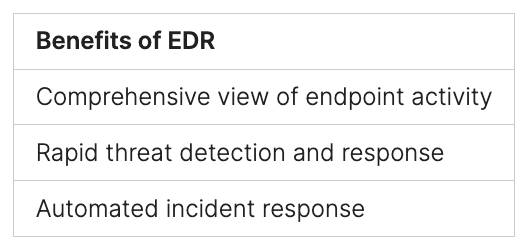
Key Features of EDR
Comprehensive visibility into endpoint activity
Rapid threat detection and response capabilities
Automated incident response
XDR: A Unified Approach
XDR (Extended Detection and Response) takes a holistic approach to security by integrating data from multiple sources, such as endpoints, networks, cloud workloads, and email. This unified platform provides a comprehensive view of the organization’s security posture across the entire IT environment, allowing for more effective threat detection and response.
Unlike traditional security solutions that focus on individual components, XDR breaks down security silos and correlates data from various sources. By analyzing and correlating data from endpoints, networks, and other sources, XDR can detect threats that may go unnoticed by individual security tools. This comprehensive and unified approach maximizes the organization’s ability to identify and respond to potential security incidents.
XDR also simplifies security operations by providing a single platform for managing all security data and activities. This centralized approach streamlines the security workflow, reduces the complexity of managing multiple tools, and improves overall efficiency.
By implementing XDR, organizations can improve their security posture by gaining a deeper understanding of their network’s vulnerabilities, identifying potential threats faster, and responding more effectively. This proactive approach to security helps organizations stay one step ahead of cyber threats and mitigate risks more efficiently.
The Benefits of XDR
XDR offers several key benefits for organizations looking to enhance their threat detection capabilities and strengthen their security posture:
Improved Threat Detection: By correlating data from multiple sources, XDR provides a more comprehensive view of potential threats, allowing organizations to detect and respond to security incidents more effectively.
Reduced Security Silos: XDR breaks down the barriers between different security tools and data sources, enabling a more coordinated and integrated approach to security.
Simplified Security Operations: With a central platform for managing security activities, XDR simplifies the management and orchestration of security processes, reducing complexity and improving operational efficiency.
XDR vs. EDR: A Comparison
To better understand the benefits of XDR, it is important to compare it to Endpoint Detection and Response (EDR), a widely adopted security solution. While EDR focuses on securing individual endpoints, XDR takes a broader and more integrated approach to threat detection and response.
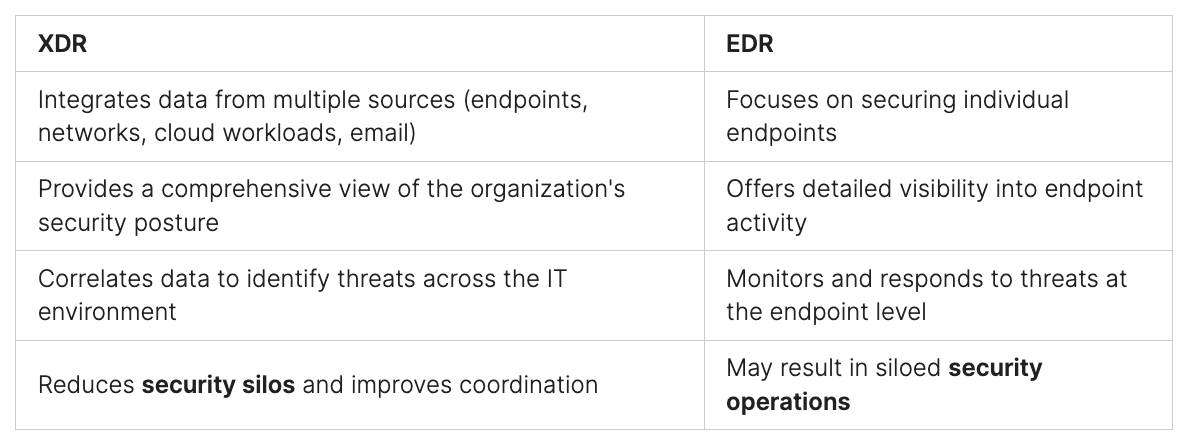
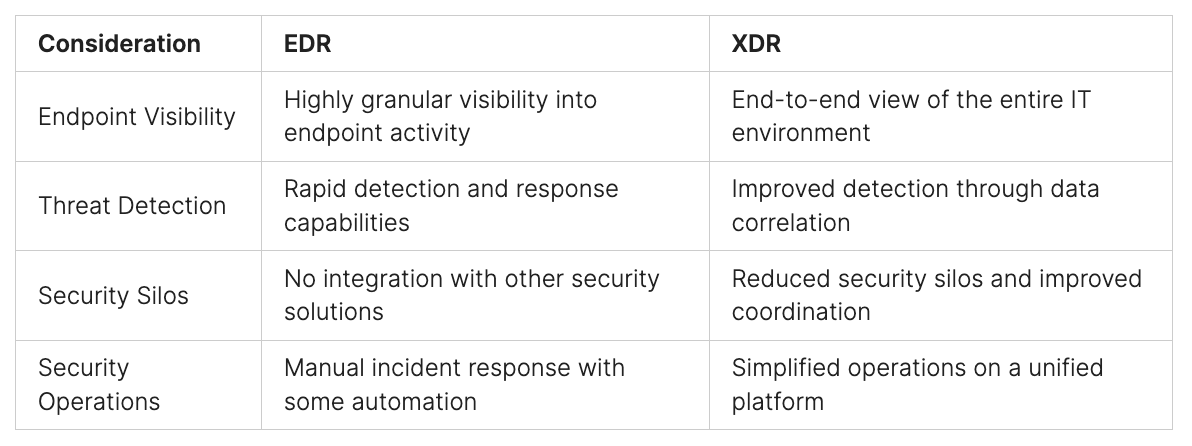
Here is a comparison of XDR and EDR in terms of their core features:
As the table illustrates, XDR provides a more comprehensive and integrated approach to security by incorporating data from various sources. This broader scope improves threat detection capabilities and reduces security silos.
Benefits of EDR
EDR solutions offer several key benefits that enhance the cybersecurity posture of organizations. By providing a comprehensive view of endpoint activity, EDR enables security teams to gain deep insights into the behavior of individual endpoints. This level of visibility makes it easier to detect anomalous activity and identify potential threats.
With EDR, organizations can quickly and effectively respond to incidents, minimizing the potential damage caused by cyberattacks. The rapid threat detection capabilities of EDR solutions enable security teams to stay one step ahead of malicious actors, proactively mitigating potential risks.
Automated incident response is another significant advantage of EDR. By automating routine tasks, such as isolating compromised endpoints or blocking malicious processes, EDR tools free up valuable time for security teams. This allows them to focus on more strategic and higher-value activities, such as threat hunting and analysis.
“EDR solutions provide comprehensive visibility into endpoint activity, enabling faster threat detection and response.”
Overall, EDR solutions play a critical role in bolstering an organization’s cybersecurity defenses. By offering detailed endpoint activity visibility, rapid threat detection, and automated incident response capabilities, EDR empowers organizations to proactively protect their networks and minimize the impact of security incidents.
Benefits of XDR
Extended Detection and Response (XDR) offers a range of benefits that significantly enhance an organization’s threat detection capabilities, streamline security operations, and break down security silos. By correlating data from multiple sources, XDR provides a more comprehensive view of potential threats, enabling a quicker and more effective response. Here are the key advantages of implementing XDR:
Improved Threat Detection: XDR leverages data from endpoints, networks, cloud workloads, and email to identify threats that may go unnoticed by individual security solutions. By analyzing and correlating data from multiple sources, XDR offers enhanced detection capabilities, enabling proactive threat hunting and rapid incident response.
Reduced Security Silos: Traditional security solutions often operate in silos, making it challenging for security teams to gain a comprehensive view of the threat landscape. XDR breaks down these silos by integrating data from various sources into a unified platform. This integrated approach empowers security teams to identify patterns and trends across the entire IT environment, improving their understanding of potential threats and enabling a more coordinated and effective response.
Simplified Security Operations: Managing security operations can be complex and time-consuming when dealing with multiple security tools and platforms. XDR simplifies security operations by providing a single platform for managing all security data and activities. This centralized approach streamlines workflows, eliminates duplicate efforts, and enables efficient collaboration between security teams, resulting in improved productivity and reduced operational costs.
Implementing XDR allows organizations to take a proactive stance against cyber threats, leveraging comprehensive threat detection capabilities, breaking down security silos, and simplifying security operations. By investing in XDR, organizations can elevate their security postures and stay one step ahead of evolving threats.
Which is Better: EDR or XDR?
The decision of whether EDR or XDR is the better cybersecurity solution depends on an organization’s specific needs and security posture. Both EDR and XDR offer unique capabilities that cater to different requirements.
EDR:
EDR, or Endpoint Detection and Response, is an ideal choice for organizations that manage a large number of endpoints and require detailed visibility into endpoint activity. EDR solutions provide a granular level of insight into processes, network connections, and file access on individual endpoints. This enhanced visibility enables security teams to quickly detect and respond to threats. With automated incident response capabilities, EDR tools streamline the management of security incidents and free up valuable time for security personnel.
XDR:
XDR, or Extended Detection and Response, takes a more holistic approach to cybersecurity. It integrates data from multiple sources, including endpoints, networks, cloud workloads, and email, providing a comprehensive view of an organization’s security posture. XDR offers improved threat detection by correlating data from various sources, which can uncover threats that may have been missed by individual security solutions. Additionally, XDR reduces security silos and simplifies security operations by consolidating security data and activities onto a single platform.
The Future of Cybersecurity
As organizations navigate the ever-evolving landscape of cybersecurity, the need for effective threat detection and response is paramount. Endpoint Detection and Response (EDR) and Extended Detection and Response (XDR) have emerged as powerful solutions in combating cybercrime. While both EDR and XDR offer valuable features, XDR represents the future of cybersecurity with its unified approach and improved security posture.
EDR focuses on securing individual endpoints, providing in-depth visibility into endpoint activity for threat detection and response. While EDR solutions excel in endpoint protection, their limited scope may lead to security gaps in complex IT environments.
XDR, on the other hand, takes a holistic approach to security by integrating data from multiple sources such as endpoints, networks, cloud workloads, and email. This unified platform offers a comprehensive view of an organization’s security posture, enabling improved threat detection and a more coordinated response to emerging threats.
By correlating data across different sources, XDR eliminates security silos and provides a single platform for managing all security activities. As organizations embrace XDR solutions, we can anticipate a significant enhancement in their overall security posture.
“The integration capabilities of XDR are key in taking cybersecurity to the next level. By breaking down silos and fostering collaboration among security tools, XDR enables organizations to stay one step ahead of sophisticated threats.”
With the ever-increasing sophistication of cyber threats, a unified approach like XDR offers unparalleled visibility and protection. By leveraging the power of XDR, organizations can proactively defend against advanced attacks and strengthen their security defenses across the entire IT infrastructure.
Benefits of XDR:
Improved threat detection through correlation of data from multiple sources
Reduced security silos for a more coordinated response to threats
Simplified security operations with a single platform for managing all security activities
Organizations that prioritize a unified approach and an improved security posture should consider adopting XDR as their cybersecurity solution of choice.
Additional Factors to Consider
When choosing between EDR and XDR, there are several additional factors to consider. These factors can help organizations make an informed decision based on their specific needs and requirements. Take a closer look at the following considerations:
Cost
XDR solutions often come with additional features and functionality, which can make them more expensive than EDR solutions. Organizations should carefully evaluate their budget and determine the level of investment they are willing to make in their cybersecurity solution.
Security Expertise
Implementing and managing an XDR solution requires more security expertise compared to EDR. Organizations should assess their internal resources and determine if they have the necessary skills and knowledge to effectively handle an XDR solution. If not, they may need to consider hiring external security experts or seeking assistance from trusted cybersecurity providers.
Integration
Integration with other security tools in the organization’s environment is a vital consideration. EDR and XDR solutions should seamlessly integrate with existing security infrastructure to ensure a cohesive and effective defense strategy. Organizations should verify compatibility and ensure that the chosen solution can integrate smoothly with their current security stack.
Organization’s Specific Needs
Every organization has unique security requirements. It is essential to carefully evaluate these needs before making a decision between EDR and XDR. Consider factors such as the size of the organization, the complexity of the IT environment, and the level of threat exposure. Each solution offers different capabilities, and organizations should choose the one that aligns best with their specific needs and addresses their most critical security challenges.
By considering these additional factors, organizations can make an informed decision about whether EDR or XDR is the best fit for their cybersecurity strategy. It’s crucial to find the right balance between cost-effectiveness, security expertise, integration capabilities, and meeting the organization’s specific needs.
Conclusion
In conclusion, both EDR and XDR are powerful tools that can play a vital role in an organization’s cybersecurity strategy. EDR offers detailed visibility into endpoint activity and rapid threat detection and response capabilities, making it a suitable choice for organizations with a large number of endpoints to manage. XDR, on the other hand, offers a more comprehensive and unified approach to security, providing improved threat detection, reduced security silos, and simplified security operations. The choice between EDR and XDR depends on the organization’s specific needs and security posture.
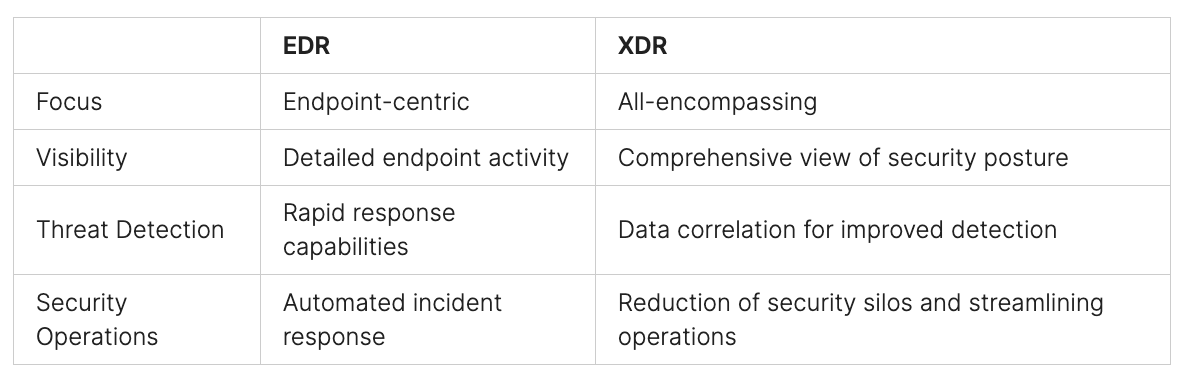
Comparative Analysis: EDR vs. XDR
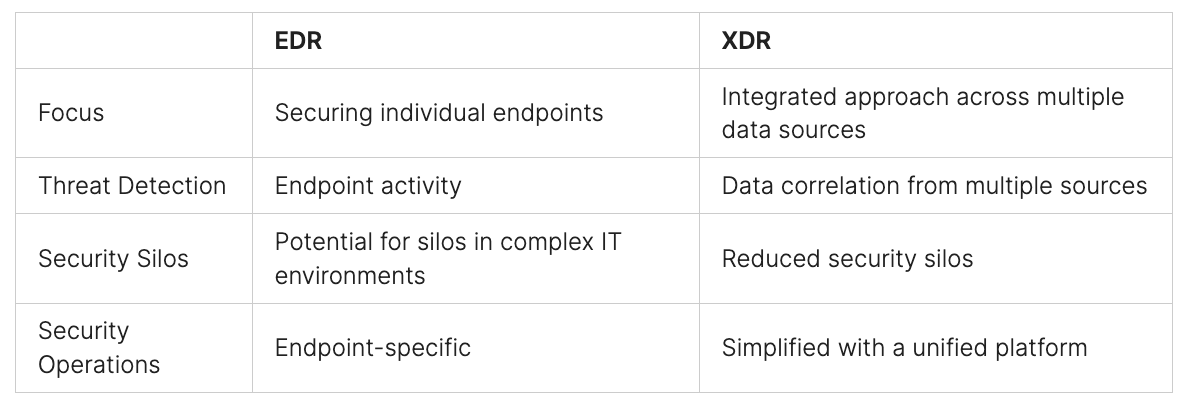
Based on this comparison, EDR excels in providing detailed visibility into endpoint activity and offering rapid threat detection and response capabilities. On the other hand, XDR goes beyond individual endpoints and provides a comprehensive view of the entire IT environment, enabling improved threat detection, reduced security silos, and simplified security operations.
EDR focuses on securing individual endpoints, while XDR takes a more holistic approach by integrating data from multiple sources. This comprehensive approach offered by XDR can detect threats that might be missed by EDR solutions, making it an increasingly attractive choice for organizations.
When selecting between EDR and XDR, organizations should assess their specific needs, IT environment complexity, and desired level of security. Ultimately, the right choice will depend on achieving a comprehensive approach to cybersecurity and comprehensive detection of threats across the organization.
Do You Need Expert Advice?
If you’re uncertain about which cybersecurity solution is best for your business, don’t worry. The Peris.ai Cybersecurity team is here to help you make an informed decision based on your specific needs and requirements. With our expert advice, you can find the perfect cybersecurity solution that offers the optimal level of protection for your business.
Book a call with Peris.ai Cybersecurity today to consult with our professionals. We’ll provide you with guidance and insights to ensure you choose the best cybersecurity solution that is tailored to your business needs. With our expertise, you can navigate through the complex landscape of cybersecurity and implement the solution that’s best for your business.
The Importance of Choosing the Right Cybersecurity Solution
Ensuring the protection of your network and critical data is paramount in today’s digital landscape. With various cybersecurity solutions available, selecting the right one can make all the difference. As you navigate through the options, it is crucial to understand the differences between EDR, NDR, and XDR, and assess your organization’s specific needs.
Endpoint Detection and Response (EDR) focuses on securing individual endpoints, offering detailed visibility into endpoint activity and rapid threat detection and response capabilities. Network Detection and Response (NDR) focuses on monitoring and analyzing network traffic to identify and respond to potential threats. Extended Detection and Response (XDR) takes a more holistic approach, integrating data from multiple sources to provide a comprehensive view of your organization’s security posture.
By evaluating your organization’s specific needs and considering the unique benefits and capabilities of EDR, NDR, and XDR, you can make an informed decision. Protecting your network and critical data requires a cybersecurity solution that aligns with your requirements, ensuring optimal security and peace of mind.
FAQ
What is Endpoint Detection and Response (EDR)?
EDR solutions focus on securing individual endpoints such as laptops, desktops, and servers, providing detailed visibility into endpoint activity, threat detection, and incident response capabilities.
What is Extended Detection and Response (XDR)?
XDR takes a holistic approach to security by integrating data from multiple sources, offering improved threat detection, reduced security silos, and simplified security operations across the entire IT environment.
How does EDR differ from Network Detection and Response (NDR)?
EDR focuses on securing individual endpoints, while NDR focuses on detecting and responding to threats within the network infrastructure.
What are the benefits of EDR?
EDR provides in-depth visibility into endpoint activity, rapid threat detection and response capabilities, and automated incident response, enhancing an organization’s security posture.
What are the benefits of XDR?
XDR offers improved threat detection by correlating data from multiple sources, reduces security silos, and simplifies security operations by providing a unified platform for managing all security data and activities.
Which is better, EDR or XDR?
The choice between EDR and XDR depends on an organization’s specific needs and security posture. EDR is suitable for organizations with a large number of endpoints, while XDR is ideal for those with a complex IT environment.
What is the future of cybersecurity?
XDR represents the future of cybersecurity, offering a unified and comprehensive approach to threat detection and response, improving overall security posture.
What additional factors should be considered when choosing between EDR and XDR?
Factors such as cost, security expertise, and integration with existing security tools should be considered when choosing between EDR and XDR.
How important is it to choose the right cybersecurity solution?
Choosing the right cybersecurity solution is crucial to ensure the protection of your network and critical data.
In today’s fast-paced digital world, the ability to respond swiftly and effectively to IT incidents is more crucial than ever. Robust incident management software plays a pivotal role in helping organizations handle crises with finesse rather than frenzy. This guide delves into the top six incident management software choices for 2024, tailored for DevOps and SRE teams across various business stages, from nimble startups to mature enterprises.
Top Incident Management Solutions
Explore the standout features, pros, and cons of each leading platform to find the best fit for your organizational needs.
Overview: Integrates on-call scheduling, incident response, and reliability workflows into a unified platform, aiming to enhance system uptime and simplify operations.
Pros: Offers a comprehensive feature set including AI-driven noise reduction, automated incident response workflows, and real-time performance tracking.
Cons: Continuous updates require teams to stay updated on new features and functionalities.
Overview: Combines intelligent alert routing, AIOps for noise reduction, and detailed incident response workflows, designed for high-stakes environments.
Overview: Known for its comprehensive alerting and on-call management capabilities, Opsgenie offers a centralized approach to incident management.
Pros: Efficient central management of alerts and communications, coupled with robust scheduling tools.
Cons: Some users have reported stability issues and infrequent updates since its acquisition by Atlassian.
Key Considerations for Incident Management Software
When choosing the appropriate incident management software, it’s essential to assess these vital features that bolster response effectiveness:
On-Call Scheduling & Management:
Ensures efficient scheduling of the right personnel.
Reduces downtime and streamlines response efforts.
Alerting and Notifications:
Provides timely, severity-based alerts via various communication channels.
Ensures that alerts capture the immediate attention of necessary team members.
Incident Response Workflows:
Utilizes structured workflows to guide teams through predefined steps.
Reduces confusion and speeds up the recovery process.
Integrations:
Achieves seamless integration with existing tools and systems.
Enhances operational visibility and aids in faster incident resolution.
Pricing Flexibility:
Offers cost-effective solutions that align with organizational budgets and needs.
Helps maintain high security levels without imposing financial burdens.
Conclusion: Peris.ai Brahma as Your Go-To Incident Management Solution
Discover Brahma by Peris.ai Cybersecurity, a powerful alternative to conventional incident management systems. Designed to optimize operational resilience, Brahma combines the best of AI technology with user-centric features:
AI-Powered Incident Management: Brahma utilizes advanced AI algorithms to anticipate, identify, and resolve IT issues before they escalate, significantly reducing potential disruptions.
Integrated On-Call Scheduling and Response: It ensures that the right personnel are alerted and ready to act swiftly and effectively, thereby minimizing downtime and enhancing operational continuity.
Customizable Workflows: Unlike some platforms that offer rigid solutions, Brahma allows for high customization, enabling you to tailor incident response workflows to meet your specific operational needs.
Comprehensive Integration Capability: With Brahma, integration isn’t just an option; it’s a priority. It supports a wide array of tools and systems, ensuring that all aspects of your IT environment are interconnected for smoother, faster incident resolution.
Cost-Effective Solution: Offering scalable pricing models, Brahma ensures that you can maintain high security and operational efficiency without overstretching your budget.
Brahma by Peris.ai Cybersecurity stands out not just for its technological prowess but for its adaptability to diverse business environments, ensuring that every organization, regardless of size, can achieve top-tier incident management capabilities. For a deeper dive into what Brahma can offer, visit our product page.
FAQ
Q: What is incident management software?
A: Incident management software helps organizations prepare for, respond to, and recover from IT incidents efficiently. It includes features for alert management, task coordination, and post-incident analysis.
Q: Why is on-call management important in incident response?
A: On-call management ensures that the right personnel are available to respond to an incident as soon as it occurs, which is crucial for minimizing downtime and resolving issues quickly.
Q: Can these tools integrate with existing IT systems?
A: Yes, most modern incident management tools offer extensive integration capabilities with popular IT systems and applications to provide a centralized management experience.