Tag: security-information-and-event-management

  • Discover the Advantages of Security as a Services (SecaaS)

    Discover the Advantages of Security as a Services (SecaaS)

    As businesses increasingly rely on technology to operate, ensuring cybersecurity has become a critical concern. However, managing security infrastructure can be complex, costly, and time-consuming, especially for small and medium-sized businesses.

    Fortunately, Security as a Service (SecaaS) offers a solution that can help businesses protect their digital assets without the hassle and expense of maintaining their security infrastructure in-house. SecaaS provides a range of benefits, including cost-effectiveness, enhanced data protection, and proactive threat monitoring.

    This article explores the advantages of implementing Security as a Service (SecaaS) and managed security services, including cloud-based security services. We’ll examine the different types of SecaaS solutions, how they can benefit businesses, and the cost savings compared to traditional security solutions. We’ll also delve into the advanced security measures and technologies utilized in SecaaS solutions and how they can protect against potential threats.

    Key Takeaways

    • Security as a Service (SecaaS) can provide businesses with cost-effective and efficient security solutions.
    • Cloud-based security services and outsourcing cybersecurity can offer significant advantages for businesses of all sizes.
    • SecaaS solutions utilize advanced security measures and technologies to enhance data protection and provide proactive threat monitoring.
    • Managed security services can offer expert guidance and support in maintaining a business’s security infrastructure.
    • SecaaS solutions can enable businesses to secure their productivity and operate more efficiently.

    Understanding Security as a Service (SecaaS)

    Security as a Service (SecaaS) is a cloud-based security solution that provides businesses with advanced security measures and technologies without the need for expensive hardware or software. SecaaS solutions allow businesses to outsource cybersecurity and benefit from expert guidance and support while reducing costs.

    Cloud-based security services are a popular form of SecaaS. These solutions utilize cloud computing for enhanced security measures, allowing businesses to store and protect sensitive data and applications in the cloud. By outsourcing cybersecurity to a trusted provider, businesses can free up resources to focus on core operations.

    SecaaS Solutions

    SecaaS solutions come in various forms, including:

    Maximizing Security, Minimizing Costs: SecaaS for Efficient Cyber Protection

    By outsourcing cybersecurity to SecaaS providers, businesses can benefit from the latest security technologies and expertise without incurring high hardware and software maintenance costs.

    Cybersecurity Outsourcing

    Outsourcing cybersecurity through SecaaS solutions can provide significant benefits for businesses. By partnering with a trusted provider, businesses can benefit from:

    • Expert guidance and support in maintaining their security infrastructure
    • Access to the latest security technologies and solutions
    • Enhanced security measures and protection against advanced threats
    • Flexible and scalable security solutions that can adapt to changing needs
    • Reduced costs compared to traditional security solutions

    Overall, Security as a Service (SecaaS) offers businesses a cost-effective and efficient way to enhance their cybersecurity posture and protect against advanced threats.

    SecaaS: Elevating Cybersecurity Effectiveness while Controlling Costs

    Cost-Effectiveness of SecaaS

    Implementing Security as a Service (SecaaS) can provide businesses with cost-effective security services that can help them save money in the long run. This is because SecaaS solutions eliminate the need for businesses to invest in expensive hardware and software, which can be both costly and time-consuming to maintain.

    By outsourcing their cybersecurity needs to a trusted SecaaS provider, businesses can benefit from the latest security technologies without having to shoulder the high costs associated with them. Additionally, because SecaaS providers have the expertise and resources to monitor and manage a business’s security infrastructure continuously, there is less risk of security breaches or other related issues that can be costly to remediate.

    Comparison of Costs

    Cost-Efficiency at a Glance: SecaaS vs. Traditional Security Solutions”

    As shown in the comparison table above, implementing SecaaS solutions can provide businesses with significant cost savings when compared to traditional security solutions. This is particularly true for small to medium-sized businesses without the resources or budget to invest in expensive security infrastructure and personnel.

    Furthermore, SecaaS providers typically offer flexible pricing models that allow businesses to scale their security services according to their needs and budgets. This means that businesses can enjoy the benefits of advanced security technologies without committing to long-term contracts or overpaying for services they don’t need.

    In conclusion, implementing Security as a Service (SecaaS) can provide businesses with cost-effective security solutions that can help them save money while benefitting from advanced security measures and technologies. By outsourcing their cybersecurity needs, businesses can focus on their core competencies and leave the management of their security infrastructure to trusted experts.

    Enhanced Data Protection with SecaaS

    One of the most significant benefits of implementing Security as a Service (SecaaS) is the enhanced data protection it provides for businesses. SecaaS solutions utilize advanced security measures and technologies to safeguard sensitive information against potential cyberattacks.

    With SecaaS, businesses can enjoy heightened protection against data breaches and other security threats. This is particularly important in today’s digital landscape, where cyberattacks are becoming increasingly common. In fact, according to a report by Accenture, the average cost of a data breach for companies worldwide is $3.86 million.

    One way SecaaS enhances data protection is by providing continuous monitoring for potential threats. This means that any suspicious activity can be detected and addressed in real time, preventing any damage or serious consequences.

    Moreover, SecaaS solutions offer encryption services that help protect data while in transit or at rest. This added layer of security ensures that even if data is accessed by unauthorized personnel, it remains undecipherable and unusable to them.

    Example of SecaaS Data Protection
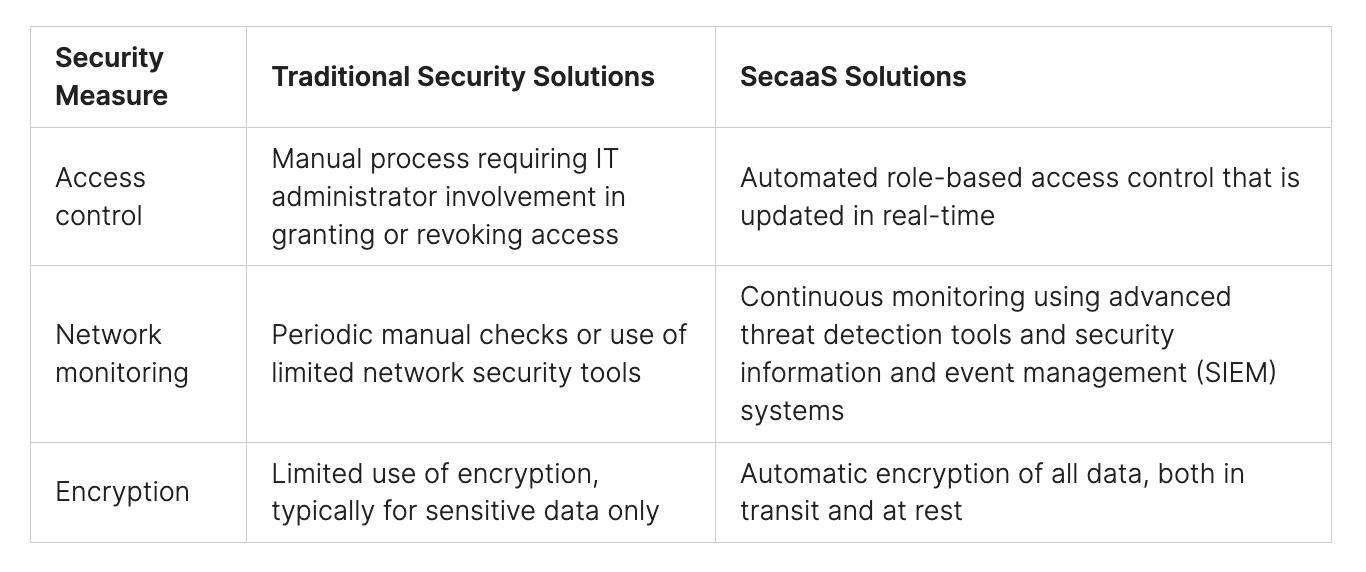
    SecaaS vs. Traditional Security: A Clear Advantage in Data Protection

    As illustrated in the table above, SecaaS solutions offer an array of advanced security measures that go beyond what traditional security solutions can provide. This translates to better data protection and a reduced risk of costly data breaches that can severely impact a business.

    In addition, enhanced data protection can also improve a company’s reputation, as customers and partners are more likely to trust businesses that prioritize their data security.

    Elevated Data Security: Building Trust and Reputation

    Proactive Threat Monitoring

    One of the key advantages of Security as a Service (SecaaS) is its proactive threat monitoring capabilities. With continuous monitoring, businesses can detect potential security threats in real time and take action before they cause any damage.

    Proactive threat monitoring involves monitoring networks, systems, and applications for suspicious activity and identifying potential security breaches. This approach helps businesses stay ahead of threats and take appropriate action to mitigate risk.

    Staying Ahead of Threats: The Proactive Advantage of SecaaS

    By leveraging SecaaS solutions for proactive threat monitoring, businesses can benefit from improved incident response times and reduced risk of data breaches. Managed security services, cloud-based security services, and scalable security solutions are all examples of SecaaS solutions that provide proactive threat monitoring capabilities.

    In addition to reducing the risk of security breaches, proactive threat monitoring can help businesses save money in the long run. Businesses can avoid costly security incidents by detecting and addressing potential threats before they cause any damage.

    Overall, proactive threat monitoring is a key benefit of Security as a Service (SecaaS). By continuously monitoring for potential security threats, businesses can stay ahead of the curve and take appropriate action to mitigate risk, leading to increased security and peace of mind.

    Proactive Protection: SecaaS for Continuous Threat Monitoring and Peace of Mind

    Scalable Security Solutions

    One of the key benefits of implementing Security as a Service (SecaaS) is the scalability it provides. Unlike traditional security solutions, SecaaS offers businesses the flexibility to adjust their security measures based on their changing needs. This means that businesses can easily scale up or down their security measures as required without the need for costly hardware or software investments.

    Scalability is particularly important for businesses that are growing rapidly or experiencing fluctuations in demand. With SecaaS, businesses can easily add or remove security measures as required, making it a cost-effective and efficient solution.

    Another advantage of SecaaS is that it allows businesses to access advanced security technologies that may otherwise be prohibitively expensive. By leveraging cloud-based security services, for example, businesses can benefit from cutting-edge security measures without the need for significant investment.

    Scalable Security Solutions in Action

    To illustrate the benefits of scalable security solutions, consider the following example:

    Scaling for Success: Demonstrating the Power of Scalable Security Solutions

    As this example illustrates, SecaaS provides businesses with a cost-effective and flexible solution for managing their security needs. By leveraging scalable security solutions, businesses can ensure that they have the right level of security measures in place to protect their data and systems without breaking the bank.

    Balancing Security and Budget: The Flexibility of Scalable SecaaS

    Managed Security Services

    Implementing Security as a Service (SecaaS) solutions can be challenging for organizations with limited IT expertise. That’s where managed security services come in. Managed security services refer to outsourcing security measures to a third party specializing in IT security management. This third party can provide expert guidance and support in maintaining an organization’s security infrastructure.

    Managed security services can be particularly beneficial for small- to medium-sized businesses. Often, these organizations do not have the resources to employ a dedicated IT security team. By outsourcing security measures to a managed security services provider, businesses can free up resources to focus on their core competencies. Additionally, managed security services provide a cost-effective alternative to hiring full-time employees with specialized security expertise.

    Managed security services can include a wide variety of services, such as:

    Diverse Offerings: The Spectrum of Managed Security Services

    Managed security services can also be customized to meet an organization’s specific needs. By working with a managed security services provider, businesses can have peace of mind knowing that experts in the field are managing their security measures.

    Managed Security Services: Elevating Security, Resources, and Compliance

    Outsourcing security measures to a managed security services provider as part of a SecaaS solution can provide numerous benefits for organizations. By leveraging managed security services, businesses can improve their security posture, free up resources, and ensure compliance with industry regulations and standards.

    Cloud-Based Security Services

    One of the key advantages of Security as a Service (SecaaS) is the availability of cloud-based security services. These services leverage cloud computing to deliver advanced security features and protect against a wide range of threats, from malware and viruses to insider attacks.

    Cloud-based security services are designed to be flexible and scalable, making them ideal for businesses of all sizes. They can be quickly and easily deployed, with no need for expensive hardware or infrastructure investments. This makes them a cost-effective solution for businesses looking to enhance their security measures.

    Cloud-Based Security Services: A Flexible and Cost-Effective Solution for All

    Overall, cloud-based security services are a crucial component of any SecaaS solution. They provide businesses with the flexibility, scalability, and cost-effectiveness they need to enhance their security measures and protect against a wide range of threats.

    Cloud Security: The Essential Pillar of SecaaS for Robust Protection

    Securing Productivity with SecaaS

    One of the key benefits of Security as a Service (SecaaS) is the ability to secure productivity within a business environment. By leveraging advanced security technologies and practices, businesses can ensure that their operations remain safe and efficient.

    One way that SecaaS can enhance secure productivity is through the implementation of strict access controls. With the ability to restrict access to sensitive data and systems, businesses can prevent unauthorized access and protect against potential security threats. This enables employees to work confidently and efficiently, without fear of compromising the security of the organization.

    In addition, SecaaS solutions can provide real-time threat detection and response capabilities. By continuously monitoring for potential security threats, businesses can address issues as soon as they arise, minimizing the impact on operations and reducing downtime. This enables employees to work without interruption, further enhancing productivity.

    Boosting Business Continuity: Real-Time Threat Detection with SecaaS

    “By leveraging advanced security technologies and practices, businesses can ensure that their operations remain safe and efficient.”

    Overall, the benefits of secure productivity with SecaaS are clear. By protecting against security threats and implementing effective access controls, businesses can operate more efficiently and with confidence.

    Benefits of SecaaS for Businesses

    Implementing Security as a Service (SecaaS) can provide numerous benefits for businesses seeking to enhance their security measures. The advantages of SecaaS solutions are numerous and effective, making it an ideal choice for businesses of all sizes. Here are some of the key benefits of implementing SecaaS solutions:

    • Cost Savings: SecaaS solutions can provide significant cost savings compared to traditional security solutions. With SecaaS, businesses can avoid the high upfront costs of purchasing and maintaining their security infrastructure and instead pay a predictable monthly fee for managed security services.
    • Enhanced Data Protection: SecaaS solutions incorporate advanced security measures and technologies that can significantly enhance data protection for businesses. This can include features such as encryption, multi-factor authentication, and real-time threat monitoring that can detect and address potential security threats before they become a problem.
    • Proactive Threat Monitoring: SecaaS solutions continuously monitor and address potential security threats in real time. This enables businesses to proactively respond to security threats and prevent damage or data loss from occurring.
    • Scalable Security Solutions: SecaaS solutions are designed to adjust easily and flexibly based on a business’s changing security needs. This means that businesses can scale their security measures up or down as needed without the need for additional hardware or infrastructure.
    • Managed Security Services: Implementing managed security services as part of a SecaaS solution can provide businesses with expert guidance and support in maintaining their security infrastructure. This can include services such as 24/7 support, vulnerability assessments, and training to help businesses stay ahead of emerging security threats.
    • Cloud-Based Security Services: SecaaS solutions often incorporate cloud-based security services, which can provide additional benefits such as increased agility, flexibility, and scalability. Cloud-based security services can also help businesses reduce their reliance on physical hardware and infrastructure, saving additional costs.
    • Secure Productivity: SecaaS solutions can secure and enhance productivity within a business environment by protecting against security threats and enabling employees to work efficiently. This can include features such as secure remote access, data backup and recovery solutions, and anti-virus and anti-malware protection.
    SecaaS: Empowering Businesses with Comprehensive Security and Peace of Mind

    The benefits of implementing Security as a Service (SecaaS) are numerous and can significantly enhance a business’s security measures. From cost savings to enhanced data protection, SecaaS solutions can provide businesses with the peace of mind they need to focus on growth and innovation.

    Conclusion

    Safeguarding your business from the relentless onslaught of security threats is more crucial than ever. That’s where BIMA comes in, offering a comprehensive Cybersecurity-as-a-Service platform that operates 24/7, providing you with the ultimate cybersecurity solution. Don’t wait any longer to protect your digital world; start securing your business with BIMA today!

    With BIMA, you can fortify your defenses against even the most advanced cyberattacks. Our array of cybersecurity tools and tailored monitoring solutions are designed to meet the unique requirements of your business. Powered by a combination of potent proprietary and open-source tools, along with access to the latest threat intelligence through our subscription-based scanners, BIMA ensures unparalleled security. And with our pay-as-you-go service, you’ll only pay for what you need, with no upfront costs or hidden fees.

    Whether your business is a small startup or a large enterprise, BIMA has got you covered. Our user-friendly platform simplifies the process of monitoring and safeguarding your business from start to finish. With BIMA, you can take control of your cybersecurity and shield your business from any potential threat.

    So why leave your digital world vulnerable? Take action today and visit our website, Peris.ai, to explore how BIMA can be the shield your business needs to stay secure in an ever-evolving digital landscape.

    Protect your digital world with BIMA because security is paramount in the digital realm.

    FAQ

    What is Security as a Service (SecaaS)?

    Security as a Service (SecaaS) is a cloud-based security solution where businesses outsource their security needs to a third-party provider. It offers a range of security services, including threat monitoring, data protection, and managed security services.

    What are the benefits of SecaaS?

    SecaaS provides several advantages for businesses, including cost-effectiveness, enhanced data protection, proactive threat monitoring, scalable security solutions, and access to managed security services. It can also secure productivity and provide expert guidance and support.

    How does SecaaS enhance data protection?

    SecaaS utilizes advanced security measures and technologies to enhance data protection. It employs encryption, access controls, and data loss prevention techniques to safeguard sensitive information from unauthorized access or breaches.

    How does SecaaS enable proactive threat monitoring?

    With SecaaS, continuous real-time monitoring is implemented to detect and address potential security threats. Advanced threat detection systems and security analytics are used to identify and respond to suspicious activities, ensuring proactive protection against cyber threats.

    What do scalable security solutions mean in the context of SecaaS?

    Scalable security solutions in SecaaS refer to the ability to easily adjust and adapt security measures to meet changing business needs. Businesses can scale their security infrastructure up or down based on their requirements without the need for significant investments in hardware or personnel.

    What are managed security services in SecaaS?

    Managed security services are an integral part of SecaaS solutions. They involve outsourcing security management and monitoring to a specialized provider who offers expertise and guidance in maintaining and optimizing a business’s security infrastructure.

    How do cloud-based security services fit into the SecaaS framework?

    Cloud-based security services are a type of SecaaS solution where security measures are delivered and managed through cloud computing technology. This approach offers numerous benefits, including scalability, flexibility, and the ability to leverage the cloud’s extensive computing resources for enhanced security.

    How does SecaaS secure productivity?

    SecaaS secures productivity by protecting against security threats that can disrupt or compromise business operations. It ensures that employees can work efficiently and confidently, knowing that their digital assets and communications are safeguarded from potential cyber risks.

    What are the main benefits of SecaaS for businesses?

    The main benefits of SecaaS for businesses include cost savings, enhanced data protection, proactive threat monitoring, scalability, access to managed security services, cloud-based security solutions, and increased productivity. SecaaS offers a comprehensive and efficient approach to securing an organization’s digital assets.

  • Exposed: Top SIEM Tactics That Security Experts Don’t Want You to Know

    Exposed: Top SIEM Tactics That Security Experts Don’t Want You to Know

    In today’s world, companies can’t think they’re safe forever. Even the strongest defenses can be broken by smart attackers. To stay safe, you need to use new, secret tactics that experts keep hidden.

    Want to know these secrets? Could you use them to make your company’s security stronger? Are you ready to see the tactics that could save your business from a big attack?

    Key Takeaways

    • Understand the transformative SIEM market landscape and its impact on security operations
    • Discover how to avoid the pitfalls of siloed security and leverage a layered approach
    • Learn how to harness the power of security platforms and AI to enhance detection and response
    • Explore the importance of operationalizing security for holistic cyber resilience
    • Uncover the top SIEM tactics that security experts don’t want you to know

    Mistaking Invisibility for Invincibility

    Many businesses think they’re not a target for cybercriminals, feeling safe. But, every company, big or small, has valuable data that hackers want. It’s important to see your business as a target and focus on security first.

    To protect your business, do regular security checks. You can do this yourself or with the help of security experts. These checks find and fix weak spots in your systems. Being proactive in cybersecurity makes your business safer and lowers the chance of an attack.

    How to Avoid It

    1. Do regular security checks: Check your security often, either by your team or with security experts, to find and fix weak spots.
    2. Use a layered security approach: Use different security tools like firewalls and intrusion detection systems to protect against threats.
    3. Train employees on cybersecurity: Teach your team how to spot and avoid threats like phishing and social engineering.
    4. Keep software and systems updated: Update your software regularly to fix known problems and lower the risk of attacks.
    5. Segment your network: Divide your network to stop attacks from spreading and limit damage if there’s a breach.

    By following these steps, you can avoid the mistake of thinking you’re invisible to hackers. Make sure your business is ready to face the changing world of cybersecurity threats.

    *10 Principles for Secure by Design: Baking Security into Your Systems: https://youtu.be/3l8GwLv2f3E?si=720M97R233JvSQ9_

    “Cybersecurity is not just about technology – it’s about people, processes, and culture. Adopting a security-first mindset is critical for organizations of all sizes.”

    Siloed Security: A Recipe for Disaster

    Cybersecurity is not just for IT; it’s a team effort. When security is seen as solely an IT responsibility, it creates blind spots and leaves the organization exposed. To prevent this, companies need to build a culture of cybersecurity awareness. This means giving all employees regular security training to teach them about threats and how to protect data.

    It’s key to empower employees to report any suspicious activity. Also, investigating all reported incidents is crucial. This helps break down silos and makes sure everyone is working together to keep the company safe. By taking a holistic, company-wide approach to cybersecurity, organizations can greatly reduce their risk and improve their security.

    “Cybersecurity is not just an IT issue; it’s a company-wide concern that requires collaboration between IT, management, and employees.”

    The role of security culture and employee training is huge. Companies that focus on these areas can better spot and handle security threats. This boosts their cybersecurity awareness and makes them more resilient.

    Creating a security-first mindset across the company helps avoid the dangers of siloed security approaches. It ensures the long-term safety of their assets and data.

    The Untamed Network: A Breeding Ground for Threats

    Many companies don’t fully understand their network setup. This makes it easy for hackers to find weaknesses. Old software, unpatched systems, and poor network visibility are big problems. It’s key to have a strong network security plan to fight these threats.

    It’s smart to do regular security checks to find and fix problems before hackers do. Using automated patching keeps software current and reduces risks. Also, breaking down your network into smaller parts can help stop attacks from spreading.

    How to Avoid It

    1. Do regular security checks to find and fix problems before hackers do.
    2. Use automated patching to keep software current and reduce risks.
    3. Use Security Information and Event Management (SIEM) tools for real-time network activity and threat spotting.
    4. Make a detailed network security plan that includes vulnerability scans, patching, and network segmentation.

    By being proactive, companies can make their networks safer. This reduces the chance of being hit by cyber threats.

    “Siloed security, where cybersecurity is seen as solely an IT issue, creates blind spots and leaves organizations exposed.”

    Beyond the Antivirus: A Layered Security Approach

    In today’s fast-changing world of cybersecurity, just using antivirus software isn’t enough. Experts say we need a layered security plan that goes beyond antivirus. This plan includes firewalls, intrusion detection and prevention systems (IDS/IPS), and endpoint detection and response (EDR) solutions. Together, they form a strong defense against cyber threats.

    How to Avoid It

    To create a layered security plan, follow these steps:

    1. Use firewalls to block unwanted traffic and manage network access.
    2. Set up IDS/IPS systems to watch your network for odd behavior and catch intruders.
    3. Use EDR tools to find, check out, and handle advanced threats on your devices.
    4. Integrate SIEM tools to gather and link log data from different sources. This helps spot and tackle security issues better.
    5. Put in place email security, like DNS filtering and anti-phishing, to fight email threats.
    6. Keep your security policies and procedures up to date to stay ahead of threats.
    7. Give your employees solid security training. This helps them spot and handle cyber threats.

    By using a layered security plan, you can greatly improve your organization’s defense against siem tactics, security experts, and many layered security threats. This includes antivirus, firewall, IDS/IPS, and EDR attacks. In today’s complex world, having a strong defense is key. A single weak spot can cause big problems.

    “Cybersecurity is not a one-size-fits-all solution. Organizations need to adopt a layered approach to effectively protect themselves against the ever-evolving threat landscape.”

    Exposed: Top SIEM Tactics That Security Experts Don’t Want You to Know

    The world of cybersecurity is always changing. Security experts are always looking for new ways to stay ahead. But, some of the best SIEM strategies are secret. We’ll share the top SIEM tactics that security experts keep hidden, helping you boost your cybersecurity.

    Old SIEM systems can be pricey because they need many people to run them. As companies grow, it’s hard to keep SIEM costs down. Also, older systems can’t handle the huge number of logs from today’s businesses. They also don’t automate tasks, so analysts have to do everything by hand.

    The attack surface has grown a lot because we rely more on IT and data. Cybercriminals are now organized like real businesses, working on schedules. To fight these threats, experts use smart SIEM platforms. These use data analytics, big data, and AI to find and fix threats faster.

    Smart SIEM platforms cut down on false alarms and focus on real threats. They make the job of security analysts easier and faster. This helps in quickly dealing with cyber threats.

    Using these top SIEM tactics, companies can fight cybercrime better. They can manage security data better, automate threat detection, and use advanced analytics. This way, security experts can keep their organizations safe from new threats.

    Don’t Let Your Guard Down at the Endpoint

    In today’s world, devices like laptops, desktops, and phones are big security risks. With more devices and BYOD policies, attackers find it easier to get in. Also, mistakes from social engineering and unpatched software give hackers a way in.

    To fight these risks, experts suggest using endpoint detection and response (EDR) solutions. EDR tools spot and tackle advanced threats, watching and analyzing what devices do. Also, using strong passwords and MFA boosts security a lot, as most data breaches come from insiders.

    It’s also key to use application whitelisting, encrypt data, and train employees on security. These steps help protect against attacks on devices.

    By using these siem tactics, security experts can make endpoint security stronger and stop EDR breaches. Taking steps ahead and using a layered defense is key to fight off threats to the endpoint.

    The Shifting SIEM Landscape: Market Consolidation and New Approaches

    The SIEM market is changing fast, with big mergers and acquisitions. Soon, many current SIEM solutions will stop being supported. This means customers will need to look at new cloud-based options or managed security services.

    Next-gen SIEMs can handle a lot of data, including logs and identity info. They are great at finding threats in different environments, using AI and machine learning. They also help with meeting rules like HIPAA and GDPR.

    Old SIEMs mainly looked at log outputs from various apps. They often sent out too many alerts, making it hard to keep up. This made it tough for companies to quickly respond to threats.

    SIEM started in the late ’90s to gather log info from devices. Now, it has two main parts: SEM for watching and responding to threats, and SIM for managing logs and meeting rules.

    Today’s SIEMs are cloud-based and can grow with your needs. They should collect and manage lots of data, work well with clouds, and be easy to use.

    As the siem market changes, customers need to think about new siem tactics and managed security services. These can offer more flexibility and help reduce alert fatigue. Moving to an open security data architecture can also help avoid being stuck with one vendor.

    “Next-generation SIEM solutions are cloud-native and offer rapid data source parser and analytics rules development, as well as MITRE ATT&CK framework integration to identify attack tactics, techniques, and procedures.”

    As the siem landscape keeps evolving, security experts suggest keeping up with market trends. Look for solutions that offer more agility and better threat detection.

    Effective SIEM Deployments: Six Tenets for Success

    To make your SIEM (Security Information and Event Management) work well, focus on six key areas: spotting insider threats, finding advanced threats, keeping the cloud safe, stopping data leaks, following rules, and watching over OT (Operational Technology) and IoT (Internet of Things) security.

    Identifying Insider Threats

    SIEM solutions mix Security Information Management (SIM) and Security Event Management (SEM) to link log data from different sources. This helps spot security issues that might be missed. By focusing on insider threats, companies can use their SIEM to find odd user actions and stop data leaks from inside.

    Detecting Advanced Threats

    SIEM tools are great at finding threats before they happen, looking for odd activity in a company and giving important info on an incident. Good SIEM use helps security teams find and handle advanced threats, keeping the company safe from new attacks.

    Securing the Cloud

    As more companies move to the cloud, SIEM solutions are key in keeping cloud data and systems safe. By linking SIEM with cloud security tools, teams get full view and control over their cloud, stopping data leaks and rule breaks.

    Uncovering Data Exfiltration

    SIEM plays a big part in finding and stopping data leaks, a common trick by hackers. By watching network traffic and user actions, SIEM tools spot odd patterns and warn teams of possible data breaches, helping them act fast.

    Managing Compliance

    Rules like HIPAA, GLBA, and GDPR need constant log checks, a job SIEM tools do well. SIEM keeps data for a long time, helping with rules and showing how well security works.

    Monitoring OT and IoT Security

    With more OT and IoT use, SIEM must cover these new threats. By linking SIEM with OT and IoT security, companies can see and control all their tech, reducing risks from connected devices.

    For SIEM to work well, you need a clear plan, knowing your security setup, picking what to watch, and doing it step by step. By focusing on these six areas, companies can use their SIEM to improve security and fight off many cyber threats.

    Conclusion

    In today’s fast-paced digital landscape, a robust cybersecurity strategy is essential. It requires a proactive approach that goes beyond basic security measures. By leveraging advanced SIEM tactics and a comprehensive SIEM framework, organizations can enhance their security posture and stay ahead of evolving cyber threats.

    Building a security-first culture is critical, where cybersecurity is prioritized at every level. Implementing advanced SIEM and XDR solutions allows businesses to detect and mitigate threats early, improving their threat-hunting capabilities and gaining clearer insights into the cyber threat landscape.

    Taking a proactive defense approach, investing in cutting-edge security solutions, and adapting to the ever-changing threat environment will help companies stay one step ahead of cybercriminals.

    To explore how our solutions can strengthen your cybersecurity and help you stay protected, visit Peris.ai Cybersecurity. Let us assist you in safeguarding your business from advanced cyber threats.

    FAQ

    What are the common cybersecurity mistakes that organizations make?

    Many businesses think they’re not at risk for cyberattacks. This can make them feel safe. But, every company has data that hackers want. To stay safe, they should think they’re a target and protect themselves well.

    How can organizations foster a culture of cybersecurity awareness?

    Cybersecurity is everyone’s job, not just IT’s. It needs teamwork from all levels of the company. To stay alert, offer regular security training and teach employees about threats.

    Also, let employees report any strange activity. Always check out these reports.

    What are the key components of a comprehensive network security strategy?

    A good plan includes checking for weaknesses, updating software, and dividing your network. Use tools like SIEM to watch your network and spot threats.

    How can organizations implement a layered security approach?

    Use firewalls, IDS/IPS, and EDR to protect your network. These tools block bad traffic, watch for odd behavior, and catch malware. They work together to keep your network safe.

    What are the six key tenets for effective SIEM deployments?

    Good SIEM setups follow six important steps. They help find insider threats, catch advanced threats, and keep the cloud safe. They also help find data leaks, manage rules, and watch over OT and IoT.

    How is the SIEM market evolving, and what should organizations consider?

    The SIEM market is changing fast, with big companies buying each other. This means old systems might stop working soon. Soon, we’ll see more cloud-based solutions.

    Customers should get ready for changes. They might want to look into managed security services or flexible security systems.

    What are the key steps to improve an organization’s security posture?

    To get better at security, fix common mistakes, teach everyone about cybersecurity, and have a strong plan. Use a layered defense and advanced SIEM tools to fight threats.

  • SIEM: The Nerve Center of Cybersecurity Operations

    SIEM: The Nerve Center of Cybersecurity Operations

    A Security Operations Center (SOC) serves as the nerve center of an organization’s cybersecurity strategy, actively monitoring and managing security incidents. SOC teams utilize SIEM (Security Information and Event Management) tools to enhance threat detection and security intelligence. SIEM allows for the proactive identification and response to potential cybersecurity incidents by analyzing network activities, access attempts, and malware infections. This centralized hub employs advanced technologies, skilled personnel, and robust processes to maintain information systems’ confidentiality, integrity, and availability.

    Key Takeaways:

    • SIEM is a vital tool used by SOC teams to enhance threat detection and security intelligence.
    • SIEM allows for proactive identification and response to potential cybersecurity incidents.
    • SIEM employs advanced technologies, skilled personnel, and robust processes to maintain information system security.
    • SIEM plays a crucial role in maintaining the confidentiality, integrity, and availability of information systems.
    • SIEM serves as the central hub for monitoring and managing security incidents.

    The Importance of a Strong SOC in Cybersecurity

    In the face of increasing cyber threats, a strong Security Operations Center (SOC) plays a critical role in minimizing the impact of these threats. By adopting a proactive stance, SOC teams can detect and mitigate potential cybersecurity incidents before they escalate. A robust SOC enhances an organization’s security posture, prevents data breaches, and ensures the resilience of its digital infrastructure. With the ever-evolving and sophisticated nature of cyber threats, a strong SOC is essential to maintaining a secure environment.

    “A strong SOC acts as a shield, identifying and neutralizing threats before they cause damage. It is the foundation of a robust cybersecurity strategy.”

    By establishing a comprehensive SOC, organizations can centralize their threat monitoring and incident response capabilities. This proactive approach empowers SOC teams to stay one step ahead of potential threats, enabling them to understand the tactics, techniques, and procedures employed by adversaries.

    The Role of a Strong SOC

    A strong SOC provides several key benefits:

    • Threat Detection and Prevention: SOC teams leverage advanced technologies and intelligence to identify and prevent potential cyber threats, improving an organization’s overall security posture.
    • Incident Response: A well-equipped SOC allows for swift and efficient incident response, minimizing the impact of security breaches and ensuring business continuity.
    • Proactive Monitoring: SOC teams constantly monitor network activities, access attempts, and emerging threats to identify and address vulnerabilities before they can be exploited.
    • Risk Mitigation: By implementing robust security measures, a strong SOC decreases the likelihood of successful attacks, reducing the potential financial and reputational damage to an organization.

    With the ever-increasing frequency and sophistication of cyber threats, organizations must invest in building and maintaining a strong SOC. By doing so, they can safeguard their valuable assets, protect customer data, and maintain trust in an increasingly digital world.

    Build Your Own SOC vs. Managed SOC Services

    Organizations have the option to either build their own in-house SOC or opt for Managed SOC Services. Building an in-house SOC requires a significant investment in technology, personnel, and ongoing maintenance. It is recommended for large enterprises with specific compliance requirements and the financial capacity to make substantial upfront investments. On the other hand, Managed SOC Services offer a cost-effective solution for small to mid-sized enterprises with budget constraints or limited in-house expertise. It provides scalability, flexibility, and the ability to focus on core business functions while leveraging the expertise of a third-party provider.

    Advantages of Managed SOC Services

    Managed SOC Services offer several advantages for organizations. It enhances the security posture and provides enhanced protection against cyber threats. With dedicated teams of cybersecurity professionals equipped with advanced tools and threat intelligence, organizations can benefit from expert knowledge and experience without the need for extensive recruitment and training efforts. Managed SOC Services adopt a proactive approach to threat management, identifying and mitigating potential threats before they escalate.

    By leveraging the expertise of Managed SOC Services, organizations can focus on their core competencies while ensuring robust security measures. The round-the-clock monitoring and analysis provided by Managed SOC Services improve incident response times, enabling swift and effective action. This proactive approach helps organizations stay one step ahead of cybercriminals, safeguarding critical data and infrastructure.

    Furthermore, Managed SOC Services offer scalability and flexibility, allowing organizations to adjust their security measures according to their needs. As threats evolve and new security challenges arise, Managed SOC Services can quickly adapt and provide the necessary expertise and solutions. This flexibility ensures that organizations always have access to the latest security technologies and strategies.

    Overall, Managed SOC Services offer enhanced security, expertise, and peace of mind. By entrusting their cybersecurity operations to experienced professionals, organizations can focus on their business objectives while knowing that their digital assets are well-protected.

    Benefits of Managed SOC Services:

    • Enhanced security posture
    • Dedicated teams of cybersecurity professionals
    • Advanced tools and threat intelligence
    • Proactive threat management
    • Immediate access to expertise
    • Round-the-clock monitoring and analysis
    • Improved incident response times
    • Scalability and flexibility
    • Access to the latest security technologies and strategies

    “Managed SOC Services provide organizations with the expertise and tools necessary to defend against ever-evolving cyber threats. By outsourcing their security operations, organizations can leverage the knowledge and experience of dedicated cybersecurity professionals, enhance their security posture, and focus on their core business functions.”

    With Managed SOC Services, organizations can stay ahead of cyber threats, confidently protect their valuable assets, and ensure the continuity of their operations.

    Key Differences between In-House SOC and Managed SOC Services

    The decision to choose between an in-house SOC or Managed SOC Services depends on the unique requirements and resources of each organization. Both options offer distinct advantages and considerations in optimizing cybersecurity operations.

    In-House SOC: Complete Control and Customization

    An in-house SOC allows organizations to have complete control and customization over their cybersecurity infrastructure. With an in-house SOC, organizations can tailor their security strategy to meet specific needs, compliance requirements, and industry standards. They can choose and deploy security tools, configure them according to their preferences, and have full visibility and control over all security operations.

    However, building and maintaining an in-house SOC requires substantial upfront investments and ongoing maintenance costs. Organizations need to invest in advanced security technologies, hire and train skilled cybersecurity professionals, and regularly update and upgrade their infrastructure. It can be an expensive endeavor, particularly for smaller organizations with limited financial resources.

    Managed SOC Services: Scalability, Cost-effectiveness, and Third-party Expertise

    On the other hand, organizations can opt for Managed SOC Services that offer several advantages. Managed SOC Services provide scalability, allowing organizations to easily adjust their security capabilities as their needs evolve. They offer flexible pricing models, allowing organizations to pay for the services they require without the burden of investing in expensive infrastructure.

    Managed SOC Services also bring the expertise and experience of a dedicated third-party provider. They have teams of cybersecurity professionals who specialize in threat detection, incident response, and overall security management. These experts are up-to-date with the latest cybersecurity trends and technologies, ensuring that organizations benefit from the best practices and industry standards.

    Additionally, Managed SOC Services allow organizations to focus on their core business functions while leaving the cybersecurity responsibilities to the experts. This frees up internal resources, enabling them to concentrate on strategic initiatives rather than day-to-day security operations.

    Choosing the Right Approach

    The choice between an in-house SOC and Managed SOC Services depends on several factors. Organizations need to assess their security needs, compliance requirements, and available resources.

    • If an organization has specific security requirements or compliance regulations that demand complete control over its infrastructure, an in-house SOC may be the preferred option.
    • For organizations with limited budgets or expertise in cybersecurity, Managed SOC Services can provide a cost-effective solution with access to specialized resources and technologies.

    Ultimately, the decision should align with the organization’s overall strategic objectives and business priorities. Both options have their merits, and organizations must choose the one that best suits their unique circumstances.

    Log Collection and Aggregation in SIEM

    Log collection and aggregation are essential components of SIEM. SIEM, which stands for Security Information and Event Management, acts as the nerve center by gathering logs from various sources such as firewalls, servers, applications, and endpoints.

    These logs are then normalized and securely stored for analysis, providing a holistic view of network activity. By analyzing these logs, SIEM can detect patterns and irregularities that may indicate potential threats.

    SIEM plays a crucial role in accurate threat detection and provides a foundation for effective incident response. Let’s take a closer look at the process of log collection and aggregation in SIEM:

    1. Gathering logs from multiple sources: SIEM collects logs from various sources within the network, including firewalls, servers, applications, and endpoints. This comprehensive collection ensures that all relevant data is captured for analysis.
    2. Normalizing and storing logs: After gathering the logs, SIEM normalizes them to a consistent format, making it easier to analyze and correlate events. The logs are then securely stored in a centralized repository, ensuring data integrity and accessibility.
    3. Analyzing logs for threat detection: SIEM utilizes advanced algorithms to analyze the collected logs and identify potential threats. By correlating events and analyzing patterns, SIEM can detect suspicious activities or anomalies that may indicate a security breach.
    4. Providing a holistic view of network activity: With log collection and aggregation, SIEM provides a comprehensive view of network activity. This visibility allows security teams to monitor and investigate potential threats effectively.

    Log collection and aggregation are vital components of SIEM that enable accurate threat detection and enhance an organization’s cybersecurity operations. By centralizing and analyzing logs, SIEM empowers security teams to proactively identify and respond to potential threats, safeguarding the organization’s digital assets.

    Benefits of Log Collection and Aggregation in SIEM

    • Improved threat detection and incident response
    • Enhanced visibility in network activities
    • Identifying patterns and anomalies for proactive security measures
    • Simplified compliance with regulatory requirements
    • Efficient log management for forensic investigations

    Log collection and aggregation in SIEM empower organizations to detect and mitigate potential cyber threats by analyzing network activities and identifying patterns and anomalies. It forms a critical foundation for effective incident response and proactive security measures.

    Event Correlation and Analysis in SIEM

    SIEM (Security Information and Event Management) employs sophisticated algorithms to correlate seemingly distinct events and identify potential threats. By analyzing the collected logs, SIEM can paint a clearer picture of security incidents and detect malicious activity. This enables security teams to proactively respond to threats and protect the organization’s digital assets.

    One of the key functionalities of SIEM is event correlation. SIEM tools gather log data from various sources within the organization’s infrastructure, such as firewalls, servers, applications, and endpoints. It then analyzes this data to identify patterns and anomalies that may indicate a potential threat. By connecting the dots between seemingly unrelated events, SIEM helps security teams uncover covert tactics used by threat actors and respond effectively.

    SIEM also leverages advanced technologies such as user and entity behavior analytics (UEBA) to identify deviations from established user baselines. This allows organizations to detect insider threats and sophisticated attacks that traditional security measures may not detect. By monitoring user behavior and identifying deviations, SIEM enhances threat detection and enables proactive incident response.

    The Importance of Event Correlation and Analysis

    Event correlation and analysis are integral to the effectiveness of SIEM in enhancing threat detection. By correlating events and analyzing their impact, SIEM helps security teams prioritize alerts and focus on critical threats. Through this process, SIEM augments the organization’s overall security posture and strengthens its defenses against cyber threats.

    “Event correlation and analysis in SIEM enable security teams to identify the ‘needle in the haystack’ – the critical security events that require immediate attention. Without this capability, organizations risk missing crucial indicators of compromise and leaving their infrastructure vulnerable to advanced threats.”

    Moreover, event correlation and analysis in SIEM contribute to the efficiency of incident response efforts. By providing a comprehensive view of event chains and their impact, SIEM enables security teams to streamline their incident response workflows. This reduces response time, minimizes the impact of security incidents, and helps organizations meet their regulatory compliance requirements.

    Benefits of Event Correlation and Analysis in SIEM

    • Identification of complex attack patterns
    • Proactive identification of threats
    • Improved incident response capabilities
    • Enhanced regulatory compliance
    • Reduction in false positives

    Incident Response and Remediation with SIEM

    SIEM (Security Information and Event Management) surpasses its role of alerting organizations to potential threats by enabling swift and effective incident response. The real-time alerting mechanisms of SIEM notify security teams of suspicious activity, ensuring immediate action. Alongside these alerts, SIEM provides predefined incident response workflows that serve as a guide for security teams, leading them through containment and mitigation actions.

    One of the significant advantages of SIEM is its ability to automate responses based on predefined rules. This automation can include isolating compromised systems or blocking malicious IP addresses, reducing the potential damage caused by cyberattacks. By automating these actions, SIEM minimizes response time and streamlines incident handling, empowering organizations to effectively combat security breaches.

    Incident response and remediation capabilities are vital in minimizing the impact of security breaches and ensuring business continuity. SIEM acts as a central hub for incident management, equipping cybersecurity teams with the necessary tools and workflows to respond to incidents efficiently and mitigate the associated risks.

    Automated Incident Response Workflows

    SIEM’s incident response capabilities are enhanced through the automation of predefined workflows. These workflows streamline the incident response process, ensuring consistent and efficient actions are taken for different types of security incidents.

    “With SIEM’s automated incident response workflows, organizations can minimize response time and ensure a consistent approach to incident handling.”

    By automating incident response, SIEM helps organizations reduce the burden on their security teams, allowing them to focus on more complex and critical tasks. Through automated workflows, SIEM ensures that incidents are promptly contained, investigated, and remediated, preventing them from escalating into major security breaches.

    Real-Time Alerting and Threat Intelligence

    One of the core functionalities of SIEM is its ability to provide real-time alerts. SIEM continuously monitors network activities, log data, and security events, promptly detecting any suspicious behavior that may indicate a potential security incident.

    • Real-time alerting mechanisms notify security teams immediately, allowing them to initiate the incident response processes without delay.
    • By providing actionable information in real-time, SIEM enables security teams to respond quickly and effectively to potential threats.

    Furthermore, SIEM leverages threat intelligence, combining it with real-time data analysis to identify new and emerging threats. This proactive approach helps organizations stay ahead of cybercriminals and implement the necessary countermeasures to prevent successful attacks.

    How Software Solutions Improve Cybersecurity Teams

    Software solutions are instrumental in enhancing the effectiveness of cybersecurity teams, providing them with tools and capabilities to tackle modern challenges. By leveraging automation, these solutions streamline processes, optimize resource allocation, and enable teams to focus on critical activities. Let’s explore the key ways in which software solutions improve cyber defense operations.

    1. Automation of Routine Tasks

    Software solutions play a pivotal role in automating repetitive and time-consuming tasks within cybersecurity teams. By automating routine activities such as log analysis, vulnerability scanning, and threat detection, these solutions free up valuable human resources. Cybersecurity professionals can then allocate their time and expertise to more complex and strategic initiatives, improving overall team productivity and efficiency.

    2. Optimized Resource Allocation

    With the help of software solutions, cybersecurity teams can effectively allocate their resources based on real-time data and analysis. These solutions provide insights into resource utilization, enabling teams to identify areas of improvement and make informed decisions. By optimizing resource allocation, organizations can better respond to emerging threats, minimize the risk of vulnerabilities going unnoticed, and ensure a robust cyber defense posture.

    3. Cost-efficiencies through Automation and AI

    Software solutions leverage automation and artificial intelligence (AI) technologies to drive cost-efficiencies within cybersecurity teams. By automating processes and utilizing AI algorithms, these solutions reduce the manual effort required for various tasks. This, in turn, leads to significant cost savings by minimizing the need for additional personnel and reducing operational expenses. Organizations can achieve a higher return on investment while maintaining a high level of security.

    4. Rapid Data Analysis and Threat Detection

    Software solutions, such as SIEM (Security Information and Event Management), provide cybersecurity teams with powerful tools for rapid data analysis and real-time threat detection. These solutions aggregate and analyze vast amounts of security data from multiple sources, allowing teams to identify patterns and anomalies that may indicate potential threats. By detecting threats early, teams can respond swiftly and effectively, minimizing the impact of security incidents.

    5. Streamlined Cybersecurity Practices

    Software solutions enable cybersecurity teams to implement streamlined practices and workflows, ensuring consistent and efficient operations. These solutions offer standardized processes and predefined workflows for incident response, ensuring that teams follow best practices and minimize response times. By implementing these streamlined practices, organizations can enhance their overall cyber defense capabilities and reduce the risk of security breaches.

    Overall, software solutions are instrumental in improving the effectiveness of cybersecurity teams. Through automation, optimized resource allocation, cost-efficiencies, rapid data analysis, and streamlined practices, these solutions empower teams to mitigate threats more effectively and protect their digital assets.

    Benefits of Software Solutions for Cybersecurity Teams:

    • Automation of routine tasks
    • Optimized resource allocation
    • Cost-efficiencies through automation and AI
    • Rapid data analysis and threat detection
    • Streamlined cybersecurity practices

    Software solutions empower cybersecurity teams to stay ahead of evolving threats and effectively protect valuable assets.

    Building an MSP Cybersecurity Solutions Suite

    Managed Service Providers (MSPs) play a crucial role in helping organizations protect their digital infrastructure from evolving cyber threats. To meet the diverse needs of their clients, MSPs can build a comprehensive cybersecurity solutions suite. This suite encompasses a range of tools and services specifically designed to address the challenges faced by organizations in today’s cyber landscape. By offering this suite, MSPs can enhance their clients’ security posture and safeguard their sensitive data.

    Components of an MSP Cybersecurity Solutions Suite

    An MSP Cybersecurity Solutions Suite typically includes the following components:

    • Business Continuity and Disaster Recovery (BCDR): Ensures the organization’s ability to recover critical data and resume operations in the event of a cyber incident or natural disaster.
    • Cloud Security: Secures cloud-based applications and infrastructure to protect against unauthorized access and data breaches.
    • Endpoint Detection and Response (EDR): Monitors and detects threats on endpoints, such as laptops, desktops, and mobile devices, providing real-time visibility and rapid response capabilities.
    • Identity Management: Manages user identities, permissions, and access to ensure only authorized individuals can access sensitive data and systems.
    • Incident Response: Establishes structured processes and procedures to effectively respond to and mitigate cybersecurity incidents, minimizing the impact on the organization.
    • Network Security: Protects the organization’s network infrastructure from unauthorized access, malicious activities, and potential data breaches.

    By integrating these components into their cybersecurity solutions suite, MSPs can provide holistic protection and support to their clients, addressing different aspects of their cybersecurity needs.

    The Value of an MSP Cybersecurity Solutions Suite

    Building an MSP Cybersecurity Solutions Suite brings numerous benefits to both MSPs and their clients. For MSPs, offering a comprehensive suite demonstrates their commitment to providing top-notch cybersecurity services, elevating their reputation in the market. It also opens up opportunities for recurring revenue streams and long-term partnerships with clients.

    For clients, an MSP Cybersecurity Solutions Suite offers peace of mind, knowing that their digital assets are safeguarded by a comprehensive and expertly-designed security framework. They can rely on their MSP to deliver robust protection, proactive threat detection, and rapid incident response, freeing up internal resources to focus on core business activities.

    As advancements in technology and cyber threats continue to evolve, MSPs must stay at the forefront of cybersecurity by continuously innovating and enhancing their solutions suite. By providing comprehensive cybersecurity services, MSPs can help organizations navigate the complex and ever-changing cybersecurity landscape, ensuring their digital assets are protected from emerging threats.

    Conclusion

    In the rapidly evolving digital landscape, the strategic implementation of Security Information and Event Management (SIEM) systems is critical for enhancing an organization’s cybersecurity defenses. SIEM technology serves as the central hub for monitoring, analyzing, and responding to security events, thereby providing organizations with the advanced threat detection and intelligence needed to preemptively address potential cybersecurity challenges.

    Peris.ai Bima stands out in the realm of SIEM solutions by offering a comprehensive suite designed to empower organizations with real-time security visibility. Our advanced agent not only detects malicious behavior but also ensures that security rules are regularly updated to reflect emerging vulnerabilities. Customizable security alerts, real-time monitoring of log data from a myriad of sources, and sophisticated analysis using correlation rules and machine learning algorithms are among the key features that make Peris.ai Bima an invaluable asset for any organization seeking to fortify its cybersecurity posture.

    Moreover, the option of deploying Peris.ai Bima as a managed service provides organizations with the flexibility to outsource the complex management and maintenance of their SIEM system. This allows businesses to concentrate on their core operations while ensuring their digital environments are protected against threats.

    Integration with third-party tools and automation of incident response actions based on the organization’s predefined response plan further enhance the efficacy of Peris.ai Bima. With features like detailed reporting for compliance and forensic purposes, and the ability to perform in-depth analysis of past security incidents, our solution equips security teams with the tools necessary for comprehensive security incident management.

    As the cybersecurity threat landscape continues to grow in complexity, the adoption of robust SIEM solutions like Peris.ai Bima is paramount for organizations aiming to stay ahead of threats and safeguard their digital assets. By enhancing the efficiency of cybersecurity teams through automation and providing a holistic view of an organization’s security posture, Peris.ai Bima plays a pivotal role in the modern cybersecurity strategy.

    Discover the advanced capabilities of Peris.ai Bima and how it can transform your organization’s approach to cybersecurity. Visit Peris.ai Cybersecurity to learn more about our SIEM solution and how we can help you achieve enhanced threat detection, intelligent security analysis, and proactive incident response to protect your business in the face of evolving cyber threats.

    FAQ

    What is the role of SIEM in cybersecurity operations?

    SIEM serves as the nerve center of cybersecurity operations, enhancing threat detection and security intelligence. It collects and analyzes logs from various sources to detect potential threats and provides a foundation for effective incident response.

    Why is a strong SOC important in cybersecurity?

    A strong Security Operations Center (SOC) plays a critical role in minimizing the impact of cyber threats. By adopting a proactive stance, SOC teams can detect and mitigate potential cybersecurity incidents before they escalate, enhancing an organization’s security posture.

    What are the differences between building an in-house SOC and using Managed SOC Services?

    Building an in-house SOC requires significant investments in technology and personnel. It is recommended for large enterprises with specific compliance requirements. Managed SOC Services, on the other hand, provide a cost-effective solution for small to mid-sized enterprises, offering scalability and expertise from a third-party provider.

    What are the advantages of using Managed SOC Services?

    Managed SOC Services enhance an organization’s security posture by providing dedicated teams of cybersecurity professionals equipped with advanced tools and threat intelligence. They offer immediate access to expertise, a proactive approach to threat management, and allow organizations to focus on core business functions.

    How does log collection and aggregation work in SIEM?

    SIEM collects logs from various sources such as firewalls, servers, applications, and endpoints. It normalizes and securely stores these logs for analysis, providing a holistic view of network activity. Log analysis helps detect patterns and irregularities that may indicate potential threats.

    What is event correlation and analysis in SIEM?

    SIEM employs advanced algorithms to correlate seemingly distinct events and identify potential threats. By analyzing collected logs, SIEM can paint a clearer picture of security incidents and detect malicious activity. It utilizes technologies like user and entity behavior analytics (UEBA) to identify deviations from established user baselines.

    How does SIEM contribute to incident response and remediation?

    SIEM provides real-time alerting and predefined incident response workflows. It notifies security teams of suspicious activity and guides them through containment and mitigation actions. SIEM can automate responses, reducing the potential damage from cyberattacks and ensuring business continuity.

    How do software solutions improve cybersecurity teams?

    Software solutions automate routine tasks, freeing up human resources for more complex initiatives. They utilize automation and AI to optimize resource allocation, drive cost-efficiencies, and enhance team effectiveness. Software solutions like SIEM provide rapid data analysis, vulnerability identification, and real-time threat detection.

    What is an MSP cybersecurity solutions suite?

    Managed Service Providers (MSPs) can build a comprehensive suite of cybersecurity solutions to meet the needs of their clients. This suite includes tools and services like Business Continuity and Disaster Recovery (BCDR), Cloud Security, Endpoint Detection and Response (EDR), Identity Management, Incident Response, and Network Security. It enhances clients’ security posture against evolving threats.

    Why is SIEM essential in cybersecurity operations?

    SIEM serves as the nerve center of cybersecurity operations, enhancing threat detection and security intelligence. With the ever-evolving nature of cyber threats, SIEM remains essential in maintaining robust cybersecurity operations.

  • Understanding Incident Response in SIEM

    Understanding Incident Response in SIEM

    In an age defined by intricate digital networks and unprecedented interconnectivity, enterprises and institutions encounter an ever-growing array of cyber perils that possess the capacity to disrupt vital operations, breach confidential information, and cast a shadow over hard-earned reputations. In response to this intensifying landscape of threats, many organizations are embracing the capabilities of Security Information and Event Management (SIEM) systems, recognizing their pivotal role in fortifying incident response strategies. This article embarks on a journey to furnish readers with an all-encompassing comprehension of incident response within the intricate realm of SIEM, meticulously illuminating its profound significance, integral constituents, and a tapestry of best practices that collectively form an impervious armor against the evolving panorama of digital risks.

    The Significance of Incident Response

    Incident response is a structured approach to addressing and managing security breaches, cyberattacks, and other incidents that could harm an organization’s IT infrastructure or compromise its data. With the increasing frequency and sophistication of cyber threats, an effective incident response strategy has become a critical component of any organization’s cybersecurity framework.

    SIEM systems are central nervous systems for an organization’s cybersecurity efforts. They collect, aggregate, and analyze data from various sources within an IT environment, such as network devices, servers, applications, and endpoints. By providing real-time visibility into security events, SIEM systems enable organizations to detect anomalies, identify potential threats, and respond proactively to mitigate risks.

    Critical Components of Incident Response in SIEM

    1. Event Collection: SIEM systems collect vast amounts of data from disparate sources, including logs, alerts, and other security-related events. These sources may include firewalls, intrusion detection systems, antivirus software, etc. The collected data is normalized and correlated to create a coherent picture of the organization’s security posture.
    2. Event Correlation and Analysis: The real power of SIEM systems lies in their ability to correlate and analyze collected data. By applying rules and algorithms, SIEM platforms can identify patterns, anomalies, and potential threats that might not be apparent when looking at individual events in isolation. This correlation helps security teams identify incidents that require further investigation.
    3. Incident Detection: Once the SIEM system has identified a potential security incident through correlation and analysis, it triggers alerts or notifications to inform security personnel. These alerts are based on predefined rules, threshold violations, or behavior that deviates from the norm.
    4. Alert Prioritization: Not all alerts are equal in severity or impact. SIEM systems can assign priorities to alerts based on the perceived risk and potential business impact. This prioritization helps security teams allocate resources efficiently and focus on the most critical incidents first.
    5. Incident Investigation: When a potential incident is detected and prioritized, security analysts use the SIEM system to investigate further. They can access the correlated data, perform deep dives into the relevant events, and piece together the events that led to the alert. This investigation is crucial for understanding the nature and scope of the incident.
    6. Threat Validation: It’s essential to verify the legitimacy of an alert before declaring it an incident. False positives can waste valuable time and resources. SIEM systems can assist in this process by providing additional context and historical data to validate whether an alert corresponds to a genuine threat.
    7. Incident Containment and Eradication: Once an incident is confirmed, the next step is to contain its spread and eliminate the threat. This might involve isolating affected systems, removing malicious files, or applying patches to exploited vulnerabilities.
    8. Remediation and Recovery: After containment and eradication, the affected systems must be restored to normal operation. This might include restoring data from backups, applying additional security measures, and ensuring that any vulnerabilities that were exploited are correctly patched.
    9. Post-Incident Analysis: Once the incident is resolved, it’s important to analyze what transpired thoroughly. This analysis helps the organization understand the incident’s root cause, the response’s effectiveness, and what steps can be taken to prevent similar incidents.

    Best Practices for Effective Incident Response in SIEM

    1. Preparation is Key: Have a well-defined incident response plan before an incident occurs. This plan should outline roles, responsibilities, and procedures for various stages of incident response. Regularly update and test this plan to ensure its effectiveness.
    2. Real-Time Monitoring: Leverage the real-time monitoring capabilities of SIEM systems to detect and respond to incidents as they occur. This can significantly reduce the impact of a security breach by allowing swift action.
    3. Automated Response: Consider implementing mechanical response mechanisms for certain types of incidents. For example, if a known malicious IP address is detected, a computerized rule could block incoming traffic from that address.
    4. Collaboration and Communication: Establish clear lines of communication between different teams, including IT, security, legal, and executive leadership. Effective collaboration ensures everyone is on the same page during an incident and can make informed decisions.
    5. Regular Training: Keep your incident response team’s skills sharp by providing regular training and simulation exercises. These exercises can mimic real-world scenarios and help the team practice their response strategies.
    6. Continuous Improvement: After each incident, conduct a thorough post-mortem analysis to identify areas for improvement. Use the lessons learned to refine your incident response plan and enhance the organization’s security posture.
    7. Integration with Other Tools: Integrate your SIEM system with other security tools, such as intrusion detection systems and endpoint protection platforms. This enhances the overall effectiveness of your incident detection and response capabilities.

    Conclusion

    In the ever-evolving landscape of digital perils, where the specter of cyber threats looms unremittingly, it has become imperative for organizations to forge ahead with a proactive and comprehensive approach to cybersecurity. Within this intricate tapestry of defense mechanisms, the role of incident response, particularly within SIEM systems, emerges as nothing short of critical. This complex choreography of swift detection, precise analysis, and strategic counteraction stands as a sentinel, safeguarding an organization’s prized digital assets, preserving the sanctity of sensitive data, and fortifying the bastions of its hard-earned reputation.

    As the digital terrain mutates and threats adopt increasingly sophisticated guises, integrating a robust incident response strategy within SIEM systems becomes an indispensable weapon in an organization’s arsenal. Organizations gain the upper hand in thwarting the adversarial advances of cyber incidents by seamlessly knitting together the threads of data collection, discerning analysis, and nimble responses to security events. Through this synergy, they mitigate the impact of breaches and erect a formidable defense against the relentless evolution of cyber threats.

    In this pursuit of digital resilience, preparation, constant refinement, and collaborative synergy emerge as guiding lights. Organizations can embrace the power of SIEM systems to curate an adaptive and dynamic incident response strategy that stands as a bulwark against the rising tide of digital vulnerabilities. To embark on this transformative journey towards safeguarding your digital future, we invite you to explore our website, where cutting-edge solutions await to empower you to navigate the complex cybersecurity seas. Discover how our tailored offerings can seamlessly integrate with your organization’s ecosystem, fortifying your defenses and ushering in an era of digital tranquility amidst the tumultuous waves of cyber challenges. Your organization’s digital future deserves nothing less than the utmost protection, and it begins with a decisive step in the realm of SIEM-powered incident response.