Tag: security-operations-center

  • How Peris.ai Cuts Mean Time to Detect (MTTD) with Agentic AI

    How Peris.ai Cuts Mean Time to Detect (MTTD) with Agentic AI

    In an age of AI-driven threats, zero-day exploits, and polymorphic malware, Mean Time to Detect (MTTD) is more than a metric—it’s a survival line. A fast MTTD doesn’t just minimize the scope of an incident; it determines whether an organization will stay operational, suffer a public breach, or even face regulatory fines.

    Despite record investments in cybersecurity tools, organizations are still struggling with MTTD, often taking days or even weeks to detect the presence of an attacker. Why? Because detection today is no longer about more tools—it’s about smarter coordination, deeper context, and automation that works at analyst speed.

    This article dives deep into the pain points organizations face around MTTD—and how Peris.ai, through its Agentic AI capabilities in Brahma Fusion and INDRA, slashes detection time from hours to minutes. You’ll explore real-world scenarios, automation strategies, and the future of AI-driven SOC operations without the hard sell—just relevance.

    Understanding the True Cost of Delayed Detection

    The Financial Impact

    A 2024 IBM report pegged the average cost of a breach at $4.45 million. The longer a threat remains undetected, the higher the cost. Breaches detected within 200 days cost 33% more than those found earlier.

    The Operational Fallout

    • Extended dwell time leads to deeper system infiltration.
    • Delayed detection allows attackers to laterally move, exfiltrate data, and set up persistent access.
    • Post-breach forensics and cleanup become exponentially more complex.

    Brand and Trust Damage

    For heavily regulated industries—banking, healthcare, defense—even a single breach due to slow detection undermines years of trust, triggers public relations crises, and potentially stalls business expansion.

    Why MTTD Is Still Stubbornly High

    Despite widespread adoption of EDR, SIEM, XDR, and log aggregation platforms, organizations struggle to bring MTTD below several hours—and in many cases, days.

    Here’s why:

    Alert Overload

    SOC teams are inundated with thousands of alerts daily, 90% of which are false positives or non-actionable.

    “Security analysts spend more time triaging noise than detecting real threats.”

    Disconnected Toolchains

    Many security tools are siloed:

    • One platform detects anomalies.
    • Another ingests logs.
    • A third sends out alerts.
    • Yet none of them share context in real time.

    This leads to slow correlation and response.

    Context-Free Alerts

    Without correlated threat intelligence or historical behavioral context, analysts can’t distinguish between a misconfigured script and an active breach—leading to paralysis or incorrect prioritization.

    Manual Investigations

    After initial alert triage, investigations often involve manual steps:

    • Querying threat databases
    • Pivoting across logs
    • Checking asset ownership
    • Mapping to MITRE ATT&CK

    These delays compound MTTD and analyst fatigue.

    The Analyst Burnout Spiral

    SOC analyst roles are among the most stressful in tech:

    • High stakes, low visibility
    • Repetitive triage work
    • Constant pressure to “not miss anything”

    This leads to:

    • Cognitive fatigue → Slower reaction time
    • High turnover → Inconsistent skill levels
    • Increased hiring costs → Diminished ROI

    In many organizations, burnout becomes a root cause of extended MTTD.

    What Organizations Actually Need to Improve MTTD

    Improving MTTD is not about deploying more tools—it’s about integrating intelligence, automating grunt work, and enhancing analyst decision-making.

    Here’s what’s required:

    • Real-time correlation: Alerts must be enriched with contextual data instantly.
    • Threat intelligence: Alerts should indicate whether the behavior matches active campaigns or known tactics.
    • Automation: Playbooks must auto-handle repetitive triage tasks.
    • Visibility: All security data (endpoint, network, identity) must be unified and searchable.
    • Integration: Data pipelines must allow seamless flow between SIEM, CTI, and response platforms.

    This is exactly where Peris.ai steps in—not as a suite of disconnected tools, but as an AI-orchestrated security nervous system.

    Introducing Brahma Fusion & INDRA: The Agentic AI Core of Peris.ai

    Brahma Fusion: Hyperautomation & SOAR for the Modern SOC

    Brahma Fusion is Peris.ai’s intelligent security automation platform—think of it as the brain that integrates data, automates workflows, and recommends actions.

    Key Features:

    • AI Playbook Builder: Generates and adapts detection and response sequences.
    • Real-time Alert Enrichment: Automatically queries CTI, past behavior, asset context.
    • Agentic AI: Makes autonomous decisions based on severity, threat context, and business impact.
    • Integration-first: Compatible with SIEM, EDR, XDR, firewall logs, and ticketing systems.

    “Brahma Fusion reduces triage time by up to 44% by replacing manual steps with intelligent agents.”

    INDRA: The Contextual CTI Engine

    INDRA is the Cyber Threat Intelligence (CTI) layer that feeds Brahma Fusion with real-time, actionable threat context.

    Key Features:

    • Global threat actor tracking
    • Mapping to MITRE ATT&CK
    • Threat trending (e.g. what CVEs are currently being exploited in the wild)
    • Exploit maturity, campaign correlations
    • AI-driven prioritization scoring

    By integrating INDRA into the SOC workflow, analysts no longer make decisions in a vacuum. They know who the attacker likely is, how they operate, and whether an alert matches current threat activity.

    AI Playbooks: Not Just Rules, But Reasoning

    Unlike traditional SOAR scripts, Peris.ai’s AI Playbooks are dynamic and agentic—they don’t just run static actions; they reason based on evolving context.

    Example:

    1. Detects abnormal outbound traffic.
    2. Queries INDRA: Is this IP in threat feeds? Yes.
    3. Checks: Is this asset high-value? Yes—finance server.
    4. Decision: Escalate to Incident Response, block traffic, and trigger containment.

    All of this happens autonomously, reducing analyst workload while increasing precision.

    Benefits Observed in Deployments

    Reduced MTTD

    Peris.ai clients reported mean time to detect dropping from 30 minutes to under 5 minutes post-deployment.

    SOC Analyst Retention

    By offloading repetitive triage tasks, analyst stress is reduced, and burnout rates drop by 40–50%.

    Threat Awareness

    With INDRA, alerts come pre-tagged with adversary mapping, enabling faster decisions and more confident actions.

    Continuous Learning

    Brahma Fusion’s AI learns from every case, every action, every analyst override—making the next detection faster and smarter.

    Why Soft, Smart Automation Is Better Than Full Black-Box AI

    Peris.ai doesn’t sell the dream of “no humans required.” Instead, it delivers trusted, contextual automation that empowers humans.

    Key principles:

    • Humans define guardrails
    • AI handles grunt work
    • Collaboration between AI, CTI, and humans ensures precision

    This is agentic AI—intelligent agents operating semi-autonomously, adjusting based on mission needs, and continuously learning from analysts.

    Roadmap for Organizations Looking to Cut MTTD

    Here’s how any enterprise can begin:

    • Step 1: Audit current detection timelines across alerts and incident types.
    • Step 2: Identify manual steps in triage/investigation.
    • Step 3: Integrate threat intelligence into detection rules.
    • Step 4: Deploy automation (like Brahma Fusion) to handle low-tier alerts.
    • Step 5: Monitor, tune, and measure detection effectiveness weekly.
    • Step 6: Expand AI Playbooks across use cases (ransomware, phishing, insider threats, etc.).

    The ROI isn’t just in metrics. It’s in resilience.

    Conclusion: MTTD Can’t Be Measured in Minutes Alone—It’s Measured in Impact

    Every second between detection and containment is an opportunity—for an attacker to exfiltrate, encrypt, or destroy.

    Most organizations don’t lack tools. They lack orchestration, intelligence, and precision.

    With Peris.ai’s Brahma Fusion and INDRA, enterprises move from reactive triage to proactive defense, reducing MTTD and freeing analysts to focus on what really matters: thinking like defenders, not acting like robots.

    Ready to reduce your detection time before attackers act? Visit peris.ai to learn more about agentic AI for your SOC. #YouBuild #WeGuard

  • Overwhelmed by Alerts? Here’s How Brahma Fusion Filters the Noise

    Overwhelmed by Alerts? Here’s How Brahma Fusion Filters the Noise

    In today’s threat landscape, security teams face a paradox: more alerts than ever, yet less clarity about what truly matters. Alert fatigue is a widespread and well-documented issue. SOC analysts are often overwhelmed by thousands of daily alerts—most of which are irrelevant, redundant, or unactionable.

    This alert overload isn’t just a productivity drain. It’s a critical security risk. When legitimate threats are buried beneath a mountain of noise, attackers can exploit the window of delayed detection and response to move laterally, exfiltrate data, or establish persistence.

    This article explores the pain points of alert fatigue, the systemic causes behind noisy SOC environments, and how Peris.ai’s Brahma Fusion empowers security teams to focus on what truly matters by filtering the noise, enriching alerts, and automating intelligent response.

    The Alert Fatigue Epidemic: What It Looks Like on the Ground

    1. Analysts Are Overwhelmed

    • The average SOC receives over 11,000 alerts per day.
    • Up to 70% of these alerts are false positives.
    • As a result, analysts become desensitized, leading to alert suppression, delayed investigation, or outright dismissal.

    2. Teams Spend Too Much Time on Low-Value Work

    • Repetitive triage of similar or duplicate alerts
    • Manual correlation of logs from disconnected tools
    • Searching for threat intelligence to validate alert relevance

    This creates a reactive and inefficient workflow that stalls response time.

    3. Real Threats Are Missed

    • High-risk events are frequently buried in low-fidelity noise
    • Lack of context prevents teams from separating false positives from true positives
    • Detection delays increase dwell time, magnifying the impact of a breach

    Why SOCs Are Flooded with Alerts

    Siloed Tools and Disconnected Systems

    • SIEMs, EDRs, NDRs, firewalls, and cloud platforms each generate alerts in isolation
    • Without integration or correlation, analysts are forced to stitch together context manually

    Static Rule-Based Detection

    • Detection rules are often broad, outdated, or misconfigured
    • These static rules fail to adapt to evolving attacker techniques or legitimate behavioral changes

    Poor Threat Intelligence Integration

    • Alerts are frequently generated without supporting threat intel
    • Analysts must waste valuable time researching indicators or manually enriching alerts

    Manual Playbook Execution

    • Even when response playbooks exist, actions must often be triggered manually
    • This creates bottlenecks, slows containment, and increases the risk of human error

    The Impact: Slower Response, Higher Risk

    Organizations that fail to address alert fatigue and high-volume noise experience:

    • Increased Mean Time to Detect (MTTD) and Mean Time to Respond (MTTR)
    • Higher false negative rates as genuine threats go undetected
    • Poor audit outcomes and greater regulatory risk due to ignored or uninvestigated alerts
    • Burned-out teams with high turnover, lost institutional knowledge, and eroded morale

    Brahma Fusion: Turning Alert Overload Into Operational Clarity

    Brahma Fusion, developed by Peris.ai, is built to solve the root causes of alert fatigue—not just suppress alerts, but intelligently understand, correlate, prioritize, and respond. It transforms disjointed data into high-confidence, actionable intelligence.

    Agentic AI Engine: Thinking Like a Human Analyst

    Brahma Fusion uses an agentic AI engine that mirrors the cognitive workflow of a Tier-1 SOC analyst:

    • Automatically suppresses known false positives
    • Correlates alerts across multiple tools and environments to reduce noise
    • Enriches alerts using INDRA’s contextual threat intelligence
    • Escalates only high-fidelity threats that require analyst action

    This enables faster, more accurate triage at scale.

    Unified Alert Stream

    Instead of forcing analysts to work across fragmented tools, Brahma Fusion centralizes alerts into a single, correlated stream, aggregating and enriching data from SIEM, EDR, NDR, cloud security tools, and beyond.

    Dynamic Playbook Execution

    • Playbooks are triggered automatically based on risk score, alert type, and observed behavior
    • Actions include:

    By automating response for known threats, Brahma Fusion frees analysts to focus on the unknown.

    Contextual Enrichment from INDRA

    Brahma Fusion integrates with INDRA, Peris.ai’s CTI engine, to:

    • Tag alerts with MITRE ATT&CK techniques and active threat actor data
    • Score indicators of compromise (IOCs) based on real-world campaign activity
    • Provide analysts with full situational awareness at a glance, not after hours of research

    Key Benefits of Using Brahma Fusion

    1. Alert Confidence

    Analysts trust the alerts they see. Every alert passed through Brahma Fusion is contextually enriched and risk-scored.

    2. Improved SOC Efficiency

    Handle more incidents with fewer personnel. Brahma Fusion scales response capacity without growing the team.

    3. Faster Incident Response

    Automated triage, correlation, and containment reduce the time between detection and action.

    4. Reduced Analyst Burnout

    By offloading repetitive, low-value tasks, Brahma Fusion lets analysts focus on threat hunting and complex investigations.

    5. Continuous Learning

    The platform evolves over time through analyst feedback and adaptation to emerging threats—improving both accuracy and relevance.

    How to Get Started with Brahma Fusion

    1. Integrate with Your Existing Stack
    2. Customize Playbooks
    3. Train the Agentic Engine
    4. Enable Threat Intelligence Sync
    5. Tune with Analyst Feedback

    Final Thoughts: Focus on What Matters

    Alert fatigue isn’t just a technical nuisance—it’s a strategic vulnerability. When security teams are buried in low-quality alerts, real threats go undetected, response times lag, and the organization remains exposed.

    Brahma Fusion helps your SOC cut through the noise, reduce operational friction, and accelerate the entire detection-to-response lifecycle. It turns chaos into clarity—and noise into protection.

    Less noise. More clarity. Real protection.

    Learn how Brahma Fusion fits into your SOC strategy: https://peris.ai/

  • SOC Analysts Are Burning Out—Let Peris.ai AI Playbooks Take Over

    SOC Analysts Are Burning Out—Let Peris.ai AI Playbooks Take Over

    Security Operations Centers (SOCs) are facing a critical challenge. While cyber threats grow in complexity and volume, SOC analysts are inundated with an overwhelming number of alerts, dashboards, false positives, and manual triage tasks. This relentless pressure leads to mental fatigue, burnout, and high turnover rates. Recent studies indicate that up to 70% of SOC analysts experience severe stress, with 64% considering leaving their roles within a year.

    This isn’t merely a talent retention issue; it’s a significant risk to organizational security. Overwhelmed and disengaged defenders provide adversaries with opportunities to exploit vulnerabilities.

    The solution lies in AI-powered playbooks that automate repetitive, time-consuming, and error-prone SOC tasks. Peris.ai’s Brahma Fusion enables SOCs to transition from reactive firefighting to intelligent, scalable operations.

    The Burnout Equation: Why SOC Teams Are Struggling

    1. Alert Overload

    Modern SOCs handle thousands of alerts daily across SIEM, EDR, NDR, and cloud platforms. On average, SOC teams receive approximately 4,484 alerts per day, with analysts spending nearly 3 hours daily on manual triage.

    2. Manual Triage Bottlenecks

    Analysts dedicate significant time to pulling logs, correlating events, and classifying alerts, many of which turn out to be false positives.

    3. Context Switching

    Managing multiple tools and dashboards with varying interfaces and data structures leads to cognitive fatigue and inefficiencies.

    4. Repetitive Tasks

    Tasks such as enriching IOCs with threat intelligence, matching user behavior to baselines, checking logs for lateral movement, and ticket management consume valuable analyst time.

    5. High Turnover and Low Morale

    The monotonous nature of SOC work, combined with high stress, results in high turnover rates. Studies show that SOC analyst turnover rates can exceed 10% annually, with some organizations experiencing up to 25% turnover.

    The Risk of Burnout: Security Suffers

    • Delayed Response: Slower triage increases the dwell time of attackers within systems.
    • Missed Threats: Fatigued analysts are more prone to overlook subtle anomalies.
    • Inconsistent Workflows: High turnover leads to knowledge gaps and inconsistent processes.
    • Decreased Innovation: Burned-out teams lack the capacity for proactive threat hunting and strategic improvements.

    The AI Playbook Solution: Brahma Fusion from Peris.ai

    Brahma Fusion offers intelligent automation through low-code, AI-powered playbooks that replicate and accelerate Tier-1 and Tier-2 SOC tasks.

    What Is an AI Playbook?

    An AI playbook is a dynamic, preconfigured sequence of detection, enrichment, triage, and response actions triggered by specific security events. Unlike rigid scripts, Brahma Fusion’s AI playbooks:

    • Adapt to context
    • Evolve with new threat intelligence
    • Learn from analyst feedback

    These playbooks free up human capacity and accelerate decision-making with consistency and scale.

    How Brahma Fusion Helps Burnout-Proof Your SOC

    1. Automated Alert Triage

    • Suppresses low-fidelity alerts
    • Enriches high-priority events with real-time threat intelligence from INDRA
    • Scores alerts based on behavioral anomalies and threat actor patterns

    2. One-Click Investigations

    • Automatically collects logs from EDR, SIEM, firewall, and cloud platforms
    • Builds visual timelines of incident-related activity
    • Generates summary reports for analyst review

    3. Proactive Response Actions

    • Automatically isolates endpoints exhibiting ransomware behavior
    • Revokes credentials for users with suspected compromise
    • Blocks malicious IPs at firewall or cloud edge

    4. Feedback-Driven Improvement

    • Analysts can approve, modify, or reject AI decisions
    • Brahma Fusion learns from every action to enhance future playbooks

    Human + Machine, Not Human vs. Machine

    Brahma Fusion doesn’t replace analysts; it amplifies them. The platform operates on the principle that:

    • AI handles scale, speed, and routine tasks
    • Humans handle judgment, intuition, and escalation

    Together, they establish a sustainable, high-performance SOC model capable of scaling with threats without burning out talent.

    How to Get Started

    1. Identify Burnout Hotspots: Determine which tasks are most draining for your team (e.g., phishing triage, false positive reviews).
    2. Deploy Prebuilt Playbooks: Start with common use cases: phishing, malware, credential abuse.
    3. Integrate Feedback Loops: Allow analysts to review and refine AI decisions.
    4. Measure and Share Wins: Report on saved analyst hours, reduced response times, and improved morale.

    Conclusion: AI Isn’t Optional. It’s Essential.

    The threat landscape continues to evolve, and alert volumes show no signs of decreasing. If your SOC is experiencing burnout, you’re not alone—but you are at risk.

    With Peris.ai’s Brahma Fusion AI playbooks, you can:

    • Alleviate alert fatigue
    • Automate routine tasks effectively
    • Refocus your analysts on critical issues
    • Establish a resilient, sustainable, high-performing SOC

    Don’t lose your best defenders to burnout. Let Peris.ai handle the noise, so your team can concentrate on the fight.

    Learn more about Brahma Fusion at https://peris.ai

  • SOC Scalability Without Growing Headcount—Is It Possible?

    SOC Scalability Without Growing Headcount—Is It Possible?

    As cyber threats intensify and attack surfaces expand, Security Operations Centers (SOCs) are under growing pressure to deliver faster detection, smarter analysis, and quicker response. But there’s a catch: most SOCs are not scaling at the same pace as the threat landscape. With limited budgets, overworked staff, and a global talent shortage in cybersecurity, growing a team isn’t always an option.

    The question every security leader must face is: How can we scale our SOC’s capability without hiring more people?

    The answer lies in optimizing workflows, automating repetitive tasks, and integrating intelligence. In this article, we explore the pain points that hinder SOC scalability, the limitations of relying solely on human analysts, and how targeted automation—such as Peris.ai‘s adaptive security solutions—enables effective scale without increasing headcount.

    The Reality of SOC Fatigue and Scalability Challenges

    1. Alert Fatigue

    • SOC analysts deal with thousands of alerts per day.
    • Many are false positives, leading to wasted time and burnout.
    • High turnover rates are common due to mental exhaustion.

    2. Skill Shortages

    • The global cybersecurity workforce gap remains in the millions.
    • Small and mid-sized SOCs often can’t compete for top-tier talent.

    3. Tool Overload

    • Many SOCs use 10-30+ disjointed tools.
    • Analysts must manually correlate data across SIEM, EDR, NDR, firewalls, and threat intel feeds.
    • Tool silos increase investigation time and lower detection fidelity.

    4. Reactive Posture

    • Many SOCs spend time putting out fires instead of hunting for threats.
    • Incident response is often delayed, even when alerts are triggered promptly.

    SOC Scalability: Key Dimensions Beyond Headcount

    Scaling a SOC isn’t just about hiring more analysts. It involves improving four critical dimensions:

    1. Volume Handling

    Can your SOC manage a growing number of alerts without compromising accuracy or speed?

    2. Visibility Expansion

    As organizations adopt cloud, SaaS, remote work, and IoT, the SOC must monitor new environments effectively.

    3. Response Velocity

    Are incidents being contained in minutes or hours? Fast response is crucial to minimize damage.

    4. Threat Intelligence Integration

    Is your SOC proactively adapting to new attacker tactics, techniques, and procedures (TTPs)?

    The Conventional Solution: Hiring More Analysts (Why It Doesn’t Scale)

    While expanding the team may seem like a logical step, it presents several problems:

    • High Cost: Each new SOC analyst costs between $80K–$150K annually.
    • Training Lag: New hires take months to become effective.
    • Scalability Ceiling: Analyst productivity doesn’t increase linearly with headcount.
    • Tool Proficiency Gap: Each new hire must learn dozens of tools.

    Ultimately, throwing people at the problem only delays the bottleneck.

    The Modern Alternative: Intelligent SOC Automation

    What Can Be Automated?

    • Alert triage and prioritization
    • Threat correlation across systems
    • Playbook-driven incident response
    • Routine threat hunting queries
    • IOC matching and enrichment

    Benefits of Automation for SOC Scalability

    • Free up analyst time for complex investigations
    • Reduce dwell time by executing response actions instantly
    • Minimize human error in alert analysis and response
    • Increase capacity to handle more threats with the same team

    How Peris.ai Helps Enable SOC Scalability

    At Peris.ai, we understand that effective SOC scalability means empowering your current team to do more, faster, and with greater confidence.

    Brahma Fusion: Hyperautomated Alert Management and Response

    • Agentic AI Workflow Engine: Emulates the logic of Tier-1 and Tier-2 analysts to triage alerts, suppress noise, and escalate high-risk events.
    • Cross-Tool Orchestration: Integrates with existing SIEM, EDR, NDR, cloud, and ticketing systems to centralize workflows.
    • Automated Playbooks: Executes predefined response actions (e.g., isolate host, block IP, reset credentials) without analyst intervention.

    Brahma IRP: One Platform for Investigation

    • Unified Interface: Analysts investigate alerts across endpoint, network, and cloud from one screen.
    • Incident Timelines: Automatically reconstruct attack chains for context-driven decisions.
    • One-Click Containment: Empowers even small teams to act decisively without navigating multiple tools.

    INDRA: Actionable Threat Intelligence at Scale

    • Real-Time Threat Feed Correlation: Enriches alerts with contextual intelligence about actors, campaigns, and tactics.
    • Risk Scoring and Prioritization: Allows the SOC to focus on high-impact threats, not just high-volume noise.

    What Organizations Should Prioritize to Scale Their SOC

    1. Consolidate Disparate Tools

    • Use platforms that provide cross-environment visibility
    • Reduce friction from switching between dashboards

    2. Automate Routine Triage

    • Focus human effort on ambiguous or advanced threats

    3. Integrate Threat Intel Into Alert Generation

    • Enrich alerts upfront so analysts don’t need to research manually

    4. Build Context-Driven Playbooks

    • Go beyond basic containment; embed situational logic into workflows

    5. Invest in Analyst Experience

    • Minimize manual tasks
    • Provide context-rich tools that support decision-making

    Key Metrics That Reflect SOC Scalability

    Organizations using automation report significant improvements:

    • MTTD (Mean Time to Detect): Dropped by 50-80%
    • MTTR (Mean Time to Respond): Reduced to minutes in critical cases
    • Analyst Productivity: Doubled incident handling capacity
    • Alert Fatigue: Dropped false positives by up to 90%

    SOC Scalability: Beyond the Numbers

    Scalability isn’t just about faster alerts or lower response times. It’s about:

    • Business Continuity: Responding to incidents before they disrupt operations
    • Resilience: Adapting to new threats without falling behind
    • Morale and Retention: Giving analysts the tools they need to succeed

    Conclusion: Yes, SOC Scalability Without Headcount Is Possible

    Today’s cyber threats demand more from SOCs—but that doesn’t mean more people. With the right automation, intelligence, and orchestration, security teams can scale their effectiveness exponentially without growing their roster.

    Peris.ai enables this transformation not by replacing human analysts, but by amplifying their capacity and allowing them to focus on what matters most.

    Scale smart. Respond fast. Secure more.

    Discover how at https://peris.ai/

  • Manual Remediation Is Failing You: Automate or Get Left Behind

    Manual Remediation Is Failing You: Automate or Get Left Behind

    Cybersecurity has rapidly evolved over the past decade, but many organizations are still clinging to legacy practices—especially when it comes to threat remediation. Despite investing in detection tools like SIEMs, EDRs, and XDRs, most security teams still rely heavily on manual processes to respond to threats. This outdated model introduces delays, drains resources, and increases the chances of missing critical alerts.

    In today’s cyber landscape, every second counts. Threat actors move fast, often exploiting vulnerabilities within minutes or even seconds. The reality is stark: if your organization still depends on manual remediation processes, you’re not just falling behind—you’re putting your entire operation at risk.

    This article explores why manual remediation is no longer viable and how intelligent automation, driven by Agentic-AI, can transform your Security Operations Center (SOC) into a resilient, efficient, and proactive defense force.

    Understanding the Manual Remediation Bottleneck

    Manual remediation refers to the traditional process of investigating and responding to security incidents through human intervention. While it worked in the past, it no longer meets the demands of the modern threat landscape.

    Common Manual Remediation Workflow:

    • Alert generated by SIEM or endpoint detection tool
    • Analyst manually triages the alert
    • Investigation steps include log review, artifact analysis, and correlation with threat intel
    • Decision on response method (e.g., isolate endpoint, disable account, block IP)
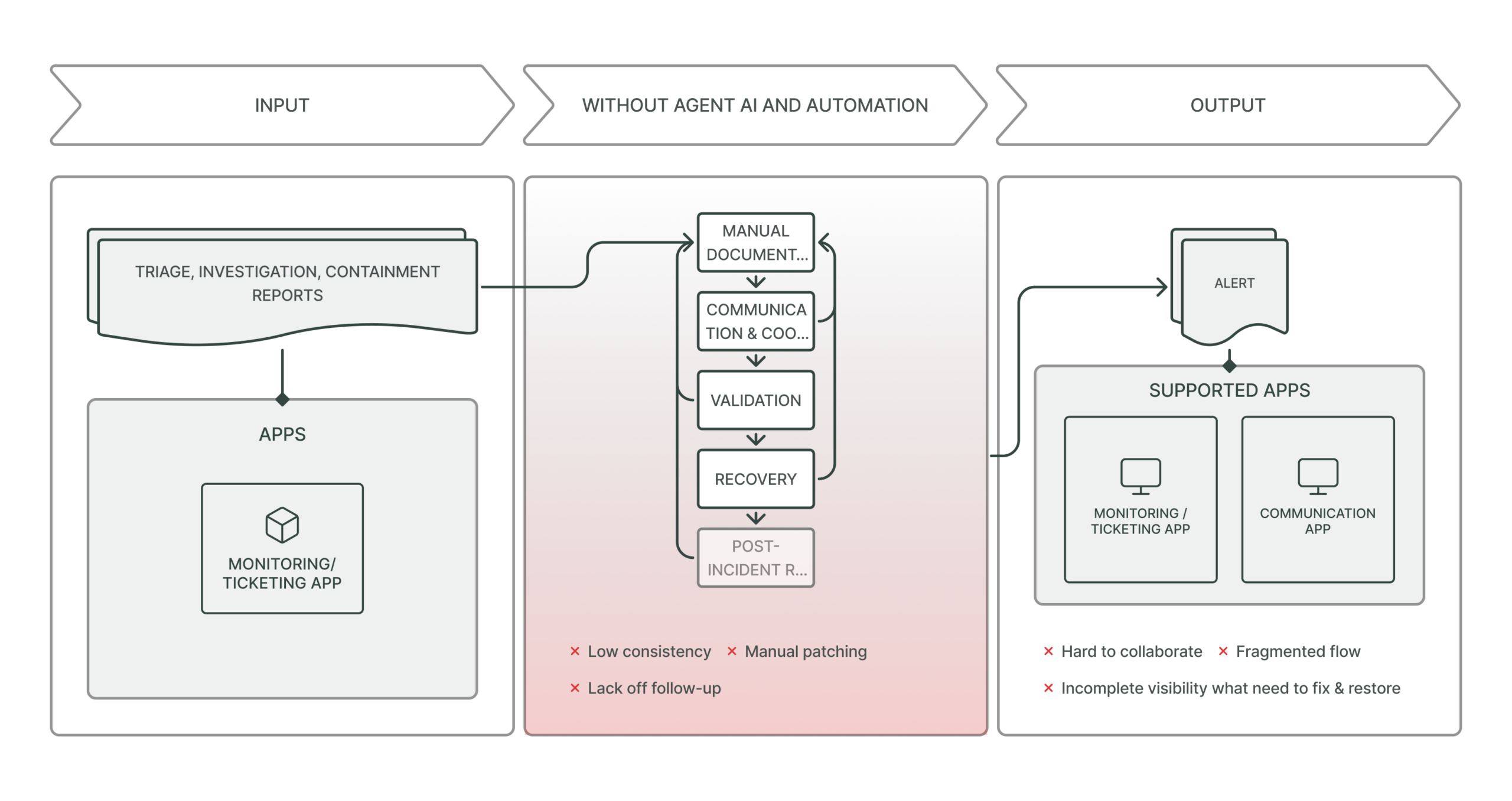
    • Manual execution of containment and recovery actions
    • Documentation and communication through disparate tools

    The Problems:

    • High Mean Time To Detect (MTTD) and Mean Time To Respond (MTTR)
    • Alert fatigue and burnout among analysts
    • 80% of time wasted on false positives
    • Context switching across multiple apps and dashboards
    • Expensive staffing requirements for 24/7 coverage

    According to IBM’s Cost of a Data Breach Report, organizations that contain a breach in under 200 days save an average of $1.2 million. Yet manual workflows make this fast response nearly impossible.

    The Real-World Impact of Manual Remediation

    Case Study: The Cost of Delay

    Imagine a financial services company hit with a phishing-based credential theft. The alert is generated, but the analyst doesn’t respond for several hours due to a high workload. By the time the compromised account is disabled, threat actors have exfiltrated sensitive financial data and initiated fraudulent transactions. The aftermath? Regulatory fines, lost customer trust, and a six-figure financial hit.

    The Human Toll

    Security analysts face repetitive, high-stress tasks that rarely scale. Constant pressure to identify false positives, switch tools, and make high-stakes decisions quickly leads to:

    • Cognitive overload
    • Decision fatigue
    • High turnover rates

    Organizations are essentially burning out their most valuable defenders.

    Why Automation Is the Only Way Forward

    Manual remediation cannot keep pace with modern threats. Automation is no longer a luxury—it’s a strategic imperative.

    Key Advantages of Automated Remediation:

    • Speed: Automatically isolate infected endpoints, disable compromised accounts, and block malicious IPs in real time.
    • Scalability: A single automation playbook can handle thousands of alerts without additional headcount.
    • Accuracy: Reduces human error by relying on pre-tested workflows and logic.
    • Consistency: Ensures uniform responses across teams and time zones.
    • Integration: Connects with existing monitoring, ticketing, and communication tools to streamline operations.

    Enter Agentic-AI and Hyperautomation

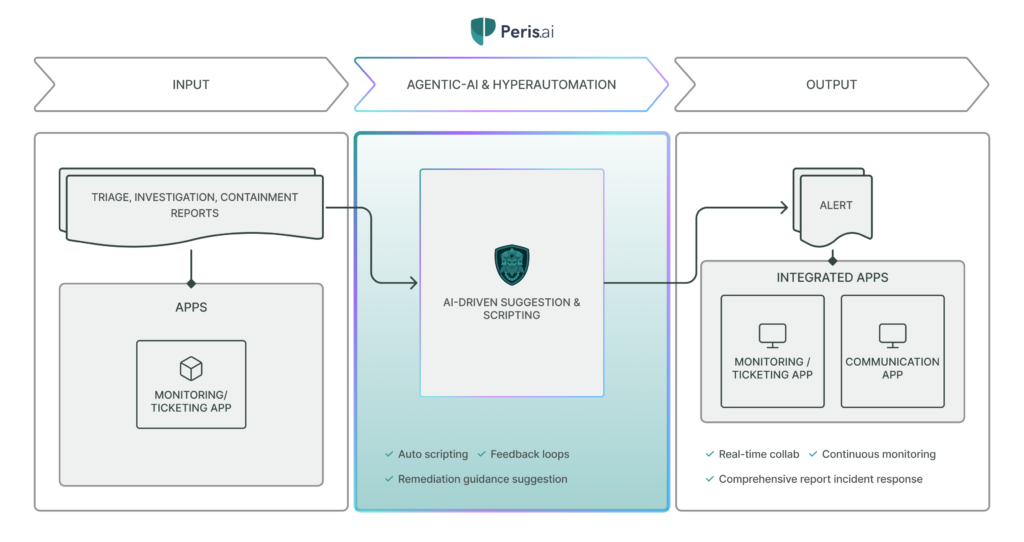
    Brahma Fusion by Peris.ai enables fast, precise, and automated investigation and remediation using Agentic-AI.

    Agentic-AI is the next evolution of automation. Unlike static playbooks, it mimics the cognitive workflow of human analysts and adapts to new threats in real-time.

    How It Works:

    1. Triage Reports are ingested and processed instantly.
    2. Deep Investigate Agent evaluates the root cause using: Threat Intelligence integration and Malware behavior analysis via sandboxing.
    3. Agent Tools auto-dismiss false positives and prioritize real threats.
    4. Automated Playbooks trigger remediation steps: Isolate affected devices, revoke session tokens, block malicious domains or IPs & notify stakeholders.
    5. Integrated Output is pushed into ticketing and communication systems for transparency.

    Key Outcomes:

    • 90% faster threat response
    • Near-zero missed alerts
    • Lower operational costs
    • Enhanced SOC analyst efficiency

    From Chaos to Control — A Side-by-Side Comparison

    Response Speed

    • Manual Remediation: Hours to days
    • Agentic-AI Remediation: Seconds to minutes

    Analyst Involvement

    • Manual Remediation: High
    • Agentic-AI Remediation: Minimal

    False Positive Impact

    • Manual Remediation: Very High
    • Agentic-AI Remediation: Auto-dismissed intelligently

    Tool Fragmentation

    • Manual Remediation: Severe
    • Agentic-AI Remediation: Fully integrated

    Scalability

    • Manual Remediation: Not scalable
    • Agentic-AI Remediation: Infinitely scalable

    MTTD/MTTR

    • Manual Remediation: Poor
    • Agentic-AI Remediation: Excellent

    Real Business Benefits

    Adopting automated remediation provides a measurable ROI:

    Financial:

    • Reduced breach cost and downtime
    • Lower personnel expenses
    • Less reliance on expensive incident response retainers

    Operational:

    • Consistent workflows across geographies
    • Streamlined compliance and audit trails
    • Easier onboarding of new analysts

    Strategic:

    • Free up analysts to focus on threat hunting
    • Boost resilience against complex attacks
    • Strengthen customer trust

    Conclusion: Automate or Get Left Behind

    The threat landscape is only getting faster, more complex, and more aggressive. Manual remediation is a relic of the past—an anchor that drags down your security posture and wastes your most valuable resource: time.

    It’s time to stop reacting and start anticipating. With Agentic-AI and hyperautomation, your organization can move from reactive firefighting to proactive defense.

    If you’re serious about securing your future, the path is clear:

    Automate. Optimize. Stay ahead.

    Ready to leave manual remediation behind? Visit https://www.peris.ai and discover how Brahma Fusion can transform your SOC into an AI-powered command center.

    #PerisAI #Cybersecurity #Hyperautomation #YouBuild #WeGuard

  • 80% False Positives, 0% Efficiency: The Real Problem Behind Alert Fatigue

    80% False Positives, 0% Efficiency: The Real Problem Behind Alert Fatigue

    In the modern cybersecurity landscape, organizations are investing more than ever in threat detection systems, yet breaches still happen — and often, they’re missed because the alert was there, but it got buried in the noise. This noise, largely composed of false positives, is at the heart of what’s known as alert fatigue.

    Security analysts are inundated daily with thousands of alerts. Yet, studies and field evidence suggest that up to 80% of these alerts are false positives — non-malicious events wrongly flagged as threats. These distractions not only waste time and resources, but also create dangerous blind spots where real threats slip through.

    This article dives deep into the true cost of alert fatigue — from analyst burnout to organizational risk — and explores the path forward with intelligent automation.

    The Anatomy of Alert Fatigue

    1. What Is Alert Fatigue?

    Alert fatigue occurs when security teams become desensitized to the overwhelming number of incoming alerts. With so many notifications — most of which are false or low-priority — it becomes nearly impossible to distinguish between genuine threats and background noise.

    2. Causes of Alert Fatigue

    • Excessive False Positives: Misconfigured tools or conservative detection thresholds.
    • Lack of Context: Alerts lacking actionable insights or threat correlation.
    • Siloed Tools: Disconnected systems force analysts to switch contexts frequently.
    • Manual Investigation: Human-only triage is slow, repetitive, and error-prone.

    3. Daily Impact on Analysts

    • Spending hours reviewing non-threat alerts
    • Increasing mental fatigue and cognitive load
    • Missing critical alerts due to information overload
    • Delayed incident response and elevated MTTD (Mean Time To Detect)

    Business Impact: The High Price of Noise

    1. Decreased SOC Efficiency

    Organizations think they’re investing in better security, but without automation, the manual triage model can’t scale. With 80% of alerts being false, the value of your security operations center (SOC) drops dramatically.

    2. Analyst Burnout & Attrition

    SOC analysts are burning out faster than ever. The psychological toll of constant firefighting, long hours, and lack of progress leads to high turnover, which further weakens security postures.

    3. Missed Real Threats

    False positives cause real threats to be ignored. Cyber attackers often hide in the noise, knowing that an overworked SOC team might never catch the anomaly.

    4. Operational Costs

    The financial impact is enormous:

    • Wasted man-hours on non-issues
    • Cost of breach due to missed real alerts
    • Hiring/training new analysts due to turnover
    • Productivity loss from internal investigations

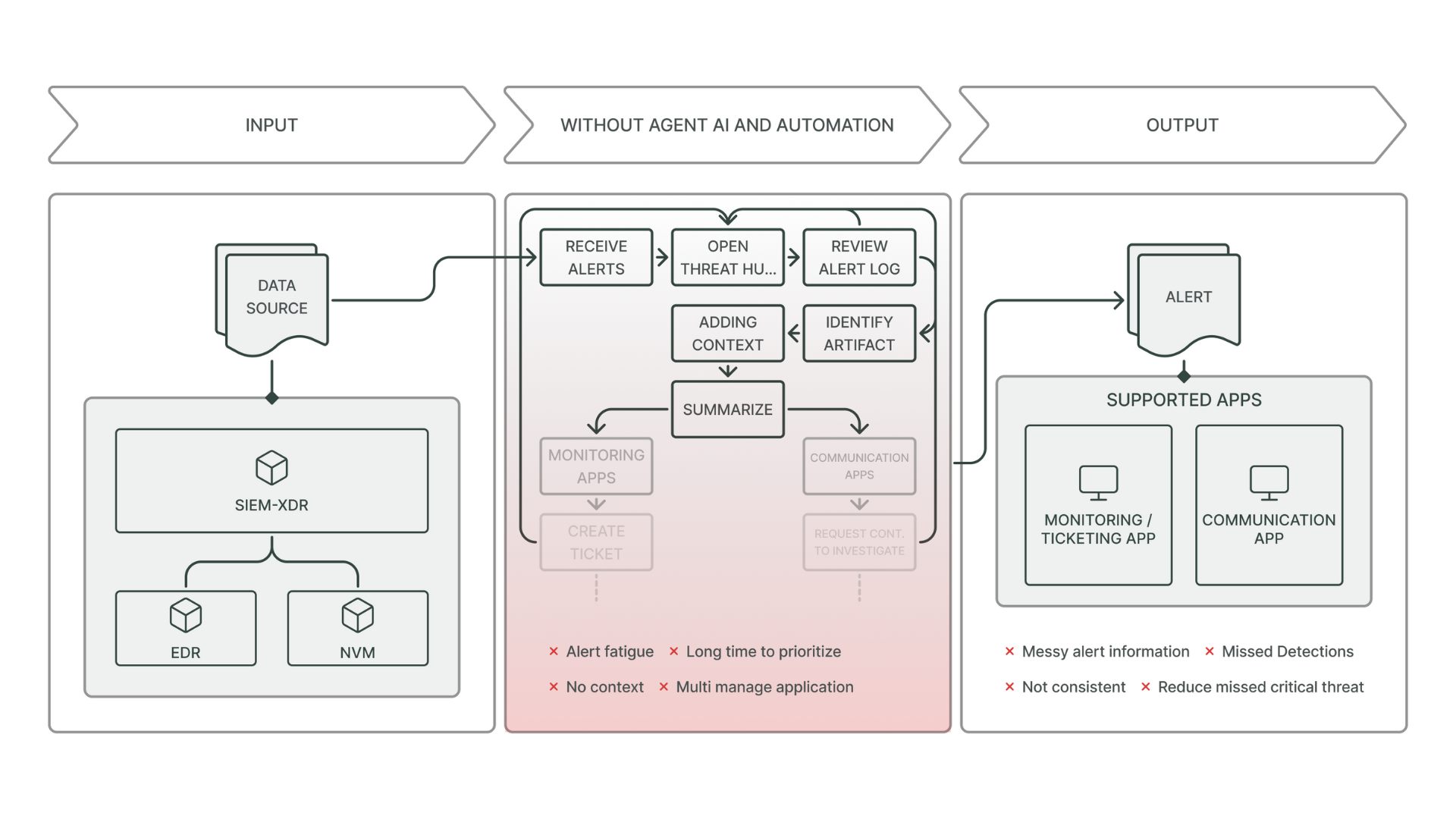
    Manual SOC Investigation Workflow: A Breakdown

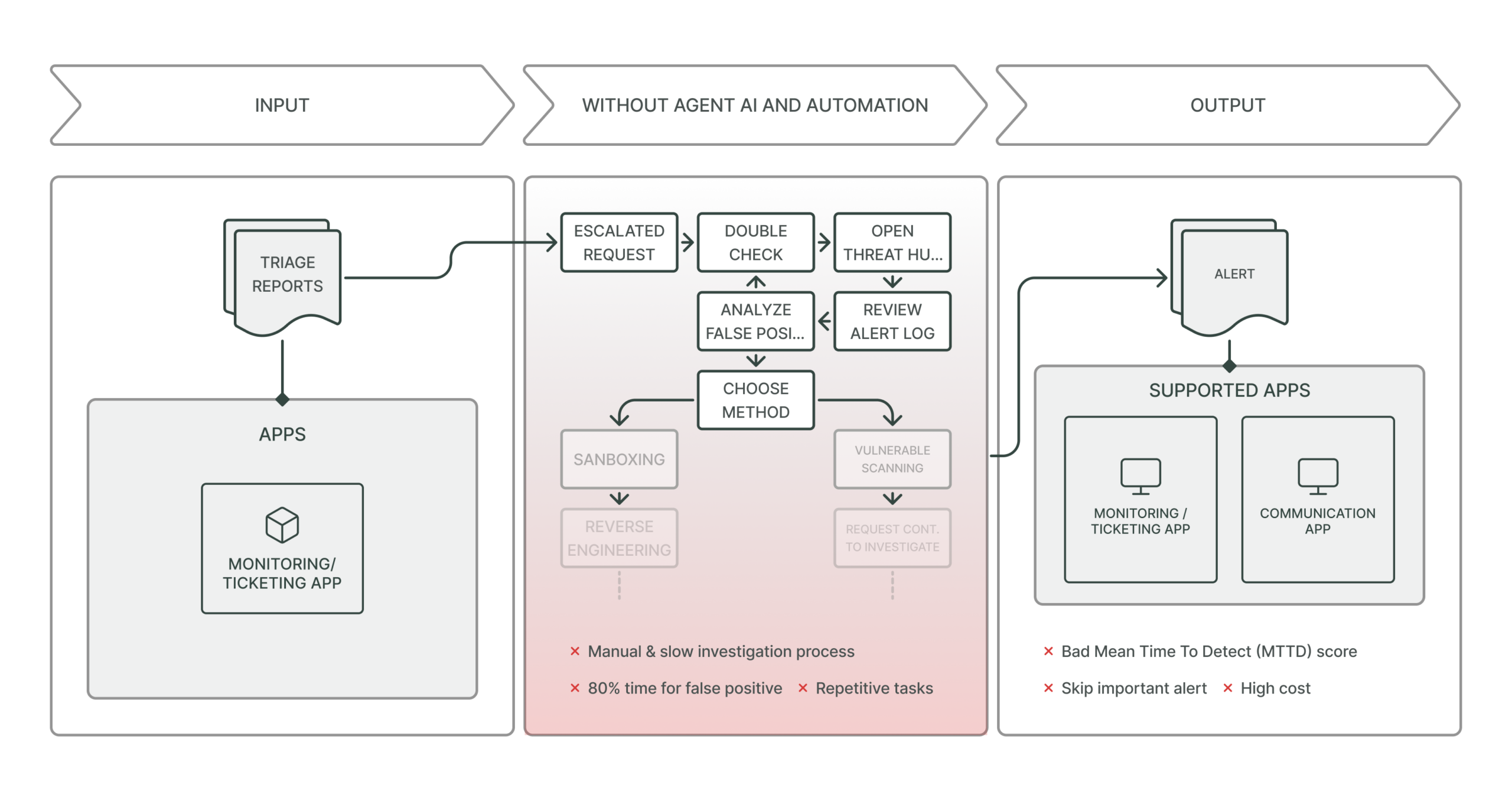
    Let’s visualize how manual investigation slows down response times and increases burnout.

    disjointed investigation workflows leading to analyst overload and missed threats
    Disjointed investigation workflows leading to analyst overload and missed threats

    Highlights from the image:

    • Triage Reports enter manually into apps
    • Analysts escalate and double-check each alert
    • Tools used in isolation: sandboxing, reverse engineering, threat hunting
    • Result: delayed detection, alert fatigue, high cost, missed threats

    This model simply doesn’t scale.

    Reframing the Solution: Agentic-AI and Hyperautomation

    The solution isn’t more tools — it’s better coordination and intelligence across your SOC workflow. Here’s where Agentic-AI and hyperautomation come in.

    Enter Brahma Fusion: Intelligent Investigation, Not More Alerts

    AI-powered investigation flow using Deep Investigate agents and automated threat intelligence tools

    What This Image Shows:

    • Same Triage Report input
    • AI-driven “Deep Investigate” module
    • Agent Tools: Threat Intelligence Apps & Malware Lab
    • Integrated apps for seamless alert output
    • Results: auto-dismiss false positives, reduce cost, faster detection

    How Agentic-AI Works:

    1. Dynamic Triage Paths

    AI agents mimic seasoned analysts by asking investigative questions, mapping relationships, and tracing anomalies.

    2. Threat Contextualization

    Cross-correlates internal logs with global threat intel to enrich alerts with deeper context.

    3. Auto-Dismiss False Positives

    Learns patterns and behaviors to suppress known benign activities, reducing noise.

    4. Human-In-The-Loop Optionality

    Analysts can supervise, confirm, or fine-tune AI decisions — blending speed with control.

    Tangible Benefits for the Organization

    1. Drastic MTTD Reduction

    Organizations using Agentic-AI solutions have reported up to 75% reduction in Mean Time To Detect.

    2. Analyst Empowerment

    Less burnout, better tooling, and more rewarding work keep your top talent engaged.

    3. Reduced Costs

    By cutting time spent on non-threats, orgs reallocate human effort to real risk response.

    4. Better Security Outcomes

    More real threats are caught early, reducing breach risk and financial losses.

    Conclusion: Cut Through the Noise Before It Cuts Into You

    The cybersecurity war isn’t just fought with firewalls and threat intel — it’s won with clarity. And right now, most organizations are drowning in alert noise. Alert fatigue isn’t just an IT problem — it’s a business risk.

    By shifting to intelligent, hyperautomated platforms like Brahma Fusion, you can eliminate the noise, protect your team, and gain the clarity your organization needs to stay secure.

    It’s not about seeing every alert. It’s about seeing the right ones — instantly.

    Explore how Peris.ai can help your SOC cut false positives, boost efficiency, and stop real threats faster. Visit www.peris.ai

  • Containment Bottlenecks: Why Most Breaches Escalate Before You Can Act

    Containment Bottlenecks: Why Most Breaches Escalate Before You Can Act

    In today’s cybersecurity landscape, organizations are investing heavily in detection systems. SIEMs, EDRs, NDRs, and advanced threat intelligence platforms promise to identify malicious activity as soon as it occurs. But even with this digital arsenal, breaches continue to happen. Why?

    Because detection alone is not enough. The real issue lies in what happens after detection: containment. And in most organizations, containment is where everything falls apart.

    This article explores one of the most overlooked vulnerabilities in modern cybersecurity operations: the delay between when a threat is detected and when it is actually contained. We’ll uncover the root causes of these containment bottlenecks, their real-world consequences, and how to fix them with intelligent automation.

    The Anatomy of Containment Bottlenecks

    1. Alert Fatigue and Prioritization Paralysis

    Security analysts are inundated with alerts every day. Studies show that over 80% of alerts are false positives. SOC teams spend countless hours triaging, correlating, and validating these alerts. In the meantime, real threats are buried in the noise.

    Even when a high-priority alert is recognized, determining the scope and severity of the incident takes time. Analysts must:

    • Review event logs
    • Correlate telemetry across tools
    • Investigate anomalies manually
    • Verify whether the alert is actionable

    This “detection-to-decision” gap is the first and most dangerous bottleneck.

    2. Fragmented Security Tools

    In many organizations, the tools used for detection, investigation, and containment are not integrated. An analyst may need to:

    • Investigate in the SIEM
    • Validate in an EDR console
    • Raise a ticket in a case management system
    • Send messages through Slack or email

    Each handoff introduces delay. Each manual step increases the chance for error or oversight.

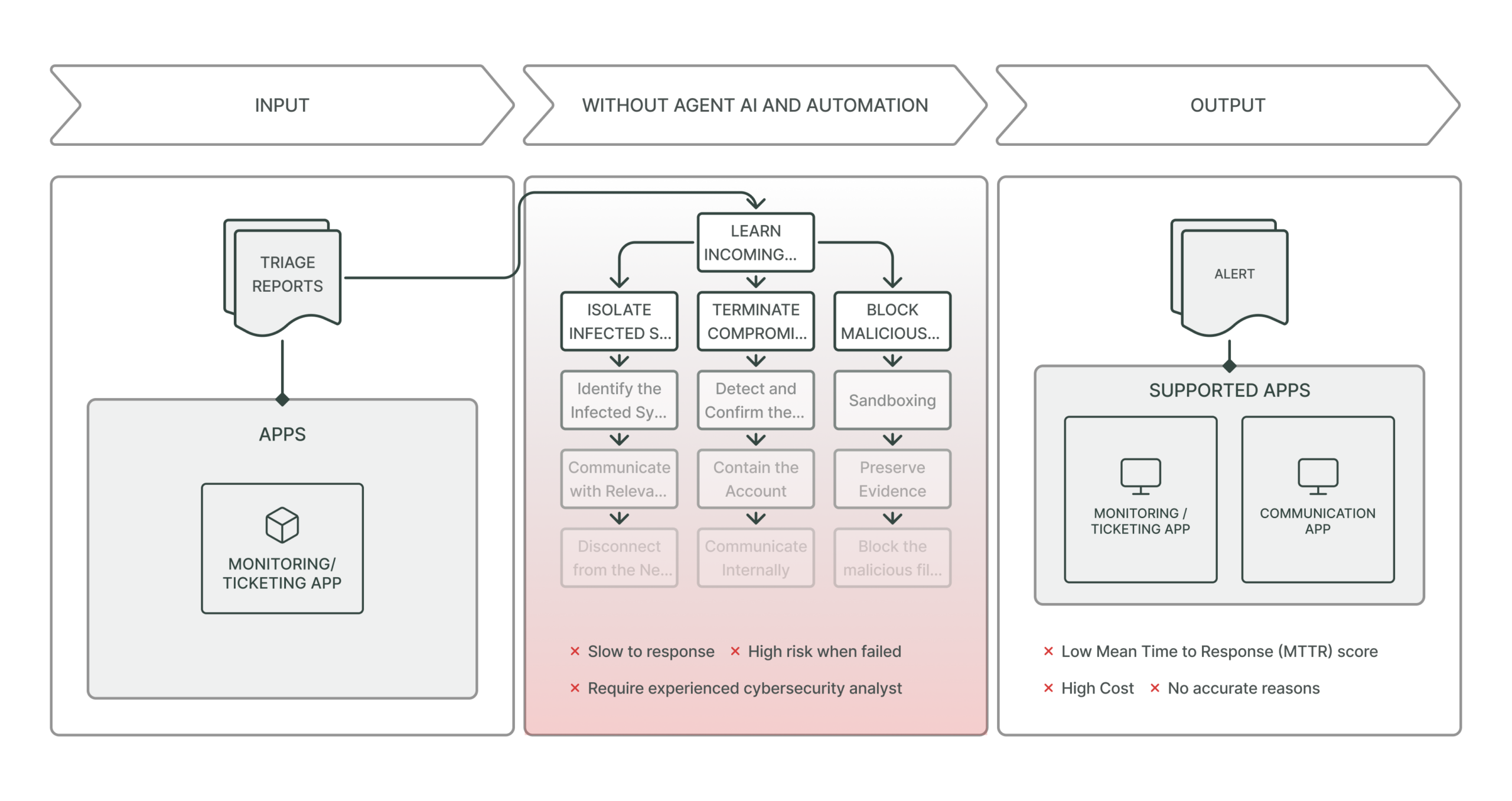
    3. Manual Containment Is Too Slow

    Once a threat is confirmed, actions like isolating a system, disabling a user, or blocking a domain still require human intervention. The process typically involves:

    • Identifying the correct system or user
    • Communicating with stakeholders
    • Executing the action in the respective tool
    • Logging the incident and reporting the action

    These actions, when done manually, can take minutes to hours. In the time it takes to isolate a compromised device, malware could already have moved laterally across the network.

    4. Lack of Contextual Awareness

    Most SOC tools do not provide automated context about:

    • Who owns the compromised asset
    • What business process it supports
    • Whether it’s part of a critical application or system

    This lack of visibility creates hesitation. Security teams delay containment out of fear they might disrupt core operations, leading to escalated breaches.

    Real-World Consequences of Containment Delay

    • Ransomware Spreading Laterally: A single uncontained endpoint becomes a gateway for network-wide encryption.
    • Credential Stuffing Escalation: Delay in disabling compromised accounts results in unauthorized access to sensitive systems.
    • Data Exfiltration: Even seconds matter when a threat actor is actively stealing files. The longer the delay, the higher the data loss.
    • Brand Damage: News spreads fast. The public often learns of the breach before the internal team contains it.

    These scenarios are not hypothetical. They happen every day.

    Brahma Fusion by Peris.ai empowers SOCs with Agentic-AI and Hyperautomation to isolate threats instantly, reducing MTTR and breach risk.
    Brahma Fusion by Peris.ai empowers SOCs with Agentic-AI and Hyperautomation to isolate threats instantly, reducing MTTR and breach risk.

    The Way Forward: Intelligent, Automated Containment

    To fix containment bottlenecks, organizations must shift from manual containment to AI-driven hyperautomation. This involves:

    1. Introducing Agentic-AI in the SOC

    Agentic-AI systems are not just reactive. They actively learn from past incidents, adapt containment strategies, and make autonomous decisions in real time. This enables:

    • Instant detection-to-decision transitions
    • Autonomous triggering of response actions
    • Continuous optimization of playbooks

    2. Automated Playbook Execution

    Hyperautomation allows organizations to:

    • Automatically isolate endpoints once indicators match known threats
    • Disable user accounts based on behavior anomalies
    • Block domains or IPs across firewall, DNS, and proxy layers

    With minimal analyst input, containment becomes fast, consistent, and precise.

    3. Real-Time Contextual Awareness

    Solutions like Brahma Fusion integrate with business asset inventories, HR systems, and application dependency maps. This gives automated systems the confidence to:

    • Understand the business impact of containment
    • Prioritize assets based on criticality
    • Contain threats with reduced risk of operational disruption

    4. Unified Dashboards and Orchestration

    Instead of managing 5-10 separate tools, analysts can operate from a single pane of glass where:

    • Alerts are enriched automatically
    • Recommended actions are generated and executed
    • Full audit trails are logged

    This orchestration removes the friction of human handoffs and enables rapid containment at scale.

    Business Impact: Why Faster Containment Matters

    Reduced MTTR (Mean Time to Respond)

    • From hours to seconds
    • Improves threat containment before lateral movement occurs

    Lower Operational Costs

    • Fewer resources needed to manage incident response
    • Less downtime due to proactive isolation

    Enhanced Analyst Productivity

    • Analysts focus on strategic analysis instead of manual tasks
    • Reduced burnout and turnover

    Better Compliance and Audit Readiness

    • All containment actions are logged and justified
    • Reports are generated automatically for regulators

    Stronger Security Posture

    • Confidence in stopping breaches before they escalate
    • Demonstrated resilience to board members and stakeholders

    Final Thoughts: Containment Is the New Battleground

    As attackers become faster, stealthier, and more sophisticated, the old way of doing things simply doesn’t work. Companies can no longer afford to rely on manual processes and fragmented tools when every second counts.

    Containment is no longer just a technical task. It’s a strategic capability.

    Agentic-AI and hyperautomation aren’t just buzzwords—they are the only way forward.

    Platforms like Brahma Fusion by Peris.ai are proving that automated, intelligent containment is not only possible, but essential. With the ability to respond in real time, orchestrate actions across environments, and adapt over time, organizations can finally stop breaches before they spread.

    Learn More

    Explore how Brahma Fusion can help your organization accelerate containment, reduce risk, and build a truly modern SOC: Visit www.peris.ai

    #ContainmentAutomation #SOCTransformation #AgenticAI #BrahmaFusion #PerisAI #Cybersecurity #YouBuild #WeGuard

  • The Risk You Don’t See: Inconsistent Alert Triage Is a Breach Waiting to Happen

    The Risk You Don’t See: Inconsistent Alert Triage Is a Breach Waiting to Happen

    Cybersecurity is no longer just about whether an organization will face threats—it’s about how quickly and effectively it can detect and respond to them. At the core of this defensive capability is one critical process: triage. Yet, in many Security Operations Centers (SOCs), triage remains inconsistent, reactive, and dangerously manual.

    Inconsistent alert triage is a silent vulnerability. While it doesn’t always make headlines like a data breach or ransomware attack, it sets the stage for these crises. Without a structured, context-aware system, even the most advanced tools can fail to deliver clarity, leaving even experienced analysts struggling to prioritize threats effectively.

    The Hidden Dangers of Inconsistent Triage

    Modern enterprises are hyper-connected ecosystems, continuously generating massive amounts of data. Within this data lie critical indicators of compromise—subtle signs of malicious activity that often appear as fragmented alerts.

    Key risks of inconsistent triage include:

    • Overwhelming Alert Volumes: Analysts must manually navigate multiple platforms (SIEMs, endpoint detection tools, network monitors, ticketing systems), creating confusion and delays.
    • Lack of Context: Alerts are frequently ambiguous, lacking sufficient context to determine urgency effectively.
    • Equal Priority for All Alerts: Traditional systems fail to assess risk contextually, forcing analysts to treat all alerts with equal urgency, regardless of their true threat level.
    • Wasted Time on False Positives: Hours spent investigating benign alerts allow genuine threats to go unnoticed, giving adversaries valuable time to act.
    • Strategic Vulnerability: Time lost isn’t just operational inefficiency—it represents strategic opportunities granted to attackers.

    The Breakdown of Manual Defense

    Manual triage creates isolated islands of information. Threat intelligence often remains detached from real-time detection. Playbooks are static, rigidly applied to dynamic threats. Analyst decisions become overly dependent on personal experience rather than systemic intelligence. This fragmentation leads to gaps that widen with every new alert.

    Human fatigue compounds the problem. Constant vigilance required for alert triage—without automation—leads inevitably to cognitive overload. Critical signals are missed, investigations stall, and overlooked alerts become breaches waiting to happen.

    Rethinking Triage with Brahma Fusion

    To break this cycle, organizations must reimagine triage not as a task but as an intelligent system—driven by intent, enriched by data, and empowered by continuous learning. This is precisely where Brahma Fusion by Peris.ai changes the game.

    Brahma Fusion is more than an orchestration platform; it’s an intelligent decision engine designed to interpret, analyze, and act upon alerts. With Agentic-AI at its core, Brahma Fusion processes every alert with deep contextual awareness. It understands relationships between events, extracts artifacts, assesses intent, and scores alerts based on actual impact, not theoretical severity.

    Intelligent Triage with Brahma Fusion

    Brahma Fusion Solution
    Brahma Fusion automates enrichment, scoring, and escalation—giving security teams clarity instead of chaos

    Brahma Fusion turns reactive responses into proactive defenses. It groups related alerts into coherent incidents, filters noise effectively, and presents analysts with high-confidence, fully contextualized threats. Brahma Fusion integrates seamlessly with existing tools—SIEMs, EDR, NVM, and others—to unify views and eliminate information silos.

    The transformation goes beyond speed. Analysts shift roles from reactive log-chasers to strategic defenders, containing threats before they escalate. Decisions become informed and precise rather than speculative.

    Beyond Efficiency: A Strategic Shift in Cyber Defense

    Security today requires more than coverage—it demands precision. With Brahma Fusion, organizations can:

    • Surface the most critical threats immediately.
    • Automate the entire detection-to-response pipeline.
    • Scale their SOC without endlessly hiring.
    • Maintain operational clarity during complex incidents.

    This approach isn’t about replacing human analysts—it’s about empowering them. Brahma Fusion provides analysts the time, context, and confidence to focus strategically, while automation handles routine noise.

    Conclusion: Seeing the Risk Before It Strikes

    The greatest risk isn’t the alert you can see—it’s the one you overlook. Inconsistent triage creates blind spots, delays action, and exposes businesses to avoidable threats.

    With Brahma Fusion, triage becomes a force multiplier, transforming alert chaos into actionable insight and reactive firefighting into intelligent orchestration. When the next threat emerges, your team will already be ahead.

    It’s time to see clearly. It’s time to triage intelligently.

    Explore how Brahma Fusion strengthens your defenses at peris.ai

  • SOC Analysts: Garda Terdepan yang Melindungi Data Anda 24/7

    SOC Analysts: Garda Terdepan yang Melindungi Data Anda 24/7

    Di era digital yang terus berkembang, ancaman siber semakin canggih dan agresif. Bisnis tidak bisa hanya mengandalkan sistem keamanan pasif—diperlukan pemantauan aktif dan respons cepat untuk menghindari risiko besar seperti kebocoran data, serangan ransomware, dan pencurian identitas.

    Di sinilah peran Security Operations Center (SOC) menjadi sangat penting. SOC analysts bekerja sepanjang waktu untuk mendeteksi, menganalisis, dan merespons ancaman siber sebelum menimbulkan dampak yang lebih besar. Dengan pendekatan proaktif, mereka memastikan keamanan jaringan, sistem, dan data tetap terjaga.

    Peran Penting SOC Analysts dalam Keamanan Siber

    SOC analysts bukan hanya bertugas memantau sistem keamanan, tetapi juga menjadi garis pertahanan pertama terhadap serangan siber. Dengan menggunakan berbagai alat canggih, mereka dapat mendeteksi dan mencegah ancaman sebelum berkembang menjadi insiden besar.

    Beberapa tanggung jawab utama SOC analysts meliputi:

    • Pemantauan terus-menerus terhadap aktivitas jaringan, endpoint, dan cloud untuk mendeteksi potensi ancaman.
    • Threat intelligence dan deteksi serangan, menggunakan kecerdasan buatan untuk mengidentifikasi pola ancaman.
    • Manajemen insiden dan mitigasi, merespons serangan dengan cepat untuk meminimalkan kerusakan.
    • Kepatuhan terhadap regulasi, memastikan bisnis memenuhi standar keamanan data yang berlaku.
    • Peningkatan keamanan berkelanjutan, dengan mengembangkan strategi baru berdasarkan tren ancaman terbaru.

    Teknologi yang Digunakan dalam SOC

    Untuk memastikan respons yang efektif terhadap ancaman siber, SOC analysts menggunakan berbagai sistem keamanan mutakhir.

    Beberapa teknologi utama yang mereka andalkan meliputi:

    • Security Information and Event Management (SIEM) untuk mengumpulkan dan menganalisis log keamanan guna mendeteksi anomali.
    • Intrusion Detection & Prevention Systems (IDS/IPS) yang mencegah lalu lintas berbahaya sebelum menyerang sistem.
    • Endpoint Detection and Response (EDR) guna memantau perangkat dari ancaman siber.
    • User and Entity Behavior Analytics (UEBA) untuk mengidentifikasi aktivitas pengguna yang mencurigakan.
    • Dark Web Monitoring guna melacak data yang mungkin dicuri dan diperjualbelikan.

    Dengan teknologi ini, SOC analysts dapat menghentikan serangan sebelum berkembang menjadi kebocoran data besar.

    Siklus Respons Insiden dalam Keamanan Siber

    Ketika terjadi insiden keamanan, SOC analysts mengikuti siklus respons insiden yang terstruktur untuk meminimalkan kerugian.

    Tahapan utama dalam siklus ini mencakup:

    • Identifikasi – Mendeteksi dan mengklasifikasikan ancaman berdasarkan tingkat keparahan.
    • Containment (Isolasi) – Mengambil tindakan untuk mencegah penyebaran serangan lebih lanjut.
    • Eradikasi – Menghapus file berbahaya dan akses tidak sah dari sistem.
    • Recovery – Memulihkan sistem yang terdampak dan menerapkan langkah-langkah pencegahan tambahan.
    • Post-Incident Analysis – Mengevaluasi serangan untuk memperbaiki celah keamanan di masa depan.

    Proses ini membantu perusahaan mengurangi downtime, mencegah kerugian finansial, dan menjaga reputasi bisnis.

    Deteksi Ancaman Real-Time: Masa Depan Keamanan Siber

    Serangan siber terus terjadi, sehingga deteksi ancaman secara real-time menjadi semakin krusial. Dengan mengadopsi SOC berbasis AI, perusahaan dapat mengurangi waktu deteksi pelanggaran dan memangkas biaya keamanan secara signifikan.

    Keuntungan utama dari deteksi ancaman real-time meliputi:

    • Identifikasi ancaman lebih cepat, dengan analisis berbasis AI yang mendeteksi serangan dalam hitungan detik.
    • Respons insiden lebih efisien, memungkinkan tindakan otomatis untuk menangani ancaman.
    • Peningkatan ketahanan siber, dengan sistem pemantauan proaktif yang mengurangi risiko serangan.

    SOC analysts memainkan peran penting dalam memastikan keamanan bisnis tetap terjaga dari ancaman yang terus berkembang.

    Membangun Infrastruktur Keamanan Siber yang Kuat

    Untuk melindungi aset digital, SOC analysts merekomendasikan berbagai strategi keamanan yang dapat diterapkan oleh perusahaan.

    Beberapa langkah utama yang bisa dilakukan meliputi:

    • Model Zero-Trust Security, yang memastikan tidak ada akses yang diberikan tanpa verifikasi ketat.
    • Multi-Factor Authentication (MFA) untuk mencegah akses tidak sah.
    • Audit keamanan rutin guna mengidentifikasi dan memperbaiki celah keamanan sebelum dimanfaatkan peretas.
    • Enkripsi data untuk melindungi informasi penting.
    • Pelatihan kesadaran keamanan siber agar karyawan dapat mengenali dan menghindari ancaman seperti phishing.

    Dengan menerapkan strategi ini, bisnis dapat menghindari serangan dan tetap mematuhi regulasi keamanan data.

    Kesimpulan: Mengapa SOC Analysts Sangat Dibutuhkan

    Serangan siber semakin berbahaya, dan bisnis tidak bisa hanya mengandalkan sistem keamanan pasif. SOC analysts bekerja sepanjang waktu untuk menjaga keamanan jaringan, mendeteksi ancaman, dan merespons insiden dengan cepat—memastikan data tetap aman kapan saja.

    Investasi dalam SOC membantu perusahaan mengurangi risiko kebocoran data, meningkatkan kepatuhan terhadap regulasi, mencegah downtime, dan melindungi reputasi bisnis.

    Jangan menunggu sampai serangan terjadi—lindungi bisnis Anda dengan layanan SOC yang andal.

  • MTTR vs. MTTD: Mana yang Paling Penting untuk Keberhasilan Keamanan Siber?

    MTTR vs. MTTD: Mana yang Paling Penting untuk Keberhasilan Keamanan Siber?

    *Untuk membaca artikel lengkapnya dalam Bahasa Inggris, kunjungi tautan berikut: MTTR vs. MTTD: Mana yang Paling Penting untuk Keberhasilan Keamanan Siber?

    Dalam dunia keamanan siber, dua metrik utama yang sering digunakan untuk mengukur efektivitas Security Operations Center (SOC) adalah Mean Time to Detect (MTTD) dan Mean Time to Remediate (MTTR).

    MTTD menunjukkan seberapa cepat tim SOC dapat mendeteksi ancaman atau pelanggaran keamanan dalam sistem IT.
    MTTR mengukur berapa lama waktu yang dibutuhkan untuk mengatasi dan memperbaiki masalah setelah ditemukan.

    Mengapa metrik ini sangat penting?
    Semakin cepat suatu ancaman dapat dideteksi (MTTD rendah) dan diperbaiki (MTTR rendah), semakin kecil potensi kerugian yang diakibatkan oleh serangan siber, kebocoran data, atau peretasan. Jika waktu deteksi dan pemulihan terlalu lama, penyerang bisa tetap bersembunyi dalam sistem, mencuri data penting, atau bahkan menyebabkan downtime yang merugikan bisnis.

    Pentingnya Metrik Keamanan Siber dalam SOC

    Metrik keamanan membantu organisasi mengukur dan meningkatkan efektivitas respons insiden serta mendukung pengambilan keputusan berbasis data.

    1️⃣ Mengukur Efektivitas Manajemen Insiden

    • MTTD dan MTTR adalah indikator utama dalam mengevaluasi seberapa efisien SOC dalam menangani insiden keamanan.
    • MTTD yang lebih rendah berarti tim dapat mendeteksi ancaman lebih cepat, sehingga bisa segera direspons.
    • MTTR yang lebih rendah menunjukkan keandalan sistem dan seberapa baik proses pemulihan berjalan.

    2️⃣ Mengoptimalkan Kinerja Tim Keamanan

    • Metrik keamanan membantu mengevaluasi efisiensi tim SOC dan mengidentifikasi area yang perlu ditingkatkan.
    • Mean Time to Acknowledge (MTTA), misalnya, mengukur seberapa cepat tim mulai menangani ancaman setelah menerima peringatan.

    3️⃣ Memastikan Kepatuhan terhadap Regulasi

    • Di industri yang memiliki aturan ketat seperti keuangan dan layanan kesehatan, metrik keamanan membantu organisasi menunjukkan bahwa kontrol keamanan mereka berfungsi dengan baik.
    • Kepatuhan terhadap standar seperti ISO 27001, NIST, dan GDPR sering kali mengharuskan perusahaan memiliki waktu deteksi dan remediasi yang terukur dan terdokumentasi dengan baik.

    “Metrik keamanan siber sangat penting untuk menunjukkan komitmen organisasi dalam melindungi data sensitif dan mengelola risiko vendor dengan baik.”

    ️‍♂️ Apa Itu Mean Time to Detect (MTTD)?

    MTTD (Mean Time to Detect) adalah waktu rata-rata yang dibutuhkan tim SOC untuk mengidentifikasi ancaman keamanan dalam sistem IT.

    Cara menghitungnya:

    MTTD=TotalWaktuDeteksiInsidenJumlahInsidenMTTD = frac{text{Total Waktu Deteksi Insiden}}{text{Jumlah Insiden}}

    Contoh:

    • Tim A mendeteksi 10 insiden dalam 1.000 menit, berarti MTTD = 100 menit.
    • Tim B mendeteksi 8 insiden dalam 1.500 menit, berarti MTTD = 187,5 menit.

    Tim A memiliki MTTD lebih baik karena lebih cepat mendeteksi ancaman.
    MTTD yang lebih pendek berarti tim keamanan lebih responsif dalam mengidentifikasi potensi serangan.

    Solusi untuk Memperbaiki MTTD:

    • Menggunakan SOC 24/7 seperti Arctic Wolf untuk deteksi ancaman secara real-time.
    • Mengoptimalkan sistem SIEM (Security Information and Event Management) untuk analisis data yang lebih cepat.
    • Automasi deteksi ancaman untuk mengurangi false positive dan meningkatkan efisiensi tim SOC.

    ⚙️ Apa Itu Mean Time to Remediate (MTTR)?

    MTTR (Mean Time to Remediate) adalah rata-rata waktu yang dibutuhkan untuk memperbaiki dan mengatasi masalah keamanan setelah ancaman terdeteksi.

    MTTR meliputi:
    Waktu untuk mengidentifikasi ancaman
    Waktu untuk menilai dampaknya
    Waktu untuk melakukan tindakan perbaikan
    Waktu untuk mencegah kejadian serupa di masa depan

    Mengapa MTTD dan MTTR Sangat Penting?

    • Jika serangan siber terdeteksi tetapi tidak segera diperbaiki, risiko kerugian finansial dan pencurian data semakin besar.
    • Jika MTTR terlalu tinggi, sistem dapat mengalami downtime yang berdampak pada operasional bisnis.

    Cara Mengurangi MTTR:

    • Menyiapkan prosedur respons insiden yang jelas dan terdokumentasi.
    • Meningkatkan kolaborasi antar tim keamanan IT untuk mempercepat remediasi.
    • Menggunakan AI-driven Security Automation untuk mempercepat langkah mitigasi ancaman.

    Metrik SOC Lain yang Perlu Diperhatikan

    Selain MTTD dan MTTR, ada beberapa metrik lain yang juga berperan penting dalam mengevaluasi efektivitas SOC:

    Mean Time to Investigate (MTTI): Waktu yang dibutuhkan untuk memulai investigasi setelah ancaman terdeteksi.
    Mean Time to Resolve (MTTR): Total waktu yang dibutuhkan untuk menyelesaikan insiden dari awal hingga akhir.
    False Positive Rate (FPR) dan False Negative Rate (FNR): Mengukur akurasi peringatan keamanan yang diterima tim SOC.
    Cost of an Incident: Biaya total yang diakibatkan oleh insiden keamanan, termasuk perbaikan, denda, dan dampak reputasi.

    “Metrik keamanan yang baik memungkinkan tim SOC untuk fokus pada perbaikan yang lebih efektif dan mengoptimalkan investasi keamanan siber perusahaan.”

    Meningkatkan Kinerja SOC dengan AI & Automasi

    Kecerdasan buatan (AI) dan otomatisasi memainkan peran besar dalam meningkatkan MTTD dan MTTR. Dengan AI, tim SOC dapat:

    Mengidentifikasi ancaman lebih cepat dengan analisis data otomatis.
    Meningkatkan efisiensi investigasi dan remediasi dengan machine learning.
    Mengurangi beban kerja analis SOC dengan otomatisasi triase insiden.

    Contoh Implementasi AI dalam SOC:

    • Automated Threat Detection & Response: Mengurangi waktu respons dengan analisis ancaman berbasis AI.
    • Incident Playbooks: Menggunakan otomatisasi untuk mengeksekusi langkah-langkah remediasi lebih cepat.
    • Security Orchestration: Menghubungkan berbagai sistem keamanan untuk mempercepat investigasi dan remediasi ancaman.

    “Unsupervised Machine Learning dapat meningkatkan deteksi anomali dan membantu mengurangi waktu respons insiden keamanan.”

    Percepat Deteksi & Respons dengan Brahma Fusion dari Peris.ai

    Di era ancaman siber yang semakin kompleks, perusahaan memerlukan solusi keamanan yang cepat dan efektif. Brahma Fusion dari Peris.ai menghadirkan automasi keamanan berbasis AI, yang membantu mengurangi MTTD dan MTTR melalui:

    Deteksi ancaman berbasis AI untuk analisis real-time.
    Automasi respons insiden untuk remediasi lebih cepat.
    Integrasi dengan berbagai sistem keamanan untuk pengelolaan ancaman yang lebih baik.

    Perkuat pertahanan siber Anda dengan Brahma Fusion!

    Kunjungi Peris.ai untuk informasi lebih lanjut dan lindungi bisnis Anda dari ancaman digital!

    #YouBuild #WeGuard

    ❓ FAQ: Pertanyaan Umum tentang MTTD dan MTTR

    Apa itu MTTD dan MTTR dalam keamanan siber?

    MTTD (Mean Time to Detect) adalah waktu untuk mendeteksi ancaman, sementara MTTR (Mean Time to Remediate) adalah waktu untuk memperbaiki dan mengatasi insiden setelah terdeteksi.

    Mengapa MTTD dan MTTR sangat penting?

    Semakin rendah MTTD dan MTTR, semakin cepat perusahaan dapat merespons ancaman, mengurangi risiko serangan siber dan potensi kerugian bisnis.