Category: Article

  • Pentesting Unleashed: Proactive Cybersecurity at its Best

    Pentesting Unleashed: Proactive Cybersecurity at its Best

    Pentesting, also known as penetration testing, is a crucial practice in the field of cybersecurity. It involves rigorously scrutinizing computer systems, networks, and web applications to identify and expose vulnerabilities that attackers could exploit. By proactively testing and reinforcing the security of digital infrastructures, pentesting plays a vital role in defending against constantly evolving cyber threats.

    This article will delve into the intricacies of pentesting, exploring its meaning, a pentester’s career path, and the practice’s technicalities. It will also discuss specialized areas of pentesting, such as network penetration testing and physical penetration testing, highlighting the importance of this proactive approach to cybersecurity.

    Key Takeaways:

    • Pentesting is a proactive approach to cybersecurity, identifying and addressing vulnerabilities before attackers can exploit them.
    • It involves rigorous testing and reinforcement of computer systems, networks, and web applications.
    • A career in pentesting requires a strong foundation in IT fundamentals, specialized skills, and continuous learning.
    • Specialized areas within pentesting, such as network penetration testing and physical penetration testing, further enhance cybersecurity measures.
    • As social engineering attacks evolve, organizations need to stay vigilant and invest in advanced security tools and awareness programs.

    The Essence of Penetration Testing in Cyber Security

    Penetration testing, also known as pen testing, is a fundamental practice in the realm of cybersecurity. It involves thoroughly examining computer systems, networks, or web applications to identify vulnerabilities that attackers could potentially exploit. By simulating cyber-attacks and pinpointing weaknesses, penetration testing helps organizations assess the effectiveness of their security measures and fortify their defenses. This proactive approach is essential in an era where cyber threats are constantly evolving, making the role of a pentester indispensable in the ongoing battle against cybercrime.

    To better understand the significance of penetration testing, let’s explore some key aspects related to this important field:

    1. The proactive nature: Penetration testing takes a proactive approach to cybersecurity. Instead of waiting for an attack, organizations employ pentesters to actively search for vulnerabilities and address them before they can be exploited. This proactive stance enables businesses to stay one step ahead of cybercriminals, minimizing the potential damage and loss.
    2. Vulnerability assessment: Penetration testing involves thoroughly assessing vulnerabilities within computer systems, networks, or web applications. It encompasses various techniques and methodologies to identify weaknesses and potential entry points for attackers. By conducting vulnerability assessments, organizations can comprehensively understand their security posture and develop effective strategies to enhance their defenses.
    3. Cybersecurity optimization: The primary objective of penetration testing is to optimize cybersecurity measures. Organizations can implement targeted solutions to address these gaps by identifying vulnerabilities and weaknesses. Regular penetration testing allows businesses to measure the effectiveness of their security measures, identify areas that require improvement, and make informed decisions regarding resource allocation for maximum cyber defense.

    Overall, penetration testing is crucial in fortifying cybersecurity by identifying vulnerabilities, assessing their potential impact, and implementing proactive measures to mitigate risks. It enables organizations to proactively approach cybersecurity, optimize their defenses, and stay ahead of the ever-evolving cyber threat landscape.

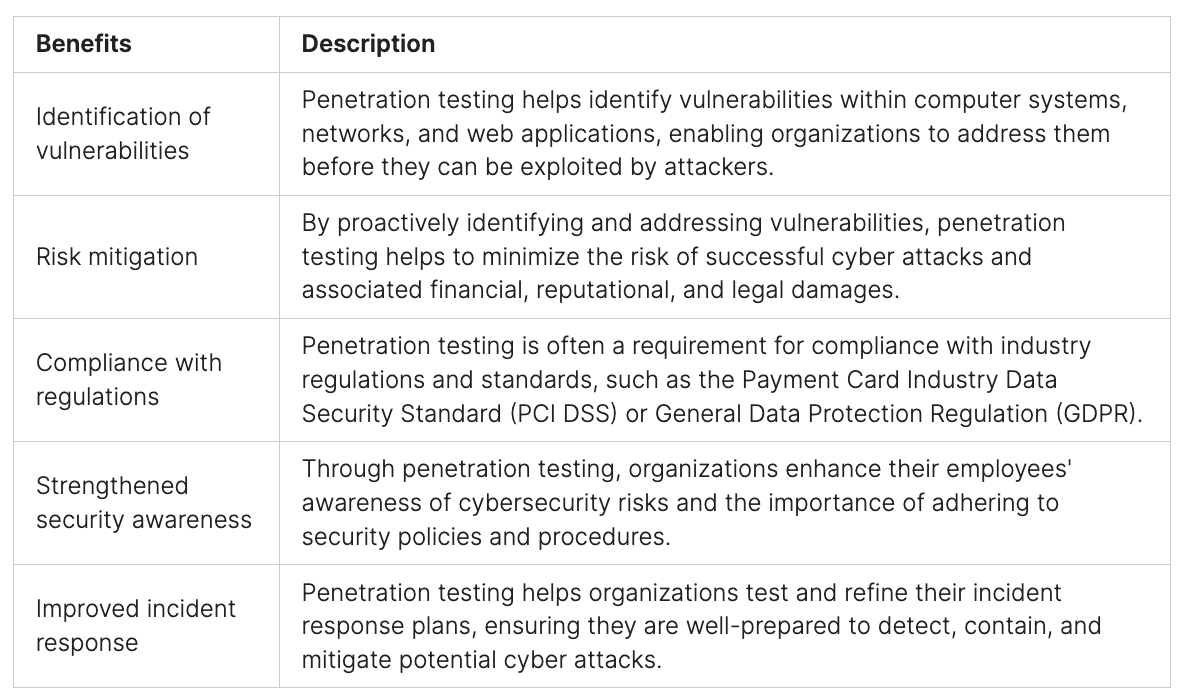
    Benefits of Penetration Testing:
    The Pentester Career Path

    The career path of a pentester is an exciting journey into the dynamic world of cybersecurity. Aspiring pentesters need to develop a strong foundation in IT fundamentals and progressively specialize in security pen and cyber penetration testing. Gaining experience in roles such as network security analyst or IT security consultant can pave the way for advancement.

    Continuous learning is crucial in this field, as cybersecurity is ever-evolving. Pentesters must stay current with the latest hacking techniques, defensive strategies, and emerging technologies. Engaging in certifications, such as the Certified Ethical Hacker (CEH) certification, demonstrates a commitment to enhancing skills and knowledge.

    Hands-on experience is invaluable for pentesters. Intrusion testing and computer security and penetration testing provide real-world exposure to identify and exploit vulnerabilities in digital systems.
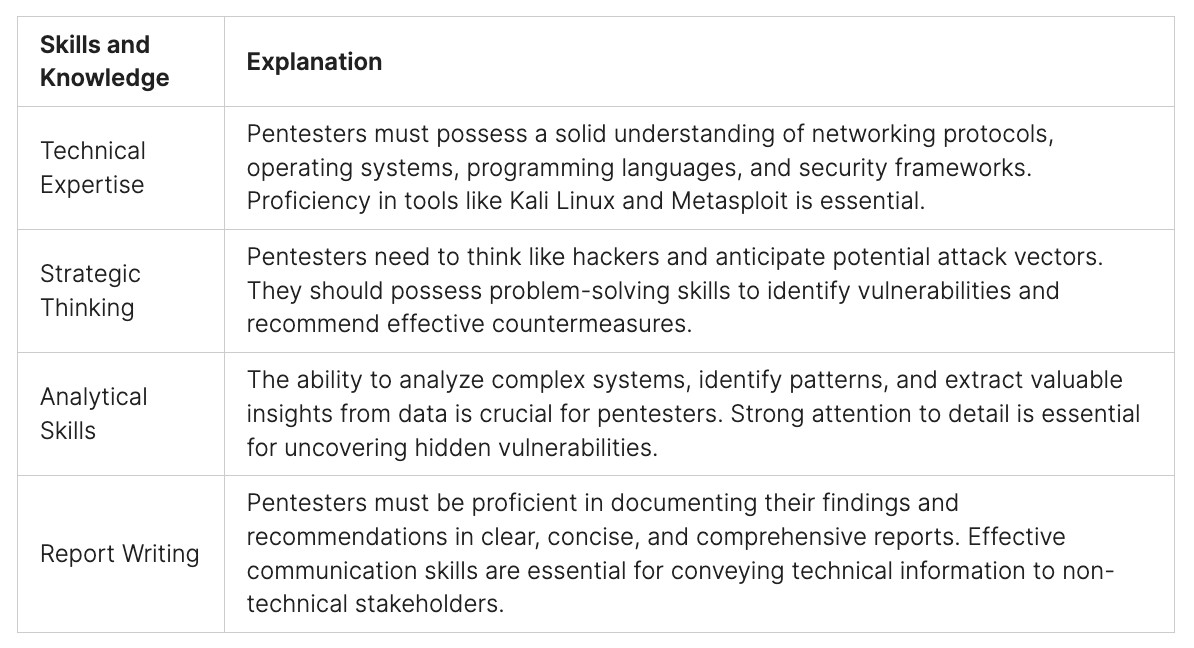
    The role of a pentester requires not only technical expertise but also ethical conduct. It is essential to work within legal frameworks and adhere to professional ethics. Pentesters are critical in enhancing cybersecurity by identifying weaknesses and helping organizations strengthen their defenses.

    The Technicalities of Penetration Testing

    Penetration testing is a systematic approach to identifying and exploiting network, system, and application security vulnerabilities. It plays a crucial role in maintaining network security, evaluating entry points, identifying weaknesses, and simulating cyber-attacks to gauge potential impact. By employing various techniques and methodologies, pentesters uncover vulnerabilities that can be further mitigated through security optimization.

    Penetration Testing Techniques

    Penetration testing involves a range of techniques tailored to address different security aspects. These techniques include:

    • Social Engineering: This technique exploits human vulnerabilities through deception and manipulation.
    • Technical System Hacking: It involves identifying and exploiting weaknesses in the target system’s infrastructure and software.
    • Network Sniffing: This technique captures and analyzes network traffic to uncover potential security vulnerabilities.

    The Penetration Testing Process

    The penetration testing process typically follows a structured methodology, ensuring a comprehensive assessment of security vulnerabilities:

    1. Reconnaissance: Gathering information about the target system to understand its architecture and potential vulnerabilities.
    2. Scanning and Gaining Access: Identifying and exploiting vulnerabilities to access the target system.
    3. Maintaining Access: Sustaining the compromised access to analyze potential impacts and uncover deeper vulnerabilities.
    4. Reporting and Suggesting Improvements: Document findings and provide recommendations to enhance network security and mitigate vulnerabilities.

    Network Security and Vulnerability Identification

    Network security penetration testing is an essential component of penetration testing, focusing on maintaining the integrity and confidentiality of a network. By evaluating entry points, identifying weaknesses, and simulating cyber-attacks, pentesters play a critical role in fortifying network defenses. Through meticulous vulnerability identification, organizations can proactively address security gaps, optimize security measures, and ensure a robust cyber defense strategy.

    Specialized Areas in Penetration Testing

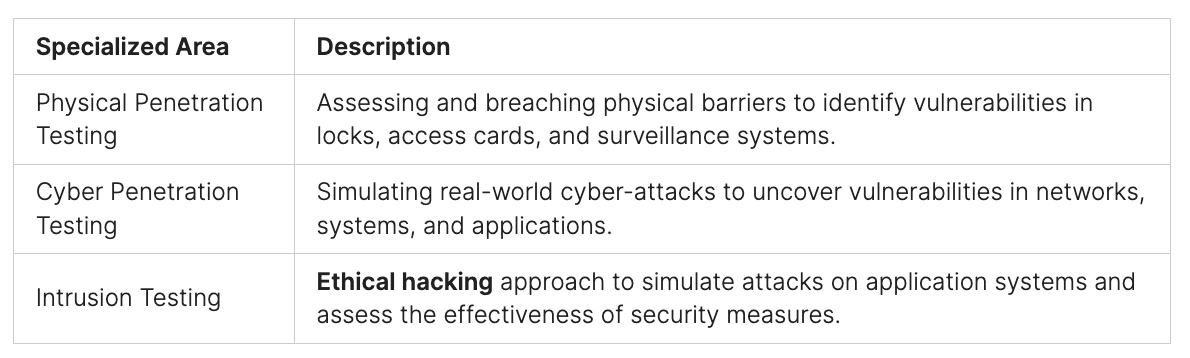
    Penetration testing, a vital practice in cybersecurity, extends beyond traditional network testing to specialized areas that further fortify digital defense systems. These specialized areas include physical penetration testing, cyber penetration testing, and intrusion testing, each serving a distinct purpose in ensuring comprehensive security.

    Physical Penetration Testing

    Physical penetration testing focuses on assessing and breaching physical barriers, such as locks, access cards, and surveillance systems. This branch of penetration testing requires a unique blend of skills and expertise, encompassing familiarity with digital and physical security protocols, social engineering tactics, and knowledge of modern security systems. By scrutinizing physical security measures, organizations can identify vulnerabilities and fortify their physical defenses.

    Cyber Penetration Testing

    Cyber penetration testing is crucial in safeguarding digital assets against various cyber threats. It involves simulating real-world cyber-attacks to identify network, system, and application vulnerabilities. By thoroughly examining the digital infrastructure, cyber penetration testing enables organizations to identify and address weaknesses, preventing potential breaches, data theft, or system compromise.

    Intrusion Testing

    Intrusion testing, or ethical hacking, is a branch of penetration testing that simulates attacks on various application systems. By adopting the perspective of a malicious actor, intrusion testers identify vulnerabilities and exploit them to assess the effectiveness of security measures. This testing methodology gives organizations critical insights into their application’s security posture, enabling them to mitigate risks and enhance their overall cybersecurity proactively.

    These specialized areas within penetration testing underscore the importance of a comprehensive and proactive approach to cybersecurity. By combining physical penetration testing, cyber penetration testing, and intrusion testing, organizations can build robust defense mechanisms that effectively safeguard their digital assets from ever-evolving threas.
    Social Engineering in Cybersecurity

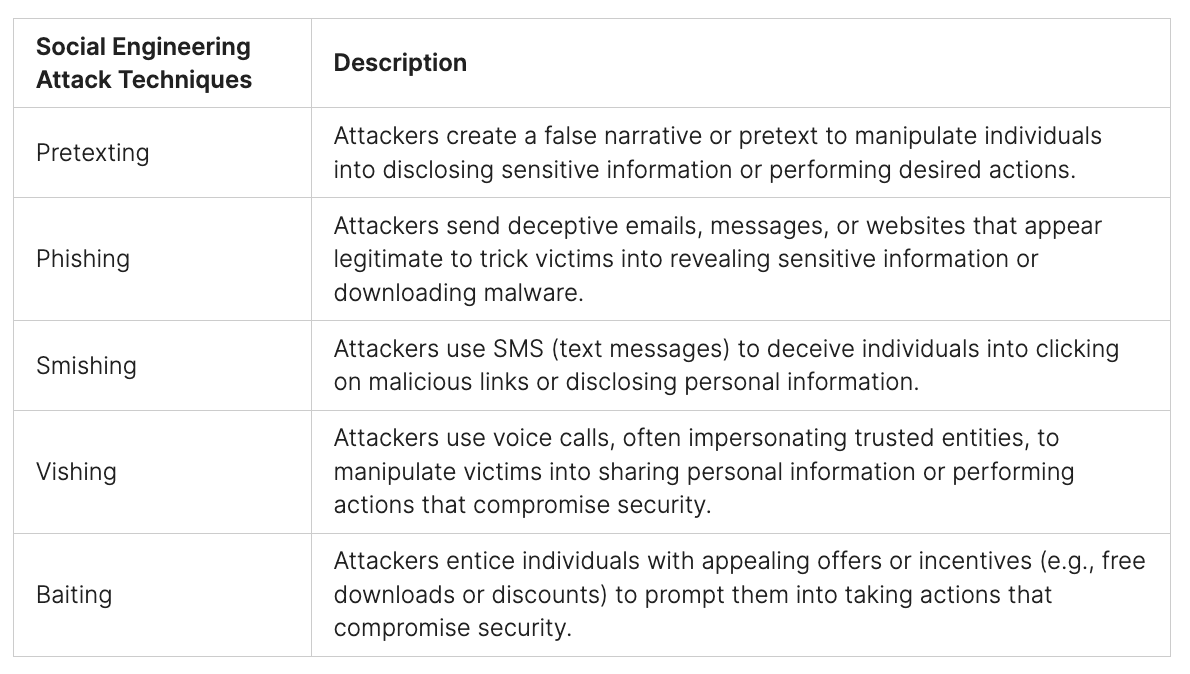
    Social engineering is an insidious tactic employed by attackers to exploit psychological vulnerabilities and manipulate individuals into providing sensitive information or performing actions that compromise cybersecurity. These attacks capitalize on human psychology and trust to deceive individuals and gain unauthorized access to sensitive data or systems. In the digital age, social engineering attacks have become increasingly sophisticated, leveraging advanced technologies such as AI-powered attacks to enhance their effectiveness.

    The Social Engineering Attack Cycle

    Social engineering attacks typically follow a cycle that involves several stages:

    • Information Gathering: Attackers collect personal, organizational, or technical information about their targets, often using open-source intelligence (OSINT) techniques.
    • Relationship Establishment: Using the gathered information, attackers build rapport or establish a relationship with the target, exploiting their trust.
    • Exploitation: Attackers manipulate the target into performing actions that benefit the attacker, such as disclosing sensitive information or clicking on malicious links.
    • Culmination: The attack reaches its intended goal, which may involve unauthorized access, data theft, financial fraud, or other malicious activities.

    An understanding of this attack cycle is crucial for individuals and organizations to recognize and defend against social engineering attacks effectively.

    Email Phishing: A Prevalent Form of Social Engineering

    One of the most prevalent forms of social engineering is email phishing, where attackers send deceptive emails posing as legitimate entities to trick recipients into disclosing sensitive information, downloading malware, or initiating unauthorized actions. Phishing attacks often exploit psychological factors such as urgency, curiosity, or fear to manipulate victims into taking the desired action.

    Email analysis and detection techniques are crucial in identifying and preventing phishing attacks. By analyzing email headers, content, and attachments, security professionals can assess their legitimacy and detect red flags that indicate phishing attempts.

    A Role of AI in Social Engineering Attacks

    “Artificial intelligence is increasingly being leveraged by attackers to craft convincing messages and enhance the effectiveness of social engineering attacks. Machine learning algorithms can analyze vast amounts of data to create highly personalized and persuasive communications.”

    The integration of AI technology in social engineering attacks poses a new level of threat. AI-powered attacks can generate emails, messages, or voice calls that closely mimic human communication styles and patterns, making it more challenging to distinguish between genuine and malicious communications.

    Addressing AI-powered social engineering attacks requires a multi-faceted approach that combines advanced security measures with user awareness and education. Organizations should deploy AI-driven tools and solutions to analyze incoming communications and identify potential phishing attempts. Additionally, ongoing training and awareness programs can help individuals recognize and report suspicious activities, mitigating the risks associated with social engineering attacks.

    By understanding the tactics employed in social engineering attacks, organizations can implement robust security measures and educate their users to stay vigilant and protect against this constantly evolving threat.
    Advanced Social Engineering Tools and Tactics

    With the rapid advancement of AI technology, social engineering attacks have become more sophisticated. Attackers are leveraging emerging tools and tactics, including the integration of AI in phishing campaigns, to increase their success rates and evade detection. Organizations must stay informed about these evolving techniques and implement robust prevention measures.

    AI-Enhanced Phishing

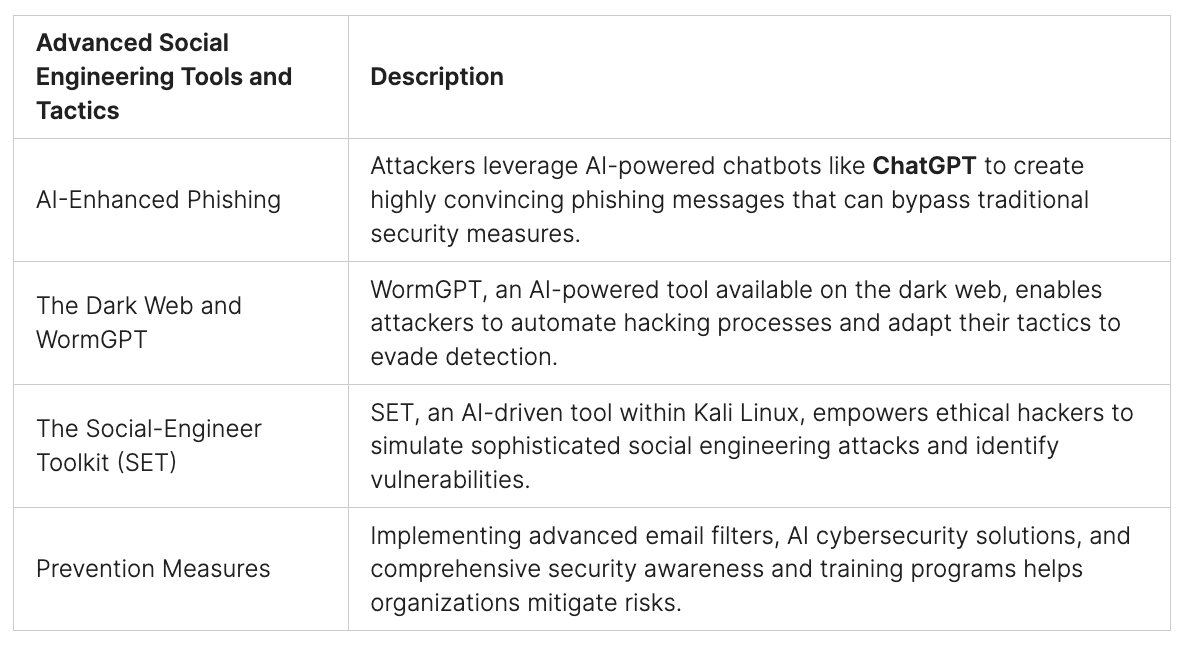
    One of the latest advancements in social engineering attacks is using AI technology to enhance phishing campaigns. Attackers leverage AI-powered chatbots like ChatGPT to create compelling messages that mimic human conversation. These AI-driven phishing attempts can bypass traditional cybersecurity defenses, making it challenging for users to discern between genuine and malicious communications.

    To illustrate the potential impact of AI-enhanced phishing, consider the example of a banking phishing attack. Attackers can use AI algorithms to analyze a target’s social media profiles, blog posts, and other publicly available information to craft personalized and plausible phishing emails. These emails may appear to come from a trusted institution, tricking recipients into revealing sensitive information or downloading malicious attachments.

    The Dark Web and WormGPT

    The dark web is a hidden part of the internet where anonymous activities occur, including buying and selling hacking tools and services. Within this underground economy, a new threat has emerged, and it is known as WormGPT. This AI-powered tool is offered as a paid service on the dark web, providing attackers with automated hacking capabilities.

    WormGPT is designed to mimic the behavior of a human hacker, autonomously scanning systems, identifying vulnerabilities, and launching attacks. Its AI capabilities enable it to adapt and evolve its tactics, making detecting and defending against it even more challenging. This tool is a stark reminder of the evolving nature of social engineering attacks and the need to enhance cybersecurity measures continuously.

    The Social-Engineer Toolkit (SET)

    While the emergence of AI in social engineering attacks raises concerns, ethical hackers and penetration testers can also leverage AI-driven tools to enhance their defensive strategies. One such tool is the Social-Engineer Toolkit (SET) within Kali Linux. With its AI capabilities, the SET empowers security professionals to simulate sophisticated social engineering attacks and identify vulnerabilities within an organization’s defenses.

    The SET offers a wide range of features, including email spoofing, spear-phishing attacks, and website cloning, enabling testers to evaluate the effectiveness of an organization’s security awareness and prevention measures. By embracing AI-driven tools like the SET, organizations can better understand their vulnerabilities and take proactive steps to strengthen their cybersecurity defenses.

    Prevention Measures

    Mitigating the risks associated with advanced social engineering attacks requires a comprehensive approach that combines technical solutions, employee awareness, and stringent prevention measures. Organizations should focus on implementing advanced email filters to detect and block AI-enhanced phishing attempts.

    Investing in AI-driven cybersecurity solutions can provide organizations with improved threat intelligence, enabling swift identification and response to emerging social engineering tactics. Regular security awareness and training programs are essential to educate employees about the evolving nature of social engineering attacks and equip them with the knowledge to identify and report potential threats.

    By staying vigilant, leveraging advanced prevention measures, and keeping pace with the rapidly evolving social engineering landscape, organizations can enhance their cybersecurity posture and protect themselves against the growing threat of AI-enhanced phishing attacks. Taking a proactive approach to security and embracing AI technology as a defensive tool is crucial in the ongoing fight against social engineering threats.
    Conclusion

    In today’s digital era, where cyber threats loom larger and more sophisticated than ever, pentesting emerges as a cornerstone practice for preemptive cybersecurity. This critical exercise empowers organizations to uncover and remediate vulnerabilities before they become gateways for malicious actors. Through meticulous evaluation of computer systems, networks, and web applications, pentesting significantly bolsters an organization’s cyber defenses and enhances its security stance.

    Delving deeper, specialized domains such as physical and cyber penetration testing amplify the breadth and depth of proactive cybersecurity efforts. These nuanced approaches enable organizations to fortify not only their digital landscapes but also their physical perimeters, thereby securing their essential assets against a spectrum of potential threats.

    As attackers increasingly leverage artificial intelligence to sophisticate their social engineering schemes, the imperative for organizations to stay alert and proactive skyrockets. The adoption of cutting-edge security solutions, along with the implementation of exhaustive awareness and training initiatives, is vital for cultivating a pervasive culture of cybersecurity awareness among staff. These measures are instrumental in navigating the complexities of modern cyber threats.

    Adopting pentesting as a proactive defense strategy, coupled with a vigilant stance against social engineering tactics, positions organizations to significantly enhance their security frameworks. This forward-looking approach, underpinned by ethical hacking methodologies, equips organizations with the readiness to protect their invaluable data and maintain their reputational integrity amidst the evolving cyber threat landscape.

    Peris.ai Cybersecurity introduces Peris.ai Pandava, a service designed with the philosophy that your organization’s security and competitive edge in the market are paramount. Sleep peacefully, knowing that our team of ethical hackers is diligently conducting penetration tests, reminiscent of a “Mission Impossible” scenario, to identify vulnerabilities within your digital and physical infrastructures. With Peris.ai Pandava, the daunting task of securing your digital platform becomes a manageable and reassuring endeavor.

    We invite you to explore how Peris.ai Pandava can transform your organization’s approach to cybersecurity. Visit Peris.ai Cybersecurity to learn more about our penetration testing services and how we can help you navigate the complexities of safeguarding your digital and physical assets against the ever-evolving cyber threats. Secure your peace of mind and give your business the protective edge it deserves with Peris.ai Pandava.

    FAQ

    What is pentesting?

    Pentesting, also known as penetration testing, is the practice of rigorously scrutinizing computer systems, networks, and web applications to identify and expose vulnerabilities that attackers could exploit.

    Why is pentesting important?

    Pentesting plays a vital role in defending against constantly evolving cyber threats. It helps organizations proactively test and reinforce the security of their digital infrastructures, making their defenses stronger and more resilient.

    What is the career path of a pentester?

    Aspiring pentesters need to develop a strong foundation in IT fundamentals and progressively specialize in security pen and cyber penetration testing. Gaining experience in roles such as network security analyst or IT security consultant can pave the way for advancement.

    What are the technicalities of pentesting?

    Pentesting involves various techniques, including social engineering, technical system hacking, and network sniffing. These techniques serve the purpose of uncovering different types of vulnerabilities and simulating cyber-attacks to assess the effectiveness of security measures.

    What are the specialized areas in pentesting?

    Specialized areas in pentesting include physical penetration testing, which assesses and breaches physical barriers, and cyber penetration testing, which safeguards digital assets against a wide range of cyber threats. Intrusion testing focuses explicitly on ethical hacking and simulating attacks on various application systems to identify vulnerabilities.

    What is social engineering in cybersecurity?

    Social engineering is an insidious tactic employed by attackers to exploit psychological vulnerabilities and manipulate individuals into providing sensitive information or performing actions that compromise cybersecurity.

    What are the advanced social engineering tools and tactics?

    With the rapid advancement of AI technology, social engineering attacks have become more sophisticated. Attackers are integrating AI in phishing campaigns and leveraging tools like the Social-Engineer Toolkit (SET) within Kali Linux. Organizations must implement advanced email filters, AI cybersecurity solutions, and comprehensive awareness and training programs to mitigate the risks associated with advanced social engineering attacks.

    Why is proactive cybersecurity essential?

    Proactive cybersecurity practices, such as pentesting, are crucial in identifying and addressing vulnerabilities before attackers can exploit them. Organizations can optimize their security posture and protect their digital assets by constantly fortifying cyber defenses and staying one step ahead of evolving threats.

  • SOAR High: Streamlining Security with Automation

    SOAR High: Streamlining Security with Automation

    In today’s rapidly evolving cybersecurity landscape, organizations face increasing challenges in defending against cyber threats. To effectively safeguard their data and systems, businesses need to adopt advanced security measures that streamline their operations and enhance their incident response capabilities. One such solution that has gained significant attention is SOAR (Security Orchestration, Automation, and Response), a powerful tool that combines security orchestration, automation, and response to optimize security operations.

    SOAR enables organizations to achieve higher cybersecurity efficiency by integrating security tools, automating repetitive tasks, and optimizing incident response processes. By streamlining security operations, SOAR improves productivity, empowers security analysts, and ensures a more rapid and effective response to cyber incidents. With the ability to standardize communication, automate reporting, and integrate with various security technologies, SOAR offers a comprehensive solution for organizations looking to enhance their security posture.

    Key Takeaways:

    • SOAR (Security Orchestration, Automation, and Response) is a powerful tool for streamlining security operations and improving incident response.
    • By integrating security tools, automating repetitive tasks, and optimizing incident response processes, SOAR enables organizations to achieve higher cybersecurity efficiency.
    • The benefits of using SOAR include increased productivity, improved threat intelligence, reduced manual operations, streamlined operations, reduced cyberattack impact, easy technology and tools integration, lowered costs, automated reporting, and standardized communication during incident response.
    • SOAR improves incident response by integrating security tools, automating tasks, and enabling quicker alert handling.
    • Security orchestration, a key component of SOAR, brings efficiency to security operations by aggregating data from various security and network tools.

    How SOAR Improves Incident Response

    SOAR, or Security Orchestration, Automation, and Response, plays a crucial role in enhancing incident response capabilities. By integrating security tools and automating tasks, SOAR enables organizations to respond more effectively and efficiently to incidents. Let’s explore how SOAR improves incident response:

    Integration of Security Tools

    SOAR allows for the seamless integration of various security tools, bringing together data from multiple sources into a centralized platform. This integration enables the correlation of alerts from disparate systems, merging them into a single incident. By consolidating relevant information, SOAR saves valuable time and facilitates quicker alert handling.

    Real-time Correlation with Threat Intelligence

    Another key feature of SOAR is its ability to correlate real-time threat intelligence with events. By automatically analyzing threat intelligence feeds and correlating them with ongoing incidents, SOAR provides actionable information to incident response teams. This real-time correlation empowers organizations to make informed decisions and respond swiftly to emerging threats.

    Standardization through Playbooks

    SOAR employs playbooks, which are predefined workflows that outline the steps of the incident response process. These playbooks automate repetitive and manual tasks, ensuring consistency and efficiency in incident handling. By following the standardized procedures outlined in playbooks, organizations can reduce human error and respond to incidents in a more structured and effective manner.

    Reduction of Manual Operations

    SOAR significantly reduces the reliance on manual operations in incident response. Through automation, repetitive tasks such as data gathering, alert enrichment, and incident triage can be handled automatically, freeing up valuable time for security analysts. This reduction in manual operations allows analysts to focus on higher-priority tasks that require human expertise and critical thinking.

    By leveraging the power of security orchestration, automation, and playbooks, SOAR enhances incident response capabilities and enables organizations to effectively combat cyber threats. The table below summarizes how SOAR improves incident response:

    Benefits of SOAR in Incident Response

    1. Integration of security tools for consolidated incident management
    2. Real-time correlation of threat intelligence and events
    3. Standardized incident response through playbooks
    4. Reduction of manual operations and automation of repetitive tasks

    By harnessing the capabilities of SOAR, organizations can strengthen their incident response posture and effectively defend against cyber threats.

    The Benefits of Security Orchestration

    Security orchestration, a vital component of Security Orchestration, Automation, and Response (SOAR), brings efficiency to security operations in organizations. By aggregating data from various security and network tools, it provides a centralized view and actionable context for alerts, empowering security teams to respond effectively to threats. The benefits of security orchestration encompass improved efficiency, enhanced incident response, and streamlined security operations.

    One of the primary advantages of security orchestration is its ability to automate the handling of low-priority and repetitive tasks. By automating these tasks, security orchestration frees up Security Operations Center (SOC) analysts to focus on more critical and value-adding work. This optimization of resources improves incident response capabilities and allows analysts to devote their expertise to tasks that require human intervention, such as analyzing complex threats and devising effective mitigation strategies.

    “Security orchestration streamlines security operations by automating low-priority and repetitive tasks, enabling SOC analysts to focus on higher-value work that improves incident response.”

    Furthermore, security orchestration minimizes the mean time to detect (MTTD) and mean time to respond (MTTR) cyberattacks. By aggregating data and providing a centralized view of security events, organizations can swiftly detect and respond to threats, reducing the impact of cyberattacks. This accelerated incident response time ensures that potential security breaches are addressed promptly, minimizing the potential damage and mitigating risks.

    Overall, security orchestration enhances the efficiency and effectiveness of incident response in the SOC. By automating tasks, prioritizing high-value work, and expediting response times, security orchestration empowers security teams to better safeguard organizations against cyber threats.

    Benefits of Security Orchestration

    • Improved efficiency in security operations
    • Enhanced incident response capabilities
    • Streamlined security operations

    The Role of Security Automation in SOAR

    Security automation plays a critical role in the effectiveness of a Security Orchestration, Automation, and Response (SOAR) platform. By automating repetitive tasks and alerts, security automation reduces the burden on SOC analysts, allowing them to focus on more complex and critical tasks. This ultimately enhances incident response capabilities and improves overall security posture.

    With the power of security automation, SOAR platforms can build workflows that require minimal human intervention. By automating low-priority alerts and incidents, analysts are freed up to dedicate their time and resources to investigating and resolving more pressing issues. This streamlined approach enables SOC analysts to respond swiftly and efficiently, minimizing the impact of potential security breaches.

    Benefits of Security Automation in Incident Response

    1. Time Savings: Automating repetitive tasks eliminates the need for manual intervention, saving valuable time and increasing operational efficiency. SOC analysts can focus on critical tasks that require their expertise, rather than being consumed by repetitive and mundane activities.

    2. Consistency: Security automation ensures consistent and standardized processes throughout incident response. This reduces the risk of human error and ensures that every incident is handled in a reliable and repeatable manner.

    3. Efficiency: By automating incident response workflows, security automation streamlines the entire process. SOC analysts can follow a predefined set of steps and actions, ensuring consistent and efficient incident handling. This results in faster response times and improved incident resolution.

    Automating repetitive tasks and alerts in incident response allows SOC analysts to focus on higher-value work, improves response times, and enhances the overall efficiency of security operations. – John Smith, Senior SOC Analyst at ABC Corporation

    4. Scalability: Security automation allows organizations to handle a greater volume of incidents without the need to scale their SOC staff proportionally. Automated workflows can handle multiple incidents simultaneously, ensuring efficient and effective incident response even during periods of high activity.

    5. Improved Decision-Making: Security automation provides SOC analysts with valuable insights and context by aggregating and correlating data from various sources. This enables analysts to make more informed decisions during incident response, resulting in more accurate threat identification and mitigation.

    6. Reduced Burnout: By automating repetitive tasks, security automation relieves SOC analysts from the monotony of routine activities. This helps prevent burnout, allowing analysts to maintain focus and perform at their best when handling more critical and complex incidents

    Streamlined Operations with SOAR

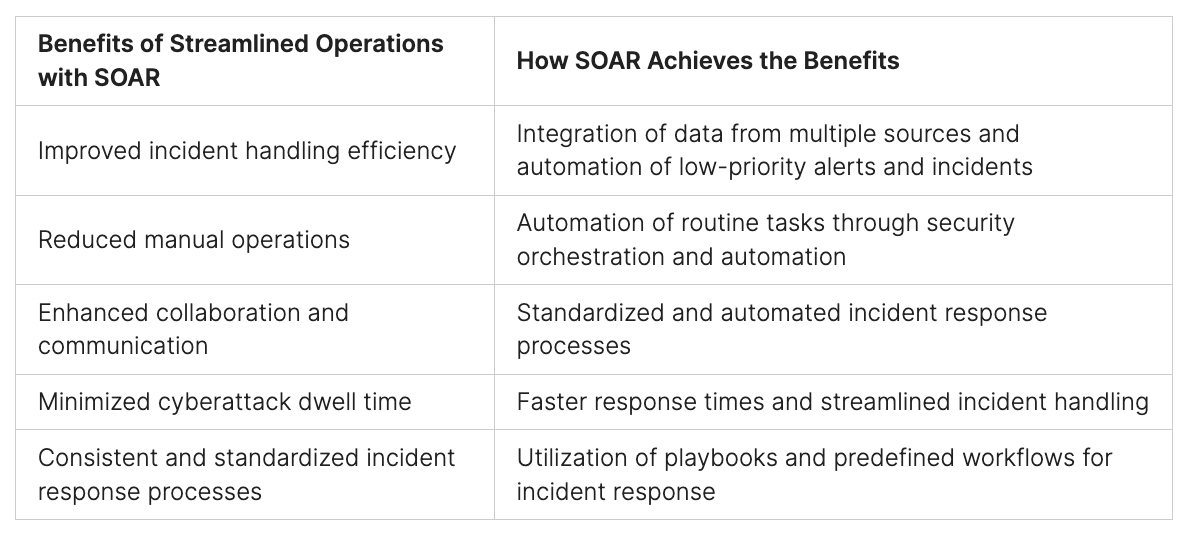
    SOAR (Security Orchestration, Automation, and Response) plays a crucial role in streamlining operations and enhancing efficiency in incident handling. Through the integration of data from various sources and the automation of low-priority alerts and incidents, SOAR eliminates manual tasks and optimizes the incident response process.

    One of the key components of SOAR is security orchestration, which consolidates data from disparate systems into a centralized view. This integration allows for better visibility and context when responding to incidents, enabling security teams to make informed decisions and take swift action.

    Additionally, SOAR leverages security automation to handle low-priority alerts and incidents. By automating these routine tasks, security teams can focus their efforts on more critical and complex issues. This reduces the need for manual intervention and accelerates incident response, minimizing cyberattack dwell time and improving overall efficiency.

    By streamlining operations, SOAR enables security teams to respond more effectively to incidents, reducing response times and minimizing the impact of potential threats. This streamlined approach eliminates guesswork and enhances incident handling through standardized and automated processes.

    “SOAR enables security teams to respond more effectively to incidents, reducing response times and minimizing the impact of potential threats.”

    Organizations that implement SOAR can benefit from:

    • Improved incident handling efficiency
    • Reduced manual operations
    • Enhanced collaboration and communication
    • Minimized cyberattack dwell time
    • Consistent and standardized incident response processes

    Implementing security orchestration and automation with SOAR not only streamlines operations but also empowers security teams to proactively tackle cybersecurity challenges and stay ahead of evolving threats.

    Easy Integration of Technology and Tools with SOAR

    One of the standout benefits of implementing a SOAR platform is its seamless integration with a wide range of security technologies and tools. SOAR platforms excel in their ability to effectively integrate with various security domains, ensuring a unified and comprehensive approach to incident response.

    When it comes to technology integration, SOAR platforms enable the correlation of alerts from different products, spanning a multitude of security domains. This integration empowers organizations to aggregate data from diverse sources, including cloud security, email security, endpoint security, network security, and more.

    This comprehensive integration of security technologies and tools is made easy with self-service marketplaces and simple button-click integration options. Organizations can quickly and effortlessly connect their existing security infrastructure to the SOAR platform, without the need for complex configurations or extensive technical expertise.

    By leveraging the power of SOAR, organizations can optimize their incident response capabilities by harnessing the strength of their security technologies and tools. This integration allows for a more precise and efficient detection of threats, enabling faster response times and improved incident resolution.

    Benefits of Technology and Tools Integration with SOAR:

    • Enhanced Visibility: The integration of security technologies and tools provides a centralized view of incidents, allowing for a comprehensive understanding of the security landscape.
    • Efficient Incident Response: Seamless integration allows for the automation of incident response processes, enabling faster and more efficient incident handling.
    • Improved Threat Detection: By correlating alerts from various security products, organizations can better identify and respond to complex threats in real-time.
    • Streamlined Workflows: Integration with existing security technologies streamlines workflows, eliminating manual tasks and optimizing resource allocation.

    The easy integration of technology and tools with SOAR enables organizations to leverage their existing investments and maximize the effectiveness of their security operation.

    Cost Savings with SOAR Implementation

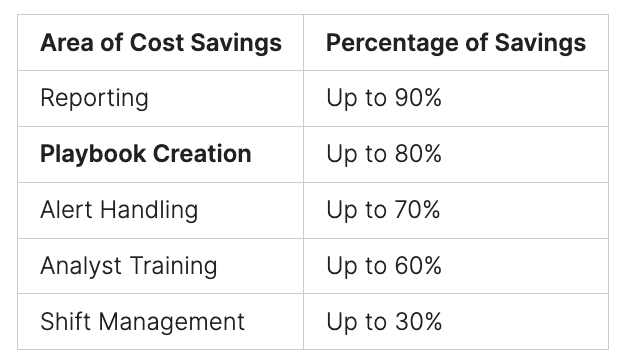
    Implementing a SOAR platform can result in significant cost savings for organizations. By automating reporting and metrics capabilities, SOAR eliminates the need for manual reporting and reduces the time and effort spent on creating reports. This directly translates to cost savings, as fewer resources are required to generate and distribute reports, allowing security teams to focus on more critical tasks.

    Furthermore, SOAR enables organizations to achieve cost savings in various areas of incident response:

    Reporting: Implementing a SOAR platform can lead to savings of up to 90% on reporting. Automated reporting capabilities streamline the process and eliminate the need for manual production of metrics and customized reports.

    Playbook Creation: SOAR enables savings of up to 80% on playbook creation. By leveraging pre-built playbooks and automation capabilities, organizations can significantly reduce the time and effort required to develop and maintain incident response processes.

    Alert Handling: With SOAR, organizations can achieve savings of up to 70% on alert handling. The automation of low-priority alerts allows security analysts to efficiently manage their workload and focus on more critical incidents.

    Analyst Training: SOAR implementation can result in savings of up to 60% on analyst training. By automating repetitive tasks and standardizing incident response processes, SOC analysts can onboard faster and spend less time on training exercises.

    Shift Management: SOAR can lead to savings of up to 30% on shift management. The automation of routine tasks reduces the reliance on manual shift handovers and allows for a smoother transition between security teams.

    Standardized communication during incident response is another area where cost savings can be achieved. Effective collaboration facilitated by SOAR minimizes the impact of cyberattacks and prevents monetary losses associated with extended incident response and recovery timelines.

    In summary, organizations that implement a SOAR platform can significantly reduce costs related to reporting, playbook creation, alert handling, analyst training, and shift management. By streamlining operations and automating repetitive tasks, SOAR improves efficiency while minimizing financial resources spent on incident response.

    Automating Reporting and Metrics with SOAR

    SOAR platforms offer automated reporting and metrics capabilities that significantly streamline the process of generating reports for security teams. With the ability to pull reports on demand or schedule them for automatic generation, SOC staff can ensure reliable and timely reporting without the need for manual intervention.

    SOAR tools provide reporting templates and the flexibility to create custom reports, allowing security teams to tailor the reporting process to their specific requirements. This simplifies the reporting workflow, making it more efficient and accurate.

    By automating reporting and metrics, SOAR eliminates the need for manual production of metrics, saving valuable time and effort for security analysts. Instead of spending hours compiling data and generating reports, analysts can focus on analyzing insights and making data-driven decisions to enhance incident response efforts.

    With automated reporting and metrics capabilities, SOAR empowers organizations to effectively track and measure their incident response performance. By leveraging these capabilities, security teams can gain valuable insights into the effectiveness of their incident response processes, identify areas for improvement, and make data-backed adjustments to optimize their overall security posture.

    “Automating reporting and metrics with SOAR has revolutionized the way security teams generate reports. It has significantly reduced the manual effort required, allowing us to focus on more critical tasks. The ability to create custom reports also allows us to tailor our reporting to specific stakeholders, ensuring they receive the information they need in a digestible format.”

    Standardized Communication in Incident Response with SOAR

    Effective communication is crucial during incident response, especially when dealing with major incidents. To facilitate standardized communication, organizations often establish a mission control hub or virtual war room. SOAR platforms play a vital role in ensuring critical information is shared consistently among team members, preventing any lapses or miscommunication.

    When major incidents occur, a mission control hub or virtual war room becomes the command center for incident response. This centralized environment enables teams to collaborate effectively and make informed decisions in real-time. SOAR platforms provide features that support standardized communication within these dedicated spaces, ensuring that all incident response stakeholders have access to critical information.

    The standardized communication flow in a mission control hub or virtual war room involves various stakeholders, both from within and outside the Security Operations Center (SOC). This includes representatives from Public Relations (PR), Human Resources (HR), Legal, and the C-suite. By involving these stakeholders, organizations can align their incident response efforts with overarching business goals and ensure consistent information dissemination across departments.

    By establishing reliable and repeatable communication processes, SOAR enhances the overall effectiveness of incident response. It enables teams to collaborate seamlessly, make informed decisions based on real-time insights, and execute response plans efficiently. With standardized communication, organizations can minimize response times, improve coordination, and mitigate the impact of security incidents.

    “Standardized communication is the backbone of effective incident response. It ensures that all team members have access to critical information in real-time, enabling them to respond swiftly and accurately. SOAR platforms help organizations establish reliable and repeatable communication processes, enhancing overall incident response capabilities.”

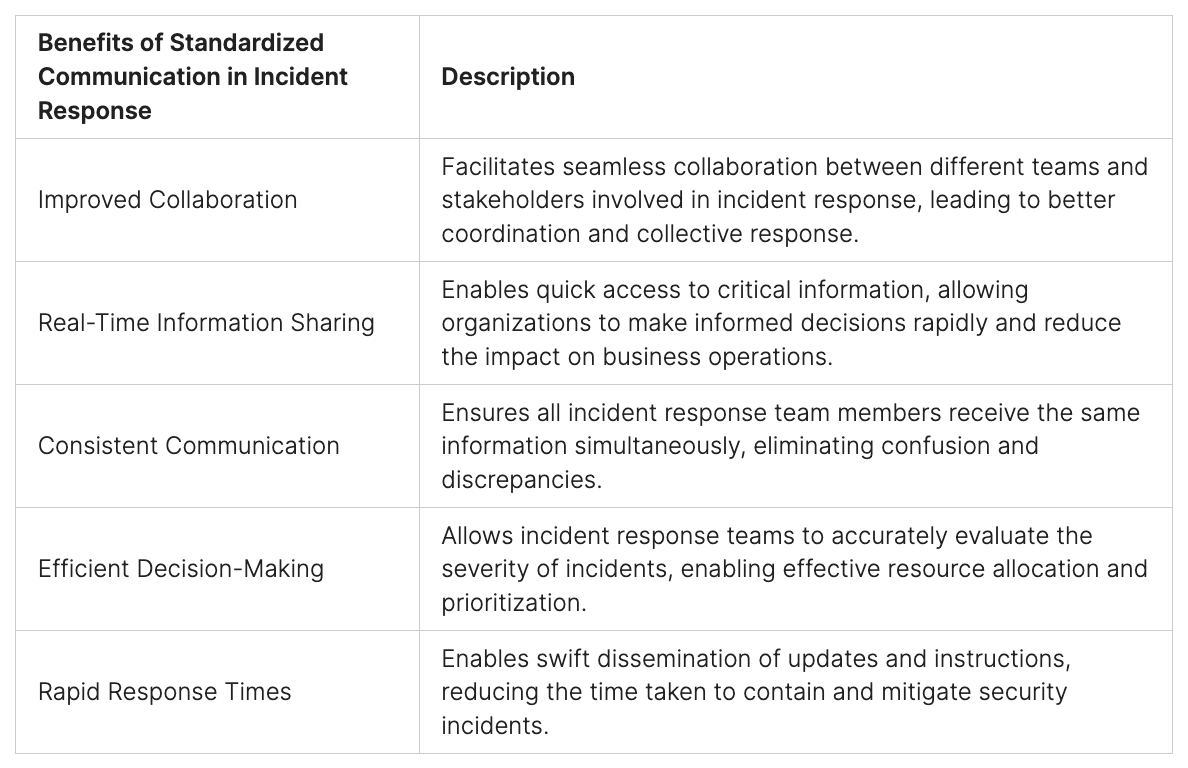
    Benefits of Standardized Communication in Incident Response

    Implementing standardized communication in incident response with SOAR platforms offers several key benefits:

    1. Improved Collaboration: Standardized communication facilitates seamless collaboration between different teams and stakeholders involved in incident response. This enables better coordination and the ability to respond collectively to security incidents.
    2. Real-Time Information Sharing: By centralizing communication and ensuring all team members have access to critical information in real-time, organizations can make informed decisions quickly. This leads to faster incident resolution and a reduced impact on business operations.
    3. Consistent Communication: Standardized communication processes ensure that all incident response team members receive the same information simultaneously. This eliminates any confusion or discrepancies that may arise from inconsistent communication practices.
    4. Efficient Decision-Making: Access to standardized communication channels allows incident response teams to evaluate the severity of incidents accurately. This enables them to prioritize their response efforts and allocate resources effectively.
    5. Rapid Response Times: Standardized communication enables incident response teams to quickly disseminate updates and instructions. This facilitates swift action and minimizes the time taken to contain and mitigate security incidents.

    Through standardized communication, organizations can optimize their incident response capabilities and minimize the impact of security incidents. By leveraging SOAR platforms, teams can establish reliable and effective communication processes that enhance collaboration, enable rapid decision-making, and improve overall incident response effectiveness.

    Conclusion

    The adoption of a SOAR (Security Orchestration, Automation, and Response) platform stands as a strategic decision in advancing security operations, automating routine tasks, and enhancing incident response mechanisms. In an era marked by an escalating number of cyber threats, the necessity for organizations to boost their cybersecurity efficacy has never been more pressing. SOAR offers a holistic solution by integrating diverse security tools, standardizing operational processes, and fostering improved collaborative efforts.

    By embracing the principles of security orchestration, automation, and response, organizations are empowered to fortify their capabilities in managing cybersecurity incidents. SOAR not only facilitates the amalgamation of various alerts for streamlined handling but also automates tasks deemed low-priority. This automation allows security teams to dedicate their focus to more critical and complex issues. The result is a tangible reduction in the impact of cyberattacks and a notable enhancement in the organization’s overall security framework.

    The Peris.ai Brahma SOAR platform, a crucial component of Peris.ai Cybersecurity’s offerings, exemplifies the power of SOAR. It enables organizations to automate security processes, coordinate diverse security tools and systems, and respond to security incidents with increased efficiency and effectiveness. Key features of Peris.ai Brahma SOAR include Task Automation, Security Tool Integration, Playbooks, and Investigative and Remediation capabilities. This functionality not only streamlines security operations but also provides a centralized viewpoint for incident management, thereby eliminating inefficiencies and improving response strategies.

    In essence, organizations that integrate the Peris.ai Brahma SOAR platform into their cybersecurity strategy are positioned to excel in the cyber landscape. This platform not only streamlines security operations and automates routine tasks but also optimizes the entire incident response process. As a result, organizations can significantly elevate their security posture, respond more effectively to cyber threats, and achieve a higher level of cybersecurity efficiency.

    To explore how the Peris.ai Brahma SOAR platform can transform your organization’s approach to cybersecurity, visit Peris.ai Cybersecurity. Discover how our innovative solutions can elevate your cybersecurity capabilities and provide you with the tools needed to successfully navigate and overcome the challenges of the modern cyber environment.

    FAQ

    What is SOAR?

    SOAR stands for Security Orchestration, Automation, and Response. It is a powerful tool for streamlining security operations and improving incident response in the face of increasing cyber threats.

    How does SOAR improve incident response?

    SOAR improves incident response by integrating security tools and automating tasks. It allows for the correlation of alerts from disparate systems into a single incident, saving time and enabling quicker alert handling. It also reduces manual operations and standardizes processes through the use of playbooks, which outline the steps of incident response and automate repetitive tasks.

    What are the benefits of security orchestration?

    Security orchestration brings efficiency to security operations by aggregating data from various security and network tools, providing a centralized view and actionable context for alerts. It automates the handling of low-priority and repetitive tasks, allowing SOC analysts to focus on higher-value work that improves incident response. It also reduces cyberattack impact by minimizing mean time to detect (MTTD) and mean time to respond (MTTR).

    What is the role of security automation in SOAR?

    Security automation reduces the need for human intervention in handling repetitive tasks and alerts. By automating low-priority alerts and incidents, it frees up SOC analysts to focus on more critical and complex tasks. This improves incident response by allowing analysts to dedicate more time and resources to investigating and resolving alerts.

    How does SOAR contribute to streamlined operations?

    SOAR integrates data from various sources and automates low-priority alerts and incidents, streamlining security operations. It gathers data from disparate systems, providing a centralized view and context for incidents. It handles low-priority alerts and incidents, reducing the need for manual intervention. Incident response in SOAR eliminates guesswork and minimizes cyberattack dwell time, resulting in more efficient and effective event handling.

    Can SOAR integrate with different security technologies and tools?

    Yes, SOAR platforms can easily correlate alerts from different products across various security domains. They facilitate the aggregation of data from cloud security, email security, endpoint security, network security, and more. The integration process is made easy with self-service marketplaces and simple button-click integration.

    How does implementing a SOAR platform result in cost savings?

    Implementing a SOAR platform enables savings on reporting, playbook creation, alert handling, analyst training, and shift management. By automating reporting and metrics capabilities, SOAR eliminates the need for manual reporting and reduces the time and effort spent on creating reports. Standardized communication during incident response also lowers costs by ensuring effective collaboration and minimizing the impact of cyberattacks.

    Can SOAR platforms automate reporting and metrics?

    Yes, SOAR platforms offer automated reporting and metrics capabilities. SOC staff can pull reports on demand or schedule them to be generated automatically. SOAR tools provide reporting templates and the ability to generate custom reports, simplifying the reporting process.

    How does SOAR facilitate standardized communication in incident response?

    SOAR platforms ensure standardized communication during incident response, particularly for major incidents. They provide features that ensure critical communication is standardized, preventing any team member from missing critical information. This standardized communication flow includes stakeholders from within and outside the SOC, such as PR, HR, legal, and the C-suite.

    What are the key benefits of implementing a SOAR platform?

    Implementing a SOAR platform streamlines security operations, automates repetitive tasks, and optimizes incident response. It enables organizations to achieve higher cybersecurity efficiency by integrating security tools, standardizing processes, and improving collaboration. It also reduces cyberattack impact, improves overall incident handling, and lowers costs.

  • The Future of Ransomware in 2025 – Are You Prepared?

    The Future of Ransomware in 2025 – Are You Prepared?

    As 2025 unfolds, the landscape of ransomware is rapidly evolving, pushing the boundaries of cybersecurity defenses with more sophisticated, AI-powered tactics. Organizations are increasingly vulnerable to these threats, prompting a critical need for robust, innovative security measures.

    This newsletter delves into the most recent findings from Zscaler ThreatLabz, revealing the pivotal trends that are reshaping ransomware strategies this year. We also provide a forward-looking analysis of what businesses can expect and how they can fortify their defenses against these emerging threats.

    Key Ransomware Trends and Predictions for 2025

    • AI-Powered Social Engineering: Cybercriminals are enhancing their phishing schemes with Generative AI (GenAI), crafting vishing attacks with localized accents and dialects that are difficult to distinguish from genuine interactions. This advancement enables attackers to bypass traditional security measures more effectively.
    • The Trifecta Attack Strategy: A disturbing trend is the integration of vishing, ransomware, and data exfiltration into a single, devastating attack, focusing on high-value targets for maximum financial gain. Notable groups like Dark Angels are pioneering this approach, opting to steal substantial datasets without deploying encryptors, complicating tracking and mitigation efforts.
    • High-Risk Industries: Sectors such as manufacturing, healthcare, education, and energy are at heightened risk due to their reliance on critical infrastructure. These industries face the dual threat of operational disruption and substantial ransom demands, making them prime targets for cybercriminals.
    • Regulatory Changes and Transparency: With new SEC regulations mandating that public companies report significant cybersecurity incidents within four business days, there is an anticipated increase in the transparency of ransomware incidents. This regulatory shift is expected to reveal more about the frequency and scale of ransom attacks and payouts.
    • Soaring Ransom Demands: The adoption of Ransomware-as-a-Service (RaaS) and profit-sharing models among cybercrime syndicates is leading to more organized and lucrative attacks. Ransom demands are projected to hit unprecedented levels in 2025.

    ️ Strategies to Mitigate AI-Powered Ransomware Threats

    • AI-Driven Defense Mechanisms: To combat sophisticated AI-utilized attacks, it’s crucial for security teams to deploy AI-powered security solutions. Technologies like AI-driven Zero Trust architectures can proactively detect and neutralize threats before they cause harm.
    • Comprehensive Zero Trust Implementation:

    Future-Proofing Your Cybersecurity

    The rapid advancement of AI in ransomware creates a formidable challenge but also presents an opportunity for organizations to reassess and strengthen their cybersecurity frameworks. Adopting a Zero Trust architecture not only addresses the immediate threats but also prepares enterprises for future challenges by reducing attack vectors, enhancing user authentication, and safeguarding sensitive data.

    As we look towards a future dominated by increasingly complex cyber threats, embracing a proactive, AI-enhanced security posture will be key to maintaining resilience and ensuring business continuity.

    Stay Proactive Against Cyber Threats

    The threat of AI-driven ransomware is a stark reminder of the need for continuous innovation in cybersecurity defenses. Is your organization prepared to face these advanced threats?

    Visit Peris.ai to explore cutting-edge cybersecurity solutions and strategies that can help protect your enterprise from the ransomware of tomorrow.

    Your Peris.ai Cybersecurity Team #YouBuild #WeGuard

  • Understanding The Dunning-Kruger Effect For Cybersecurity

    Understanding The Dunning-Kruger Effect For Cybersecurity

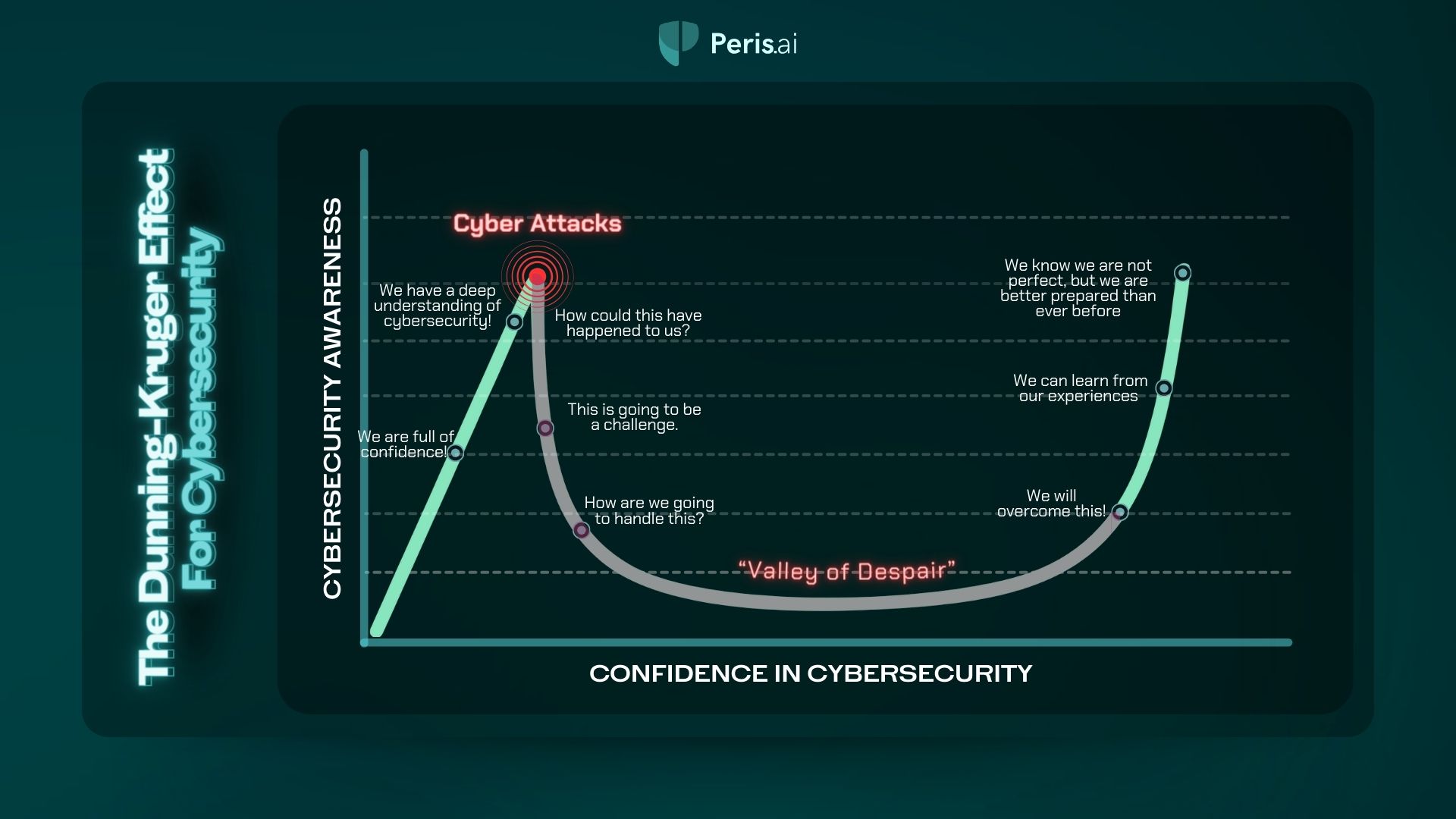
    The Dunning-Kruger Effect is a cognitive bias that has significant implications for cybersecurity. It refers to the tendency for individuals with limited knowledge or skills in a subject to overestimate their abilities. In the context of cybersecurity, this can lead to dangerous misconceptions and a false sense of security.

    As cyber threats continue to evolve, it is crucial to recognize the impact of cognitive bias on our understanding of cybersecurity. By understanding the Dunning-Kruger Effect and its implications, we can take proactive steps to bridge the knowledge gap and improve our overall security posture.

    Uncover the risks of overestimation in a rapidly evolving cyber landscape

    Key Takeaways:

    • The Dunning-Kruger Effect is a cognitive bias that affects individuals’ self-assessment of their competence in cybersecurity.
    • It can lead to cybersecurity misconceptions and a false sense of security.
    • Overconfidence in one’s abilities can leave organizations vulnerable to cyber threats.
    • Bridging the knowledge gap and seeking expert guidance are crucial in combating the Dunning-Kruger Effect.
    • A culture of continuous improvement and education can enhance cybersecurity skills and risk awareness.

    The Impact of Cognitive Bias in Cybersecurity

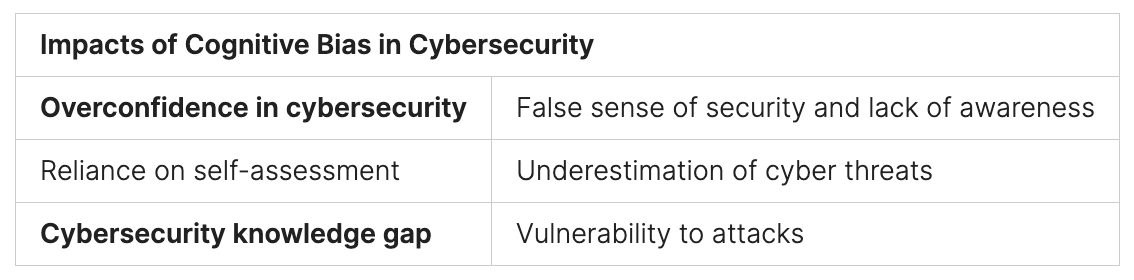
    The field of cybersecurity is not immune to the influence of cognitive biases. One common cognitive bias that affects individuals in the cybersecurity realm is the Dunning-Kruger Effect. This bias can lead to overconfidence in one’s cybersecurity abilities and a false sense of security. Instead of recognizing their limitations, individuals may rely on self-assessment and underestimate the complexity of cyber threats.

    Overconfidence in cybersecurity can be detrimental as it can lead to a lack of awareness and preparedness. It may prevent individuals from seeking expert guidance or staying informed about the evolving threat landscape. This can create a significant cybersecurity knowledge gap, leaving organizations vulnerable to attacks.

    To mitigate the impact of cognitive bias in cybersecurity, it is crucial to promote a culture of continuous learning and improvement. By acknowledging the existence of biases and the limitations of one’s knowledge, individuals can actively seek opportunities to enhance their cybersecurity skills. This may involve attending training programs, obtaining certifications, and engaging with cybersecurity communities to stay updated on best practices and emerging threats.

    By addressing cognitive biases and fostering a learning mindset, individuals and organizations can improve their cybersecurity posture and reduce the risks associated with overconfidence and self-assessment. It is essential to recognize that cybersecurity is a complex and ever-changing field, requiring continuous education and a humble approach to ensure effective protection against cyber threats.

    Recognizing the Illusion of Cybersecurity Competence

    The Dunning-Kruger Effect sheds light on the illusion of cybersecurity competence that individuals may experience. This phenomenon occurs when individuals with limited knowledge or skills in cybersecurity mistakenly believe that they possess a high level of competence. The consequences of this illusion can be significant, as it leads to a false sense of security and a failure to recognize the gaps in one’s cybersecurity knowledge.

    To bridge the cybersecurity knowledge gap, it is crucial to address this illusion and take proactive measures to enhance our understanding of cybersecurity. Education and training play a vital role in dispelling misconceptions and developing a more accurate assessment of one’s abilities. By seeking out reputable cybersecurity courses and certifications, individuals can gain the foundational knowledge needed to recognize their limitations and evaluate their true competence.

    Furthermore, self-reflection and humility are essential in combating the cybersecurity competence illusion. It is important to acknowledge that cybersecurity is a complex and rapidly evolving field, and no individual can possess mastery in every aspect. By embracing a growth mindset and being open to feedback and constructive criticism, individuals can continually improve their skills and avoid falling victim to the Dunning-Kruger Effect.

    Bridging the Gap: Understanding the Dunning-Kruger Effect in Cybersecurity

    To illustrate the knowledge gap that the Dunning-Kruger Effect can create, let’s consider a hypothetical scenario. Suppose an individual with limited cybersecurity knowledge believes they are competent in implementing robust security measures. However, without a comprehensive understanding of cyber threats and risk factors, they may overlook critical vulnerabilities in their systems, leaving them susceptible to attacks.

    This table clearly illustrates the disparity between perceived competence and actual competence, highlighting the dangers of the cybersecurity competence illusion. It emphasizes the importance of objective self-assessment and continuous learning to bridge the knowledge gap and improve cybersecurity skills.

    Understanding Cyber Threats and Risks

    When it comes to cybersecurity, understanding the various threats and risks is crucial for protecting sensitive information and maintaining a secure environment. Cyber threats are constantly evolving, and organizations must stay informed and aware to effectively defend against potential attacks. By gaining a comprehensive understanding of these threats, individuals can develop a proactive approach to cybersecurity and minimize the risk of falling victim to malicious activities.

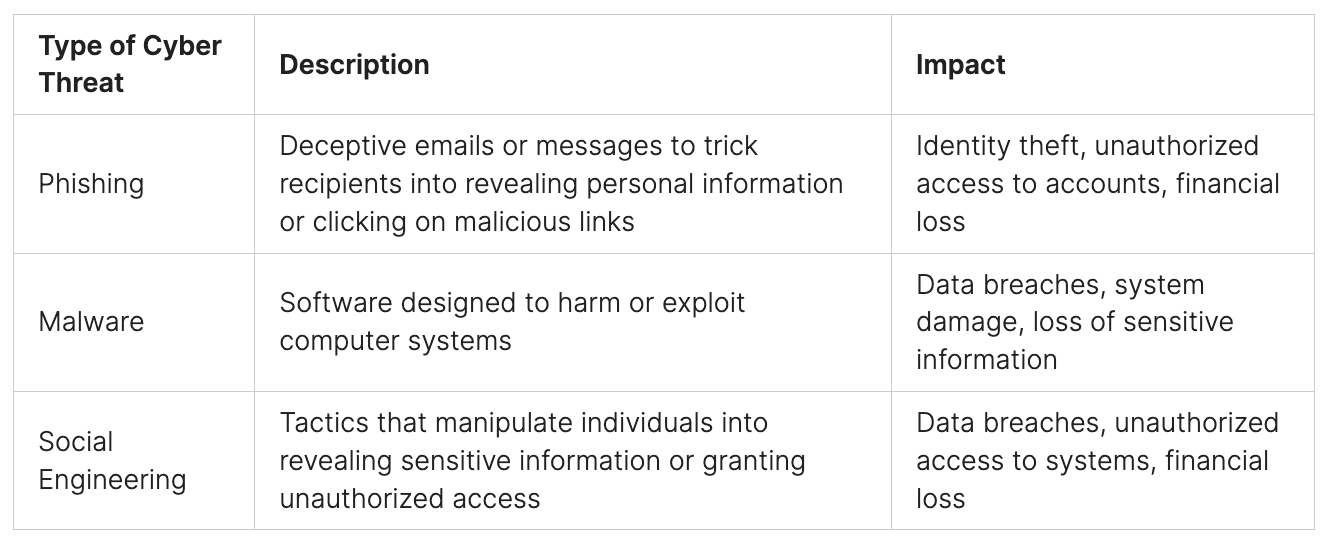
    There are several common cyber threats that individuals should be familiar with. Phishing, for example, involves the use of deceptive emails or messages to trick recipients into providing personal information or clicking on malicious links. Malware refers to any software designed to harm or exploit computer systems, while social engineering tactics manipulate individuals into revealing sensitive information or granting unauthorized access.

    To visually illustrate the different types of cyber threats and their impact, consider the following table:

    By understanding the different types of cyber threats and their potential impact, individuals can better assess their own cybersecurity risk and take appropriate measures to protect themselves and their organizations. It is essential to stay informed about the latest threats and security best practices to maintain a strong defense against cyber attacks.

    Improving Cybersecurity Skills

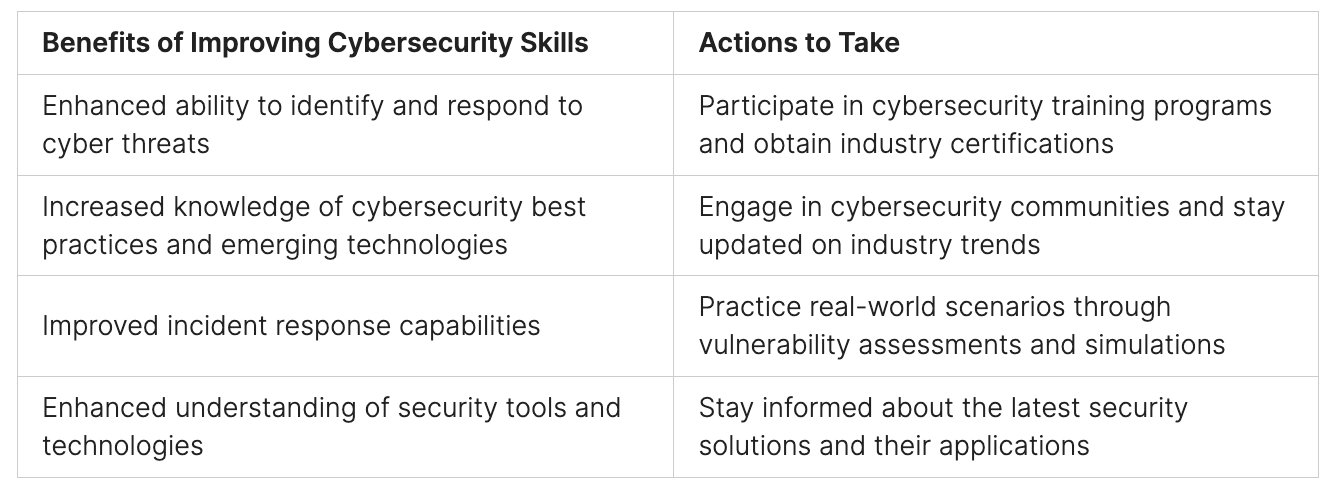
    Enhancing cybersecurity skills is imperative to counter the effects of the Dunning-Kruger Effect and bolster overall security measures. Here are some key strategies and approaches that can help bridge the cybersecurity knowledge gap and improve individual and organizational cybersecurity competence:

    Continuous Learning and Training Programs

    Participating in dedicated training programs and continuous learning initiatives is essential for keeping up with the ever-evolving cybersecurity landscape. By attending workshops, webinars, and conferences, individuals can gain valuable insights and stay updated on the latest security practices and technologies. Additionally, pursuing industry certifications can demonstrate proficiency and provide a structured framework for skill development.

    Engagement in Cybersecurity Communities

    Active engagement in cybersecurity communities can foster collaboration, knowledge sharing, and access to expert guidance. Joining online forums, participating in discussion groups, and networking with experienced cybersecurity professionals can offer a wealth of insights and support. It also allows individuals to stay informed about emerging threats, best practices, and industry trends.

    Familiarity with Latest Security Tools and Technologies

    Improving cybersecurity skills entails staying abreast of the latest security tools and technologies. This involves familiarizing oneself with emerging solutions, such as advanced threat detection systems, secure coding practices, and encryption protocols. By understanding and leveraging these tools, individuals can enhance their ability to prevent, detect, and mitigate cyber threats.

    Practicing Real-World Scenarios

    To reinforce and apply cybersecurity skills, individuals should engage in practical exercises and simulations that mimic real-world scenarios. This includes conducting vulnerability assessments, penetration testing, and incident response drills. By actively engaging in hands-on exercises, individuals can develop critical thinking, problem-solving, and decision-making abilities, contributing to a more robust cybersecurity skill set.

    By adopting these strategies and actively investing in skill enhancement, individuals and organizations can improve their cybersecurity preparedness, mitigate risks, and develop a more comprehensive understanding of the cybersecurity domain.

    Leveraging Expert Guidance

    Overcoming the Dunning-Kruger Effect in cybersecurity requires recognizing the limitations of one’s knowledge and seeking expert guidance. Cybersecurity experts play a crucial role in providing valuable insights and helping individuals gain a more accurate understanding of their capabilities and potential vulnerabilities. By engaging with these experts through consultations, mentorships, or online communities, individuals can access the expertise and guidance needed to develop effective cybersecurity strategies.

    “Seeking the advice of cybersecurity experts is essential for navigating the complex landscape of threats and risks. Their experience and knowledge can help individuals gain a deeper understanding of the latest trends and best practices, ultimately strengthening their cybersecurity posture.”

    Working with cybersecurity experts allows individuals to tap into a wealth of industry-specific knowledge and experience. These experts can provide tailored advice, recommendations, and strategies based on the unique needs and challenges faced by individuals and organizations. By leveraging their expertise, individuals can bridge the cybersecurity knowledge gap and enhance their overall security defenses.

    Benefits of Seeking Expert Advice in Cybersecurity

    Seeking expert advice in cybersecurity offers several key benefits:

    • Access to up-to-date knowledge and best practices
    • Insights into emerging threats and vulnerabilities
    • Validation of existing security measures
    • Identification of weak points and areas for improvement
    • Guidance in developing effective cybersecurity strategies
    • Potential cost savings by avoiding breaches and incidents

    By leveraging the expertise of cybersecurity professionals, individuals can gain a competitive edge in the ever-evolving cybersecurity landscape. The guidance provided by experts can help individuals make informed decisions, prioritize their security efforts, and stay one step ahead of potential threats.

    Seek guidance from experts to gain a competitive edge in the dynamic cybersecurity landscape

    Fostering a Culture of Continuous Improvement

    To overcome the Dunning-Kruger Effect and cultivate a learning mindset in cybersecurity, it is essential to foster a culture of continuous improvement within organizations and individuals. This involves creating an environment that encourages employees to acknowledge their limitations, embrace feedback and constructive criticism, and actively seek opportunities for growth and development.

    One effective way to foster continuous improvement is through regular training and education programs. By providing employees with access to cybersecurity training resources, organizations can ensure that their workforce stays updated on the latest threats, vulnerabilities, and best practices. This not only enhances the overall cybersecurity knowledge and skills of individuals but also helps to bridge the cybersecurity knowledge gap.

    Another important aspect of fostering continuous improvement is to create a supportive and collaborative work environment. Encouraging employees to share their experiences, insights, and lessons learned can promote knowledge sharing and the exchange of ideas. This can be done through team meetings, workshops, or even online platforms dedicated to cybersecurity discussions.

    By fostering a culture of continuous improvement, organizations can empower their employees to take ownership of their cybersecurity skills and stay proactive in keeping abreast of the evolving threat landscape. This ultimately enhances the organization’s overall security posture and helps mitigate the risks associated with cognitive biases such as the Dunning-Kruger Effect.

    The Role of Education and Awareness

    The role of education and awareness is crucial in addressing the Dunning-Kruger Effect and other cognitive biases in cybersecurity. By providing comprehensive cybersecurity education programs, individuals can gain the knowledge and skills necessary to make informed decisions and protect themselves from cyber threats.

    In addition to education, raising awareness about the Dunning-Kruger Effect is vital. This includes highlighting the risks of overestimating one’s abilities in cybersecurity and emphasizing the importance of seeking expert guidance. By educating individuals about the potential pitfalls of cognitive biases, organizations can foster a culture of self-awareness and accountability.

    One effective way to promote cybersecurity education and awareness is through workshops and training sessions. These sessions can cover a range of topics, such as identifying common cyber threats, understanding the importance of secure password practices, and recognizing social engineering techniques. By equipping individuals with this knowledge, they can better recognize their limitations and take proactive measures to enhance their cybersecurity.

    Cybersecurity EducationBenefits

    Workshops and Training

    • Equips individuals with cybersecurity knowledge and skills
    • Raises awareness about common cyber threats
    • Encourages self-awareness and accountability

    Online Resources and Courses

    • Provides convenient access to cybersecurity materials
    • Allows individuals to learn at their own pace
    • Offers a wide range of topics and expertise

    Professional Certifications

    • Validates individuals’ cybersecurity skills and knowledge
    • Enhances career prospects in the cybersecurity field
    • Demonstrates commitment to ongoing learning and improvement

    In conclusion, education and awareness are essential in combating the Dunning-Kruger Effect and promoting a more informed approach to cybersecurity. By providing comprehensive education programs, raising awareness about cognitive biases, and equipping individuals with the necessary knowledge and skills, organizations can enhance their cybersecurity practices and reduce the risks posed by overconfidence and misinformation.

    Conclusion

    In summary, the Dunning-Kruger Effect emerges as a formidable obstacle in the realm of cybersecurity, fostering overconfidence and misconceptions that jeopardize our collective digital security. Heightened awareness of this cognitive bias is imperative, as it underscores the potential for overlooked risks, rendering individuals and organizations susceptible to cyber threats.

    To navigate the challenges posed by the Dunning-Kruger Effect and fortify cybersecurity defenses, it is paramount to prioritize the cultivation of robust cybersecurity skills. The path forward involves a commitment to continuous learning and enhancement, achieved through participation in comprehensive training programs and the attainment of industry-recognized certifications. These efforts are instrumental in bridging the existing knowledge gap and fostering a more resilient cybersecurity ecosystem.

    Furthermore, seeking expert guidance from seasoned cybersecurity professionals serves as a linchpin in acquiring invaluable insights. Such guidance facilitates a more accurate understanding of one’s capabilities and vulnerabilities, contributing significantly to an elevated level of cybersecurity preparedness. Nurturing a culture of perpetual improvement and fostering a mindset of ongoing learning within organizations are essential elements in advancing cybersecurity practices and mitigating the inherent risks associated with cognitive bias.

    In conclusion, acknowledging the constraints of one’s knowledge, actively engaging in educational initiatives, and staying abreast of evolving cyber threats are pivotal steps toward refining cybersecurity skills and bolstering risk awareness. We invite you to explore further insights and innovative solutions on our website, Peris.ai Cybersecurity, to empower yourself and your organization in the ongoing pursuit of a secure digital landscape. Visit us today to stay ahead in the ever-evolving landscape of cybersecurity.

    FAQ

    What is the Dunning-Kruger Effect in cybersecurity?

    The Dunning-Kruger Effect is a cognitive bias that affects individuals’ self-assessment of their competence in cybersecurity. It refers to the tendency for people with low levels of knowledge or skill in cybersecurity to overestimate their abilities.

    How does cognitive bias impact cybersecurity?

    Cognitive bias in cybersecurity, such as the Dunning-Kruger Effect, can lead to overconfidence, misconceptions, and a lack of awareness of potential risks. This can result in a significant cybersecurity knowledge gap and leave organizations vulnerable to attacks.

    What is the illusion of cybersecurity competence?

    The illusion of cybersecurity competence occurs when individuals with limited knowledge or skills in cybersecurity mistakenly believe that they have a high level of competence. This can lead to a false sense of security and a failure to recognize the gaps in their knowledge.

    How can I understand cyber threats and risks better?

    Understanding cyber threats and risks involves awareness of common attack vectors, such as phishing, malware, and social engineering. Staying informed about the ever-evolving cybersecurity landscape can help individuals better protect themselves and their organizations from cyber attacks.

    How can I bridge the cybersecurity knowledge gap?

    Bridging the cybersecurity knowledge gap requires continuous learning and improvement of cybersecurity skills. This can be achieved through attending training programs, obtaining industry certifications, participating in cybersecurity communities, and staying updated on the latest security practices and technologies.

    How can I leverage expert guidance in cybersecurity?

    Seeking expert guidance from cybersecurity professionals can provide valuable insights and help individuals gain a more accurate understanding of their capabilities and potential vulnerabilities. Engaging with cybersecurity experts through consultations, mentorships, or online communities can offer guidance and support in developing effective cybersecurity strategies.

    How can I foster a culture of continuous improvement in cybersecurity?

    Fostering a culture of continuous improvement in cybersecurity involves encouraging employees to acknowledge their limitations, embrace feedback and constructive criticism, and actively seek opportunities for growth and development. Prioritizing continuous learning and improvement enhances cybersecurity practices and mitigates the risks associated with cognitive bias.

    What is the role of education and awareness in cybersecurity?

    Education and awareness play a critical role in combating misconceptions and cognitive biases in cybersecurity. Providing comprehensive cybersecurity education programs and raising awareness about the Dunning-Kruger Effect and other cognitive biases helps individuals develop a more nuanced understanding of their knowledge and skills, reducing the likelihood of falling victim to cyber threats.

    How can I improve my cybersecurity skills?

    Improving cybersecurity skills requires a commitment to continuous learning and improvement. This can be achieved through various means, such as attending training programs, obtaining industry certifications, participating in cybersecurity communities, and staying updated on the latest security practices and technologies.

  • Why Antivirus Software Is No Longer Enough – Here’s What You Need

    Why Antivirus Software Is No Longer Enough – Here’s What You Need

    More people than ever are online, using many apps and devices. Traditional antivirus software can’t protect us from the wide range of cyber threats we face. With over 450,000 new harmful programs appearing daily, the fight against cyber threats has become huge and complex. Basic antivirus tools are now often not enough.

    As a business leader, you’ve likely felt the growing problem of antivirus software not keeping up with cybercriminals’ new tactics. Threats and malware keep getting better, going beyond what basic antivirus can handle. They can’t stop things like ransomware, zero-day exploits, and advanced threats. It’s time to look into stronger, more complete cybersecurity solutions to protect your business in this new digital risk era.

    Key Takeaways

    • Antivirus software alone is no longer enough in today’s evolving cybersecurity landscape.
    • The scale and complexity of cyber threats have outpaced the capabilities of traditional antivirus tools.
    • Advanced threats and malware require a more comprehensive, proactive approach to security.
    • Implementing a multi-layered cybersecurity strategy is essential for effective protection.
    • Exploring alternative security solutions, such as EDR and managed security services, can enhance your organization’s defenses.

    The Evolving Cybersecurity Landscape

    The digital world has changed a lot. More devices connect online every day, which has caused cyber threats to increase sharply. Now, we need more than traditional antivirus software to keep companies safe from new, complex attacks.

    The Growing Need for Robust Cybersecurity Solutions

    Cybercriminals use many new techniques now. They deploy ransomware, target supply chains, and use APTs, among other things. The push for digital upgrades by businesses has made them more vulnerable. This is because of cloud use, IoT, and more.

    Antivirus Software’s Limitations in Today’s Threat Environment

    Usually reliable defenses like firewalls are not enough anymore. Attacks now often go past these barriers. Also, the shift to remote work and using the cloud means old security rules don’t work as well. Devices connecting from everywhere, such as with BYOD, add to these difficulties.

    Endpoint security and EDR tools can safeguard single devices against some threats. However, this is harder for big companies. MDR can help, but it also has its own problems, like finding too many false alarms.

    With cyber threats growing, companies need to use different tactics together for safety. This shows we must look beyond just using antivirus software.

    https://youtube.com/watch?v=zEWfJpDVJwY

    “Antivirus software alone detects only around 90% of known malware samples, leaving a substantial percentage undetected, as indicated by a study conducted by AV-TEST.”

    The risk of cyber threats is becoming more complicated, so businesses must find ways to deal with these new dangers.

    Understanding Antivirus Software

    Antivirus software is key to keeping devices safe from harmful software like viruses and malware. It uses different ways to spot threats, including signature-based and heuristic-based detection. Next-generation antivirus uses AI to stop new threats without needing constant updates.

    Malware attacks can cause big problems, like losing data or money and harming your reputation. To stay safe, it’s important to use antivirus software, keep software updated, and back up your data.

    When picking antivirus software, think about how well it detects threats, its modern security features, and how it affects your system. Free versions can protect you, but you might need to pay for more features.

    Windows antivirus software helps protect against malware by scanning your system and checking emails and websites. MacOS antivirus software also guards against malware, focusing on emails and web browsing. Android antivirus is crucial because many mobile devices are targeted by malware.

    Antivirus software uses different ways to find and stop threats. Signature-based detection looks for known malware patterns, while heuristic-based detection uses algorithms to spot threats. Behavior-based detection watches how software acts to see if it’s harmful. To keep up with new malware, antivirus companies use cloud analysis.

    “The cybersecurity landscape is constantly evolving, and antivirus software alone is no longer sufficient to protect against the ever-increasing threats. A comprehensive, multi-layered approach to cybersecurity is essential for safeguarding individuals and organizations in today’s digital landscape.”

    Antivirus software is vital for fighting malware, but it’s not enough. For full protection, you also need to use encryption, multi-factor authentication and managed security services.

    The Limitations of Antivirus Software

    Antivirus software is key to cybersecurity, but it has big limits in fighting new threats. It looks for known malware patterns, finding new ones every day. Most software scans files or directories in real-time and does full scans at set times. Keeping your software updated is crucial for the best protection.

    The Staggering Number of New Malicious Programs

    Over 450,000 new malicious programs appear every day. This shows that antivirus software alone can’t fully protect your data. With so many new threats, antivirus vendors can’t always keep up, leaving users at risk.

    The Reactive Nature of Antivirus Software

    Antivirus software reacts after an infection, not before. This means businesses can suffer damage from quick attacks. IT Architechs says over 90% of cyber attacks start with emails. Just antivirus isn’t enough against these complex attacks.

    The Rise of Smarter Malicious Programs

    Cybercriminals now create malware that antivirus programs cannot catch. Since antivirus programs only look for known threats, new, smarter malware can slip through. This shows that we need a stronger, proactive approach to fighting cyber threats.

    “While installing anti-virus software is effective, it has limitations as it can only detect malware with known characteristics, making users susceptible to new malware before it is identified by anti-virus vendors.”

    In conclusion, antivirus software is vital but has its limits. We need a stronger, multi-layered approach to fight the growing cyber threats.

    Cyber-attacks That Bypass Antivirus

    Cybercriminals are getting smarter and finding new ways to beat antivirus software. They use polymorphic malware that changes its file hash often, making it hard to catch. Malicious documents can also change their file hashes to slip past antivirus checks. Fileless malware attacks are making antivirus solutions harder to keep up with.

    Phishing attacks are becoming more common. These scams trick people into sharing sensitive info like passwords or bank details. What’s scary is that many phishing sites now use HTTPS to hide their true nature, making them tough to spot.

    Browser-based attacks are another big threat, spreading malware through web pages. Data-stealing malware can get into browsers and grab sensitive data, avoiding antivirus.

    These attacks show that traditional antivirus software can’t keep up with new threats. DoS and DDoS attacks try to flood systems and take them down, making antivirus less effective. MITM attacks intercept data, so strong encryption is key to protect against them.

    Cybercriminals keep getting better, so we need a strong, multi-layered defense against them. Using advanced security tools, training employees, and being proactive can help protect against these threats.

    https://youtube.com/watch?v=OzfIG0p_lxw

    “The rise of cyber-attacks that bypass antivirus software underscores the need for a holistic approach to cybersecurity. Traditional solutions are no longer sufficient to protect against the growing sophistication of modern threats.”

    Antivirus Software in Cybersecurity

    Antivirus software is still key in cybersecurity, but it’s not enough to fight all threats alone. The average cost of a data breach on mobile devices hit $1.9 million in 2023, showing we need a broader cybersecurity plan.

    There are two kinds of antivirus software: free and paid. Top names include Bitdefender, AVAST, and Panda. These tools help block spam, protect against viruses, and stop hackers. But they can slow down your computer, show ads, and have security gaps, especially in free versions.

    Antivirus software uses different ways to find and stop threats. It looks for known threats, uses sandboxing, and learns from data to protect you. But, it mainly reacts to threats it knows about, not new ones.

    To really protect digital assets, we need a full cybersecurity plan. This includes updating software, using strong passwords, and training staff. It also means backing up data, securing networks, and following rules for cybersecurity.

    In summary, antivirus software is crucial but not enough for today’s complex threats. We must use a mix of antivirus and other security steps to protect our digital world.

    Robust Cybersecurity Solutions Beyond Antivirus

    As cybersecurity evolves, businesses need more than just antivirus software. They must use a mix of advanced security tools to protect themselves. This mix helps fight off many cyber threats.

    Device Encryption

    Using device encryption is key to a strong cybersecurity plan. It ensures that all company devices, such as laptops and phones, are safe. If a device gets lost or stolen, encrypted data is hard for others to access.

    Multi-Factor Authentication

    Multi-factor authentication (MFA) is vital today. It makes logging in more secure by asking for extra proof, like a code or your face. This stops hackers from getting into accounts easily.

    Password Managers

    Bad passwords are a big risk for hackers. Password managers keep strong, unique passwords safe for each account. They make it easy for employees to keep their passwords secure.

    Endpoint Detection and Response (EDR)

    Endpoint detection and response (EDR) systems monitor devices closely. They spot and act on threats quickly, helping stop attacks before they get worse.

    Cybersecurity Awareness Training

    Teaching employees about cybersecurity best practices is crucial. Training covers how to spot phishing, manage passwords, and report incidents, turning employees into the first line of defense.

    Managed Security Service Providers (MSPs)

    For those without the skills or resources for cybersecurity, working with a managed security service provider (MSP) is smart. MSPs offer many services, like monitoring and handling security issues. They make sure companies have the right tools and knowledge to fight cyber threats.

    By using a layered cybersecurity approach, businesses can protect themselves well. This is better than just relying on antivirus software.

    https://youtube.com/watch?v=GwR1g-pm0pQ

    “A strong cybersecurity strategy requires a multi-layered approach that goes beyond traditional antivirus software. By implementing a combination of advanced security tools, businesses can significantly enhance their resilience against the ever-evolving threat landscape.”

    The Rise of Ransomware-as-a-Service (RaaS)

    The ransomware industry has grown into a huge business, with cybercriminals using Ransomware-as-a-Service (RaaS) more and more. RaaS lets even new hackers do complex ransomware attacks. The people who make the malware give the tools and help, taking a share of the money made. This has led to more ransomware attacks on businesses of all sizes, with many new types and groups making money from this.

    IBM’s X-Force Threat Intelligence Index says ransomware was a top cyber attack type in 2022. Zscaler’s 2022 report found that 8 out of 11 top ransomware types were RaaS. Now, ransomware attacks happen much faster, taking just 3.85 days on average in 2022, down from over 60 days in 2019.

    RaaS has let many cybercriminals start ransomware attacks. Some types, like LockBit, made up 17% of ransomware cases in 2022. REvil was also big, causing 37% of ransomware attacks in 2021. The DarkSide ransomware was used in a big 2021 attack on the U.S. Colonial Pipeline, seen as the worst cyberattack on U.S. infrastructure.

    Ransomware attacks are very profitable, with an average demand of $6 million in 2021. Total ransomware money made in 2020 was about $20 billion, up from $11.5 billion the year before. RaaS groups take a cut of the money made by affiliates, often 20% to 30%. The DarkSide group made nearly $5 million from the Colonial Pipeline attack, and REvil demanded $10 million in one case.

    RaaS has made it easier for cybercriminals to attack, causing big problems for businesses and organizations worldwide. As threats grow, it’s key for companies to use strong cybersecurity to fight these attacks.

    Getting over a ransomware attack is hard and expensive, which is why stopping RaaS attacks before they happen is crucial. With the ransomware industry growing, we need strong cybersecurity solutions that go beyond antivirus software.

    The Advantages of EDR and MDR

    As the world of cybersecurity changes, the usual antivirus software isn’t enough to stop advanced threats. So, many groups are now using more powerful tools, including Endpoint Detection and Response (EDR) and Managed Detection and Response (MDR) services.

    How EDR Works to Detect and Respond to Threats

    Traditional antivirus just can’t keep up. EDR solutions constantly monitor what’s happening on devices. They find strange or unknown things. When they find something bad, they act fast to stop it from spreading.

    EDR is different from antivirus because it doesn’t just focus on known dangers. It uses smart tools and learns from patterns to spot any kind of threat. This means companies get a big-picture view of their safety. Then, they can move fast to deal with serious threats.

    The Role of Managed Detection and Response (MDR) Services

    For even more protection, companies use MDR services on top of EDR. MDR is like EDR, but it’s also a team that watches over your security all the time. They find problems and help fix them right away.

    Choosing MDR means companies can find and stop threats quickly without adding more people to their teams. MDR also helps teams react quickly when there’s a security emergency.

    EDR and MDR, together with antivirus, provide a strong defense against many kinds of threats.

    Extended Detection and Response (XDR) solutions offer even more protection. XDR doesn’t just watch the devices; it keeps your whole security system safe. This kind of system watches for threats and acts to stop them.

    By using EDR, MDR, and XDR, companies become better at seeing threats. They act quickly, save money, and manage their security team more easily.

    “Implementing EDR, MDR, or XDR can help organizations improve threat visibility, accelerate security operations, reduce total cost of ownership (TCO), and ease the security staffing burden.”

    Cyber Insurance and the Importance of EDR

    Cyber insurance companies now see the big role of endpoint detection and response (EDR) tools. They know EDR is key to lowering cyber risks and keeping security strong. Traditional antivirus software can’t stop today’s complex cyber threats.

    Many insurers now ask for EDR to qualify for policies. EDR tools have features like Endpoint Protection Platform (EPP), threat intelligence, and a central management console. These help companies spot, analyze, and act on security issues fast.

    With new AI tools, keeping cybercriminals out is harder. Insurers want businesses to use strong security, such as EDR and multifactor authentication, to obtain cyber insurance.

    Adding EDR to a company’s security plan shows that they’re ready to handle cyber risks. It helps them get cyber insurance, keeps their data safe and in compliance with laws, and strengthens them against cyber threats.

    Cyber insurance also requires other security steps, like data backups and employee training. Using EDR and other strong security steps helps companies get cyber insurance. It also improves their security and lowers their risk.

    Cyber insurance has many benefits, like covering cyberattack costs and helping with compliance. But insurers now want EDR and behavioral detection to fight new threats. Traditional antivirus isn’t enough against today’s threats.

    Adding EDR to a company’s security plan is key for cyber insurance and fighting new threats. EDR helps protect digital assets, reduce losses, and keep customers and partners trusting.

    The Value of Managed IT Services

    As the world of cybersecurity changes, working with a managed IT service provider (MSP) is key for companies. These services are gaining popularity among businesses for their reliable IT support. They offer access to skilled engineers who can set up and manage advanced security tools like Endpoint Detection and Response (EDR). These services are paid monthly and vary in cost based on the number of users, making them a good fit for small and medium-sized businesses.

    Managed IT services offer more than just saving money. They provide a range of services, including cybersecurity management, cloud services, and remote monitoring and management. They also offer business continuity and disaster recovery solutions. Plus, MSPs are experts in handling rules for industries like finance, healthcare, and education, which is very useful.

    One big plus of managed IT services is getting 24/7 IT support from skilled engineers who can fix problems quickly. The cybersecurity package includes antivirus, anti-spam, and DNS protection, making businesses safer. These services also make hiring IT staff easier, letting businesses focus on what they do best.

    Working with a managed IT service provider helps businesses get the cybersecurity help and proactive management they need. This partnership helps businesses stay ahead of cyber threats and keeps their IT systems reliable and efficient.

    “Managed IT services enable small to medium-sized businesses to access critical network, endpoint, and data management for smooth operations at a fraction of the cost of in-house management.”

    By using the skills and resources of a managed IT service provider, companies can improve their cybersecurity, stay ahead of threats, and make their IT work better. This leads to more efficiency and profit.

    Conclusion

    In today’s rapidly evolving cyber landscape, traditional antivirus software alone is no longer sufficient to protect businesses from sophisticated threats. While antivirus solutions play a crucial role in detecting and blocking malware, their effectiveness relies heavily on frequent updates to identify new threats. Although essential, this approach may fall short against the complexities of modern cyber threats like ransomware.

    To overcome antivirus software’s limitations, companies need to adopt a multi-layered cybersecurity strategy. This includes implementing advanced tools such as Endpoint Detection and Response (EDR), Multi-Factor Authentication (MFA), password managers and managed security services. EDR software is particularly effective in detecting, investigating, and responding to network attacks, providing comprehensive protection for businesses of all sizes.

    By integrating these advanced cybersecurity measures, businesses can fortify their defenses against emerging threats. A robust cybersecurity plan should encompass regular security assessments, ongoing employee training, and expert support to mitigate cyber risks effectively.

    Empower your cyber defense with Peris.ai Brahma – Incident Response Platform. Brahma offers an all-in-one, enterprise-grade solution designed to identify, prevent, and respond to both known and emerging cyber threats across your organization’s infrastructure. Utilizing advanced machine learning and behavior analytics, Brahma delivers exceptional detection and response capabilities across endpoints (EDR), network (NDR), and extended (XDR) systems.

    Key Features of Brahma:

    • Dashboard Monitoring: Central hub for real-time security metrics, interactive charts, graphs, and alerts.
    • Security Configuration Assessment: Comprehensive view of system security configurations, identifying vulnerabilities due to misconfigurations.
    • MITRE ATT&CK Framework: Visualizes defensive coverage, helping you understand tactics and techniques used by attackers.
    • Vulnerabilities Dashboard: Centralized view of identified vulnerabilities, prioritizing and managing remediation efforts effectively.

    Choose Brahma to fortify your organization’s defenses with cutting-edge technology, seamless integration, and unparalleled protection. Elevate your cybersecurity strategy and secure your digital future with Brahma. For more information, visit Peris.ai Cybersecurity.

    FAQ

    What are the limitations of traditional antivirus software in today’s cybersecurity landscape?

    Antivirus software falls short in the battle against modern cyber threats. It struggles with the increase in devices and online actions, making it less effective against new types of malware and cyber threats.

    What types of cyber-attacks can bypass antivirus software?

    Phishing, browser attacks, and data theft are among the dangerous online threats. These dodgy tactics take advantage of gaps in antivirus software’s protection and sneak past undetected.

    What are the key components of a robust cybersecurity solution beyond antivirus?

    A strong cybersecurity setup needs several layers beyond basic antivirus. It includes device encryption, strong authentication, and password management. Also crucial are EDR, training on cybersecurity, and help from MSPs.

    How do Endpoint Detection and Response (EDR) and Managed Detection and Response (MDR) solutions enhance cybersecurity?

    EDR doesn’t just set watch like antivirus. It actively looks for threats by monitoring device activities. MDR steps up by not only watching but also having experts ready to take down threats as they spot them.

    Why is cyber insurance increasingly requiring EDR as a prerequisite for policy qualification?

    EDR is a must for cyber insurance these days. It proves that a company is doing its best to stay secure against cyber risks. Traditional antivirus can’t do this job well enough alone.

    How can managed IT services help organizations enhance their cybersecurity?

    Managed IT services offer vital help in keeping up with the fast-changing cyber threats. They can bring in and manage the latest security tech. This keeps businesses reacting fast and staying safe.

  • 5 Shocking Incident Response Failures and How to Avoid Them

    5 Shocking Incident Response Failures and How to Avoid Them

    Incident response failures can have serious consequences for organizations, leading to data breaches, financial losses, and damage to reputation. Businesses must understand the common cybersecurity mistakes that can result in these failures and implement effective prevention strategies to avoid them.

    Security protocols play a vital role in incident response, providing a framework for organizations to respond swiftly and effectively to cyber threats. By prioritizing risk avoidance and adhering to established security protocols, organizations can enhance their incident response capabilities and protect themselves against potential breaches.

    Key Takeaways:

    • Incident response failures can lead to significant consequences, such as data breaches and financial losses.
    • Understanding common cybersecurity mistakes is crucial for avoiding incident response failures.
    • Prevention strategies, including implementing security protocols, can help mitigate the risk of failures.
    • Risk avoidance should be a priority in incident response planning to enhance overall cybersecurity.

    The Importance of IT Asset Management in Incident Response

    IT asset management (ITAM) plays a crucial role in incident response by ensuring that all IT assets are properly accounted for and protected. In today’s digital landscape, organizations face cybersecurity vulnerabilities that can lead to costly data breaches and reputational damage. By implementing strong ITAM practices, organizations can enhance their incident response capabilities and safeguard against cyber threats.

    Regular audits of IT assets are essential to keep systems up-to-date and secure. These audits help identify vulnerabilities, gaps in security protocols, and potential risk areas. By staying proactive and vigilant in IT asset management, organizations can mitigate the risk of cyberattacks and strengthen their incident response strategies.

    ITAM software tools are invaluable resources for organizations as they provide real-time insights and automate various processes. These tools offer comprehensive visibility into an organization’s IT infrastructure, allowing for effective asset tracking and management. By leveraging ITAM software tools, organizations can streamline their incident response efforts and address vulnerabilities swiftly.

    The Benefits of IT Asset Management Software Tools

    “ITAM software tools provide organizations with critical capabilities in incident response, enabling proactive protection against cyber threats and improving overall cybersecurity posture.”

    • Real-time Visibility: ITAM software tools offer real-time insights into an organization’s IT assets, providing a comprehensive view of the entire infrastructure. This visibility helps identify potential vulnerabilities and respond promptly to incidents.
    • Automation and Efficiency: ITAM software tools automate various IT asset management processes, reducing manual effort and human error. Organizations can allocate their resources more effectively by eliminating time-consuming manual tasks and enhancing incident response efficiency.
    • Compliance and Audit Support: ITAM software tools assist organizations in maintaining compliance with regulatory requirements. These tools facilitate proper documentation, asset tracking, and reporting, streamlining the audit process and ensuring adherence to industry standards.
    • Centralized Data and Reporting: ITAM software tools provide centralized data storage and reporting capabilities, enabling easy access to relevant information during incident response. This centralized approach enhances collaboration and communication among incident response teams.

    Investing in ITAM practices and partnering with the right ITAM provider is crucial for organizations seeking to enhance their incident response capabilities. By prioritizing IT asset management and leveraging the power of ITAM software tools, organizations can effectively shield themselves from cyberattacks and strengthen their overall cybersecurity posture.

    The Impact of Compliance Issues on Incident Response

    Compliance with regulations and industry-specific standards is crucial for effective incident response. Failure to adhere to compliance requirements can have severe consequences, including financial penalties and reputational damage to organizations. Organizations must prioritize compliance in their incident response strategies to protect sensitive information and maintain stakeholder trust.

    In particular, organizations must ensure that their incident response efforts align with relevant regulatory requirements, such as the General Data Protection Regulation (GDPR) and the Health Insurance Portability and Accountability Act (HIPAA). These regulations define strict guidelines for handling personal data and protected health information. Organizations can safeguard individuals’ privacy and prevent legal ramifications by incorporating these requirements into incident response plans.

    Another aspect of compliance in incident response is vendor management. Organizations must extend their high standards and requirements to their vendors and ensure that their assets and practices comply with security and regulatory standards. This includes verifying that vendors have strong IT asset management (ITAM) practices to protect data and prevent cybersecurity breaches.

    “Compliance with regulations and industry-specific standards is critical for effective incident response.”

    By proactively addressing compliance issues throughout the entire incident response process, organizations can strengthen their defenses against cyber threats. Integrating compliance requirements into incident response plans, training employees on regulatory obligations, and conducting regular audits are key steps toward maintaining compliance. Organizations should also collaborate with legal and compliance teams to ensure a comprehensive approach to an incident response that aligns with both cybersecurity best practices and regulatory obligations.

    “Failure to adhere to compliance requirements can have severe consequences for organizations.”

    Furthermore, organizations should regularly review and update their incident response plans to reflect any changes in compliance regulations. By staying up to date with evolving regulatory requirements, organizations can adapt their incident response strategies accordingly and ensure ongoing compliance.

    Key Takeaways

    • Compliance with regulations and industry-specific standards is crucial for effective incident response.
    • Non-compliance can result in financial and reputational damage to organizations.
    • Organizations must ensure that their incident response efforts align with regulatory requirements, such as GDPR and HIPAA.
    • Vendors should also adhere to good ITAM practices and maintain assets compliant with security and regulatory requirements.
    • Proactively addressing compliance issues strengthens incident response capabilities and protects sensitive information.

    “By proactively addressing compliance issues throughout the entire incident response process, organizations can strengthen their defenses against cyber threats.”

    The Role of Incident Response Planning in Effective Cybersecurity Management

    Effective cybersecurity management requires well-defined incident response planning. Incident Response Plans (IRPs) provide a structured framework for security personnel to handle and mitigate the impact of cyber threats. By establishing comprehensive IRPs, organizations can enhance their incident response capabilities and be better prepared for cybersecurity incidents.

    One way to optimize the creation of IRPs is by leveraging the power of Large Language Models (LLMs) like ChatGPT. These advanced AI models can assist organizations in drafting initial incident response plans, suggesting best practices, and identifying documentation gaps. With the assistance of LLMs, organizations can create more robust and efficient IRPs, tailored to their specific needs and industry requirements.

    Continuous refinement is essential for ensuring the effectiveness of IRPs. Regularly reviewing, updating, and testing the plans allows organizations to stay up-to-date with emerging threats and adapt their incident response strategies accordingly. By embracing a proactive approach to incident response planning, organizations can stay ahead of cyber threats and minimize the potential impact of security incidents.

    Benefits of Incident Response Planning:

    1. Structured Response: IRPs provide clear guidelines and procedures for security personnel to follow during an incident, ensuring a coordinated and effective response.
    2. Faster Resolution: Well-defined IRPs enable organizations to respond promptly, reducing the time to detect, contain, and mitigate the impacts of security incidents.
    3. Minimized Damage: Through timely and efficient incident response, organizations can prevent the escalation of cyber threats, minimizing potential data breaches and financial losses.
    4. Compliance Adherence: IRPs help organizations meet regulatory requirements by establishing predefined processes for incident response and data breach notification.

    “Having a well-structured incident response plan in place is like having a roadmap during a crisis. It provides clarity and confidence to security teams, guiding them through the chaos and enabling a more effective response.” – John Smith, Chief Information Security Officer, ABC Corporation.

    Organizations must also consider the integration of Standard Operating Procedures (SOPs) within their IRPs. SOPs provide granular instructions and specific steps for incident responders to follow. By combining IRPs and SOPs, organizations can ensure consistent and standardized incident response practices throughout the entire organization.

    Key Elements of Comprehensive Incident Response Planning:

    Minimize imageEdit imageDelete image

    By incorporating robust incident response planning into their cybersecurity management practices, organizations can enhance their ability to detect, respond to, and recover from security incidents. Through the integration of LLMs, continuous refinement, and the utilization of SOPs, organizations can strengthen their incident response capabilities and better protect their critical assets from cyber threats.

    Common Challenges in Incident Response Planning

    Effective incident response planning is critical for organizations to mitigate risks and respond promptly to security incidents. However, there are several common challenges that organizations face in this process:

    • Complex systems: With the increasing complexity of IT infrastructures, incident response planning becomes more challenging. Coordinating responses across multiple systems and applications can be overwhelming.
    • High turnover rates: Employee turnover can impact incident response planning and capabilities. New team members need to be onboarded and trained, while knowledge gaps may arise when experienced team members leave.
    • Legacy technologies: Many organizations still rely on legacy technologies that are no longer supported or updated. These technologies may lack proper documentation and pose a significant challenge in incident response planning.
    • Lack of documentation: Inadequate documentation can hinder developing, reviewing, and refining incident response plans. Without proper documentation, ensuring consistency and accuracy in response processes is difficult.

    To overcome these challenges, organizations can leverage advanced technologies such as Large Language Models (LLMs) and incorporate artificial intelligence (AI) into their incident response planning processes. LLMs can streamline the planning process by suggesting innovative solutions, providing best practices, and identifying documentation gaps. By harnessing these technologies, organizations can enhance their incident response planning capabilities and improve their preparedness for security incidents.

    One example of an LLM that can assist in incident response planning is ChatGPT. ChatGPT can help organizations develop initial incident response plans, offer guidance on best practices, and identify areas that require documentation improvement.

    Implementing comprehensive incident response planning that considers these challenges and leverages the power of LLMs and AI technologies can significantly enhance an organization’s incident response capabilities and ensure a swift and effective response to security incidents.

    Best Practices for Incident Response Planning

    Implementing best practices in incident response planning is crucial for effective cybersecurity management. By following these best practices, organizations can enhance their incident response capabilities and improve their overall cybersecurity posture.

    1. Tailor Incident Response Plans: Develop incident response plans (IRPs) specifically tailored to your organization’s culture, environment, and business goals. Consider your organization’s unique challenges and vulnerabilities and create plans that address them effectively.

    2. Continuous Refinement: Regularly refine and update your IRPs to ensure their relevance and effectiveness. Cyber threats constantly evolve, and your response plans should reflect these changes. Conduct thorough reviews and assessments, and make necessary adjustments to your plans.

    3. Documentation is Key: Document all aspects of your incident response planning process, including procedures, protocols, and communication channels. Clear and comprehensive documentation ensures that all team members clearly understand their roles and responsibilities during an incident.

    4. Training and Education: Provide ongoing training and education to your incident response team. Keep them updated on the latest cybersecurity threats, techniques, and best practices. Regular training exercises and simulated incidents can help your team stay prepared and test the effectiveness of your IRPs.

    5. Regular Testing and Evaluation: Test your IRPs regularly to ensure their effectiveness and compatibility with emerging threats. Conduct incident response drills and exercises to assess your team’s readiness and identify areas for improvement. Evaluate the outcomes of these tests and make necessary adjustments to your plans.

    6. Embrace a Culture of Continuous Improvement: Encourage and foster a culture of continuous improvement within your organization’s incident response team. Foster an environment where feedback is welcomed, lessons learned from past incidents are shared, and new insights are integrated into the planning process.

    Quote:

    “Best practices for incident response planning require organizations to tailor their plans, continuously refine them, prioritize documentation and training, and regularly conduct testing. By following these guidelines, organizations can enhance their incident response capabilities and better protect against cyber threats.”

    By adhering to these best practices, organizations can strengthen their incident response planning and be better prepared to mitigate the impact of cybersecurity incidents. The continuous refinement of incident response plans, coupled with comprehensive documentation and ongoing training, allows organizations to adapt to evolving threats and respond effectively to incidents.

    Common Mistakes to Avoid in Incident Response Planning

    When it comes to incident response planning, there are several common mistakes that organizations should avoid. By learning from these mistakes, organizations can enhance their incident response capabilities and avoid common pitfalls. Let’s explore these mistakes and understand how to overcome them:

    1. Overcomplicating Response Procedures: One of the most prevalent mistakes in incident response planning is overcomplicating response procedures. When response procedures are overly complex, it can hinder investigations and slow down incident resolution. Organizations should strive for simplicity in their response procedures, ensuring they are clear, concise, and easy to follow.
    2. Using Outdated Plans: Another notable mistake is relying on outdated plans that are ineffective against evolving threats. In the rapidly changing landscape of cybersecurity, it is crucial to regularly review and update incident response plans to address emerging risks and vulnerabilities. Organizations should prioritize maintaining up-to-date plans that align with current cybersecurity best practices.

    3. Neglecting Regular Testing and Evaluation: Regular testing and evaluation of Incident Response Plans (IRPs) is essential for effective incident response. Neglecting this crucial step can lead to ineffective incident response during critical situations. By conducting regular testing exercises and evaluations, organizations can identify and address any weaknesses or gaps in their IRPs, ensuring their readiness to handle security incidents.

    By prioritizing simplicity, currency, and testing in incident response planning, organizations can avoid these common mistakes and optimize their incident response efforts.

    Effective Communication in Incident Response

    Effective communication is vital to incident response, particularly in organizations with segmented functions. Coordinating and interacting with key stakeholders can be challenging, but implementing a centralized communication dashboard can significantly streamline the communication process and enhance incident response capabilities.

    A centralized communication dashboard provides incident response teams with a dedicated platform for efficient information exchange during critical incidents. This centralized system allows teams to publish detailed information, retrieve relevant data, and ensure accurate and timely communication without relying on overloaded email systems.

    This centralized approach to communication offers several benefits:

    • Streamlined communication: All incident-related communication is consolidated in one central location, facilitating easy access and ensuring all team members are on the same page.
    • Real-time information: The dashboard provides real-time updates on incident status, allowing teams to stay informed and make informed decisions quickly.
    • Enhanced collaboration: Clear communication channels foster collaboration among team members, enabling effective coordination and faster incident resolution.

    In addition to these benefits, a centralized communication dashboard can provide a platform for incident documentation and knowledge sharing, allowing teams to maintain a repository of valuable incident response insights and best practices.

    To illustrate the impact of a centralized communication dashboard, consider the following scenario:

    An organization encounters a sophisticated cyberattack that targets sensitive customer information. The incident response team needs to coordinate with multiple departments, including IT, legal, and public relations. Without a centralized communication dashboard, team members must rely on emails, phone calls, and in-person meetings to exchange crucial information.

    In summary, effective communication is a fundamental aspect of incident response. Organizations can enhance coordination, streamline information exchange, and facilitate efficient incident resolution by implementing a centralized communication dashboard. Clear communication channels, supported by a centralized system, are essential for successful incident response efforts.

    Building a Skilled and Well-Managed Incident Response Team

    Building a skilled and well-managed incident response team is crucial for effective incident response. Organizations of all sizes face challenges in selecting the right personnel and allocating resources appropriately. Small organizations may assign incident response responsibilities to employees with technical knowledge but lacking experience in crisis management. Large organizations may struggle with resource allocation. It is important to carefully assess the need for training and seek assistance recruiting experienced staff for the incident response team. Strong leadership, clear roles and responsibilities, and ongoing training contribute to the team’s success.

    When forming an incident response team, organizations should consider the following:

    • Select individuals with diverse skills: Incident response involves various technical and non-technical tasks. Ensure the team comprises members with expertise in areas such as network security, forensics, and communication.
    • Assign clear roles and responsibilities: Define the functions and responsibilities of each team member to ensure efficient collaboration and workflow.
    • Provide thorough training: Regular and continuous training is essential to keep the team updated on the latest security threats, incident response strategies, and tools.
    • Cultivate strong leadership: A skilled and knowledgeable team leader can inspire and guide the team, promote effective decision-making, and ensure smooth coordination.

    Organizations must also establish effective team management practices, such as:

    • Regularly reviewing and evaluating team performance to identify areas for improvement and implement necessary changes.
    • Promoting a culture of collaboration and open communication within the team to facilitate information sharing and knowledge transfer.
    • Providing the necessary resources and support enables the team to carry out their incident response tasks effectively.
    • Encouraging a proactive approach to incident response by fostering a sense of ownership and responsibility among team members.

    By building a skilled and well-managed incident response team, organizations can enhance their incident response capabilities and effectively mitigate the impact of cybersecurity incidents.

    Preserving Evidence in Incident Response

    Preserving evidence is a critical aspect of incident response, ensuring the integrity and accuracy of investigations. In this process, support service personnel play a crucial role, working alongside the incident response team to secure evidence and facilitate an effective incident investigation.

    Support staff should be trained to recognize indicators that require the involvement of the incident response team. By understanding the significance of potential evidence, support personnel can promptly escalate incidents, ensuring that critical information is not overlooked or lost.

    Documentation is key in evidence preservation. Support staff should meticulously document their activities when responding to incidents. This includes capturing relevant information such as timestamps, actions taken, and any observations made during the incident response process. Detailed documentation helps maintain a clear and accurate incident record, contributing to comprehensive investigations.

    Actions taken by support staff to fix user problems should be carefully managed to avoid inadvertently destroying key evidence. Organizations can balance resolving issues promptly and preserving potential evidence by implementing proper incident response protocols.

    Creating a culture of documentation is paramount in preserving evidence. Organizations should emphasize the importance of documentation in incident response and ensure that support staff are aware of their role in evidence preservation. This can be achieved through regular training programs, reinforcing the significance of accurate record-keeping and providing guidelines for documenting incidents and their corresponding actions.

    By prioritizing evidence preservation and fostering a culture of documentation, organizations can strengthen their incident response efforts. The preservation of evidence enables thorough investigations, aiding in the identification of attackers, the understanding of attack vectors, and the implementation of effective security measures to prevent future incidents.

    Key Points:

    • Support service personnel play a crucial role in evidence preservation during incident response.
    • Documentation of activities and actions is essential for maintaining an accurate record of incidents.
    • Avoiding the destruction of evidence while resolving user problems requires careful management.
    • Creating a culture of documentation and providing training are vital for effective evidence preservation.

    Leveraging Incident Response Tools for Effective Incident Management

    Incident response tools are essential for efficiently managing and resolving security incidents. However, organizations must ensure these tools are adequately implemented, properly managed, regularly tested, and fully utilized. By optimizing incident response tool management, organizations can enhance their incident management capabilities and effectively address cybersecurity threats.

    Proper Tool Management

    Proper tool management is crucial to ensure the functionality, reliability, and effectiveness of incident response tools. Centralizing records of the tools used and regularly evaluating their performance can help organizations maintain optimal tool functionality. Organizations can identify and address any issues or gaps in tool capabilities by keeping track of tool updates and conducting periodic assessments.

    Data Accessibility

    Data accessibility is critical in incident response, as access to relevant information is vital for effective incident management. Organizations must ensure that incident response tools provide easy and timely access to critical data. Missing or unavailable information can hinder incident response efforts and potentially prolong the resolution time. Therefore, it is imperative to establish proper data accessibility protocols to facilitate efficient incident management.

    Threat Intelligence Integration

    Integrating threat intelligence into incident response processes enhances organizations’ understanding of potential threats and enables proactive incident management. By leveraging threat intelligence feeds and integrating them into incident response tools, organizations can quickly identify emerging threats, patterns, and indicators of compromise. This integration allows incident responders to make informed decisions and act promptly to mitigate risks.

    In their words…

    “Proper management and utilization of incident response tools is essential for effectively addressing cybersecurity incidents. By ensuring tool functionality, data accessibility, and threat intelligence integration, organizations can enhance their incident management capabilities and mitigate risks effectively.” – Cybersecurity Expert

    Minimize imageEdit imageDelete image

    Leveraging incident response tools and integrating them into incident management processes significantly improves an organization’s ability to respond to security incidents effectively. By adopting proper tool management practices, ensuring data accessibility, and integrating threat intelligence, organizations can enhance their incident response capabilities and better protect against cyber threats.

    Conclusion

    In today’s digital landscape, the consequences of incident response failures are far-reaching, potentially jeopardizing an organization’s data security, financial stability, and reputation. Yet, by adopting proactive measures, organizations can significantly mitigate these risks and enhance their incident response capabilities.

    The key to preventing such failures is the implementation of robust cybersecurity strategies. This includes regularly updating security protocols and leveraging the latest in cybersecurity technology. Organizations can fortify their defenses and reduce the likelihood of significant incidents by keeping cybersecurity management a top priority and staying vigilant against emerging threats.

    Moreover, crafting and maintaining a comprehensive incident response plan (IRP) is crucial for effective cybersecurity management. Organizations should develop these plans and continually refine and test them to ensure they are effective when most needed. Utilizing advanced technologies, such as Large Language Models (LLMs), can aid in drafting and improving these IRPs, optimizing an organization’s readiness to respond to incidents.

    Successful incident response also hinges on having skilled technical expertise, ensuring clear communication channels, establishing well-thought-out processes, and providing ongoing training for all involved. These elements are critical for organizations looking to enhance their cybersecurity measures and maintain readiness against potential threats.

    Peris.ai Cybersecurity recognizes the critical need for advanced, proactive cybersecurity solutions. Our platform is designed to support organizations in developing, refining, and implementing comprehensive incident response strategies that are robust and effective. Visit Peris.ai Cybersecurity to explore how our tools and services can help safeguard your organization against cybersecurity threats and enhance your incident response capabilities. Don’t wait for a security failure to realize the importance of proactive incident management—partner with us today to secure your organization’s future.

    FAQ

    What are some shocking incident response failures?

    Incident response failures can include data breaches, financial losses, and damage to the reputation of organizations.

    How can organizations avoid incident response failures?

    Organizations can avoid incident response failures by implementing effective prevention strategies, following security protocols, and prioritizing risk avoidance.

    What is the importance of IT Asset Management in incident response?

    IT Asset Management (ITAM) ensures that all IT assets are properly accounted for and protected, reducing the risk of cyberattacks.

    How can ITAM software tools help in incident response?

    ITAM software tools provide real-time insights and automate processes, helping organizations maintain comprehensive cybersecurity.

    What impact do compliance issues have on incident response?

    Non-compliance with regulations and industry-specific standards can result in financial and reputational damage for organizations.

    How can organizations address compliance issues in incident response?

    Organizations should ensure that their vendors adhere to good ITAM practices and maintain assets that are compliant with security and regulatory requirements.

    What role does incident response planning play in cybersecurity management?

    Incident response plans (IRPs) provide a framework for guiding security personnel during incidents and mitigating the impact of cyber threats.

    How can organizations enhance their incident response planning efforts?

    Organizations can leverage Large Language Models (LLMs) to draft initial plans, suggest best practices, and identify documentation gaps.

    What are some common challenges in incident response planning?

    Challenges in incident response planning include complex systems, high turnover rates, and the lack of documentation for legacy technologies.

    How can organizations overcome challenges in incident response planning?

    Organizations can leverage LLMs and incorporate AI technologies to streamline processes and improve organizational preparedness for security incidents.

    What are the best practices for incident response planning?

    Best practices for incident response planning include developing tailored IRPs, continuous refinement, documentation, training, and regular testing and evaluation.

    What are some common mistakes to avoid in incident response planning?

    Common mistakes to avoid include overcomplicating response procedures, relying on outdated plans, and neglecting regular testing and evaluation of IRPs.

    How does effective communication impact incident response?

    Effective communication, facilitated by a centralized communication dashboard, enhances collaboration and ensures accurate and timely information during incidents.

    How can organizations build a skilled and well-managed incident response team?

    Organizations can build a skilled and well-managed incident response team by carefully assessing training needs and recruiting experienced staff.

    What is the role of support service personnel in incident response?

    Support service personnel play a crucial role in preserving evidence and should be trained to recognize indicators that require the involvement of the incident response team.

    How can organizations leverage incident response tools for effective incident management?

    Organizations should ensure that incident response tools are adequate, properly managed, regularly tested, and fully utilized to improve their incident response capabilities.

    How can organizations avoid incident response failures and improve their cybersecurity readiness?

    By implementing prevention strategies, prioritizing cybersecurity management, and following best practices in incident response planning, organizations can mitigate risks and enhance their incident response capabilities.

  • Breach Alert: The 6 Cloud Security Threats 2024 Every Business Must Prepare For!

    Breach Alert: The 6 Cloud Security Threats 2024 Every Business Must Prepare For!

    As we approach the new year, it is crucial for businesses to familiarize themselves with the potential cloud security threats that could jeopardize their operations. With the increasing innovation of attackers and the advancements in technologies such as AI and quantum computing, organizations must be proactive in developing a flexible and comprehensive security strategy. By staying prepared and informed, businesses can safeguard their digital assets and maintain the trust of their customers.

    Key Takeaways:

    • Businesses need to be aware of the potential cloud security threats that could impact their operations.
    • Developing a flexible and comprehensive security strategy is crucial in safeguarding digital assets.
    • Technologies such as AI and quantum computing are expected to bring changes to the cloud landscape.
    • Organizations must adopt quantum-resistant encryption algorithms and protocols to defend against quantum threats.
    • AI-powered attacks can pose both positive and negative implications for cybersecurity, necessitating robust security controls.

    Quantum Disrupting Security: A Growing Threat

    Quantum computing is a rapidly emerging technology that has the potential to revolutionize various fields, including encryption and security. With its extraordinary computational power, quantum computers pose a serious threat to the security of current encryption standards.

    “As quantum computers become more powerful and accessible, traditional encryption methods may become obsolete.”

    Traditional encryption algorithms, such as RSA and AES, rely on the difficulty of certain mathematical problems, such as factoring large numbers, to protect sensitive data. However, quantum computers can solve these problems much faster than classical computers, rendering these encryption methods vulnerable.

    To defend against the impending quantum threat, organizations need to adopt quantum-resistant encryption algorithms and protocols. These cryptographic techniques are specifically designed to withstand quantum attacks and provide robust security in the post-quantum era.

    It is crucial for organizations to stay proactive and vigilant in monitoring the quantum computing landscape. By staying updated on the latest developments and best practices, businesses can ensure they are well-prepared to mitigate the risks associated with quantum computing.

    Quantum-Resistant Encryption Algorithms

    Quantum-resistant encryption algorithms, also known as post-quantum cryptography, are designed to resist attacks from both classical and quantum computers. These algorithms are based on mathematical problems that are believed to be hard for both types of computers to solve.

    Some of the prominent quantum-resistant encryption algorithms include:

    • Lattice-based cryptography
    • Code-based cryptography
    • Multivariate cryptography
    • Hash-based cryptography
    • Isogeny-based cryptography

    Implementing these quantum-resistant encryption algorithms and protocols can significantly enhance the security of organizations’ sensitive information in the face of evolving threats from quantum computing.

    Staying Ahead of the Quantum Threat

    As quantum computing continues to advance, it is essential for businesses and security professionals to stay informed and proactive. Adopting quantum-resistant encryption algorithms is just one aspect of defending against the quantum threat.

    Organizations should also:

    • Regularly assess their security infrastructure and protocols
    • Upgrade their encryption standards to be quantum-resistant
    • Monitor the progress in quantum computing research and its potential implications for security
    • Collaborate with experts and institutions in the field to establish best practices

    By taking these proactive measures, businesses can better prepare themselves for the challenges posed by quantum computing and safeguard their sensitive data from future security breaches.

    AI-Powered Attacks: Harnessing New Technologies for Malicious Purposes

    Artificial intelligence (AI) is revolutionizing various industries, including cybersecurity. While AI presents opportunities for improving security measures, it also introduces new risks and challenges. Cybercriminals are harnessing AI to launch sophisticated and stealthy attacks, posing significant threats to businesses and individuals alike.

    Deepfake Attacks: Manipulating Reality for Ill Intent

    One alarming application of AI in cyber attacks is deepfake technology. Deepfake refers to the use of AI algorithms to manipulate images, videos, and audio, creating hyper-realistic fake content that is difficult to discern from authentic media. Malicious actors leverage deepfake technology to spread misinformation, engage in identity theft, and perpetrate social engineering attacks.

    Deepfake attacks can have severe consequences for individuals and organizations. By convincingly impersonating someone, attackers can deceive users into sharing sensitive information, compromising personal and corporate security. As deepfake technology evolves, it becomes increasingly challenging to detect and prevent these malicious activities.

    Adversarial AI: Outsmarting Defenses with AI

    Another concerning aspect of AI-powered attacks is the use of adversarial AI. Adversarial AI refers to AI algorithms that are designed to exploit vulnerabilities in machine learning systems. These attacks aim to manipulate AI models by subtly altering input data, leading to incorrect outputs or system failures.

    Adversarial AI attacks have the potential to bypass traditional security defenses, evade detection mechanisms, and compromise the integrity of AI-powered systems. By exploiting vulnerabilities in AI algorithms or training data, attackers can undermine the reliability and trustworthiness of AI-driven technologies.

    Counteracting AI-Powered Attacks: Building Resilient Cybersecurity

    To defend against AI-powered attacks, organizations must proactively invest in AI-based cybersecurity solutions. Utilizing AI technologies can help augment security defenses, automate threat detection and response, and enhance incident management capabilities. By leveraging AI, cybersecurity professionals can better analyze vast amounts of data, identify patterns, and detect anomalies in real-time.

    However, simply relying on AI-based solutions is not enough. Organizations must also implement robust security controls and policies. This includes implementing multi-factor authentication, regular vulnerability assessments and penetration testing, and user awareness training. Maintaining an educated and proactive workforce is crucial to prevent falling victim to AI-powered attacks.

    Moreover, collaboration and information sharing among businesses, cybersecurity experts, and law enforcement agencies are essential. By working together, organizations can strengthen their defenses, share knowledge on emerging threats, and develop effective countermeasures against AI-powered attacks.

    In conclusion, the rise of AI-powered attacks poses significant challenges to cybersecurity. Deepfake attacks and adversarial AI techniques are growing threats that require immediate attention. By investing in AI-based cybersecurity solutions, implementing robust security controls, and fostering collaboration within the industry, organizations can effectively counter these malicious AI-driven activities and safeguard their digital assets.

    Ransomware: A Persistent and Evolving Threat

    Ransomware continues to pose a significant threat in the realm of cybersecurity. This form of malware encrypts victims’ files and holds them hostage until a ransom is paid, often in the form of cryptocurrency.

    What makes ransomware especially dangerous is its adaptability. Attackers are constantly evolving their tactics, employing advanced encryption algorithms and sophisticated extortion techniques to maximize their profits and avoid detection.

    Organizations must take a proactive approach to protect themselves from ransomware attacks. This involves implementing a comprehensive cybersecurity strategy that encompasses prevention, detection, response, and recovery.

    Patching systems and keeping software up to date is crucial in mitigating vulnerabilities that attackers may exploit. Additionally, organizations must employ robust security measures to limit network exposure and ensure proper user education on recognizing and handling phishing emails and suspicious links.

    Awareness and preparedness are key to minimizing the impact of ransomware attacks. Regularly backing up important files and storing them offline or in a secure cloud environment can help organizations recover their data without succumbing to the demands of attackers.

    It is also essential to have a well-defined incident response plan in place. This plan should include steps to isolate infected systems, identify the type of ransomware, and notify the appropriate authorities.

    By understanding the persistent nature of ransomware and implementing effective protection measures, organizations can minimize the risks associated with this ever-evolving cyber threat.

    The Impact of Ransomware Attacks

    Ransomware attacks can cause significant financial losses and reputational damage for businesses. Organizations that fall victim to ransomware may experience operational disruptions, loss of sensitive data, and potential legal and regulatory liabilities.

    It is vital for businesses to prioritize ransomware prevention and preparedness as part of their overall cybersecurity strategy. By investing in robust defenses, regular employee training, and incident response planning, organizations can mitigate the risks and consequences associated with this persistent and evolving threat.

    Cloud Computing Challenges: Navigating Data Security and Compliance

    While cloud computing offers numerous advantages, it also introduces new challenges in terms of data security and compliance. With the increasing adoption of cloud services, organizations must ensure that their sensitive information is protected and that they meet regulatory requirements.

    One of the main challenges is the risk of misconfigured cloud storage accounts. Improperly configured storage settings can expose sensitive data to unauthorized access and increase the likelihood of data breaches. It is essential for businesses to implement proper access controls and regularly audit their cloud storage settings to prevent these vulnerabilities.

    Infrastructure vulnerabilities also pose a significant threat to cloud data security. Weaknesses in the underlying cloud infrastructure can be exploited by attackers to gain unauthorized access to data. Organizations must work closely with cloud service providers to ensure that robust security measures are in place to protect their data.

    “Ensuring data security and compliance in the cloud is a shared responsibility between the organization and the service provider.”

    Organizations must prioritize access control mechanisms to limit who can access their cloud resources and data. Implementing strong authentication methods, such as multi-factor authentication, can help prevent unauthorized access. Additionally, regular monitoring and logging of access activities can provide insight into potential security breaches and aid in incident response.

    Compliance with regulations and industry standards is critical in cloud environments. Organizations need to stay up to date with evolving data protection laws and compliance requirements to ensure their cloud operations align with legal and regulatory obligations. Conducting regular compliance assessments and audits can identify any gaps and help organizations address them effectively.

    Best Practices for Cloud Data Security and Compliance:

    • Implement strong access controls, including multi-factor authentication
    • Regularly review and update cloud storage settings to prevent misconfigurations
    • Work closely with cloud service providers to ensure robust security measures are in place
    • Monitor and log access activities for early detection of security breaches
    • Stay up to date with data protection laws and compliance requirements
    • Conduct regular compliance assessments and audits
    • Train employees on cloud security best practices

    By addressing these cloud computing challenges and prioritizing data security and compliance, organizations can leverage the benefits of cloud technology while mitigating potential risks and ensuring the confidentiality, integrity, and availability of their data.

    Complexity in Multi-Cloud Environments: Managing Security in a Sprawling Landscape

    Managing security in multi-cloud environments can be a daunting task due to the complexity and variety of cloud platforms and services. With businesses relying on multiple cloud providers to meet their diverse needs, administrators often struggle to maintain control over their sprawling estates. This complexity introduces potential vulnerabilities, making it crucial for organizations to prioritize cloud security and implement effective security controls.

    One of the main challenges in managing security in a multi-cloud environment is ensuring consistent security practices across different platforms. Each cloud provider has its own set of security features and configurations, requiring administrators to have a deep understanding of each provider’s security controls. This can be time-consuming and error-prone, increasing the risk of misconfigurations and leaving cloud environments exposed to cyber threats.

    To address these challenges, organizations must adopt a comprehensive security strategy that includes a centralized platform for managing all their cloud assets and configurations. This centralized platform allows administrators to enforce consistent security policies and controls across all cloud providers, simplifying the management process and reducing the risk of human errors. Additionally, it provides a holistic view of the entire multi-cloud environment, enabling administrators to identify potential security gaps and take proactive measures to mitigate them.

    Implementing strong security controls is crucial in a multi-cloud environment. This includes deploying robust access management policies, applying encryption to protect sensitive data at rest and in transit, and regularly monitoring the cloud environment for any suspicious activities or vulnerabilities. By leveraging cloud security solutions that offer advanced threat detection and automated security measures, organizations can strengthen their security posture and effectively mitigate the risk of cyber attacks.

    Benefits of Centralized Security Management in Multi-Cloud Environments

    Centralized security management brings several benefits to organizations operating in multi-cloud environments. Firstly, it provides a unified view of security across all cloud platforms, enabling administrators to monitor security events, investigate incidents, and respond quickly and efficiently. This level of visibility enhances the overall security posture of the organization and simplifies compliance with regulatory requirements.

    Secondly, a centralized approach allows for the consistent enforcement of security policies and controls across multiple cloud providers. Administrators can define a set of standardized security configurations and apply them uniformly across all cloud environments, reducing the risk of misconfigurations and ensuring a high level of protection against potential threats.

    Finally, centralized security management minimizes complexity in multi-cloud environments. Instead of juggling different security tools and interfaces for each cloud provider, administrators can leverage a single platform that integrates with all their cloud environments. This streamlines security operations, improves efficiency, and enables administrators to focus their time and resources on addressing real security risks rather than managing disparate security systems.

    In conclusion, managing security in multi-cloud environments requires organizations to navigate through the complexity and variety of cloud platforms while ensuring consistent security practices across different providers. By adopting a centralized security management approach, organizations can streamline security operations, reduce complexity, and improve their overall security posture. With robust security controls and automated measures in place, businesses can confidently embrace the benefits of multi-cloud environments while effectively mitigating the risks and challenges they present.

    Conclusion

    As we advance into 2024, the imperative for businesses to intensify their cybersecurity initiatives has never been more critical, especially with the escalating threats in cloud security. The advent of quantum computing, AI-powered attacks, sophisticated ransomware, and the inherent challenges of cloud computing and multi-cloud environments demand a proactive and informed approach to cybersecurity. Businesses must stay abreast of the latest threats and advancements, embrace cutting-edge security solutions, and adopt best practices to safeguard their digital assets effectively.

    The landscape of cloud security is continually evolving, necessitating that organizations adopt robust cybersecurity strategies to stay ahead of potential threats. By investing in the latest technologies and solutions, businesses can enhance their defenses and solidify their security postures. Cultivating a culture of awareness and preparedness is essential for mitigating risks associated with cloud security threats.

    Furthermore, compliance with regulatory requirements and the implementation of effective access control measures are crucial for maintaining security integrity. Regular security assessments and audits play a vital role in identifying vulnerabilities and fostering continuous improvement in security practices. Additionally, establishing strong partnerships with reliable security providers and engaging actively in industry forums and networks are strategic moves that can significantly boost a business’s preparedness against cloud security challenges.

    At Peris.ai Cybersecurity, we are dedicated to equipping businesses with the tools and expertise needed to navigate the complexities of cloud security. Our advanced solutions are designed to address the unique challenges of your business, ensuring compliance, enhancing security, and fostering a resilient cybersecurity posture. Visit us at Peris.ai Cybersecurity to explore how our tailored cybersecurity solutions can help protect your business against the emerging threats of the digital age. Let us help you stay one step ahead in the rapidly evolving world of cloud security.

    FAQ

    What are the top cloud security threats that businesses should prepare for in 2024?

    The top cloud security threats that businesses should prepare for in 2024 include quantum computing disruptions, AI-powered attacks, ransomware, challenges of cloud computing, and managing security in multi-cloud environments.

    How does quantum computing pose a threat to encryption and security?

    Quantum computing has the potential to render traditional encryption methods obsolete. As quantum computers become more powerful, the encryption standards currently in use may no longer be sufficient. To defend against this threat, organizations need to adopt quantum-resistant encryption algorithms and protocols.

    What are AI-powered attacks and how can organizations protect against them?

    AI-powered attacks leverage artificial intelligence to create sophisticated and stealthy cyberattacks. To protect against these attacks, organizations need to invest in AI-based cybersecurity solutions, implement robust security controls and policies, and stay updated on the latest developments and best practices.

    How can organizations protect themselves from ransomware attacks?

    To protect against ransomware attacks, organizations should adopt a comprehensive strategy that includes patching systems, limiting network exposure, educating users, and having a plan to detect, respond to, and recover from attacks.

    What are the main challenges of cloud computing in terms of data security and compliance?

    The challenges of cloud computing in terms of data security and compliance include misconfigured cloud storage accounts, infrastructure vulnerabilities, and the potential exposure of sensitive information. Organizations must prioritize data security, access control, and compliance by implementing robust security measures, conducting regular assessments, and staying updated on evolving regulations and standards.

    How can organizations manage security in multi-cloud environments?

    Managing security in multi-cloud environments can be challenging due to the complexity and variety of cloud platforms and services. Organizations can improve security by adopting a comprehensive security strategy that includes a centralized platform for managing all cloud assets and configurations, reducing complexity and providing better control over the sprawling landscape.

    How can businesses enhance their preparedness for cloud security threats?

    Businesses can enhance their preparedness for cloud security threats by staying informed about the latest threats, adopting advanced security solutions, and implementing best practices such as proactive monitoring, continuous security training, and regular security assessments.

  • Cybersecurity Health Check: Is Your Business at Risk?

    Cybersecurity Health Check: Is Your Business at Risk?

    Cyber risk assessment is a vital part of any organization’s risk management strategy. With the increasing cyber threats in today’s digital landscape, it’s essential to understand and address potential risks to your business’s information systems and data. A cybersecurity health check can help identify, evaluate, and mitigate these risks, ensuring the safety and security of your valuable assets.

    In this article, we will explore the benefits and step-by-step process of cyber risk assessment. From understanding the concept and importance of cyber risk assessment to utilizing technology for automation, real-time monitoring, and data analytics, we will provide the insights you need to safeguard your business from cyber threats.

    Key Takeaways:

    • Cyber risk assessment is crucial for identifying and mitigating potential threats to your organization’s information systems and data.
    • Utilizing technology in cyber risk assessment provides automation, real-time monitoring, and data analytics for enhanced efficiency and accuracy.
    • The process of cyber risk assessment involves preparation, categorization, and selecting the right tools to assess and mitigate risks effectively.
    • Cyber risk assessment offers benefits such as improved decision-making, financial stability, reputation protection, and regulatory compliance.
    • There are various cybersecurity risk assessment frameworks, including the NIST Cybersecurity Framework and ISO 27000, that organizations can leverage for comprehensive assessments.

    Understanding Cyber Risk Assessment

    Cyber risk assessment is a strategic process designed to identify, evaluate, and mitigate potential threats to your organization’s information systems and data. In the digital age, understanding and addressing cyber risks are critical components of a comprehensive risk management strategy. It involves strategically planning to avoid risks and make your business safer, navigating potential pitfalls, and ensuring resilience.

    With cyber threats becoming increasingly sophisticated and prevalent, organizations must proactively assess and manage their cyber risk. By conducting a comprehensive cyber risk assessment, businesses can gain a holistic view of their vulnerabilities and develop targeted strategies to strengthen their cybersecurity defenses.

    During a cyber risk assessment, various factors are considered, including the organization’s IT infrastructure, data management processes, security measures, and regulatory compliance. By analyzing these areas, businesses can identify potential weaknesses and prioritize areas for improvement.

    “Cyber risk assessment is not a one-time event, but an ongoing process. It requires continuous vigilance and adaptation to stay ahead of emerging threats.”

    A thorough cyber risk assessment enables organizations to take a proactive approach to cybersecurity rather than reacting to incidents once they occur. By understanding their cyber risk exposure, businesses can make informed decisions about cybersecurity investments, allocate resources effectively, and implement appropriate risk mitigation measures.

    Furthermore, a comprehensive risk assessment helps organizations comply with industry-specific regulations and standards, safeguard customer data, protect brand reputation, and ensure business continuity.

    Key Elements of Cyber Risk Assessment:

    • Identifying potential cyber threats and vulnerabilities
    • Evaluating the likelihood of each threat occurrence
    • Assessing the potential impacts and consequences of each threat
    • Quantifying the overall cyber risk exposure
    • Developing a risk mitigation plan
    • Implementing security controls and measures
    • Regularly reviewing and updating risk assessments

    By following these key elements, organizations can ensure a comprehensive and effective cyber risk assessment process.

    Edit imageDelete imageMinimize image

    With cyber threats continuously evolving, cyber risk assessment remains critical for organizations of all sizes and industries. By understanding the concept and importance of cyber risk assessment, businesses can take proactive steps to protect their valuable data and information systems.

    The Benefits of Utilizing Technology in Cyber Risk Assessment

    Integrating technology into cyber risk assessment processes offers numerous benefits for businesses. By leveraging automation, real-time monitoring, data analytics, and scalability, organizations can enhance their cybersecurity measures and mitigate the ever-evolving threats they face.

    Automation for Efficient Risk Identification

    Automation plays a crucial role in cyber risk assessments by enabling rapid identification and categorization of potential threats. Instead of manual and time-consuming processes, automated tools can analyze vast amounts of data and detect vulnerabilities with greater efficiency. This ensures that crucial risks are not overlooked and allows businesses to respond promptly.

    Real-Time Monitoring for Prompt Response

    Real-time monitoring enables organizations to detect and respond to cyber threats as they occur, minimizing their impact. Through continuous network activity monitoring, businesses can identify suspicious behavior, unauthorized access attempts, and potential data breaches. Prompt response allows immediate remediation and reduces the risk of substantial damage to information systems and data.

    Data Analytics for Enhanced Risk Assessment

    Data analytics tools provide in-depth insights into patterns and trends related to cyber risks. By analyzing historical data and identifying correlations, organizations better understand potential vulnerabilities and attack vectors. This enhances the accuracy of risk assessments, enabling informed decision-making in implementing security measures and allocating resources for maximum risk mitigation.

    Scalability for Adapting to Evolving Threats

    Leveraging technology in cyber risk assessments allows for scalable solutions that can adapt to the ever-evolving landscape of cyber threats. Organizations need agile and adaptable security measures as new attack techniques emerge and existing vulnerabilities are patched. Technology-driven approaches provide the flexibility to implement changes and updates seamlessly, ensuring robust cybersecurity measures that keep pace with the dynamic nature of cyber risks.

    Benefits of Utilizing Technology in Cyber Risk Assessment Efficient risk identification through automation Prompt response to cyber threats through real-time monitoring Enhanced risk assessment through data analytics Adaptability to evolving threats through scalability

    By harnessing the power of technology in cyber risk assessment, businesses can proactively protect their sensitive information, strengthen their cybersecurity defenses, and maintain a robust security posture in the face of growing cybersecurity challenges.

    Breaking Down the Process of Cyber Risk Assessment

    Cyber risk assessment is a crucial component of effective cyber risk management. This process involves several key steps organizations should follow to ensure comprehensive evaluation and mitigation of cyber risks.

    Step 1: Preparation

    In this initial step, adequately preparing for the cyber risk assessment is important. This involves managing security and privacy risks, identifying key stakeholders, and establishing a robust cyber risk management framework. Organizations can lay the groundwork for a successful assessment by aligning these foundational elements.

    Step 2: Categorization

    After preparation, the next step is categorizing digital systems and information based on their impact on the business. This categorization allows for a more focused evaluation of cyber risks, enabling organizations to prioritize and allocate resources based on the level of risk posed by different assets.

    Step 3: Selecting the Right Tools

    Selecting the right tools is a critical aspect of the cyber risk assessment process. Organizations must identify and implement tools aligning with their needs and goals. These tools can range from vulnerability scanners and penetration testing software to threat intelligence platforms and risk assessment frameworks. Choosing the right tools ensures that the assessment is comprehensive and effective.

    Step 4: Implementation and Evaluation

    Organizations must implement the appropriate tools and assess their effectiveness once the appropriate tools have been selected. This involves conducting the assessment, analyzing the results, and identifying areas for improvement. Reviewing and updating the assessment regularly is essential to stay ahead of evolving cyber threats.

    Step 5: Mitigation and Continuous Improvement

    The final step in the process is to implement mitigation measures based on the assessment findings. This may involve enhancing security controls, implementing new policies and procedures, or providing additional employee training. Continuous improvement ensures that cyber risks are effectively managed and mitigated over time.

    By following this step-by-step process, organizations can enhance their cyber risk management efforts and protect their valuable assets from potential cyber threats.

    Delete imageMinimize imageEdit image

    The Benefits of Cyber Risk Assessment

    Cyber risk assessment offers numerous benefits for businesses. It enhances decision-making by providing a crystal-clear understanding of potential threats and challenges. Companies can gain valuable insights into their vulnerabilities and make informed decisions to protect their critical assets by conducting a comprehensive cyber risk assessment.

    Enhancing Decision-Making

    A cyber risk assessment acts as a powerful tool for decision-makers. It provides an in-depth analysis of cybersecurity risks, allowing organizations to prioritize their resources and implement effective mitigation strategies. By identifying potential threats and evaluating their impact, decision-makers can allocate resources strategically and make informed choices that align with their business goals.

    Ensuring Financial Sturdiness

    Financial stability is essential for the success of any business. Cyber risk assessment acts as a financial health check-up by identifying, measuring, and managing risks that could impact the bottom line. Organizations can take proactive measures to mitigate risks, protect their assets, and ensure long-term financial sturdiness by understanding the potential financial implications of cyber threats.

    Being a Reputation Guardian

    In today’s digital landscape, a company’s reputation is paramount. A cyber risk assessment helps protect the brand by identifying vulnerabilities and implementing robust security controls. By proactively addressing potential threats, organizations can safeguard customer trust, maintain a positive reputation, and mitigate the damage caused by cyber incidents. A strong reputation is a valuable asset that sets businesses apart from their competitors.

    Ensuring Regulatory Compliance

    Adhering to industry standards and legal requirements is crucial for every business. A cyber risk assessment ensures regulatory compliance by aligning business practices with industry standards and legal obligations. By identifying gaps in compliance and implementing necessary controls, organizations can avoid costly penalties, legal issues, and reputational damage.

    “A cyber risk assessment serves as a strategic tool for businesses to enhance decision-making, secure financial stability, protect their reputation, and maintain regulatory compliance”

    Edit imageDelete imageMinimize image

    What is a Cybersecurity Assessment?

    A cybersecurity assessment, also known as a cybersecurity risk assessment, analyzes an organization’s cybersecurity controls and its ability to remediate vulnerabilities. It evaluates the organization’s cybersecurity posture within the context of its business objectives. The assessment helps identify weaknesses and provides a high-level analysis of network vulnerabilities, allowing security teams to implement control measures.

    The Importance of Cybersecurity Assessments

    Ensuring the security of your organization’s digital assets is crucial in today’s interconnected world. Cybersecurity assessments play a significant role in protecting sensitive data and preventing potential attacks. By conducting regular assessments, businesses can:

    • Identify and Mitigate Risks: Assessments help identify vulnerabilities, weaknesses, and potential threats. They enable organizations to mitigate risks and improve their cybersecurity posture proactively.
    • Enhance Cybersecurity Controls: Assessments provide valuable insights into their effectiveness by evaluating existing cybersecurity controls. This allows organizations to identify gaps and implement stronger controls to protect against vulnerabilities.
    • Comply with Regulations: Cybersecurity assessments help organizations ensure compliance with industry regulations and legal requirements. They provide evidence of proactive efforts to protect sensitive data and maintain customer trust.
    • Strengthen Business Continuity: Identifying vulnerabilities and implementing robust cybersecurity controls helps organizations maintain operational continuity, even in the face of potential cyber threats or breaches.

    The Cybersecurity Assessment Process

    The process of conducting a cybersecurity assessment typically involves several key steps:

    1. Evaluating the Scope: Assessing the scope of the assessment involves defining the boundaries and determining the systems, assets, and networks that will be included in the evaluation.
    2. Determining Asset Value: Understanding the value of each asset helps prioritize resources and allocate appropriate security measures based on the potential impact of an attack or breach.
    3. Identifying Risks: Thoroughly assessing potential risks and vulnerabilities enables organizations to develop effective mitigation strategies and prioritize remediation efforts.
    4. Implementing Security Controls: Based on the identified risks, organizations can implement suitable cybersecurity controls to protect against vulnerabilities and enhance their overall security posture.

    By following these steps, organizations can create a comprehensive approach to cybersecurity assessment and strengthen their defenses against cyber threats.

    Edit imageMinimize imageDelete image

    The Steps of a Cybersecurity Assessment

    A cybersecurity assessment is a systematic process that organizations undertake to comprehensively evaluate their security posture. Following a series of steps, businesses can identify vulnerabilities, assess risks, and establish effective security controls. This section will outline each step involved in a cybersecurity assessment.

    Evaluating the Scope of the Assessment

    The first step in a cybersecurity assessment is to determine the scope. This involves identifying the systems, networks, and data to be assessed. By clearly defining the scope, organizations can focus their efforts and ensure a thorough evaluation of their security measures.

    Determining the Value of Each Asset

    Next, organizations need to determine the value of each asset. This includes assessing the importance of systems, data, and infrastructure to the overall business operations. Organizations can prioritize their security efforts and allocate resources effectively by assigning a value to each asset.

    Identifying Cybersecurity Risks

    Identifying cybersecurity risks is a crucial step in the assessment process. Organizations must identify potential threats and vulnerabilities that could compromise their systems or data. This can be done through vulnerability scanning, penetration testing, and analyzing security logs.

    Comparing Asset Value with Prevention Cost

    Once the risks have been identified, organizations need to compare the value of their assets with the cost of implementing preventive measures. This analysis helps determine the cost-effectiveness of security controls and aids in decision-making regarding resource allocation.

    Establishing Security Controls

    The final step in a cybersecurity assessment is to establish security controls. This involves mitigating the identified risks and protecting the organization’s assets. These controls include firewalls, intrusion detection systems, encryption, access controls, and employee training.

    By following these steps, organizations can conduct a thorough cybersecurity assessment and gain valuable insights into their security posture. This enables them to identify vulnerabilities, assess the cost-effectiveness of preventive measures, and establish robust security controls to protect their systems and data.

    The Importance of Performing a Cybersecurity Assessment

    Performing a cybersecurity assessment is crucial for organizations to defend against various threats. By conducting regular assessments, businesses can identify vulnerabilities, minimize gaps in security, and keep key stakeholders informed about the organization’s cybersecurity posture. Additionally, cybersecurity assessments ensure compliance with regulations such as GDPR, HIPAA, PCI-DSS, CMMC, and FERPA.

    A robust defense is essential in today’s digital landscape, where cyberattacks are becoming more sophisticated and prevalent. Cybersecurity assessments play a vital role in maintaining a strong defense by:

    1. Identifying Vulnerabilities: Through thorough assessments, organizations can pinpoint weaknesses in their systems and networks, enabling them to implement measures to address and mitigate these vulnerabilities.
    2. Minimizing Gaps in Security: Assessments help identify gaps or weaknesses in the organization’s cybersecurity measures, allowing for the development of more robust and comprehensive defense strategies.
    3. Keeping Stakeholders Informed: By regularly performing assessments, organizations can provide stakeholders, including executive management, board members, and customers, with a clear understanding of the organization’s cybersecurity efforts and any potential risks.

    Cybersecurity assessments also play a critical role in ensuring industry regulations and standards compliance. Meeting compliance requirements is necessary not only for legal and ethical reasons but also to enhance customer trust and safeguard sensitive data.

    To illustrate the importance of cybersecurity assessments, consider the following scenario:

    Company XYZ, a growing e-commerce business, has recently experienced an increase in cyberattacks targeting their customer data. By performing a cybersecurity assessment, they discovered vulnerabilities in their payment processing system that could potentially be exploited by hackers. Through remediation efforts based on the assessment’s findings, XYZ was able to strengthen their defense and protect their customers’ sensitive information.

    By investing in regular cybersecurity assessments, organizations can proactively identify and address vulnerabilities, maintain a robust defense, and ensure compliance with industry regulations. These assessments form the foundation of a comprehensive cybersecurity strategy, helping businesses stay one step ahead of cyber threats and safeguard their valuable assets.

    Different Types of Cybersecurity Risk Assessment Frameworks

    When it comes to cybersecurity risk assessment, organizations have a range of frameworks at their disposal. These frameworks provide structured approaches and guidelines for evaluating and managing cyber risks. The NIST Cybersecurity Framework and the ISO 27000 standards are two widely recognized frameworks in the industry.

    NIST Cybersecurity Framework

    The NIST Cybersecurity Framework, developed by the National Institute of Standards and Technology (NIST), is a comprehensive framework that assists organizations in managing and mitigating cybersecurity risks. It outlines essential components and best practices for effective cybersecurity risk assessment and management.

    Key features of the NIST Cybersecurity Framework include:

    • Identification of critical assets and systems
    • Assessment of existing cybersecurity measures
    • Detection, response, and recovery capabilities
    • Continuous monitoring and adaptation to evolving threats

    The NIST Cybersecurity Framework is widely adopted and recognized for its flexibility and scalability across various industries.

    ISO 27000 Standards

    The ISO 27000 standards provide a holistic approach to information security management systems (ISMS). ISO 27001, in particular, sets out the requirements for establishing, implementing, maintaining, and continuously improving an ISMS within the context of the organization’s overall business risks.

    Key features of ISO 27001 include:

    • Identification and assessment of information security risks
    • Implementation of appropriate security controls
    • Monitoring, measurement, analysis, and evaluation of the ISMS
    • Ensuring compliance with legal, regulatory, and contractual requirements

    ISO 27001 is a globally recognized standard that not only focuses on internal information security but also extends to the security of third-party vendors and suppliers.

    Minimize imageEdit imageDelete image

    These frameworks, along with others available in the industry, play a crucial role in guiding organizations through the process of cybersecurity risk assessment. By leveraging these frameworks, businesses can enhance their understanding of cyber risks, prioritize mitigation efforts, and establish robust cybersecurity measures.

    Challenges and Best Practices in Security Health Checks

    Conducting effective security health checks can pose several challenges for organizations. Some of the common challenges include resource constraints, lack of expertise, and the ever-evolving nature of cyber threats. However, adopting best practices can help overcome these challenges and ensure a robust security posture.

    One challenge that organizations often face is resource constraints. Limited budgets, manpower, and time can make it difficult to dedicate sufficient resources to security health checks. This can result in inadequate assessments and vulnerabilities being overlooked.

    Lack of expertise is another hurdle that organizations encounter. Conducting thorough security health checks requires specialized knowledge and skills. Organizations may struggle to identify and mitigate potential risks without the necessary expertise.

    The dynamic nature of cyber threats is an ongoing challenge for organizations. The landscape of cybersecurity is constantly evolving, with new threats emerging regularly. Organizations must continuously update their security protocols to stay one step ahead of cybercriminals.

    Implementing best practices is essential to address these challenges and ensure effective security health checks. One best practice is leveraging Application Performance Monitoring (APM) tools. APM tools provide real-time insights into the performance and security of applications, enabling organizations to detect and respond to threats promptly.

    Setting regular schedules for security health checks is another important best practice. By consistently conducting assessments, organizations can identify and address vulnerabilities before malicious actors exploit them.

    Continuous updates to security protocols are crucial for maintaining a strong defense against evolving threats. Regularly reviewing and updating security measures, such as patch management and access controls, helps ensure the organization remains protected from the latest cyber threats.
    Finally, inclusivity across all application tiers is a best practice that organizations should prioritize. Every layer of an application, from the front end to the back end, should be included in security health checks to ensure comprehensive protection.

    “Leveraging APM, setting regular schedules for checks, continuously updating security protocols, and ensuring inclusivity across all application tiers are among the recommended best practices.”

    By implementing these best practices, organizations can overcome the challenges associated with security health checks and establish a strong cybersecurity foundation. Taking proactive measures to assess and strengthen their security posture will ultimately safeguard sensitive data, protect against cyber threats, and maintain the trust of customers and stakeholders.

    Edit imageMinimize imageDelete image

    Conclusion

    In today’s digital age, adopting a proactive approach to cybersecurity is more crucial than ever for safeguarding applications against evolving cyber threats. By integrating regular security health checks and utilizing Application Performance Monitoring (APM), organizations can significantly bolster their software resilience and safeguard sensitive data. When paired with regular updates and a robust crisis response plan, these consistent security assessments form the cornerstone of effective cybersecurity measures.

    Prioritizing cybersecurity and committing to ongoing security health checks enhances customer trust and strengthens an organization’s reputation. Effective protection of applications from malicious attacks not only secures critical information but also underscores a dedication to customer privacy and data security. This proactive stance ensures organizations are consistently ahead of cybercriminals, effectively mitigating potential risks.

    In conclusion, organizations must embrace a forward-thinking approach towards cybersecurity. Routine security health checks, enhanced by the capabilities of APM, equip organizations with a deep understanding of their applications’ vulnerabilities, enabling timely and effective risk management. By championing application protection and fostering a culture centered on proactive cybersecurity, organizations can ensure their software remains robust, customer trust is preserved, and their reputation remains untarnished in the competitive digital landscape.

    To learn more about how your organization can enhance its cybersecurity posture and effectively protect its digital assets, visit Peris.ai Cybersecurity. Discover our innovative solutions and strategies to keep you one step ahead of cyber threats. Join us in our mission to secure your applications and protect your data by exploring the tools and services we offer at Peris.ai Cybersecurity. Take the proactive step today to secure a safer tomorrow for your organization.

    FAQ

    What is cyber risk assessment?

    Cyber risk assessment is a strategic process designed to identify, evaluate, and mitigate potential threats to your organization’s information systems and data.

    Why is cyber risk assessment important?

    Understanding and addressing cyber risks are critical components of a comprehensive risk management strategy in the digital age.

    What are the benefits of utilizing technology in cyber risk assessment?

    Technology provides automation for efficiency, real-time monitoring, data analytics for in-depth insights, and scalability and adaptability to evolving threats.
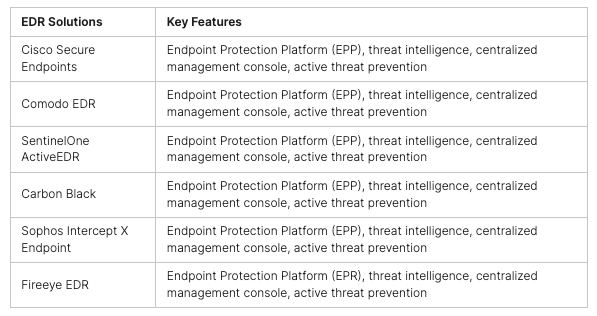
    What are the steps involved in cyber risk assessment?

    The process includes preparation, categorization, and selecting the right tools to evaluate and manage cyber risks.

    What are the benefits of cyber risk assessment?

    Cyber risk assessment enhances decision-making, acts as a financial health check-up, serves as a reputation guardian, and ensures regulatory compliance.

    What is a cybersecurity assessment?

    A cybersecurity assessment analyzes an organization’s cybersecurity controls and their ability to remediate vulnerabilities within the context of its business objectives.

    What are the steps involved in a cybersecurity assessment?

    The steps include evaluating the scope, determining asset value, identifying risks, comparing asset value with prevention cost, and establishing security controls.

    Why is performing a cybersecurity assessment important?

    Performing a cybersecurity assessment helps identify vulnerabilities, minimize security gaps, and maintain compliance with regulations.

    What are some popular cybersecurity risk assessment frameworks?

    Two popular frameworks are the NIST Cybersecurity Framework and the ISO 27000 standards.

    What are the challenges and best practices in security health checks?

    Challenges include lack of expertise, resource constraints, and keeping up with evolving threats. Best practices include leveraging APM, setting regular schedules, continuously updating security protocols, and ensuring inclusivity across all application tiers.
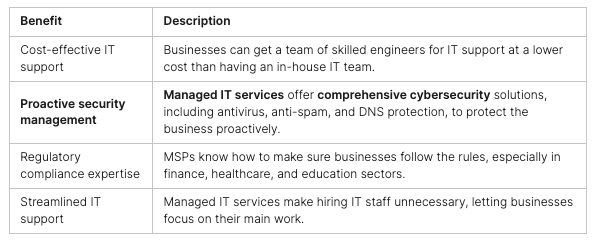
    Why is a proactive approach to cybersecurity important?

    Taking a proactive approach, including security health checks and leveraging APM, helps safeguard applications, ensure ongoing security, improve customer trust, and maintain a strong reputation.

  • Effective Incident Reporting for Organizational Safety

    Effective Incident Reporting for Organizational Safety

    The modern business landscape is intricately woven with technology and interconnected networks, ushering in unparalleled efficiency and innovation. Yet, this digital progress comes hand in hand with a pressing issue that transcends industries and organizational scales – cybersecurity. As technology advances, so do the tactics of cyber threats that loom over businesses. These threats possess the potential to not only disrupt daily operations but also breach sensitive data, casting long-lasting shadows on hard-earned reputations. In the relentless pursuit of mitigating these risks, the internal IT teams are the vanguards entrusted with fortifying an organization’s digital infrastructure. Among the array of tools at their disposal, none shine as brightly as the effective incident reporting platform – a cornerstone of organizational well-being and an embodiment of cutting-edge cybersecurity measures, converging to provide a shield of comprehensive threat protection.

    The Landscape of Modern Cybersecurity Threats

    Before delving into the significance of an effective incident reporting platform, it’s crucial to comprehend the evolving landscape of cybersecurity threats that organizations encounter today. Cybercriminals have become increasingly sophisticated, employing many tactics to breach digital defenses, including malware, phishing attacks, ransomware, and social engineering. These threats can exploit an organization’s infrastructure vulnerabilities, leading to data breaches, financial losses, and reputational damage.

    Role of Internal IT Teams in Cybersecurity

    Internal IT teams are the first line of defense against cyber threats. Their responsibilities extend beyond maintaining the organization’s technological infrastructure. They are tasked with monitoring network activity, identifying potential vulnerabilities, deploying security patches, and responding swiftly to incidents. In this context, an incident refers to any suspicious or unauthorized activity that could lead to a security breach.

    Challenges in Incident Reporting and Management

    Effective incident reporting and management are paramount in maintaining robust cybersecurity. When internal IT teams identify a potential threat, their ability to promptly report and address the incident can differentiate between containment and escalation. However, several challenges can impede this process:

    1. Lack of Centralized Reporting: IT teams may be spread across different departments or locations in larger organizations, making it difficult to centralize incident reporting.
    2. Communication Gaps: Clear communication between IT teams and other departments, such as legal, PR, and upper management, is essential during incident response. Communication breakdowns can lead to mismanagement of the incident.
    3. Data Fragmentation: Incidents generate a wealth of data, including logs, network traffic analysis, and user activity. Without a centralized platform, this data may be scattered, making it challenging to piece together the full scope of the incident.
    4. Delayed Response: Traditional methods of incident reporting, such as emails or manual forms, can lead to delays in response times, allowing cyber threats to propagate.

    Enter the Effective Incident Reporting Platform

    An effective incident reporting platform addresses these challenges and fortifies an organization’s cybersecurity posture. Such a platform is a centralized hub for reporting, tracking, and managing cybersecurity incidents. Here’s how it contributes to organizational safety and advanced cybersecurity:

    1. Centralized Reporting and Tracking:

    An incident reporting platform provides a unified interface for IT teams to report and track incidents in real-time. This centralized approach ensures that all incidents are documented, providing a comprehensive overview of the threat landscape. Moreover, authorized personnel can access the platform to view the status of ongoing incidents and track their resolution progress.

    2. Streamlined Communication:

    Communication gaps can be bridged through the incident reporting platform. IT teams can collaborate seamlessly with other departments by sharing incident-related information, updates, and action items within the platform. This real-time collaboration fosters a holistic approach to incident response, enabling quicker decision-making and more efficient containment strategies.

    3. Data Consolidation:

    An incident generates a plethora of data from various sources. An incident reporting platform facilitates the aggregation of this data, creating a comprehensive dataset for analysis. This data-driven approach enhances the organization’s understanding of the incident, enabling IT teams to identify patterns, root causes, and potential points of vulnerability.

    4. Automated Workflows:

    Modern incident reporting platforms often feature automation capabilities. Routine tasks can be automated, such as assigning incident ownership, notifying stakeholders, and triggering predefined response actions. This accelerates the incident response process and reduces the risk of human error.

    5. Real-time Analysis:

    Incident reporting platforms can integrate with cybersecurity tools that offer real-time analysis of incoming threats. This integration empowers IT teams to identify and respond to incidents as they unfold, enhancing the organization’s ability to thwart cyber threats before they escalate.
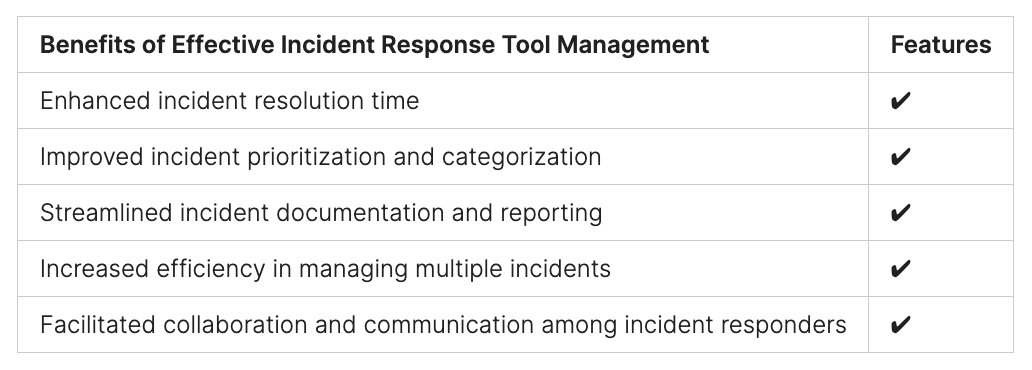
    Conclusion: Empowering Organizational Resilience through Advanced Incident Reporting

    In this digital epoch, where every facet of business is intricately intertwined with technology, the fortification of cybersecurity has emerged as an unassailable imperative. For organizations to thrive, preserving their digital landscapes is paramount, and this demands an unwavering shield against the relentless onslaught of cyber threats. Central to this defense is the internal IT teams – the unsung sentinels who guard invaluable digital assets in the ever-evolving theatre of cyber warfare. Amidst their arsenal of strategies, an exceptional incident reporting platform rises as a beacon of assurance, addressing the multifaceted challenges that IT teams encounter in incident reporting and management. Through its capability to centralize reporting, enhance communication channels, unify disparate data, and propel automation, this platform bestows organizations with the capability to unleash formidable cybersecurity mechanisms that guarantee total protection against a diverse spectrum of threats.
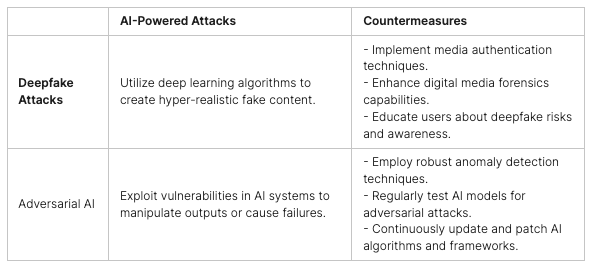

    As our digital continues to expand, organizations are in a perpetual dance with dynamic and ingenious cyber adversaries. The manifestation of success now hinges on the ability to anticipate and circumvent these threats before they breach the digital moat. Internal IT teams, often the unsung heroes, are at the forefront of this battle, defending an organization’s digital realm against all odds. Their vigilance ensures operations remain unmarred, sensitive data remains inviolable, and business reputation remains untarnished.

    Yet, the challenge is multifaceted. Cyber threats don’t adhere to convention; they evolve, adapt, and proliferate. In this intricate dance, an effective incident reporting platform emerges as a steadfast ally, streamlining the processes at the heart of cyber defense. By seamlessly centralizing incident reporting, this platform bridges the gap between IT teams spread across various domains, fostering a unified front against potential threats. Simultaneously, it becomes a conduit for unimpeded communication, enabling collaboration between IT teams, management, legal experts, and PR departments – all essential components of a swift and effective response to cyber incidents.
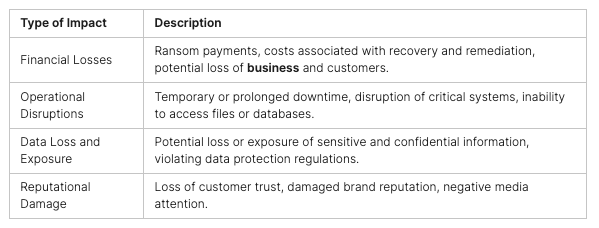

    The true essence of an incident reporting platform goes beyond mere aggregation; it’s about consolidating data into a strategic advantage. This platform paints a comprehensive picture of the incident through its ability to harmonize diverse data streams. Such insights are indispensable – they unravel patterns, expose vulnerabilities, and pinpoint potential points of compromise. With this knowledge, IT teams are empowered to formulate robust countermeasures, arming the organization against future attacks.


    As the symphony of cyber threats continues, adopting an advanced incident reporting platform takes center stage. It transforms a reactionary approach into a proactive strategy, reinforcing an organization’s cyber defenses and bolstering its capacity to thrive in an inherently perilous digital realm. To embark on this transformative journey towards fortified cybersecurity, we invite you to explore our comprehensive incident reporting solution on our website. Elevate your organization’s security posture, equip your internal IT teams with the tools of the future, and secure your digital legacy. Visit our website today and embrace the paradigm shift towards organizational safety and resilience in the face of adversities born in the digital crucible.

  • Google’s New AI Search Feature Unwittingly Promotes Malicious Sites

    Google’s New AI Search Feature Unwittingly Promotes Malicious Sites

    Google’s latest innovation in search technology, the Search Generative Experience (SGE), has introduced AI-generated quick summaries and site recommendations to streamline user queries. However, recent observations by SEO consultant Lily Ray, backed by findings from BleepingComputer, have raised serious concerns. The SGE is inadvertently promoting websites involved in malware distribution and various online scams, including fake giveaways and tech support fraud.

    The Unintended Consequences of AI-Enhanced Search Results

    Earlier this month, Google began integrating SGE into its search mechanisms, aiming to enhance the user experience by providing concise AI-driven responses to queries. However, it soon became apparent that this feature might be suggesting sites that lead users into traps set by cybercriminals. The domains often share similarities such as the .online TLD, identical HTML templates, and a pattern of redirects, indicating their role in a coordinated SEO poisoning campaign designed to manipulate search engine results.

    How Scammers Exploit SGE Recommendations

    When users follow links recommended by SGE, they are often taken through a series of redirects, ending up on sites that deploy aggressive tactics such as fake captchas or misleading YouTube pages. These sites typically coax users into enabling browser notifications, which then serve as a conduit for delivering incessant spam directly to their desktops.

    The Dangers of Browser Notification Spam

    Once enabled, these notifications bombard users with misleading ads promoting tech support scams, counterfeit giveaways, and other dubious content. For instance, alerts claiming to be from McAfee may warn users of non-existent viruses, urging them to download software that is actually just a ploy to generate affiliate revenue for the fraudsters.

    Complex Web of Deception and Financial Motives

    Some of the scams further exploit user trust by promising high-value items like an Apple iPhone 15 Pro through fake Amazon loyalty programs. These schemes are particularly insidious as they harvest personal information for sale to other scammers or direct marketers, amplifying the victim’s risk exposure.

    SGE’s Challenges and Google’s Response

    Google has acknowledged the issue, noting that while they continuously enhance their spam-fighting capabilities, spammers are also evolving their strategies. This ongoing “cat and mouse” game makes it difficult to completely safeguard SGE from being manipulated. Despite this, Google has taken steps to remove known malicious entries and continues to refine its systems to better detect and exclude harmful content.

    Protecting Yourself from Malicious Search Results

    As users navigate this new AI-enhanced search landscape, vigilance is essential. Users should be wary of unsolicited browser notifications and suspicious links, even if they appear in Google’s search results. Here’s how you can manage unwanted notifications in Google Chrome:

    1. Open Chrome and go to Settings > Content > Notifications.
    2. Under “Allowed to send notifications,” review the list of sites.
    3. Click the three dots next to any suspicious URLs and select ‘Remove’ to stop the notifications.

    In light of these developments, Peris.ai Cybersecurity encourages users to exercise increased caution and to critically evaluate the credibility of websites and the legitimacy of online offers. As AI continues to reshape how we interact with digital content, staying informed about potential security threats and understanding how to mitigate them is crucial. By doing so, users can safeguard their digital experience against the evolving tactics of cybercriminals.