
Open Source Intelligence (OSINT) is a powerful tool for gathering, analyzing, and reporting data from publicly available sources. It involves collecting and interpreting information to extract valuable insights and intelligence. OSINT techniques are used to acquire information from various online sources and enhance decision-making processes. It serves as an unseen cyber informant by providing valuable intelligence on security threats, market research, and competitive intelligence.
Key Takeaways:
- Open Source Intelligence (OSINT) is a valuable tool for gathering intelligence from publicly available sources.
- OSINT techniques are used to acquire information from various online sources.
- OSINT serves as an unseen cyber informant by providing valuable intelligence on security threats, market research, and competitive intelligence.
- OSINT enhances decision-making processes by offering valuable insights and intelligence.
- OSINT plays a crucial role in risk mitigation and intelligence gathering.
Understanding Open Source Intelligence (OSINT)
Open Source Intelligence (OSINT) is a crucial component in gathering, evaluating, and analyzing publicly available information to produce intelligence. Through the process of locating, processing, and interpreting data, OSINT aims to provide answers to specific intelligence questions. This valuable form of intelligence can be acquired from a wide range of sources, including public records, news media, social media platforms, websites, and even the dark web.
OSINT is utilized by various entities, such as government agencies, law enforcement, military organizations, investigative journalists, and private investigators. Its applications extend to investigations, intelligence gathering, and information analysis. By harnessing the power of OSINT, these entities can gain insights, uncover hidden connections, and make informed decisions based on the analyzed information.
Let’s explore some examples of OSINT:
- Monitoring social media platforms to gather information related to security threats or criminal activities.
- Researching publicly available financial records to analyze the financial stability of a company before a merger or investment.
- Examining news articles and reports to gather intelligence on regional conflicts and geopolitical trends.
- Scanning online forums and discussion boards to identify potential threats or risks.
What is Open Source Intelligence (OSINT) Investigation?
Open Source Intelligence investigation involves the systematic collection and analysis of publicly available information to uncover valuable insights and intelligence. Investigators use OSINT techniques to access and evaluate information from diverse sources and piece together a comprehensive understanding of a subject or target.
The process of OSINT investigation typically includes:
- Identifying the objective of the investigation and the specific intelligence requirements.
- Gathering information from various open sources, utilizing techniques such as web scraping and data mining.
- Validating and verifying the collected information to ensure its accuracy and reliability.
- Organizing and analyzing the gathered data to extract meaningful patterns, relationships, and insights.
- Presenting the findings in a clear and concise manner, often in the form of intelligence reports or visualizations.
Overall, open source intelligence plays a crucial role in modern-day investigations, intelligence analysis, and decision-making processes. Its accessibility, versatility, and effectiveness make it an invaluable tool for organizations and individuals alike.

The Intelligence Cycle in Open Source Intelligence (OSINT)
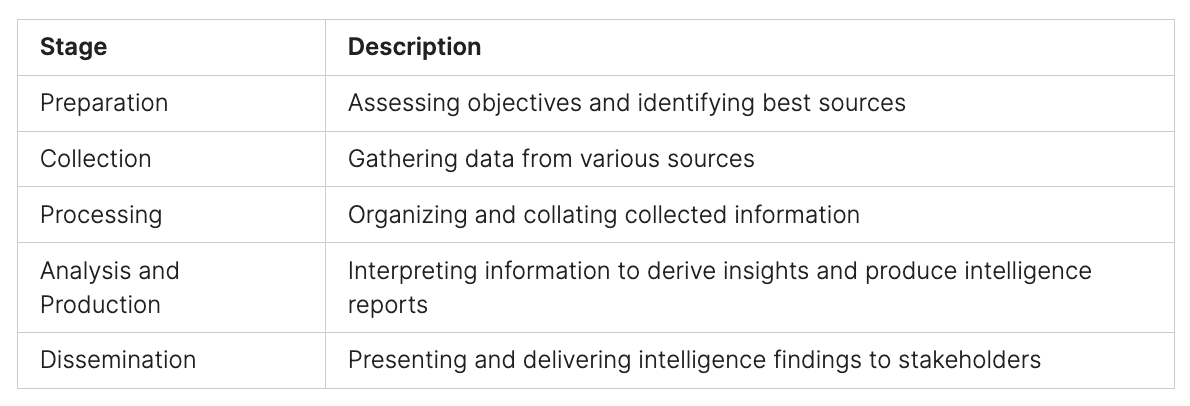
The Intelligence Cycle is a crucial framework that drives the process of intelligence gathering and analysis in Open Source Intelligence (OSINT). This cycle consists of several distinct stages, each playing a vital role in extracting valuable insights and intelligence from publicly available sources. Understanding and effectively implementing the Intelligence Cycle is essential for a successful OSINT workflow.
1. Preparation
During the preparation stage, the objectives of the tasking are carefully assessed, and the best sources of information are identified. This stage sets the foundation for the entire OSINT workflow and ensures that the gathering and analysis processes align with the intended goals.
2. Collection
The collection stage involves gathering data and information from a diverse range of sources. These sources can include public records, social media platforms, news articles, websites, and more. The collection process requires meticulous attention to detail to ensure the completeness and accuracy of the gathered information.
3. Processing
In the processing stage, the collected information is organized, structured, and collated for further analysis. This involves extracting relevant data, removing duplicates, and ensuring data integrity. Effective processing techniques streamline the subsequent analysis phase.
4. Analysis and Production
The analysis and production stage is where the true value of OSINT shines. Here, the collected and processed information is analyzed to derive meaningful insights and actionable intelligence. Advanced techniques such as data visualization, natural language processing, and pattern recognition are utilized to uncover hidden connections, trends, and potential risks.
5. Dissemination
The final stage of the Intelligence Cycle involves presenting the findings and intelligence reports to stakeholders. A clear and concise delivery of the analyzed information ensures effective decision-making based on the intelligence gathered. Proper dissemination ensures that the right people receive the right information at the right time.
Creating an effective OSINT workflow is crucial to harness the power of intelligence gathering and information analysis. By following the Intelligence Cycle, organizations can maximize the value derived from open source intelligence, resulting in enhanced situational awareness, improved decision-making, and a proactive approach to risk managemen.
Passive versus Active OSINT Research
When conducting Open Source Intelligence (OSINT) research, there are two main approaches to consider: passive and active. Each approach has its own distinct characteristics and purpose, making them suitable for different scenarios.
Passive OSINT
In passive OSINT, the focus is on gathering information about a target without directly engaging with them. This approach involves collecting publicly available information from sources such as websites, social media, news articles, and public records. Researchers rely on existing data without interacting with individuals online or leaving any visible traces. Passive OSINT is valuable for collecting a wide range of information about a target without alerting them to your presence or intentions.
Active OSINT
Active OSINT involves engaging directly with a target by interacting with them online. This can include commenting on their posts, messaging them, or following their social media accounts. The goal is to gather information by blending in with the target group and appearing as a genuine user. Active OSINT requires more involvement and effort, as you need to be actively present and participate in the online communities related to your research. It allows for more direct and immediate access to information but also carries the risk of alerting the target to your presence.
Organizations that utilize OSINT research need to establish clear policies and guidelines regarding passive and active engagement. Ethical considerations, legal boundaries, and the potential impact on targets should be carefully evaluated. Striking a balance between collecting valuable intelligence and respecting privacy and ethical boundaries is crucial.

The Benefits of Passive and Active Engagement
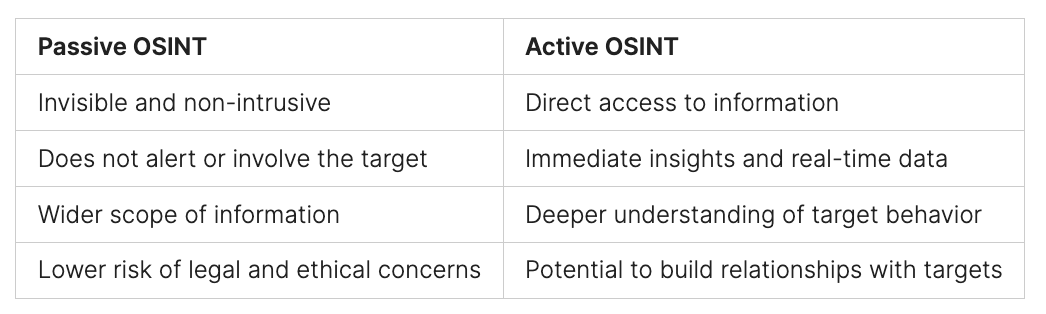
Ultimately, the choice between passive and active OSINT research depends on the specific goals, resources, and ethical considerations of each organization. Both approaches have their merits and limitations, and understanding how to effectively deploy each in the intelligence gathering process is crucial for achieving successful outcomes.
The Benefits of Open Source Intelligence (OSINT)
Open Source Intelligence (OSINT) provides numerous benefits and advantages over other forms of intelligence collection. By utilizing publicly available information, OSINT eliminates the need for accessing classified or restricted sources, making it a cost-effective and efficient solution for gathering intelligence.
One of the key advantages of OSINT is its ability to gather information from a wide range of sources. Organizations can tap into diverse platforms such as social media, news articles, research papers, and websites to gather insights on various topics from multiple perspectives. This comprehensive approach allows for a more holistic understanding of the subject matter.
Another benefit of OSINT is its transparency and verifiability. The information collected through OSINT can be easily validated, ensuring its accuracy and reliability. This level of confidence empowers organizations to make informed decisions based on the intelligence gathered.
Moreover, OSINT offers timeliness and agility. With the vast amount of publicly available information, OSINT enables real-time intelligence gathering, enabling organizations to stay ahead of emerging trends, potential risks, and ever-evolving situations. This dynamic nature of OSINT makes it a valuable tool for decision-making processes.
“Open Source Intelligence (OSINT) eliminates the need for classified or restricted sources, making it a cost-effective and efficient solution for gathering intelligence.”
Furthermore, OSINT provides a wide range of sources to gather information from, ensuring a comprehensive view of the subject matter:
- Social media platforms
- News articles
- Research papers
- Government reports
- Academic publications
These various sources contribute to the richness and diversity of the information gathered through OSINT, enhancing the quality of intelligence and facilitating better decision-making.
Overall, the benefits of Open Source Intelligence (OSINT) make it an invaluable tool for organizations across different sectors. It offers access to publicly available information, cost-effectiveness, transparency, verifiability, timeliness, and a wide range of sources for intelligence gathering. Embracing OSINT can significantly enhance an organization’s intelligence capabilities and ultimately drive better outcomes.
Open Source Intelligence (OSINT) Benefits:
- Access to publicly available information
- Cost-effectiveness
- Transparency and verifiability
- Real-time intelligence gathering
- Diverse sources for comprehensive insights

How Open Source Intelligence (OSINT) Works
Open Source Intelligence (OSINT) involves a series of processes to collect, process, and analyze publicly available information. The goal is to extract valuable insights and intelligence that can inform decision-making and provide actionable intelligence.
The Collection Stage
During the collection stage, OSINT professionals gather information from various sources, including but not limited to:
- Social media platforms
- News articles
- Government reports
- Academic papers
This broad range of sources ensures a comprehensive and diverse dataset for analysis.
The Processing Stage
Once the information is collected, it goes through a processing stage. This involves organizing and structuring the data to make it easily interpretable and digestible. Data cleaning techniques are applied to remove any irrelevant or redundant information, ensuring data accuracy.
The Analysis Stage
The processed data is then subjected to various analysis techniques to identify patterns, trends, and relationships. Advanced tools and techniques, such as data visualization and natural language processing, are used to aid in this analysis. The goal is to gain deeper insights into the information collected and extract intelligence that can support decision-making processes.
Providing Actionable Intelligence
The ultimate objective of OSINT is to provide actionable intelligence based on the information collected, processed, and analyzed. This intelligence can be used for a variety of purposes, including:
“The key to OSINT success lies in the ability to transform raw data into meaningful insights that contribute to effective decision-making.”
By leveraging OSINT collection, processing, and analysis, organizations and individuals can gain valuable intelligence that can guide their strategies and actions.
Image: Keywords related to the current section: osint collection, osint processing, osint analysis.
Applications of Open Source Intelligence (OSINT)
Open Source Intelligence (OSINT) is a versatile tool with a wide range of applications across various industries and sectors. Let’s explore some of the key uses of OSINT:
1. Security and Intelligence:
OSINT is extensively used by governments, law enforcement agencies, and the military for security and intelligence purposes. It plays a crucial role in gathering valuable information on potential threats, risks, and emerging security trends.
2. Business and Market Research:
OSINT provides valuable insights for businesses by facilitating competitor analysis, monitoring industry trends, and conducting market research. It helps organizations understand consumer behavior, market dynamics, and identify new business opportunities.
3. Investigative Journalism:
Investigative journalists rely on OSINT to gather information for their investigations. It helps uncover hidden connections, verify facts, and expose wrongdoing. OSINT tools and techniques are essential for conducting in-depth research and reporting accurate stories.
4. Academic Research:
OSINT plays a significant role in academic research, enabling scholars to access publicly available data. It is particularly useful in fields such as social sciences, criminology, and political science, helping researchers gather information and analyze trends.
5. Legal Proceedings:
OSINT is increasingly being used in legal proceedings to gather evidence, support litigation, and strengthen cases. It provides lawyers and investigators with valuable information from public sources that can be admissible in court.
6. Information Security:
Information security professionals utilize OSINT to identify vulnerabilities, assess risks, and protect against cyber threats. It helps in understanding the tactics, techniques, and procedures employed by potential attackers.
7. Human Rights Investigations:
OSINT plays a crucial role in human rights investigations, providing organizations with the ability to track and document human rights abuses. It helps shine a light on violations and hold perpetrators accountable.
Industries and Sectors Benefiting from OSINT
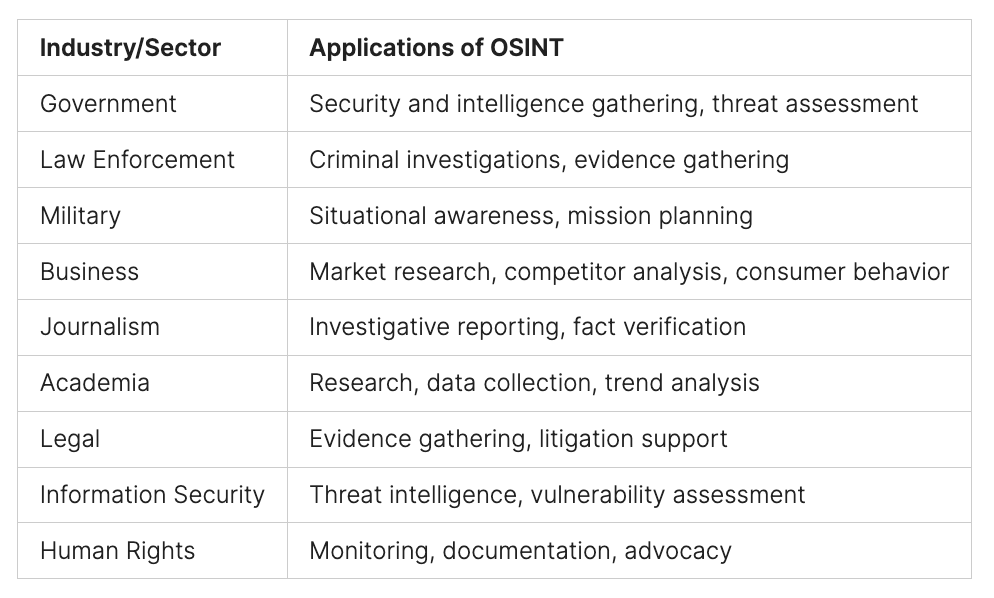
As evident from the table above, OSINT finds significant applications across various industries and sectors, making it an invaluable tool for gathering information, enhancing decision-making processes, and driving positive outcomes.
The Open Source Intelligence (OSINT) Market Overview
Several factors contribute to the growth of the OSINT market. Firstly, the rising number of cyber threats and security breaches has created a pressing need for advanced intelligence gathering techniques. Organizations across various industries are leveraging OSINT to gather crucial insights and stay ahead of potential risks.
The government’s initiatives and regulations also play a significant role in propelling the OSINT market forward. With a growing emphasis on national security, governments around the world are investing in OSINT capabilities to enhance their intelligence gathering and analysis efforts.
Furthermore, technological advancements are driving the expansion of the OSINT market. As technology evolves, new tools and techniques are being developed to collect, process, and analyze data from a variety of sources. This allows organizations to extract valuable intelligence and make informed decisions.
Key Players in the OSINT Market
A number of key players dominate the OSINT market, each contributing to its overall growth and development. These companies are at the forefront of providing innovative OSINT solutions and services, empowering organizations with advanced intelligence capabilities:
These companies have established themselves as leaders in the field, offering cutting-edge technologies and expertise to clients across various industries.
The growing OSINT market presents numerous opportunities for organizations and industries to harness the power of open source intelligence. By leveraging OSINT capabilities and partnering with key players, businesses can gain a competitive edge, mitigate risks, and make well-informed decisions in an increasingly complex digital landscape.
Conclusion
In the digital age, Open Source Intelligence (OSINT) has become an indispensable asset for organizations aiming to navigate the complexities of cybersecurity threats and vulnerabilities. OSINT platforms, like the one offered by Peris.ai Cybersecurity, harness the wealth of information available in public domains to deliver actionable intelligence that can protect businesses from potential cyber threats.
Our OSINT platform stands out in the market by providing comprehensive insights into the latest hacking techniques, malware trends, phishing campaigns, and more, drawing from a diverse array of open and closed sources, including social media, forums, and underground marketplaces. Our dedicated team of experts ensures that our clients have access to the most current information, enabling them to make informed decisions about their cybersecurity strategies.
What sets Peris.ai Pandava’s OSINT platform apart?
- Potential Threat Alerts: Customize alerts to receive timely notifications about threats pertinent to your business. This feature allows you to stay ahead of potential risks, ensuring quick and effective response measures.
- Multi Sources Analytics: Our platform’s strength lies in its ability to aggregate and analyze data from multiple sources, including social media, blockchains, messaging platforms, and even the dark web. This comprehensive approach facilitates thorough investigations and the discovery of crucial insights and connections, making it invaluable for various organizations seeking to bolster their cybersecurity measures.
Integration with SIEM systems is seamless, consolidating all security data in one place for a holistic view of your security posture. This integration enhances your ability to swiftly identify and react to emerging threats, fortifying your defenses against the dynamic challenges of the cyber landscape.
As the demand for OSINT grows, driven by the escalating need for sophisticated intelligence gathering and cybersecurity measures, Peris.ai Pandava positions itself as a key player in this evolving market. Our OSINT solution not only offers a competitive edge but also fosters a safer digital environment for businesses across industries.
Embrace the advanced capabilities of Peris.ai Pandava’s OSINT platform to elevate your organization’s intelligence gathering and cybersecurity strategies. Visit Peris.ai Cybersecurity to explore how our OSINT platform can empower your organization to mitigate risks, make well-informed decisions, and thrive in the increasingly complex digital world. Join us in harnessing the full potential of open source intelligence for a secure and informed future.
FAQ
What is Open Source Intelligence (OSINT)?
Open Source Intelligence (OSINT) is the practice of gathering, analyzing, and reporting intelligence from publicly available sources. It involves collecting and interpreting information to extract valuable insights and intelligence.
How is OSINT used in investigations?
OSINT is used in investigations by government agencies, law enforcement, and private investigators to gather information and intelligence. It helps uncover valuable insights, patterns, and relationships to aid in decision-making and solving cases.
What is the Intelligence Cycle in OSINT?
The Intelligence Cycle in OSINT is a framework that guides the process of collecting and analyzing intelligence. It consists of stages such as preparation, collection, processing, analysis and production, and dissemination. Each stage contributes to the overall effectiveness of the OSINT workflow.
What is the difference between passive and active OSINT research?
Passive OSINT research involves gathering information about a target without engaging with them directly. Active OSINT research, on the other hand, involves engaging with a target by commenting, messaging, or following them on social media platforms. Both approaches have different ethical considerations and advantages depending on the research goals.
What are the benefits of using Open Source Intelligence (OSINT)?
OSINT provides access to publicly available information, allowing organizations to gather information on diverse topics from different perspectives. It is cost-effective, transparent, and easily verifiable. OSINT also offers timeliness and a wide range of sources, making it a valuable tool for intelligence gathering and decision-making.
How does Open Source Intelligence (OSINT) work?
OSINT works by collecting publicly available information from various sources, processing and organizing the collected data, and analyzing it to extract insights and intelligence. The information is gathered from online sources such as social media, news articles, government reports, and academic papers.
What are the applications of Open Source Intelligence (OSINT)?
OSINT has applications in various industries and sectors. It is used for security and intelligence gathering, business and market research, investigative journalism, academic research, and legal proceedings. OSINT provides valuable insights and information for decision-making processes.
How does Open Source Intelligence (OSINT) contribute to decision-making?
OSINT provides valuable intelligence and insights that can inform decision-making processes. By gathering information from publicly available sources, organizations can assess potential risks, understand market trends, identify competitors, and make informed decisions based on accurate and reliable data.