Category: Article

  • How Source Code Scanning Prevents Vulnerabilities

    How Source Code Scanning Prevents Vulnerabilities

    In today’s fast-paced software development world, keeping apps safe and secure is key. Source code scanning is a vital tool for finding and fixing security issues before they can be used against us. It checks the app’s code automatically to spot things like buffer overflows and SQL injection. This helps developers take action early to keep their apps safe.

    Adding source code scanning to the development process helps catch and fix problems early. This lowers the chance of security breaches and makes apps safer for everyone. It’s not just about keeping the app safe. It also protects the data it handles and keeps users’ trust. With new threats always coming up, using strong source code scanning is now key for any good security plan in software development.

    Key Takeaways

    • Source code scanning is a critical process for identifying and addressing security vulnerabilities in software development.
    • It involves automatically analyzing the source code of an application to detect potential security flaws, such as buffer overflows and SQL injection.
    • Integrating source code scanning into the software development lifecycle allows developers to catch and fix vulnerabilities early on, reducing the risk of breaches.
    • Source code scanning is a crucial component of a comprehensive security strategy for modern software development teams.
    • The adoption of robust source code scanning practices is essential in the face of the evolving threat landscape.

    Introduction to Source Code Scanning

    Source code scanning, also known as static code analysis, is key in making software secure. It checks the software’s source code for security risks, bugs, and defects. This helps developers find and fix problems early, making the software safer and better.

    What is Source Code Scanning?

    It’s about looking at an app’s source code line by line to find security risks, errors, and flaws. Automated tools do this, using advanced methods like data flow analysis and lexical analysis. They spot issues like buffer overflows and SQL injection vulnerabilities.

    Benefits of Source Code Scanning

    • It makes apps more secure by finding and fixing security risks before they can be used to harm, reducing the chance of security breaches.
    • It saves time and resources by finding problems early, so developers don’t spend more time fixing them later.
    • It helps make the code better by finding coding errors and defects, improving the software’s quality and reliability.
    • It meets security and compliance standards in many industries by ensuring apps are secure and free of vulnerabilities.

    Source code scanning is crucial for making software secure. It lets developers find and fix security risks and other issues before they cause problems.

    How Source Code Scanning Prevents Vulnerabilities

    Source code scanning is key to stopping vulnerabilities and making code secure. It checks the code to find security weaknesses and possible attack paths early. This way, it’s better than waiting to check for security after the code is out there. It helps fix risks while the code is still being made.

    Code scanning tools check the code at every step of making software. They make sure the code is safe, private, and works right before it goes live. Tools like SAST look at the code to find things like unauthorized access risks and outdated software. DAST tests the code by pretending to be an attacker to find issues that SAST might miss, like XSS and SQL injections.

    SCA checks code libraries for known security problems. This shows how important it is to check open-source parts for security risks. Also, Privacy Code Scanning tools help find privacy risks in real-time across different systems.

    By fixing issues found by these tools early, developers can stop them from turning into big problems. Automated scanners also make sure code follows important rules, avoiding big fines for not following them.

    In summary, scanning source code is vital for preventing vulnerabilities and writing secure code. By finding and fixing security issues early, companies can keep their apps safe, protect data, and lower the chance of cyber threats.

    Types of Vulnerabilities Detected by Code Scanning

    Code scanning tools find many security risks, like buffer overflows and SQL injection flaws.

    Buffer Overflows

    Buffer overflow happens when an app puts too much data in a small buffer. This can let an attacker run harmful code and control the system. Scanning tools spot these issues by making a model of how the app works and using known patterns.

    SQL Injection Flaws

    SQL injection happens when bad data changes database queries. This lets attackers see private data. Tools use fuzzing to find these problems by testing the app with strange inputs.

    Scanning code early helps fix these issues before they cause problems, saving time and money.

    *Broken Access Control | Complete Guide: https://youtube.com/watch?v=_jz5qFWhLcg

    Scanning tools also find other risks like XSS, insecure settings, and bad dependencies. Using different scanning methods like SCA, SAST, and IAST gives a full check for vulnerabilities.

    “Effective code scanning helps developers find and fix security problems early, reducing the risk of big attacks.”

    Techniques Used in Source Code Scanning

    Source code scanning uses advanced methods to find security risks in software. These include data flow analysis, taint analysis, and lexical analysis. Each method is key to spotting and fixing potential issues.

    Data Flow Analysis

    Data flow analysis tracks how data moves through the app. It helps spot wrong ways of handling sensitive info. This way, it finds security risks.

    Taint Analysis

    Taint analysis looks for variables touched by user input and follows them to possible weak spots. It’s great at catching injection flaws, where bad data gets into queries or commands.

    Lexical Analysis

    Lexical analysis turns code into tokens for security checks. It helps find issues that aren’t easy to see, like wrong use of security functions or hardcoded passwords.

    Using these techniques, scanning tools can spot many security problems, like buffer overflows and SQL injection. These methods, along with others, make source code scanning vital for software security.

    Strengths and Weaknesses of Source Code Scanning

    Source code scanning has many benefits. It finds problems early in development, letting developers fix them before they’re used. It also makes sure code follows certain rules, making it better and safer. Plus, it automates code checks, making developers’ work more efficient and saving time.

    These tools spot many security risks, like null pointer errors and buffer overflows. They also catch weak passwords and SQL injection attacks, protecting software.

    But, source code scanning has its downsides. Checking all the code takes time, and sometimes it mistakes or misses things. It mainly looks at the code itself, not at bigger security issues.

    Analysts might run into problems with missing libraries or incomplete code, leading to wrong results. These tools can’t always check apps that use closed-source parts or interact with other systems, missing some risks.

    Even though source code scanning tools are getting better, they can’t catch every security problem. Methods like static code analysis help find some issues, but not all.

    As software development changes, it’s key for companies to use a mix of automated tools, manual checks, and other security steps to keep their software safe.

    Selecting the Right Source Code Scanning Tool

    When picking a source code scanning tool, it’s important to look at a few key things. These include the programming languages it supports, the kinds of vulnerabilities it finds, and how well it fits with the team’s tools and workflows.

    Language Support

    It’s key that the tool can handle the programming languages your organization uses. A detailed language support list helps make sure the tool can scan all your code.

    Types of Vulnerabilities Detected

    How well a tool can find different security weaknesses matters a lot. You want it to spot everything from buffer overflows to SQL injection. This ensures a thorough check of your code’s security.

    Integration with Developer Tools

    Working well with developer tools like IDEs and CI pipelines makes the scanning process better. It lets teams add security checks easily into their work.

    By looking at these factors, you can pick a tool that meets your needs and finds and fixes code vulnerabilities.

    Looking at these factors and checking out different tools helps you find the best one for your needs. This way, you can spot and fix vulnerabilities in your codebase.

    “Automated code scanning tools are essential for identifying vulnerabilities in source code and preventing potential cyber attacks. The right tool can make a significant difference in the security of an organization’s codebase.”

    Examples of Source Code Scanning Tools

    The software development world is full of tools to check source code for security. These tools help make apps safer. They use advanced methods like data flow analysis to find security risks in code.

    OWASP’s Source Code Analysis Tools support over 30 programming languages, including Java and Ruby. ReSharper offers over 1,200 quick fixes and checks code quality. Code Climate Quality gives a 10-point check on code quality and how easy it is to maintain.

    CAST Highlight supports over 40 languages and helps with cloud migration. Codacy works with more than 40 languages and frameworks right away. Snyk scans code in real-time and works with Git to find security issues.

    Looking at these tools helps organizations pick the right one for their needs.

    Using these tools helps protect apps from security risks and keeps code safe.

    “Using on-premises source code security analyzers can impair development timelines, hindering speed-to-market.”

    Cloud-based solutions like Veracode are becoming popular for their effectiveness.

    OWASP offers a list of free tools for open source projects. These include tools for checking code security in different ways. Developers have many options to make their apps secure.

    Best Practices for Effective Source Code Scanning

    To make source code scanning work well, follow these best practices. First, add scanning to the software development process. This way, you catch and fix problems early.

    Keep your scanning tool updated. This helps you keep up with new threats and bugs. Also, fix any problems you find quickly to keep your apps safe.

    Teach your developers about secure coding. Make security a big part of your team’s culture.

    Automate your scanning, like putting it in your continuous integration pipelines. This makes sure you find and fix issues often.

    By doing these things, you’ll make your source code scanning better. You’ll also improve your app’s security and handle problems better during development.

    “Effective source code scanning is a critical component of a comprehensive application security strategy, helping organizations identify and address vulnerabilities before they can be exploited.”

    Conclusion

    Source code scanning is now key to making software safe, helping companies spot and fix security issues early. Tools use methods like data flow and lexical analysis to find problems like buffer overflows and SQL injection. Even with its limits, using source code scanning well can make software much safer and lower the chance of data breaches.

    To get the most from source code scanning, companies need to pick the right tools. Look for ones that support your programming languages, find many vulnerabilities, and work well with your team’s workflow. By adding source code scanning to the development process, companies can boost their application security, prevent vulnerabilities, and make sure their software is secure. A strong source code scanning strategy, along with other security steps, is key to protecting systems, data, and customer trust online.

    The role of source code scanning in secure software development will keep growing as software changes. By being alert, using the right tools, and valuing security, companies can tackle code-level risks. This way, they can offer strong, dependable, and safe apps to their users.

    FAQ

    What is source code scanning?

    Source code scanning, also known as static code analysis, checks software applications’ source code automatically. It looks for security weaknesses and defects.

    What are the benefits of source code scanning?

    It makes applications more secure, lowers the risk of security breaches, and speeds up development. It finds problems before they’re deployed.

    How does source code scanning prevent vulnerabilities?

    It checks the code for security weaknesses and attack points. Developers fix these issues early, making the code safer and more secure.

    What types of vulnerabilities can source code scanning detect?

    It finds many security weaknesses, like buffer overflows and SQL injection flaws.

    What techniques are used in source code scanning?

    It uses techniques like data flow analysis, taint analysis, and lexical analysis to find security issues.

    What are the strengths and weaknesses of source code scanning?

    It can scale well and find some vulnerabilities automatically. But, it struggles with complex issues and can show many false positives.

    What should organizations consider when selecting a source code scanning tool?

    Look at the languages it supports, the vulnerabilities it can spot, and how it fits with your team’s tools and workflows.

    What are some examples of source code scanning tools?

    Popular tools include OWASP’s Source Code Analysis Tools, NIST’s Source Code Security Analyzers, and RIPS and pixy.

    What are the best practices for effective source code scanning?

    Make it part of your development cycle, keep the tool updated, fix issues fast, and teach developers about secure coding.

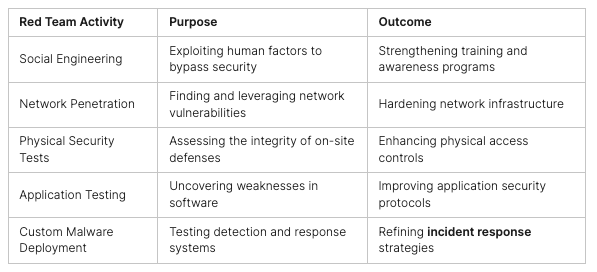
  • Inside the Cybersecurity Arena: Comparing Red Teams and Blue Teams!

    Inside the Cybersecurity Arena: Comparing Red Teams and Blue Teams!

    Today’s digital world is like a battlefield. Cybersecurity strategies are vital to protect an organization’s data and operations. Two main groups, Red Teams and Blue Teams, play a key role. They form the heart of cyber defense, which is crucial for strong network security.

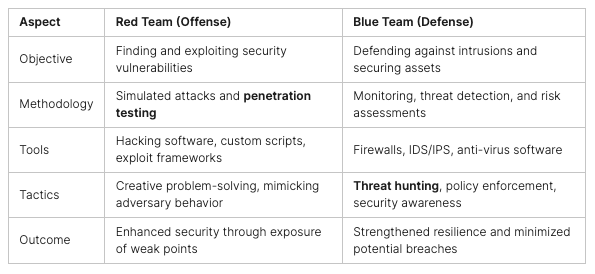
    Red Teams are made up of expert ethical hackers. They take offensive actions to mimic real cyber attackers. Their job is to break into an organization’s defense to find weak spots. This helps businesses improve their security by understanding potential threats. On the flip side, Blue Teams defend against these simulated attacks. They work hard to make sure an organization’s cyber defenses stay strong.

    The threat landscape in cybersecurity changes very fast. It’s the combined work of both Red and Blue Teams that helps create and improve cybersecurity strategies. This teamwork makes an organization’s security stronger. It builds a strong defense against cyber threats.

    Key Takeaways

    • The interplay between Red Teams and Blue Teams is foundational to an effective cybersecurity strategy.
    • Red Teams employ ethical hacking to test and improve cyber defense mechanisms.
    • Blue Teams are essential for maintaining resilient network security against incoming threats.
    • Continuous adaptation and updating of the security posture are necessary to respond to the evolving threat landscape.
    • Threat intelligence gathered by Red Teams is critical for informing the defensive strategies of Blue Teams.
    • Both teams contribute to a holistic approach to cybersecurity, ensuring the protection of sensitive data and business continuity.

    The Strategic Role of Red Teams in Cybersecurity

    In the dynamic world of cybersecurity, Red Team exercises are vital for protecting information systems. They use tactics like penetration testing and vulnerability exploitation. These teams perform ethical hacking to mimic real attacker strategies. Their cyber attack simulations help improve an organization’s defenses.

    Simulating Real-Life Cyber Attacks

    Red Teams work to reflect the unpredictable nature of real cyber threats. They conduct tests ranging from social engineering to advanced digital intrusions. This strengthens security and gets organizations ready for evolving cyber threats.

    Continuous Pursuit of System Vulnerabilities

    The main goal of Red Teams is to find system vulnerabilities. They carefully check an organization’s network to find possible entry points for hackers. With advanced techniques, they ensure the security measures are strong and effective.

    Creativity and Persistence: The Hallmarks of Red Teams

    Red Team members are known for their creativity and persistence. These qualities help them find and use system weaknesses. By simulating attacks, they help make security stronger against potential breaches.

    Red Teams follow strict rules and ethics to improve, not harm, security. The feedback from their tests is crucial for building a solid cybersecurity defense.

    Defensive Protocols: How Blue Teams Safeguard Organizations

    Blue Team protocols are the backbone of strong cybersecurity. These teams work tirelessly at the forefront of incident response. They use detailed security measures to protect assets. Their work starts with a thorough risk assessment. Then, they focus on protecting a company’s most valuable assets.

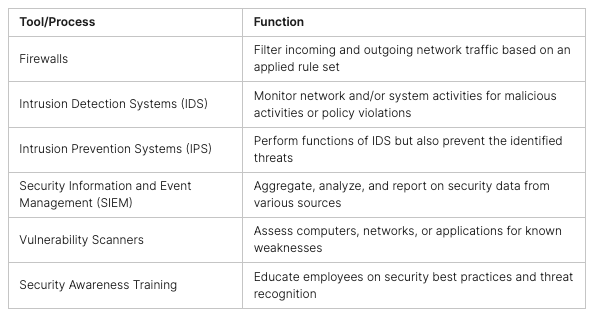
    At the heart of their strategy is network monitoring. This helps in catching suspicious activity early. By doing so, they can stop threats before they turn into major issues. Below, you’ll find a list of tools and processes Blue Teams use to protect digital spaces:

    The Blue Teams also conduct DNS audits and vulnerability scanning. These are crucial in forming a proactive defense. They check domain names and search for security vulnerabilities.
    The Blue Teams are quick to respond in a crisis. Their incident response process includes:

    1. Immediate containment to limit threat impact.
    2. Root cause removal to stop further spread.
    3. System recovery to restore full functionality.
    4. Learning lessons to better prepare for future threats.

    As digital assets grow more important, Blue Teams keep improving and watching networks closely. This strengthens an organization’s defenses.

    To wrap up, Blue Teams’ expert balance of proactive steps, technical skills, and quick response helps them protect organizations. Their expertise in risk assessment and incident response is crucial for keeping assets safe.

    Red Teams and Blue Teams: Enhancing Organizational Resilience

    In the world of cybersecurity, merging the power of Red and Blue Teams boosts organizational strength. These teams are key in making a business’s digital space safer and more secure. By combining Red Teams’ proactive steps with Blue Teams’ defensive skills, they create a powerful duo. This mix lets companies quickly adapt and stand strong against cyber threats.

    An Integrated Approach to Cyber Threats

    Companies that mix both offensive and defensive cyber strategies fare better. They use Red Teams to find weak spots and Blue Teams to protect vital assets. This balanced approach brings out the best in cybersecurity team work. It ensures smooth communication and quick action against threats. Together, these teams set a high standard in cybersecurity that others aim to reach.

    Triumph Through Teamwork: The Competitive Edge

    Teamwork in cybersecurity is more than working together; it’s a smart strategy. It has these expert teams challenge each other, raising security standards. This rivalry boosts creativity and keeps defenses up-to-date against new cyber threats. As a result, competitive cybersecurity acts as more than a safeguard. It gives companies an edge, making them tough targets for hackers. This protects their reputation and financial health.

    The mix of attack and defense insights builds a culture focused on organizational resilience. This creates a flexible and strong cybersecurity system. It’s built to last against both time and cyber-attacks.

    The Cybersecurity Battleground: Offense vs. Defense

    In the high-stakes world of cybersecurity battleground, teams face off in a vital power clash. On this battlefield, offensive cyber strategies and defensive cyber measures meet head-on. The key to success? Using both proactive and reactive approaches to keep the balance of security.

    Distinct Mindsets of Attack and Defense Teams

    The Red Team’s approach is all about finding weak spots in a company’s digital armor. They use offensive cyber strategies to mimic real attackers. By doing this, they expose and fix vulnerabilities, making the company’s cybersecurity stronger.

    On the other hand, Blue Teams focus on defense. They work hard to protect the company from cyber attacks. Their strategy includes being always alert, constantly monitoring, and having solid plans for dealing with incidents.

    Balancing Cyber Defenses with Proactive Threat Hunting

    While Blue Teams strengthen the company’s defenses, having proactive cybersecurity is also crucial. This involves not just updating defenses but also actively looking for threats within the system. Such efforts help companies stop potential attacks before they happen, rather than responding after the fact.

    Maintaining a balance between offense and defense is crucial. It prepares organizations to face current dangers and quickly adjust to new ones. This makes them strong on the ever-changing cybersecurity battleground.

    Developing a Holistic Cybersecurity Framework

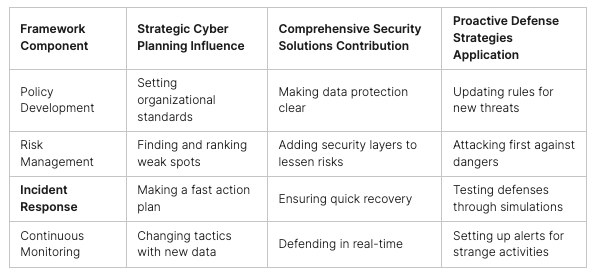
    To build a holistic cybersecurity framework, groups need strategic cyber planning. They also need proactive defense strategies. A good framework uses broad coverage, adaptability, and various cyber functions. This is key today.

    It mixes Red Teams’ attack skills with Blue Teams’ defenses. This creates a strong, ready system. It can quickly handle new cyber threats.

    To make this complex system, commitment to comprehensive security solutions is needed. It’s about setting standard rules and uniting the work of Red and Blue Teams. This way, every cybersecurity aspect is handled well and thoroughly. Here’s an example:

    “A holistic cybersecurity framework combines proactive steps, smart planning, and reaction skills. It forms a digital fortress that’s hard to break.”

    A smart security plan gets better over time. It keeps up with new threats and uses the latest tech. By aligning improvements with business goals, companies become robust. They’re ready for today’s and tomorrow’s threats.

    In conclusion, groups should dive into making a holistic cybersecurity framework. It should include strategic cyber planning, comprehensive security solutions, and proactive defense strategies. This three-part approach keeps our digital worlds safe against growing cyber threats.

    Evolving Threat Landscapes: Adapting through Red and Blue Team Collaboration

    As the digital world expands, evolving threats become a major concern for security experts. It’s vital to combine Red Team collaboration with Blue Team adaptability. This creates a strong defense against changing cyber threats. Sharing threat intelligence is key to staying informed and ready.

    Sharing Threat Intelligence: A Global Imperative

    Changing cybersecurity defenses to face evolving threats requires threat intelligence sharing. By sharing info, Red and Blue Teams can understand and stop attacks early. Having access to global intelligence data is crucial. It helps teams stop attacks before they happen.

    Adaptive Defense: Learning from Simulated Threats

    Learning from Red Team exercises, Blue Team can improve. These simulations help Blue Teams make their defenses stronger. By practicing and reviewing these simulations, they keep learning and adapting. This ensures they stay ready for new tactics from adversaries.

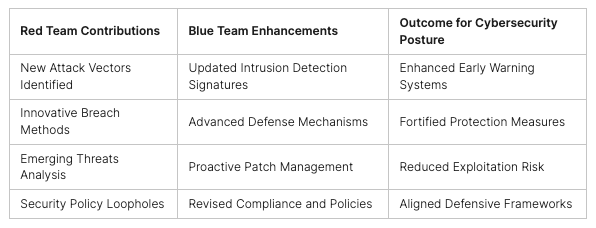
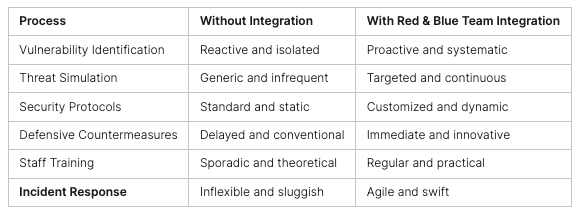
    This strategy uses offensive and defensive strengths together. The table below shows key areas of shared intelligence and how teams adapt.

    In conclusion, cybersecurity landscapes continuously change. The teamwork of Red and Blue Teams, through intelligence sharing and learning, is crucial. Their ongoing cooperation makes organizations ready to face digital threats.

    Advanced Cyber Defense Tactics: The Integration of Red Teams and Blue Teams

    The world of cybersecurity tactics has changed a lot with Red Team integration and Blue Team collaboration coming together. This mix is at the heart of advanced cyber defense. It creates a culture that focuses on stopping threats and making systems stronger. By combining Red Teams’ aggressive threat spotting with Blue Teams’ defensive skills, companies can set up fast and flexible cyber safety actions.

    At the center of this teamwork is making security better, where Red and Blue Teams unite to strengthen defense. This teamwork forms a solid strategy that helps organizations stay secure against new cyber threats.

    With security response optimization, there’s always room for getting better. The lessons from practice attacks lead to stronger defenses.

    When we look closer, we see how Red Team integration boosts Blue Team efforts:

    By adopting advanced cyber defense strategies through this teamwork, the effect of cyberattacks is reduced. This approach helps companies get ready for and stop future threats. It’s a vital shift in cybersecurity tactics—a field that’s always changing and needs smart, fast teamwork.

    In short, advanced cyber defense is more than just using tools. It’s about creating a space where Red Team integration and Blue Team collaboration push security to new heights. The shared knowledge of these teams leads to a smarter way of optimizing responses. This is what sets the standard in today’s cybersecurity efforts.

    Conclusion

    In the dynamic and ever-evolving world of digital security, the collaboration between Red Teams and Blue Teams is essential for fortifying cybersecurity defenses. This partnership epitomizes the synergy necessary to safeguard online environments effectively. Red Teams, by simulating real-world cyber attacks, identify vulnerabilities in security systems, while Blue Teams focus on defending against these infiltrations and strengthening the system’s resilience.

    The continuous interaction between Red and Blue Teams not only identifies and rectifies vulnerabilities but also fosters an environment of perpetual learning and improvement. This iterative process is crucial for adapting to the sophisticated tactics of modern cyber threats, ensuring that security measures evolve faster than the tactics employed by attackers. This teamwork is the cornerstone of a robust cybersecurity strategy, ensuring that defenses are not only reactive but proactively tested and enhanced.

    For organizations aiming to maintain a cutting-edge defense against cyber threats, the integration of both Red and Blue Team efforts is vital. Their combined expertise allows businesses to anticipate potential security breaches and adapt their defenses before any real damage can occur. This proactive approach to cybersecurity ensures that organizations can continue to operate safely and reliably in an increasingly hostile digital landscape.

    At Peris.ai Cybersecurity, we understand the importance of this dynamic and offer comprehensive Red Teaming services as part of our Peris.ai Pandava suite. Our Red Team Service goes beyond traditional penetration testing by simulating sophisticated cyber attacks to uncover deep-rooted vulnerabilities, providing your organization with the insights needed to fortify your defenses. Visit us at Peris.ai Cybersecurity to learn more about how our Red Team services can help you stay one step ahead of cyber threats and ensure that your organization is prepared to face the future of digital security with confidence. Embrace the collaborative power of Red and Blue Teams with Peris.ai and secure your digital world today.

    FAQ

    What are Red Teams in cybersecurity?

    Red Teams are groups that work on offensive cybersecurity. They use ethical hacking to find weaknesses in a network’s security. Their goal is to find these issues to make the network stronger against real attacks.

    How do Blue Teams contribute to cyber defense?

    Blue Teams focus on defending an organization from cyber threats. They handle risk analysis, monitor networks, and respond to incidents. They aim to keep critical assets safe and fend off threats.

    Why is the collaboration between Red Teams and Blue Teams important?

    When Red and Blue Teams work together, they create a strong cybersecurity strategy. Red Teams find flaws, and Blue Teams improve security with this knowledge. This teamwork makes the organization’s defenses better.

    What distinguishes the offensive strategies of Red Teams from the defensive measures of Blue Teams?

    Red Teams attack using unique hacking methods to find and fix security gaps. In contrast, Blue Teams protect the organization. They watch for threats and keep the company’s data safe.

    How does proactive threat hunting contribute to an organization’s cybersecurity?

    Proactive threat hunting means always looking for cyber threats. It uses offense and defense to respond to new dangers. This makes the security stronger and more effective.

    What is a holistic cybersecurity framework, and why is it necessary?

    A holistic framework combines attacking and defending in cybersecurity. It involves planning and defending against threats. This ensures an organization can handle new dangers and keep improving its defenses.

    In what ways can threat intelligence sharing improve cybersecurity?

    Sharing threat intelligence means exchanging information on cyber threats worldwide. This makes defense strategies smarter and more effective. It helps organizations be better prepared for new risks.

    What constitutes advanced cyber defense tactics?

    Advanced tactics come from mixing Red Teams’ attacks with Blue Teams’ defenses. This creates new strategies that keep up with the latest security practices, making defenses stronger.

    How does simulation of cyber threats aid in improving cybersecurity?

    Simulating threats tests a network’s defenses safely. It shows what attackers might do. This helps Blue Teams improve defenses and plan better for real attacks.

    What is the role of competitive cybersecurity in an organization?

    Competitive cybersecurity means Red and Blue Teams challenge each other. This competition improves their methods and makes cybersecurity stronger. It leads to continuous learning and better defenses.

  • New Sign1 Malware Campaign Targets Thousands of WordPress Websites

    New Sign1 Malware Campaign Targets Thousands of WordPress Websites

    A sophisticated malware, known as Sign1, has been identified as the culprit behind a series of unauthorized redirects and popup ads on numerous WordPress sites. This alarming cybersecurity breach was uncovered by the team at Sucuri, following a report from a client experiencing unusual website behavior, according to BleepingComputer.

    Innovative Attack Strategies and Wide Impact

    Unlike traditional WordPress attacks that often involve tampering with site files, the perpetrators behind Sign1 opted for a more clandestine approach. They gained initial access through brute-force attacks, tirelessly testing username and password combinations until successful. Subsequently, the malware was either directly injected into existing HTML widgets and plugins or facilitated via the installation of the Simple Custom CSS and JS plugin, allowing attackers to embed malicious JavaScript code seamlessly.

    This method of attack has proven effective on a grand scale, with over 39,000 websites reported to be afflicted by the same malware. The exact method of compromise for these sites remains speculative, with Sucuri suggesting a mix of brute-force entry and exploitation of vulnerabilities within various plugins and themes as the likely tactics.

    Evasive Measures and Ongoing Development

    Sign1 exhibits sophisticated evasion techniques to remain under the radar. One notable method is its use of time-based randomization, which generates dynamic URLs that refresh every 10 minutes. This ensures that the malicious domains remain unlisted by blocklists. Moreover, by hosting these domains on services like HETZNER and Cloudflare, the attackers effectively mask both the hosting and IP addresses. The malware further complicates detection through XOR encoding and the use of randomly generated variable names.

    The campaign, identified to have been active for approximately six months, is characterized by its continuous evolution. Sucuri’s findings indicate that the malware is still in development, with new versions leading to a spike in infections. The most recent wave of attacks commenced in January 2024, compromising around 2,500 websites to date.

    Preventive Measures for Website Owners

    In light of these findings, cybersecurity experts stress the importance of robust security practices to mitigate the risk of compromise. Website owners are urged to employ strong username and password combinations to thwart brute-force attacks effectively. Additionally, conducting regular audits to remove or update any unnecessary or outdated plugins and themes is essential for minimizing vulnerabilities that could serve as gateways for attackers.

    Peris.ai Cybersecurity remains committed to providing the latest insights and recommendations to protect against such sophisticated threats. Staying informed and proactive in cybersecurity hygiene is key to safeguarding your online presence against the evolving landscape of cyber threats.

  • Safeguarding Your Digital Assets: The Importance of Cyber Risk Mitigation

    Safeguarding Your Digital Assets: The Importance of Cyber Risk Mitigation

    In our hyper-connected world, are your digital assets truly safe? This question looms large as cybercrime escalates, threatening businesses and individuals alike. The digital landscape is fraught with evolving threats, making cybersecurity a critical priority for all.

    Cyber attacks have surged by 38% in 2022, underscoring the urgent need for robust cybersecurity measures and awareness training. As we navigate this treacherous digital terrain, understanding the importance of cyber risk mitigation becomes paramount for safeguarding our valuable data and assets.

    The stakes are high in this digital battleground. Cyber incidents can lead to significant business disruptions, operational downtime, and financial losses. Cyber insurance has emerged as a crucial tool, offering coverage for various costs associated with cyber incidents, including forensic investigations, data recovery, and legal fees.

    To combat these threats, we must adopt a multi-faceted approach to data protection and risk management. This includes implementing strong encryption methods, utilizing two-factor authentication for identity theft prevention, and staying vigilant against phishing attempts. By embracing these cybersecurity best practices, we can build a robust defense against potential threats.

    Key Takeaways

    • Cyber attacks increased by 38% in 2022, highlighting the growing threat landscape
    • Cybersecurity awareness training is crucial for protecting digital assets
    • Two-factor authentication is essential for preventing online identity theft
    • Cyber insurance provides financial coverage for various cyber incident costs
    • A multi-layered approach to cybersecurity is necessary for effective risk mitigation

    Understanding the Current Cyber Threat Landscape

    The cyber threat landscape is changing fast, posing new challenges for everyone. With technology advancing, cybercriminals’ tactics are getting smarter. This makes it crucial for businesses and individuals to have strong security plans.

    Evolution of Cyber Threats in 2024

    In 2024, cyber attacks are on the rise. Since the pandemic, cyber attacks have more than doubled, says the International Monetary Fund (IMF). Also, 75% of U.S. business leaders are very worried about cybersecurity and data privacy.

    The use of AI and advanced tech has brought new risks. 52% of business leaders think AI and other tech will create new challenges. AI can expose sensitive info through large language models.

    Common Attack Vectors and Vulnerabilities

    Ransomware attacks are a big threat, causing financial and operational problems. Different types of malware keep coming, trying to disrupt or steal data. Advanced persistent threats are especially dangerous, often staying hidden for a long time.

    To fight these threats, businesses need strong patch and vulnerability management. Training employees is key to avoid security mistakes. Having good incident response plans is vital for fighting cybercrime.

    Impact of Cybercrime on Global Economy

    Cybercrime’s economic impact is huge. In 2023, there were 2,365 cyber attacks with 343,338,964 victims, a 72% jump from 2021. The financial services sector saw “extreme losses” of $2.5 billion in one year.

    These numbers show how important it is to manage cyber risks well. As threats grow, businesses must keep updating their strategies. This is to protect their digital assets and keep their operations safe.

    Safeguarding Your Digital Assets: The Importance of Cyber Risk Mitigation

    In today’s digital world, keeping your assets safe is key. Cybercrime threats are rising fast. Experts predict cybercrime will cost the world over $20 trillion by 2026, up from $13.2 trillion in 2022.

    Protecting your digital world is now a must. As cyber threats grow, so must our defenses. The U.S. economy could lose over $350 billion to cyber theft in 2024.

    Using a Network-Attached Storage (NAS) device is a smart move. NAS systems offer safe storage, backup, and encryption. They help control access and work remotely, key for today’s security.

    Cyber insurance is also crucial. It covers costs for managing incidents, recovering data, legal fees, and fines. This safety net helps quickly recover from attacks and keeps operations running.

    Protecting your digital world is a constant battle. Stay alert, invest in strong security, and keep improving your network’s defenses.

    Essential Components of Digital Asset Protection

    Protecting digital assets is key in today’s world. Companies use cyber assets to offer products and services. So, keeping data safe is a top goal. Let’s look at the main parts of a strong digital asset protection plan.

    Data Encryption and Security Protocols

    Data encryption is the base of good data protection. It keeps sensitive info safe, whether it’s stored or moving. It’s crucial to have strong security rules, as 92% of malware comes through email. This shows the need for good endpoint security to stop bad attacks.

    Access Control and Authentication Measures

    Strong access control and authentication are key for managing risks. These systems make sure only the right people can see sensitive data. Adding multi-factor authentication makes it even harder for unauthorized access.

    Network Security Infrastructure

    A strong network security setup is vital to stop cyber attacks. Firewalls, IDS, and encryption are the core of a safe system. Regular checks for risks and threats help protect cyber assets.

    Adding these key parts can really help protect your digital assets. Remember, cyber threats are getting worse, especially as more businesses go online. By focusing on these areas, you can create a strong defense against cyber threats and keep your digital assets safe.

    Implementing Robust Cybersecurity Measures

    Protecting digital assets from theft and cyber attacks is key. With data breaches costing $4.88 million on average in 2024, it’s vital to focus on security.

    • Use strong, unique passwords and enable multi-factor authentication (MFA) for all accounts
    • Regularly update software to benefit from the latest security patches
    • Employ firewalls and encryption protocols like HTTPS and VPNs
    • Conduct frequent network audits to identify vulnerabilities

    For those with cryptocurrency, using hardware wallets for offline storage is a good idea. Choose exchanges with strong security, encryption, and servers.

    Be careful of phishing scams by checking emails and using filters. Regular audits keep your systems secure and compliant.

    Cybersecurity breaches can lead to severe financial losses, legal liabilities, and damage to the company’s reputation.

    Comprehensive cybersecurity protects your business from threats and keeps it stable. Investing in security is crucial for success and stability.

    The Role of Network-Attached Storage in Asset Protection

    In today’s digital world, keeping your data safe is key. Network-Attached Storage (NAS) is vital for protecting your data and keeping your network secure. With cyber-attacks up by 31% and companies facing 270 attacks last year, strong security is a must.

    Centralized Storage Benefits

    NAS makes data management easier and safer. It gives you one place to manage and secure your data. This is important since 50% of cyber-attacks take months to find out. NAS also has built-in encryption to keep your data safe while it’s moving or stored.

    Backup and Recovery Solutions

    Regular backups are key for disaster recovery. NAS devices make backups easy and automatic. This is especially important as ransomware attacks are on the rise, causing big problems for businesses. World Backup Day on March 31st reminds us to back up our data regularly to avoid losses from cyber attacks and hardware failures.

    Remote Access Security

    With more people working from home, secure remote access is more important than ever. NAS systems have VPNs, which create safe paths for data to travel. VPNs encrypt data, keeping it safe from hackers and unauthorized access. This is crucial as attacks through supply chains have jumped from 44% to 61%.

    By using NAS with strong security, companies can greatly improve their data and network protection. This helps them stay safe against the growing number of cyber threats.

    Risk Assessment and Management Strategies

    In today’s digital world, keeping your organization safe is key. You need a plan to spot and deal with risks. This keeps your security strong.

    *Mastering Cybersecurity Risk Assessment & Management: https://youtube.com/watch?v=X-gM8rLxJPs

    Cybersecurity risk asset valuation helps figure out what digital assets are worth. It shows which ones might be at risk. This helps protect your digital valuables.

    Managing risks means using tools like risk scoring and data analysis. These tools help you focus on what’s most important. They make your security better.

    Regular risk checks are very important. In 2023, data breaches went up by 72% from 2021. This shows we always need to be watching out.

    A good risk assessment includes several steps:

    • Defining what to check
    • Getting info about your IT setup
    • Finding risks and weak spots
    • Looking at threats
    • Coming up with plans to fix things
    • Writing down what you find
    • Putting in place new security steps
    • Keeping an eye on things and checking again

    Penetration testing is also key. It shows you where your security might be weak. It helps you understand how to improve.

    To make risk assessments better, consider using automated tools. Also, focus on the most important things first. Make sure your team is trained well. And, sometimes, get outside help for a fresh look.

    By making risk assessments part of your business plan, you can stay safe. This is very important. About 60% of small businesses close after a cyberattack.

    Cryptocurrency and Digital Asset Security

    The world of digital assets needs strong cybersecurity. As the cryptocurrency market grows, so do threats. In October, investors lost $129 million to hacks and scams, showing the need for better protection.

    Wallet Security Best Practices

    Keeping your digital wallet safe is key. Use hardware wallets for top security. These devices keep your private keys offline, making them safer from cyber attacks. Make strong, unique passwords and turn on two-factor authentication (2FA) for extra security.

    Exchange Protection Measures

    Cryptocurrency exchanges are often targeted by hackers. Pick platforms that focus on security. Look for exchanges that store most funds in cold storage and have strict access controls. Regular security checks help find and fix vulnerabilities before they’re used.

    Transaction Security Protocols

    Every transaction has risks. Always check addresses before sending money. Use multi-signature wallets for big transactions. These need more than one approval, making unauthorized transfers less likely. Watch out for phishing scams that try to get your login details or private keys.

    The cryptocurrency world lacks the oversight of traditional finance. Keep up with new rules, especially on anti-money laundering (AML) and know-your-customer (KYC) practices. Your alertness is crucial for safeguarding your digital assets in this fast-changing world.

    Employee Training and Security Awareness

    In today’s digital world, teaching employees about cybersecurity is key. The fact that 95% of breaches come from human mistakes shows how vital it is. Companies must focus on building a culture that values security to safeguard their digital assets.

    Phishing attacks are a big problem, with 88% of companies facing them in 2020. For example, in 2021, a US city’s government fell to a phishing attack, leading to data loss and high costs. These cases show the need for thorough training to fight cyber threats.

    Starting a cybersecurity training program can bring big benefits. It makes employees more alert and helps them respond faster to threats. By teaching employees to handle information safely, companies can lower the chance of security breaches.

    To create a strong cybersecurity training program, organizations should:

    • Check what employees know and what risks they face
    • Set clear goals for the training
    • Make the training fit the company’s specific needs and threats
    • Use tools like KnowBe4, Cofense, and LastPass for hands-on learning
    • Practice safe password use and multi-factor authentication

    By focusing on security training, companies can show they are secure and reliable. This can give them an edge in their field. This dedication to protecting data through training can boost customer trust and help companies succeed in a digital age.

    Incident Response and Recovery Planning

    In today’s digital world, a strong incident response plan is key to protecting your organization. A good plan can cut down on financial losses from cyber attacks. It also helps follow industry rules.

    Creating Response Protocols

    Good incident response starts with clear steps. Companies should check their security often to find weak spots. This helps make plans that fit the specific risks they face.

    Business Continuity Measures

    Quick response and recovery mean less lost time. This keeps operations running smoothly. Using extra security checks and changing passwords often are key steps in managing risks. These steps help keep business going, even when threats come up.

    Disaster Recovery Strategies

    A solid disaster recovery plan is crucial for staying strong. Having plans for data backup and recovery is key to keeping things running after an attack. Keeping software and systems up to date, and training employees, are the core of good disaster recovery.

    By adding these parts to your incident response and recovery plans, you build a strong system. This system helps manage cyber risks and keeps your digital assets safe.

    The Role of Cyber Insurance in Risk Mitigation

    Cyber insurance is key for businesses to manage risks. As cyber threats grow, companies need financial protection against data breaches and network attacks. This insurance helps reduce the financial hit of cyber attacks, letting businesses recover and keep running.

    Coverage Types and Benefits

    Cyber insurance policies cover many cybersecurity risks. They protect against losses from data breaches and third-party attacks. The main benefits are:

    • Data breach response costs
    • Business interruption expenses
    • Legal fees and settlements
    • Ransomware attack payments
    • Data recovery expenses

    The healthcare sector benefits a lot from cyber insurance. Breaches in this field cost an average of $10 million a year. Big companies like Sony have also faced huge costs from cyber attacks, with one breach costing over $171 million.

    Policy Selection Considerations

    Choosing the right cyber insurance policy is important. It depends on your business’s unique risks and threats. The global cyber insurance market is growing fast, valued at $7.8 billion in 2020 and expected to hit $20 billion by 2025. Key things to think about are:

    Cyberattacks have jumped by 125% worldwide in 2021 compared to 2020. The average cost of data breaches has also risen to $4.35 million in 2022. Cyber insurance is now a vital part of managing corporate risks. By picking the right coverage, businesses can safeguard their digital and financial health against rising threats.

    Conclusion

    In today’s fast-evolving digital landscape, safeguarding our digital assets is more crucial than ever. Events like Fraud Prevention Month and World Backup Day remind us to stay vigilant against cyber threats by adopting proactive measures. Regularly backing up data, using strong passwords, updating software, and encrypting sensitive information are essential steps in protecting against cyberattacks and hardware failures.

    Cybersecurity awareness among employees is equally vital. Educating teams about phishing scams and insider threats empowers organizations to minimize risks and maintain a secure digital environment. Continuous learning and vigilance are key to staying one step ahead of cybercriminals.

    By combining advanced technical solutions, comprehensive training, and consistent risk monitoring, businesses can fortify their defenses and ensure the safety of their valuable digital assets.

    Stay ahead of cyber threats. Visit Peris.ai to explore our cutting-edge cybersecurity products and services designed to protect your digital world.

    FAQ

    What are the key components of digital asset protection?

    Digital asset protection includes data encryption and strong authentication. It also has access controls and a secure network. These elements protect digital assets from cyber threats and unauthorized access.

    How can Network-Attached Storage (NAS) enhance cybersecurity?

    NAS enhances cybersecurity with centralized storage and advanced security. It offers data encryption, access control, and secure remote access. For example, Ciphertex Data Security’s SecureNAS® has FIPS 140-2 level 3 encryption and tamper-proof designs.

    What are some best practices for cryptocurrency security?

    For cryptocurrency security, use hardware wallets and multi-factor authentication. Be cautious of phishing and follow secure transaction protocols. Update software regularly, use strong passwords, and keep private keys offline.

    Why is employee training important in cybersecurity?

    Employee training is key because human error often leads to breaches. Educating employees about risks and data protection creates a security-conscious culture. This helps defend against cyber threats.

    What should be included in an incident response plan?

    An incident response plan should have clear protocols and business continuity measures. It should outline roles, communication, and steps for threat containment. Regular testing and updates are crucial for effectiveness.

    How does cyber insurance contribute to risk mitigation?

    Cyber insurance provides financial protection against cyber incidents. It covers data breaches, business interruption, and legal liabilities. Choose a policy that fits your risk profile and needs.

    What are some common attack vectors in cybersecurity?

    Common attacks include phishing, malware, and ransomware. Social engineering and DDoS attacks are also common. Credential stuffing and IoT vulnerabilities are increasing threats.

    How can organizations assess and manage cyber risks?

    Organizations can manage cyber risks through security audits and vulnerability assessments. Identify vulnerabilities, assess their impact, and implement mitigation measures. Cybersecurity experts can provide valuable insights.

  • The Cybersecurity Challenge: Common Threats for SMBs and Large Enterprises, But Different Response Routes

    The Cybersecurity Challenge: Common Threats for SMBs and Large Enterprises, But Different Response Routes

    Interconnected systems have woven an environment where safeguarding digital domains transcends mere necessity—it emerges as an imperative. This overarching concern traverses the spectrum of business scales, encompassing the expansive terrain of Large Enterprises and the dynamic realm of Small and Medium-sized Businesses (SMBs). As the digital threat landscape continually morphs, it crafts a distinctive set of challenges for each, prompting a meticulous exploration of common perils these entities face. While shared vulnerabilities exist, the strategies and countermeasures employed to thwart these dangers often navigate divergent trajectories shaped by the nuances of available resources, proficiencies, and risk dispositions. This article embarks on an odyssey through cybersecurity, unraveling the shared cybersecurity threats encountered by SMBs and Large Enterprises while illuminating the journey into the distinct avenues they traverse to fortify their digital citadels.

    The Common Threats

    1. Phishing Attacks

    Phishing attacks remain a prevalent threat across the board. Cybercriminals use carefully crafted emails or messages to deceive employees into divulging sensitive information, such as login credentials or financial data. Both SMBs and Large Enterprises are vulnerable to this type of attack. The allure of phishing lies in its simplicity and potential for devastating consequences.

    2. Ransomware

    Ransomware has emerged as a particularly insidious threat in recent years. Malicious actors encrypt an organization’s data and demand a ransom for the decryption key. SMBs are often targeted due to their perceived weaker defenses, while Large Enterprises become attractive targets due to the potential for larger ransoms. The aftermath of a successful ransomware attack can cripple operations and result in significant financial losses.

    3. Insider Threats

    Whether intentional or unintentional, insider threats pose a risk to both SMBs and Large Enterprises. These threats arise when employees, contractors, or partners misuse access to an organization’s systems or data. The motivations behind insider threats can vary from personal gain to negligence. Detecting and mitigating insider threats requires a delicate balance between trust and security measures.

    Different Response Routes

    While SMBs and Large Enterprises face similar threats, their response routes differ due to their varying resources, organizational structures, and risk profiles.

    SMBs: Navigating Limited Resources

    1. Comprehensive Security Education

    For SMBs with limited budgets, proactive security education becomes paramount. Employees are often the first line of defense, and training them to identify and respond to threats can significantly reduce the risk of successful attacks.

    2. Outsourced Solutions

    Lacking the extensive in-house expertise of their larger counterparts, many SMBs opt for outsourced cybersecurity solutions. Managed Security Service Providers (MSSPs) offer cost-effective monitoring, threat detection, and incident response options.

    3. Focus on Critical Assets

    Resource constraints necessitate a focused approach. SMBs should identify and prioritize their most critical assets and implement strong security measures around them. This targeted strategy helps optimize resource allocation.

    4. Cloud Security

    Leveraging cloud services can be a double-edged sword for SMBs. While the cloud offers cost savings and scalability, it also introduces new security considerations. SMBs must adopt robust cloud security practices to safeguard their data and applications.

    Large Enterprises: Capitalizing on Scale and Expertise

    1. In-House Security Teams

    Large Enterprises often maintain dedicated in-house security teams. These teams, comprised of experts in various cybersecurity domains, can proactively monitor, assess risks, and respond swiftly to incidents.

    2. Advanced Threat Detection

    With greater resources, Large Enterprises can invest in advanced threat detection technologies, such as AI-powered analytics and machine learning algorithms. These tools enhance the ability to identify and mitigate sophisticated threats.

    3. Robust Incident Response Plans

    Large Enterprises can afford to develop comprehensive incident response plans that outline clear steps for handling various cyberattacks. Regular simulations and testing ensure preparedness when a real incident occurs.

    4. Regulatory Compliance

    Due to their size and reach, Large Enterprises often face more stringent regulatory requirements. Compliance with these regulations becomes crucial to their cybersecurity strategy, necessitating ongoing efforts to align with industry standards.

    Collaboration and Knowledge Sharing

    Despite their differences, SMBs and Large Enterprises can benefit from collaborating and sharing cybersecurity knowledge. The threat landscape is ever-evolving, and cyber criminals continuously adapt their tactics. By pooling their insights and experiences, SMBs and Large Enterprises can better understand emerging threats and effective defense strategies.

    1. Threat Intelligence Sharing

    Participating in threat intelligence-sharing communities enables organizations of all sizes to access real-time information about new threats and vulnerabilities. This collective knowledge enhances their ability to defend against potential attacks proactively.

    2. Joint Training Exercises

    SMBs and Large Enterprises can join training exercises to simulate cyberattack scenarios. These exercises provide valuable hands-on experience and foster collaboration between entities with differing resources and perspectives.

    3. Industry Alliances

    Joining industry-specific cybersecurity alliances or associations can provide access to resources, best practices, and a network of peers facing similar challenges. These alliances are platforms for sharing insights and coordinating responses to sector-specific threats.

    Conclusion

    In the ever-expanding realm of our digitally interwoven world, the parallels between the cybersecurity challenges confronting Small and Medium-sized Businesses (SMBs) and their Large Enterprise counterparts are striking. The ominous specters of phishing attacks, ransomware, and insider threats loom large, casting shadows of potential devastation across the digital landscape. Yet, the paths taken diverge greatly in response to the multidimensional resources, competencies, and risk profiles that distinguish these organizational archetypes.

    For SMBs, the journey to safeguard their digital territories is an exercise in resource optimization and tactical precision. Guided by the North Star of prudence, these entities navigate the intricacies of cybersecurity through a multifaceted prism. By prioritizing comprehensive security education, leveraging the prowess of outsourced cybersecurity solutions, and erecting bastions of protection around their most critical assets, SMBs orchestrate a harmonious symphony of security that resonates through their operations.

    In the grand theater of Large Enterprises, the stage is set for a more elaborate production. With the curtains drawn, in-house security teams, akin to virtuoso conductors, lead the ensemble with a commanding presence. Armed with an arsenal of advanced threat detection technologies powered by artificial intelligence and machine learning, Large Enterprises stand fortified against the ever-shifting tide of cyber threats. Their acts are scripted meticulously as robust incident response plans take center stage, ensuring that every twist and turn of the cybersecurity narrative is anticipated and accounted for.

    In this era of perpetual digital transformation, safeguarding our digital realms demands a collective embrace of cybersecurity’s imperative. As custodians of these virtual landscapes, the onus is upon us, regardless of organizational size, to fortify our digital bastions and stand unwavering in adversity. To embark on this quest for digital security, we invite you to explore our website, where a comprehensive array of solutions awaits to guide you through the labyrinthine corridors of cybersecurity. Let us stride forward united, fortifying the pillars of the global digital ecosystem and ensuring that the beacon of integrity continues to shine brightly amidst the shadows of an ever-evolving threat landscape.

  • Third-Party Pen Testing: Why It’s Essential and Who Does It Best!

    Third-Party Pen Testing: Why It’s Essential and Who Does It Best!

    Today, our digital world is growing fast, but so are cyber threats. This makes it key to regularly check our online security. But what makes some third-party pen testing teams stand out? Let’s delve into how important they are and find out who’s great at keeping our data safe.

    Key Takeaways

    • Penetration testing, or ethical hacking, is a critical cybersecurity practice that identifies vulnerabilities in systems and networks.
    • Third-party penetration testing services leverage the expertise of specialized cybersecurity professionals to provide an objective and comprehensive security assessment.
    • Partnering with a reputable third-party provider can help organizations uncover hidden vulnerabilities, enhance their cybersecurity measures, and maintain regulatory compliance.
    • Investing in third-party pen testing is a strategic decision that can protect digital assets and stay ahead of potential threats.
    • The selection of the right third-party provider is crucial, as their expertise, methodology, and support can significantly impact the effectiveness of the assessment.

    Understanding Third-Party Penetration Testing Service

    Penetration testing, often called “pen testing,” simulates cyberattacks to find system and network flaws. This testing uses real hackers’ tactics to uncover security holes. You can then fix these areas before they’re misused.

    What is Penetration Testing?

    Penetration testing uses hackings tools and strategies, but for good, to make an organization more secure. It’s about enhancing security, not causing trouble. This ethical hacking process offers a full view of how security works in an organization.

    Importance of Ethical Hacking

    Ethical hacking, or penetration testing, is essential. It helps cybersecurity experts stop attacks before they happen. By imitating attacks, ethical hackers show organizations how to better protect themselves and follow security rules.

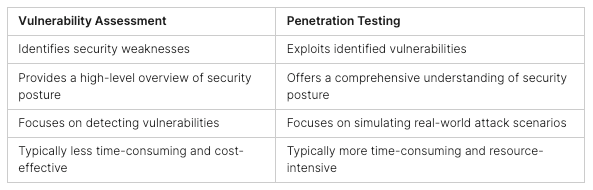
    Vulnerability Assessment vs. Penetration Testing

    Vulnerability assessments find security problems. Penetration tests then try to use these weaknesses to see the whole security situation. This helps companies focus on fixing the most important security issues.

    Types of Third-Party Penetration Testing Services

    Third-party penetration testing services can focus on different parts of a company’s security. These include special checks designed to find weak spots and make the company’s cybersecurity better.

    Web Application Penetration Testing

    This type looks for weak spots in web applications. It finds common issues like XSS, SQL injection, and weak logins. By acting like real hackers, these experts help make online services safer and keep data secure.

    Network Penetration Testing

    This service checks how secure an organization’s networks are. It looks at things like firewalls and servers. By finding and fixing problems early, it helps keep out cyber attackers.

    Wireless Penetration Testing

    Here, the focus is on making sure wireless networks are safe. Because these are often easy targets for cybercriminals. The testers look at things like who can access the network and encryption to stop attacks before they can happen.

    IoT Penetration Testing

    With more smart devices around, IoT testing is very important. These checks make sure smart devices are hard to hack. They help because many smart gadgets don’t always have the best security.

    Thick Client Penetration Testing

    This service looks at apps on computers or laptops. They check for security holes against different kinds of attacks. By looking at apps, they make sure the whole computer system is safe.

    Benefits of Third-Party Penetration Testing Service

    Hiring a third-party for penetration testing has several key benefits. It allows companies to enhance their cybersecurity. These services use experts and advanced methods to find vulnerabilities missed by internal teams.

    They do a full check of security gaps and weak points. Then, they help put in place better defenses. This improves a company’s network and web security greatly.

    Identifying Vulnerabilities

    Third parties like penetration testing as a service use the latest tools for deep security checks. Their goal is to find and exploit weaknesses. This way, they unearth hidden vulnerabilities that might otherwise go unnoticed.

    They simulate real-life cyber attacks. This gives companies a clear picture of their security level. And it helps them understand the risk of actual cyber threats.

    Enhancing Cybersecurity Posture

    The information from these tests is vital. It lets companies make smart security choices. By fixing vulnerabilities, they improve their overall security and resilience against cyber threats.

    This comprehensive security approach keeps them safe from evolving threats. And it ensures a strong and ongoing security position.

    Compliance and Regulatory Requirements

    Many industries need regular security checks because of rules and standards. Third-party services are key in meeting these demands. They show that the company is serious about keeping data and systems safe.

    Fulfilling these tests builds trust and keeps the company’s image positive. It also helps avoid fines or legal issues related to security breaches.

    Choosing the Right Third-Party Penetration Testing Service Provider

    When picking a third-party penetration testing service provider, it’s key to check their skills and certifications. Find one with a strong history of doing thorough security assessments. They should also know a lot about the latest threat landscape.

    Expertise and Certifications

    Good penetration testing as a service providers have teams with ethical hackers and cybersecurity consultants. These experts are great at vulnerability assessment and network security audits. They hold certificates like Certified Ethical Hacker (CEH) and Offensive Security Certified Professional (OSCP). All of this shows they’re skilled in web application security testing and red team operations.

    Methodology and Approach

    It’s smart to look at how the provider plans to work. Make sure their methods suit your security goals. They should use a solid and detailed process for external penetration testing. This should include checking your network security, web applications, and IoT devices.

    Reporting and Remediation Support

    Think about the reports and help they’ll give you after the tests. Good reports and clear advice on fixing issues are vital. They can make your information security audit work better. This can boost your company’s cybersecurity posture.

    Third-Party Penetration Testing vs. In-House Testing

    Organizations can do in-house penetration testing. But working with a third-party service provider has its benefits. These providers have more tools and techniques at their disposal. This can help find weaknesses not caught by in-house teams. Plus, they bring a fresh look. This shows problems that might be hard for those inside to see.

    Cost Considerations

    Money talks when it comes to cybersecurity. Maintaining a penetration testing team inside can be costly. By going outside to a specialized team, organizations can save big. They get top-notch security assessments without the cost of a full in-house team.

    Objectivity and Fresh Perspective

    Being objective benefits everyone. A third-party penetration testing as a service provider offers clear eyes and thoughts. This can pinpoint weaknesses that might have been missed. Such security audits spot overlooked issues, improving an organization’s cybersecurity stance.

    Access to Advanced Tools and Techniques

    Specialists have special tools. Third-party penetration testing service providers have a plethora of leading tools and techniques. They’re ideal for red team operations and external penetration testing. This cutting-edge information security audit gear is hard to maintain in-house. Relying on them is smart and cost-efficient.

    Preparing for a Third-Party Penetration Test

    Getting ready for a third-party penetration test is important. There are three main steps to take. You need to know what the test will cover, set up how you’ll communicate, and get permission to do the test.

    Defining Scope and Objectives

    The first thing is to decide what the test will look at and what it should achieve. This helps the third-party penetration testing service understand what your company needs. The tests will match your main security goals, giving you the most useful results.

    Establishing Communication Channels

    Talk well with the testing provider is key. Good communication makes the test run smoothly. It lets you share information quickly and solve any problems fast. This way, you and the provider stay on the same page.

    Securing Necessary Approvals

    Getting the green light from those in charge is vital before the test starts. You might need permission from management or IT. These approvals make sure the test goes ahead without issues.

    Interpreting Penetration Testing Results

    Finishing a third-party third-party penetration testing service is just the start of making a place more secure. Knowing what the test results mean and the risk ratings is critical. This helps in fixing the most dangerous security issues first.

    Understanding Risk Ratings

    Pen testing reports give vulnerabilities a risk rating, from low to critical. These ratings show how much damage a flaw could do if hackers use it. It’s important for teams to really understand these risks to fix them.

    Prioritizing Remediation Efforts

    With the risk ratings clear, organizations can set priorities. They should fix the biggest security holes first. By doing this, they lower the chance of facing serious cyber threats.

    Developing a Comprehensive Security Strategy

    Insights from penetration tests should help make a full security plan. This plan includes using the right controls, policies, and checks. With this strategy, a place can keep its defenses strong and protect its digital stuff well.

    Cybersecurity Consulting and Managed Services

    After hiring a third-party penetration testing service, businesses can keep getting help with cybersecurity consulting and managed services. These ongoing services include continuous monitoring and threat detection. They help keep an eye out for new security threats.

    Continuous Monitoring and Threat Detection

    These solutions let organizations always monitor their systems and networks. They watch for any weird activity or vulnerability risks. Using advanced analytics and SIEM technologies, services quickly find and fight cybersecurity incidents. This can reduce harm and prevent worse damage.

    Incident Response and Forensics

    If there’s a security breach, having incident response and forensic capabilities is key. They ensure a fast and strong reaction. This helps contain the incident, gather evidence, and get back to normal soon. Working with skilled cybersecurity consulting teams prepares businesses for handling security issues well.

    Security Awareness Training

    A good security posture needs everyone in the company to be involved. Security training is vital. It creates a culture where staff can spot and report dangers. It also teaches them how to keep important information and digital assets safe. With the right security awareness training, a company improves its network security audits and web application security testing.

    Conclusion

    In today’s rapidly evolving landscape of security threats, maintaining robust cybersecurity measures is more crucial than ever. Partnering with a trusted third-party penetration testing service can identify and address vulnerabilities within your digital infrastructure before they can be exploited. This proactive approach not only protects your sensitive data but also ensures compliance with industry regulations.

    Opting for third-party penetration testing is a strategic move. It prepares your company for potential threats by leveraging the expertise of ethical hackers to uncover and resolve hidden issues. This thorough security assessment ensures your online assets remain secure, giving you peace of mind and a competitive edge.

    The demand for third-party penetration testing and red team operations is increasing. Businesses that embrace this approach are better equipped to safeguard their critical assets and demonstrate a serious commitment to security, which is essential in today’s digital age.

    With Peris.ai Pandava, you can rest assured that your business will stay secure while gaining a competitive edge in the marketplace. Sleep better at night knowing your data is safe. Our ethical hackers conduct thorough penetration testing and provide detailed reports, identifying vulnerabilities before they’re exploited. “Finding vulnerabilities and weak points within your digital platform & infrastructures” may sound daunting, but with Peris.ai Pandava Service, it’s something you can rest easy about.

    Visit Peris.ai Cybersecurity to learn more about Peris.ai Pandava and how our services can help you secure your business against evolving cyber threats. Secure your digital future today!

    FAQ

    What is penetration testing?

    Penetration testing, also known as ethical hacking, is a way to find system or network problems. It’s like a cyber-attack test run by experts to see where a company’s security is weak.

    What is the difference between vulnerability assessment and penetration testing?

    Vulnerability assessments look for security flaws. Penetration testing takes it further by trying to use those flaws. This helps understand how safe an organization really is.

    What are the different types of third-party penetration testing services?

    There are many types of third-party tests. These include checks on web applications, networks, wireless tech, IoT, and thick client services.

    What are the benefits of engaging a third-party penetration testing service provider?

    Having outside experts test your security finds more issues. It boosts your security measures and helps meet rules and standards.

    What should organizations consider when selecting a third-party penetration testing service provider?

    Look for a provider with a deep skillset. They should have known certifications and use solid methods. Their reports and help to fix issues should be top-notch.

    What are the advantages of third-party penetration testing over in-house testing?

    Outsiders can bring new tools and thinking. They might find hidden problems that your team missed.

    How should organizations prepare for a third-party penetration test?

    Get ready by setting clear goals and sharing the plan with all involved. Make sure everyone knows what’s being tested and approved for the test.

    How should organizations interpret and act on the results of a penetration test?

    Put the found problems in order of risk and fix what’s most urgent first. Use the test findings to build a stronger security plan.

    What additional cybersecurity services can organizations benefit from beyond penetration testing?

    They can gain from services like ongoing checking, spotting threats, dealing with attacks, exploring attacks afterwards, and training people to be more security aware.

  • What Is S-SDLC and How It Enhances Security

    What Is S-SDLC and How It Enhances Security

    In today’s digital world, software plays a key role in business. That’s why we need strong security. Secure Software Development Lifecycle (S-SDLC) is a way to make software safer. It adds security steps at every stage, from planning to maintenance.

    This approach helps lower the chance of security problems. It makes software safer for everyone.

    S-SDLC is vital today because threats and software complexity grow. It deals with security at each step of making software. This way, companies can fight off many cyber threats.

    Key Takeaways

    • S-SDLC adds security steps at every stage of making software.
    • It helps create a culture focused on security, lowering the chance of software flaws.
    • Using S-SDLC can make making software faster and cheaper by finding security issues early.
    • Regular testing and using security tools are key parts of S-SDLC.
    • Training developers on security is important for making secure applications.

    Introduction to Secure Software Development Lifecycle (S-SDLC)

    The Secure Software Development Lifecycle (S-SDLC) makes the traditional SDLC better by adding security steps at every stage. It puts security first for all teams working on software. This way, security is a key part from the start, not just an afterthought.

    Definition and Importance of S-SDLC

    S-SDLC is key because it offers a detailed and flexible way to handle security for today’s software development and deployment. Adding security at each step of the process helps lower the chance of security issues. It also makes software more secure.

    Benefits of Implementing S-SDLC

    Using S-SDLC brings many benefits, like cutting costs and focusing on security first. It also improves how development is planned and makes software more secure. Some main benefits include:

    • Finding and fixing security problems early, which saves money
    • Adding security best practices into development, creating a culture that values security
    • Matching security goals with business aims for a strategic approach to software security
    • Boosting overall security and lowering the risk of attacks or data breaches

    By following S-SDLC, companies can make their software more secure and resilient. This helps protect their data and assets from cyber threats.

    Phases of Secure SDLC

    The Secure Software Development Lifecycle (S-SDLC) makes the traditional SDLC better by adding security steps at every stage. It aims to cut down on risks, meet compliance needs, and make secure apps from the start.

    Planning: Assessing Risks and Security Landscape

    In the planning phase, teams look at security risks and the threat scene. They plan how to use resources, schedule projects, and prepare for security from the beginning.

    Requirements: Defining Security Requirements

    The requirements phase focuses on setting clear security needs, knowing about laws, and adding them to the project. This makes security a key part of making software, not just an add-on.

    Design: Incorporating Security Considerations

    In design, security is a big part of planning, including threat modeling and checking design’s security effects. It’s important to use secure coding and testing to find and fix code issues.

    The National Institute of Standards and Technology (NIST) made the Secure Software Development Framework (SSDF) to guide secure SDLC practices. The SSDF suggests training developers in secure coding, automating security checks, and securing open source parts.

    https://youtube.com/watch?v=ZNECM4PffuE

    Microsoft’s Security Development Lifecycle (SDL) and CLASP, a rule-based security framework, are more ways to boost security early in development.

    Secure Coding Practices and Tools

    Secure coding practices are key in the Secure Software Development Lifecycle (S-SDLC). They make sure the code is safe and has no bugs. This means cleaning inputs, not using hard-coded secrets, and using tools to find bugs early.

    Developers need to learn about secure coding and follow security rules for their languages and frameworks. Checking the code often, with help from security experts, helps spot security problems early.

    Tools like software composition analysis (SCA) and penetration testing are crucial in the S-SDLC. They find bugs in open-source parts and the app itself. These tools help teams see, fix, and prevent security issues at every stage of development.

    Using secure coding and security tools in the S-SDLC makes software safer. It lowers the chance of data breaches and keeps customers trusting the brand.

    Security Testing in S-SDLC

    Security testing is key in the Secure Software Development Lifecycle (S-SDLC). It makes sure the software works right and is safe for users. This process uses manual tests, big tests in real-like settings, and security checks by special teams.

    Static and Dynamic Testing Techniques

    S-SDLC uses static and dynamic testing to find security problems during development. Static testing looks at the code without running it. Dynamic testing checks the software while it’s running. These methods help spot issues like SQL injection, which hits 9% of web apps, says OWASP. Using whitelisting and blacklisting can cut code injection risks by 70%.

    Penetration Testing and Vulnerability Scanning

    S-SDLC also has deep checks like penetration testing and scanning for vulnerabilities. Experts do these tests to find any security weak spots before the software goes live. Role-Based Access Control (RBAC) can cut down on unauthorized access by 50%. Multi-factor authentication (MFA) boosts security by 80% over single-factor methods.

    Adding security testing at different S-SDLC stages helps find and fix security issues early. This makes software safer overall.

    https://youtube.com/watch?v=TTBNMH8igEU

    “Effective security testing is not just about finding vulnerabilities, but about understanding the context and potential impact of those vulnerabilities on the overall system.”

    Using a full security testing plan in S-SDLC makes software safer and lowers cyber threat risks.

    Deployment and Continuous Security Monitoring

    In the secure software development lifecycle (S-SDLC), deployment and continuous security monitoring are key. They make sure the application stays secure over time. It’s important to set up the application securely from the start to avoid risks. Continuous security monitoring helps spot and fix security threats quickly, keeping the application safe.

    Secure Configuration and Deployment Practices

    Setting up the application securely means it’s ready for production with strong security measures. This includes using least privilege access and multi-factor authentication, and doing risk assessments. Adding security early in the development process helps find and fix problems before they’re big, saving time and money.

    Monitoring and Responding to Vulnerabilities

    Keeping an eye on the application for new threats is crucial. This way, security issues can be caught and fixed fast, keeping the application safe. Using DevSecOps and CI/CD/CS pipelines makes it 50% less likely to have a data breach, and it’s used more often in 2023.

    By making security a part of the development process, we can make more secure applications. This reduces the chance of vulnerabilities and keeps production environments safe.

    “Secure deployment and continuous security monitoring are essential components of the Secure SDLC, ensuring the long-term security and integrity of the application.”

    What Is S-SDLC and How It Enhances Security

    The Secure Software Development Lifecycle (S-SDLC) is a way to make software safer from start to finish. It starts with security in mind, tackling risks early. This method covers phases like gathering requirements, designing, implementing, testing, and deploying, making security key at each step.

    Using an S-SDLC boosts software security a lot. Experts say it’s a must for any modern web app developer to cut down on risks. It helps find and fix problems early, making software safer, cheaper, and more efficient.

    Old ways of testing security don’t work well with today’s fast-paced software making and using. That’s why we need agile security testing methods like the Secure Software Development Framework. S-SDLC makes apps safer, saves money, and meets deadlines, which is key in today’s fast-paced software world.

    Secure coding, like using safe SQL queries, helps protect against attacks. Finding security problems early can also cut down on costs, as fixing them later can be very expensive, up to 100 times more.

    https://youtube.com/watch?v=cME03QCequ0

    S-SDLC doesn’t replace old security checks but adds security to the making of software. There are different security models, like Waterfall and Agile, based on the Software Development Life Cycle. The ISO standard on software development, ISO/IEC 12207, outlines how to do software development safely.

    By using S-SDLC, companies can make their software safer, lower risks, and make security a team effort in making software. This way, they can reduce attacks, keep data safe, and keep users’ trust.

    DevSecOps: Integrating Security into DevOps

    DevSecOps blends security into the DevOps process. It makes sure development, operations, and security teams work together. This way, security is always part of the continuous process.

    Goals and Principles of DevSecOps

    DevSecOps aims to make software safer and faster. It does this by finding security problems early and making the release process quicker. It also uses automation to lower risks and make security more visible.

    This approach helps avoid costly fixes and protects the app’s good name.

    Implementing DevSecOps Practices

    Using DevSecOps makes security a key part of making software. It uses tools like open source vulnerability scanning. It also uses Static and Dynamic Application Security Testing, and container image scanners.

    These scans check for security problems at different stages of making and building the software.

    DevSecOps also means getting new features and fixes out faster. It makes sure updates don’t break the app. This way, fixing security issues is cheaper and done early.

    Tools like GitHub Actions, Trivy, Starboard, and OWASP ZAP help automate security checks. They find vulnerabilities and make security a key part of making software.

    Software Supply Chain Security

    Software development’s security is now a top concern. It’s about keeping the whole chain of components and entities safe from start to finish. This means protecting development tools, source code, and all systems in the Software Development Life Cycle (SDLC).

    Importance of Software Supply Chain Security

    Software supply chain security is very important. The SolarWinds attack showed how vulnerable software chains can be, affecting 18,000 customers. President Biden’s order to improve software security shows we need strong measures now.

    Best Practices for Software Supply Chain Security

    It’s key to follow best practices to protect against software risks and attacks. These include:

    • Implementing least-privilege access to limit the impact of potential breaches.
    • Hardening the security of connected devices and sensitive data to prevent unauthorized access.
    • Knowing and evaluating your suppliers to ensure the integrity of the entire supply chain.
    • Continuously monitoring the software supply chain for potential vulnerabilities or threats.

    Organizations use tools like Synopsys Black Duck® for analyzing software, Coverity® for testing, and WhiteHat Dynamic for dynamic testing. These tools help see into the supply chain, find risks, and fix security issues early.

    As attacks on software supply chains grow more common and complex, it’s time to review our security steps. Frameworks like SSDF (Software Supply Chain Defense) and SLSA (Supply-chain Levels for Software Artifacts) help with strong security controls. They ensure the software supply chain is safe and secure.

    “Securing the software supply chain is no longer an option, it’s a necessity. Proactive measures and the adoption of best practices are crucial to protect against the growing threats in this space.”

    By following best practices and using advanced tools, organizations can protect their software development. This helps fight the risks from supply chain attacks.

    Conclusion

    Implementing a Secure Software Development Lifecycle (S-SDLC) is crucial for creating secure software applications. By integrating security considerations and best practices into every phase of development, S-SDLC helps minimize security risks, enhance overall security posture, and ensure that security remains a top priority across all teams.

    The advantages of adopting S-SDLC are clear. It results in lower costs, fosters a security-first mindset, improves development processes, and strengthens application security. By embracing S-SDLC alongside practices like DevSecOps and software supply chain security, companies can develop safer, more resilient, and secure software.

    As the pace of software development accelerates, the need for a comprehensive secure SDLC becomes more critical than ever. By adopting S-SDLC principles and best practices, companies can position themselves as leaders in cybersecurity, reducing risks and delivering high-quality, secure software in today’s digital landscape.

    To learn more about enhancing your software security and exploring our comprehensive range of cybersecurity solutions, visit Peris.ai Cybersecurity. Secure your software development process and protect your digital assets with Peris.ai today!

    FAQ

    What is S-SDLC and why is it important?

    S-SDLC stands for Secure Software Development Lifecycle. It makes sure security is part of making software from start to finish. This helps lower the chance of security problems and makes software safer. In today’s world, security threats are always changing, so this is key.

    What are the key benefits of implementing S-SDLC?

    Using S-SDLC brings many benefits. It cuts costs, makes security a top priority, and helps plan better. It also makes software more secure overall. By adding security at every step, software becomes safer and more secure.

    How does S-SDLC integrate security into the different phases of the software development process?

    S-SDLC adds security to each step of making software. It starts by looking at security risks early on. Then, it sets clear security goals and makes sure the design is secure.

    It also makes sure the code is secure, tests it well, and keeps it secure after it’s made. This makes the software safer and more secure.

    What are the key secure coding practices and tools used in S-SDLC?

    Secure coding is a big part of S-SDLC. It means writing code that’s safe and doesn’t have bugs. This includes cleaning inputs, avoiding secrets in code, and using tools to find problems.

    Developers need to know how to code securely and follow the rules for their languages and frameworks.

    What types of security testing are performed in the S-SDLC framework?

    Security testing is key in S-SDLC. It checks that software works right and is safe. This includes tests by developers, big tests in real-like settings, and security checks by experts.

    It uses different tests like SAST and IAST to find bugs. Penetration testing and scanning for vulnerabilities are also done to find any security issues before it’s released.

    How does S-SDLC address security during the deployment and maintenance phases?

    S-SDLC also looks at security when the software is put into use and kept up. It makes sure the software is set up safely in production. It also keeps an eye on it to catch any new security problems.

    This helps fix security issues fast, keeping the software safe over time.

    What are the key principles and practices of DevSecOps, and how does it relate to S-SDLC?

    DevSecOps combines security with the DevOps process. It aims to make software safer and faster. It does this by finding security issues early, speeding up releases, and making security automatic.

    By using DevSecOps, security is part of making and updating software. This makes sure security is always looked after in the S-SDLC.

    Why is software supply chain security an important aspect of S-SDLC?

    Software supply chain security is vital for S-SDLC. It protects all parts of the software’s journey from making to using. This includes keeping development tools and data safe.

    Good practices include giving access only when needed, securing devices, knowing suppliers, and watching for threats. This keeps the software supply chain safe.

  • XDR vs. EDR: Which Solution Best Protects Your Enterprise?

    XDR vs. EDR: Which Solution Best Protects Your Enterprise?

    The digital world is changing fast, with more devices connected than ever. This includes not just computers and phones, but also smart devices and more. With more entry points for hackers, protecting these devices is key for businesses. Antivirus alone can’t keep up with today’s cyber threats.

    This article looks at XDR (Extended Detection and Response) and EDR (Endpoint Detection and Response). We’ll see which one is better for keeping your business safe online. Knowing what each offers helps you choose the right cybersecurity for your company.

    Key Takeaways

    • More than 68% of organizations have been victims of endpoint threats.
    • Remote workers account for 20% of security breaches in organizations.
    • EDR focuses on protecting endpoints, offering visibility and threat prevention for individual devices.
    • XDR provides a broader security approach by integrating security across various components.
    • XDR complements EDR by incorporating telemetry from non-endpoint sources for enhanced security insights.

    Differentiating EDR and XDR

    Endpoint Detection and Response (EDR) Explained

    Endpoint Detection and Response (EDR) is a security tool that protects and watches over devices like computers and phones. It gathers data from these devices to find and fight off threats. This way, EDR helps keep devices safe by spotting and stopping threats early.

    Extended Detection and Response (XDR) Explained

    Extended Detection and Response (XDR) looks at security from a bigger picture. It doesn’t just focus on devices but also on networks and cloud systems. This wide view helps XDR find threats more accurately and act faster, reducing mistakes.

    XDR’s wide view helps fight threats better by understanding the whole security picture. It can also work together with other security areas to stop threats quickly.

    Even though EDR and XDR share some features, they are different in what they do and how they do it. Companies need to think about their security needs and what they can do to choose the best option.

    Delete imageEdit imageMinimize image

    Both EDR and XDR need experts to set up and run well. They require knowledge of cyber threats and security. The right choice depends on what the company needs and what they can do.

    EDR and XDR are key in keeping computers safe. For example, malware was behind up to 30% of data breaches in 2023, says Verizon. With more devices online, strong security is more important than ever.

    Companies like WatchGuard offer tools like EDR and XDR to help fight threats. Their WatchGuard ThreatSync tool helps manage threats across different systems, making it easier to keep everything safe.

    “XDR reduces manual investigation time, streamlines notifications, and cuts down on the volume of alerts.”

    Importance of EDR and XDR in Cybersecurity

    As more people work from home, the number of devices in organizations grows. Endpoint security strategies are now key. Endpoint Detection and Response (EDR) solutions help monitor these devices. They detect and respond to security incidents.

    Extended Detection and Response (XDR) goes further. It combines data from various security products, like EDR, network, cloud, and email security.

    XDR uses advanced analytics and machine learning to find and tackle threats. It automates incident response, making security operations better. Both EDR and XDR are vital for detecting and responding to threats. They improve incident response, reduce risk, and enhance security visibility.

    EDR mainly focuses on endpoint security. XDR, on the other hand, looks at multiple data sources. It uses SIEM, UEBA, NDR, and EDR tools for a broader security view.

    EDR uses signature-based detection and machine learning for endpoint security. XDR adds to this by analyzing network traffic, cloud services, and more.

    EDR works with endpoint security tools and has some automation. XDR, however, works with the whole security stack. It offers advanced automation and orchestration across multiple security layers.

    XDR quickly and accurately detects advanced attacks by analyzing various data sources. It provides a comprehensive security posture view for efficient threat detection and response. EDR protects against endpoint attacks. XDR, however, covers more sophisticated threats that traditional security measures can’t handle.

    Edit imageMinimize imageDelete image

    In summary, EDR and XDR are key to a strong cybersecurity strategy. They improve threat detection, incident response, risk reduction, and security visibility. EDR focuses on endpoint security. XDR’s comprehensive approach integrates data from multiple sources. This enables more efficient and effective security operations.

    Key Differences Between EDR and XDR

    Both Endpoint Detection and Response (EDR) and Extended Detection and Response (XDR) aim to boost cybersecurity. EDR mainly targets individual devices like laptops and servers. On the other hand, XDR uses data from many sources, including endpoints, networks, and cloud services.

    Coverage

    EDR and XDR differ in what they cover. EDR focuses on endpoint security, detecting and responding to threats on devices. XDR goes further, combining data from various tools for a broader security view.

    • XDR offers wide security coverage, tackling threats on endpoints, networks, and clouds.
    • XDR merges different security tools into one system, improving threat detection and response.
    • EDR mainly deals with endpoint threats.
    • XDR includes EDR and more, offering better protection across business systems.

    XDR is a cost-effective option for businesses with many networks and cloud apps. It helps prevent costly breaches.

    “XDR offers a centralized dashboard, enabling organizations to monitor and prioritize threat data from a single point.”

    In summary, EDR and XDR differ mainly in their scope. EDR focuses on endpoint security, while XDR integrates data from various sources. This gives a complete view of an organization’s security and improves threat detection and response.

    Detection and Response Capabilities

    In today’s fast-changing cybersecurity world, Endpoint Detection and Response (EDR) and Extended Detection and Response (XDR) are key. EDR uses methods like signature-based detection and machine learning to spot threats at endpoints. But, it might miss out on new, advanced attacks, leaving networks open to danger.

    XDR goes beyond EDR by looking at more data, like network traffic and cloud services. This wider view helps XDR find threats that EDR might miss. Also, XDR can respond in more ways than just isolating endpoints or stopping processes.

    Delete imageEdit imageMinimize image

    The MITRE ATT&CK Framework is a key tool for EDR and XDR. It helps spot and understand adversary tactics. Using this framework, teams can better defend against threats, making their security stronger.

    With cyber threats getting more complex, using advanced solutions like XDR is essential. XDR gives a full view of an organization’s security, helping teams fight threats better.

    Minimize imageEdit imageDelete image

    For those with limited resources or cybersecurity knowledge, Managed Detection and Response (MDR) is a good option. MDR combines EDR or XDR with expert security help, offering better threat detection and response.

    As threats keep changing, it’s vital for businesses to use advanced security tools like EDR and XDR. These tools help teams detect and handle complex threats, protecting important assets and keeping businesses running.

    XDR vs. EDR: Which Solution Best Protects Your Enterprise?

    Enterprises today face many cyber threats. These threats target their endpoints, cloud, and mobile devices. The debate between EDR and XDR solutions is key in this digital world.

    EDR gives deep insight into endpoints to prevent threats. XDR, on the other hand, offers security across endpoints, cloud, and mobile devices.

    XDR makes security management simpler and enforces policies across an organization. Both EDR and XDR aim to stop threats before they happen. They use automated detection and response to lessen cyberattack impact.

    EDR protects individual endpoints, while XDR covers multiple platforms. XDR also integrates threat management in one solution, making security operations smoother.

    Choosing between EDR and XDR is key for endpoint security. XDR is the next step in endpoint security, offering advanced threat protection. It’s best for modern computing, distributed workforces, and diverse endpoint usage.

    “XDR coordinates and extends the value of siloed security tools, unifying and streamlining security analysis, investigation, and remediation into one consolidated console.”

    Choosing between EDR and XDR depends on your enterprise’s needs. Knowing each solution’s strengths and weaknesses helps protect your digital assets and infrastructure.

    Pros and Cons of EDR

    Endpoint Detection and Response (EDR) solutions protect against threats at the endpoint level. They offer real-time monitoring, threat detection, and incident response. EDR’s main benefits include analyzing a lot of data to find malicious activities and quickly stopping security breaches.

    However, EDR only protects endpoints and might miss threats that spread across the IT environment.

    One big plus of EDR is its ability to do detailed forensic analysis. This helps organizations understand security incidents and find their causes. Also, EDR is often cheaper than Extended Detection and Response (XDR), which is good for businesses with tight budgets.

    But, EDR’s main weakness is its use of signature-based detection. This method doesn’t work well against unknown or zero-day threats. Also, the cost of a data breach can be very high, averaging $4.34 million, as reported by Xcitium.

    Choosing between EDR and XDR depends on what a company needs, its resources, and its current setup. EDR gives focused security, quick response, and deep insight into endpoint activities. XDR offers wide visibility, automated threat detection, and easier security management. Companies need to think about these points to pick the right cybersecurity solution for them.

    Integration and Automation

    Organizations are looking to boost their cybersecurity by integrating and automating security solutions. EDR, or Endpoint Detection and Response, works with other endpoint security tools. It also connects with network security tools to give a full view of attacks. On the other hand, XDR, or Extended Detection and Response, integrates with many security tools. This includes network, identity, cloud, and email security.

    EDR automates common actions like isolating endpoints and stopping processes. XDR, with SOAR, offers advanced automation and orchestration. It works across multiple security layers, automating complex workflows. This makes it easier to detect, analyze, and respond to threats. SIEM and SOAR systems are key in improving these abilities.

    Automation and Orchestration

    Automation and orchestration are vital in cybersecurity. SOAR technology automates responses and supports multiple vendors. It makes incident response tasks easier and automates security operations. MDR services combine tech and human expertise to fight cyber threats, boosting security.

    Combining EDR, XDR, and SOAR offers a strong security strategy. EDR targets endpoint threats, while XDR covers more areas. With SOAR, these tools automate complex workflows. This helps organizations respond to threats more efficiently.

    The need to integrate security tools and automate workflows is growing. Using EDR, XDR, and SOAR, organizations can improve their security. They can better defend against various cyber threats.

    Conclusion

    In today’s complex cybersecurity landscape, proactive and adaptive protection across endpoints, networks, and beyond is essential. Brahma’s comprehensive EDR/NDR/XDR platform equips organizations with powerful, enterprise-grade tools to detect, prevent, and respond to threats at every level. By combining advanced machine learning with behavior analytics, Brahma ensures both known and emerging threats are swiftly identified, mitigated, and managed.

    Whether focused on in-depth endpoint protection through EDR or a broader security strategy via XDR, Brahma offers a tailored approach to meet your organization’s unique needs. With real-time dashboard monitoring, MITRE ATT&CK framework coverage, and an intuitive vulnerabilities dashboard, Brahma brings clarity, agility, and strength to your security operations.

    Strengthen your cybersecurity with Brahma. Discover more about our advanced solutions and how we can empower your organization’s digital defense—visit Peris.ai today.

    FAQ

    What is the difference between XDR and EDR?

    EDR (Endpoint Detection and Response) mainly deals with endpoint security. It gives visibility and control over devices like desktops and laptops. XDR (Extended Detection and Response) looks at the bigger picture. It gives security teams a full view of the company’s security to make quicker and smarter decisions.

    What are the key capabilities of EDR and XDR?

    EDR uses methods like signature-based detection and machine learning to find threats at the endpoint. XDR goes further by looking at network traffic, cloud services, and more. This helps it spot complex threats that EDR might miss.

    What are the advantages of XDR over EDR?

    XDR can look at data from many places, like networks and clouds. This lets it find unusual behaviors and complex attacks that EDR might not see. XDR’s detailed view and advanced analytics make it better for protecting a company’s digital world.

    How do EDR and XDR integrate with other security tools?

    EDR works with other endpoint security tools and can link with network security tools too. XDR is made to work with many security tools, including network, cloud, and email security.

    What are the automation and orchestration capabilities of EDR and XDR?

    EDR automates simple actions like isolating endpoints. XDR, with a SOAR solution, can automate more complex tasks. It works across different security layers, making complex responses easier for teams.

  • Beware: New Android Malware Steals Private Keys from Screenshots and Images

    Beware: New Android Malware Steals Private Keys from Screenshots and Images

    In 2024, a new Android malware called SpyAgent has emerged, threatening cryptocurrency holders by using optical character recognition (OCR) technology to steal private keys from images and screenshots stored on devices. Here’s an in-depth look at how SpyAgent operates and steps you can take to safeguard your digital assets.

    Understanding SpyAgent’s Operation

    Mechanism of Attack:

    • Target Applications: SpyAgent masquerades as legitimate applications such as banking, streaming, and government apps to deceive users into installation.
    • Data Harvesting: Once installed, the malware scans for images and screenshots on the device, specifically searching for cryptocurrency wallet recovery phrases. These private keys are crucial as they grant access to the user’s cryptocurrency funds.

    ⚠️ Distribution Techniques of SpyAgent

    Spread Mechanisms:

    • Communication Channels: The malware is predominantly spread through malicious links shared via text messages and social media platforms.
    • Deceptive Installations: Users are tricked into downloading fraudulent apps from websites that mimic reputable sources. These apps are designed to look authentic and trustworthy to elicit user trust and compliance.

    Scope of the Attack

    Recent Developments:

    • Geographical Focus: Initially, SpyAgent has heavily targeted users in South Korea, with over 280 fake apps identified as part of the campaign.
    • Global Expansion: There are indications that SpyAgent’s activities are extending to the UK, and there is ongoing development towards creating a version that could potentially affect iOS users as well.

    Strategies to Defend Against SpyAgent

    Protective Measures:

    • App Source Verification: Always download apps from official app stores such as Google Play to minimize the risk of encountering malicious software.
    • Secure Storage Practices: Avoid storing sensitive information like cryptocurrency recovery phrases on your phone. Opt for physical security devices or dedicated secure storage solutions.
    • Permission Management: Scrutinize the permissions requested by apps. Limit access to essential functions only, particularly for new or less trusted applications.
    • System Updates: Maintain up-to-date security measures by regularly updating your device’s operating system and security applications to protect against known vulnerabilities.

    ‍☠️ Context: Rising Threats in Cryptocurrency Security

    The rise of digital currencies has led to increased activities by cybercriminals aiming to exploit the digital finance space. Tools like SpyAgent and other malware variants, such as the Cthulhu Stealer targeting macOS, highlight the ongoing and evolving threats to cryptocurrency users.

    For more comprehensive cybersecurity insights and to stay updated on the latest methods to protect your digital interests, visit our website at peris.ai.

    Stay vigilant and secure,

    Your Peris.ai Cybersecurity Team #YouBuild #WeGuard

  • Compliance Made Simple: How Asset Discovery Helps You Stay Ahead of Regulations

    Compliance Made Simple: How Asset Discovery Helps You Stay Ahead of Regulations

    In today’s world, companies face many challenges in following new data protection laws and security standards. But, there’s a simple way to tackle this: asset discovery. It helps find, list, and manage all IT, OT, and IoT assets in an organization. This is key for good compliance management.

    Groups like the National Institute of Standards and Technology (NIST) and the Center for Internet Security (CIS) say asset discovery is very important. It gives a clear view of what’s in a company’s digital world. This lets security teams find and fix problems, keep data safe, and prepare for audits.

    Key Takeaways

    • Asset discovery is key for following rules from NIST, CIS, ISO 27001, CMMC, and NIS 2.
    • It makes reporting accurate, improves risk handling, and keeps data safe.
    • Asset discovery makes audits easier, helps manage compliance, and supports changes.
    • Keeping up with vulnerabilities and secure settings is crucial for following rules.
    • Having a solid asset discovery plan and a good IT asset discovery tool is best for compliance.

    Understanding Asset Discovery and Its Role in Regulatory Compliance

    Asset discovery helps organizations find and list all hardware and software on their network. It also includes users and setup data. This makes it easier to manage IT and follow data privacy and security rules.

    What is Asset Discovery?

    Asset discovery uses a network scanning tool to find hardware and software on the network. It gives detailed info on each asset, like specs, software, network settings, warranties, and security risks.

    Why is Asset Discovery Crucial for Regulatory Compliance?

    Asset discovery helps meet many regulatory standards, like GDPR and ISO/IEC 27001. It’s key for staying compliant. Modern tools work with many data sources, making inventory management easier.

    Cyber threats are getting worse, as shown in the 2024 CrowdStrike Global Threat Report. Tools like CrowdStrike Falcon Exposure Management help manage risks and meet security standards.

    “The IT asset discovery process supports compliance with various regulatory standards, including GDPR, ISO/IEC 27001, PCI DSS, HIPAA, SOX, NIST, FISMA, among others, emphasizing its importance in regulatory compliance efforts.”

    Asset discovery tackles many business challenges, like managing diverse assets and keeping up with tech changes. The right tools are crucial for success.

    The link between IT and OT systems is growing, making asset discovery even more vital. A recent survey showed more attacks hit both systems, highlighting the need for better protection.

    In summary, asset discovery is key for keeping track of technology assets. It helps manage IT and follow rules. Modern tools improve cybersecurity and data protection.

    Key Benefits of Asset Discovery for Compliance

    Keeping a detailed list of your IT assets is key for following rules. Asset discovery helps businesses in many ways. It makes reporting easier, reduces risks, and protects data better.

    Accurate Compliance Reporting

    Asset discovery helps make detailed, current reports on IT assets. It lists all hardware, software, cloud, and network items. This way, companies avoid fines and show they’re following rules.

    Tools for finding assets give a clear view of everything. This makes it simpler to follow industry rules and laws.

    Improved Risk Management

    Asset discovery finds and fixes IT risks. It keeps an eye on the IT world. This way, companies can quickly fix security problems and meet cyber and data protection rules.

    This helps keep businesses running smoothly. It also prevents big data breaches or failing to meet rules.

    Enhanced Data Protection

    It’s important to know where sensitive data is. Asset discovery helps find and protect data. It makes sure companies follow rules like GDPR and HIPAA.

    With a clear list of data, companies can use strong security. They can watch for security issues and quickly handle data problems.

    In short, asset discovery is very helpful for following rules. It makes reporting easier, reduces risks, and protects data. By using this tool, companies can keep up with rules and keep their IT safe.

    Compliance Made Simple: How Asset Discovery Helps You Stay Ahead of Regulations

    In today’s fast-changing digital world, keeping up with regulations is tough. But, using asset discovery strategies can make it easier. It helps organizations stay on top of new rules.

    Asset discovery finds and lists IT assets like hardware and software. It helps manage risks and follow rules. This way, it aligns tech with business goals and keeps things running smoothly.

    It’s about knowing what IT assets you have. This knowledge helps with risk management and making smart IT choices. Asset discovery tools automate tasks, making it easier to follow rules and keep up with changes.

    The software asset management market is growing fast. This is because companies need to manage audits and follow rules better. Asset discovery tools help by organizing tech assets and spotting odd behavior.

    Rules like GDPR and HIPAA set strict standards for data handling. Not following these can lead to big fines. So, having a solid asset management plan is key.

    Asset management software tracks all assets. This makes sure everything is accounted for and keeps risks low.

    Asset discovery helps organizations follow rules better and improve their IT setup. Using these tools with other IT solutions makes governance and compliance even stronger.

    As the digital world keeps changing, asset discovery’s role in following rules will become even more important. By using these strategies, companies can handle compliance with confidence. This sets them up for success in the long run.

    Asset Discovery’s Role in Adhering to NIST and CIS Frameworks

    Asset discovery is key for following top frameworks like the NIST Cybersecurity Framework and CIS Controls. It gives a clear view of the IT world. This helps organizations meet important rules and stay safe.

    NIST Cybersecurity Framework Requirements

    The NIST Cybersecurity Framework has important parts for organizations to follow. Asset discovery helps with these parts, like Asset Management and Vulnerability Management. It helps keep track of assets, find and report on risks, and manage settings. This way, organizations stick to safe standards and rules.

    CIS Controls and Asset Discovery

    Asset discovery is also crucial for CIS Controls, a set of top cybersecurity tips from the Center for Internet Security. It’s used for things like keeping track of hardware and software, and for always checking for risks. Asset discovery tools give a full view of the IT world. This helps keep an accurate list, watch for dangers, and make sure everything is set up securely.

    In today’s fast-changing threat world, managing and securing IT assets is very important. Asset discovery tools are vital for organizations to follow rules like NIST and CIS. They help keep the IT world safe and secure.

    Best Practices for Effective Asset Discovery and Compliance

    Keeping up with changing rules is key for businesses in all fields. Asset discovery best practices and strong compliance management strategies help your company stay on top. By using these methods, you can manage your assets well and make compliance easier.

    1. Set Up a Detailed Asset Discovery Plan: Create a solid plan to find and manage all digital assets. This includes hardware, software, cloud services, and IoT devices.
    2. Do Regular Asset Scans: Keep your IT environment up to date with regular scans. This helps you stay ready for changes and avoid risks.
    3. Watch Assets from Start to End: Have a complete view of your assets, from when you get them to when you get rid of them. This helps with compliance and reduces risks.
    4. Use Automated IT Asset Discovery Tools: Get a tool that makes finding and managing IT assets easy. It should work well with your current systems.

    Focus on these asset discovery best practices and compliance management strategies. This way, you keep your data safe, make compliance easier, and stay ahead of new rules.

    “Effective asset discovery is the foundation of a robust cybersecurity and compliance program. It provides the visibility and insights needed to mitigate risks and ensure regulatory adherence.”

    Choosing the Right Asset Discovery Solution

    When picking an asset discovery solution, focus on features that fit your organization’s needs. The best tool offers clear asset visibility and compliance tools. This helps you meet changing regulations.

    Key Features to Look for in Asset Discovery Tools

    Asset discovery is key for regulatory compliance. It lets you keep an accurate IT asset list. Look for these important features:

    • Automated asset detection and real-time updates: Make sure the tool finds and tracks assets automatically, from servers to cloud services, with little human help.
    • Robust reporting and analytics: Find tools with detailed reporting. They help you make compliance reports, check risks, and find ways to get better.
    • Seamless integration with existing systems: The tool should work well with your CMDB, SIEM/SOAR, and ITSM platforms. This makes your workflow smoother.
    • Compliance-focused features: Choose tools with special features for compliance, like finding vulnerabilities, managing patches, and enforcing policies.
    • User-friendly interface: Pick a solution that’s easy to use. This lets your team quickly find and use the data they need.

    By picking an asset discovery tool with these features, you boost your compliance, reduce risks, and make your IT team more efficient.

    “Effective asset discovery is the foundation of a robust compliance strategy. By maintaining a comprehensive and up-to-date inventory of your IT assets, you can ensure your organization stays ahead of regulatory requirements and mitigates potential risks.” – [Expert Name], Compliance Specialist

    The Importance of External Asset Discovery

    In today’s digital world, keeping an organization’s digital assets safe is more complex than ever. External asset discovery is key. It helps security and IT leaders find and track digital assets outside their network. This includes web apps, cloud services, IoT devices, and network devices. Knowing what’s out there is vital for protecting against cyber threats.

    Understanding Your Attack Surface

    An organization’s digital world is always changing. New assets and connections pop up all the time. Keeping up with this can be tough. Regular, automated external asset discovery helps security teams see their digital footprint clearly. They can spot unknown assets that might be at risk of attacks.

    Benefits of External Asset Discovery

    • It gives a clear view of the attack surface, helping manage risks better.
    • Automated scans find all digital assets, like cloud services and IoT devices, for a full inventory.
    • It helps meet rules like GDPR and HIPAA by keeping detailed records of assets and their security.
    • It finds and fixes vulnerabilities fast, lowering the chance of cyber attacks.

    Using external asset discovery helps organizations stay ahead of cyber threats. It protects digital assets and keeps up with changing rules.

    Modern Approaches to IT Asset Discovery

    In the past, finding IT assets was done manually. IT teams would do inventories and list them in spreadsheets. But this old way doesn’t work well anymore. Today, with BYOD, cloud use, and remote work, there are more ways for hackers to get in.

    Now, companies are using new tools to find their IT assets. These tools work with many sources like endpoint systems and cloud services. They use AI to find all the assets, known and unknown.

    Legacy Manual Approaches

    Before, finding IT assets was hard work. IT teams would spend a lot of time making lists in spreadsheets. This method was slow, made mistakes, and missed many assets. It was especially bad with new tech coming out fast.

    Today’s Automated Asset Discovery Methods

    Now, we have new tools that make finding assets easy. They collect data from many places and use AI to spot all assets. This helps companies keep up with threats and follow rules.

    Using these new methods helps companies understand their IT better. They can make better choices, use resources wisely, and improve their security.

    “Automated asset discovery is the key to staying ahead of rapidly evolving technology trends and ensuring comprehensive security coverage in today’s dynamic IT environments.”

    Conclusion

    Asset discovery is essential for simplifying compliance and adapting to evolving regulations. It provides a comprehensive view of an organization’s IT landscape, enabling accurate reporting, effective risk management, and robust data protection.

    By aligning with key standards like NIST and CIS, asset discovery supports better asset management, vulnerability identification, and secure configurations. Leveraging modern, automated asset discovery tools enhances compliance strategies, minimizes risks, and fortifies cybersecurity in a dynamic regulatory environment.

    The benefits of asset discovery are clear: streamlined compliance, strengthened security, and the ability to stay ahead of regulatory changes. Embrace asset discovery to confidently drive growth and innovation while safeguarding your organization.

    Take the first step towards stronger compliance and security. Explore our Products and Services at Peris.ai today!

    FAQ

    What is Asset Discovery?

    Asset Discovery is finding and listing all hardware and software in a network. It includes users and setup data. It gives a full list of a company’s tech assets.

    Why is Asset Discovery crucial for Regulatory Compliance?

    It’s key for following rules because it keeps an up-to-date list of IT assets. It spots weaknesses and makes sure setups are safe. This is vital for following NIST and CIS rules.

    How does Asset Discovery benefit Compliance Reporting?

    It makes sure reports are right and detailed. This lowers the chance of fines and makes it clear to regulators. It finds and fixes IT risks, keeping the company in line with security rules.

    How does Asset Discovery support NIST and CIS Compliance?

    It helps meet NIST Cybersecurity Framework and CIS Controls needs. It keeps track of all assets, finds and reports on risks, and checks setups. This ensures everything is secure and follows the rules.

    What are the best practices for effective Asset Discovery and Compliance?

    Good practices include having a solid plan for finding assets, scanning regularly, and managing assets well. Use a good IT asset discovery tool that’s easy to use and automates tasks.

    What should organizations consider when choosing an Asset Discovery solution?

    Look for a tool that finds and tracks many assets well. It should be easy to use and work with other systems like CMDB and SIEM. Important features include automatic scans, updates, and detailed reports.

    How does External Asset Discovery benefit Compliance and Security?

    It finds and maps digital assets outside the company, like web apps and cloud services. This helps protect against cyber threats. It lets leaders strengthen defenses and add strong security steps.

    How have modern approaches to Asset Discovery improved compliance efforts?

    New, automated tools have replaced old methods. They gather data from many sources, giving a clear view of the IT world. This helps enforce controls and keep up with changing rules.