The first administrative penalties for EU cybersecurity non-compliance arrived in Q1 2026. They were not for organizations that were attacked. They were for organizations that were attacked and failed to report the incident correctly.
This is the shift regulators made clear when DORA enforcement began: the question is no longer whether your organization gets breached. It is whether you can demonstrate adequate controls, documented incident response, and timely reporting when it does.
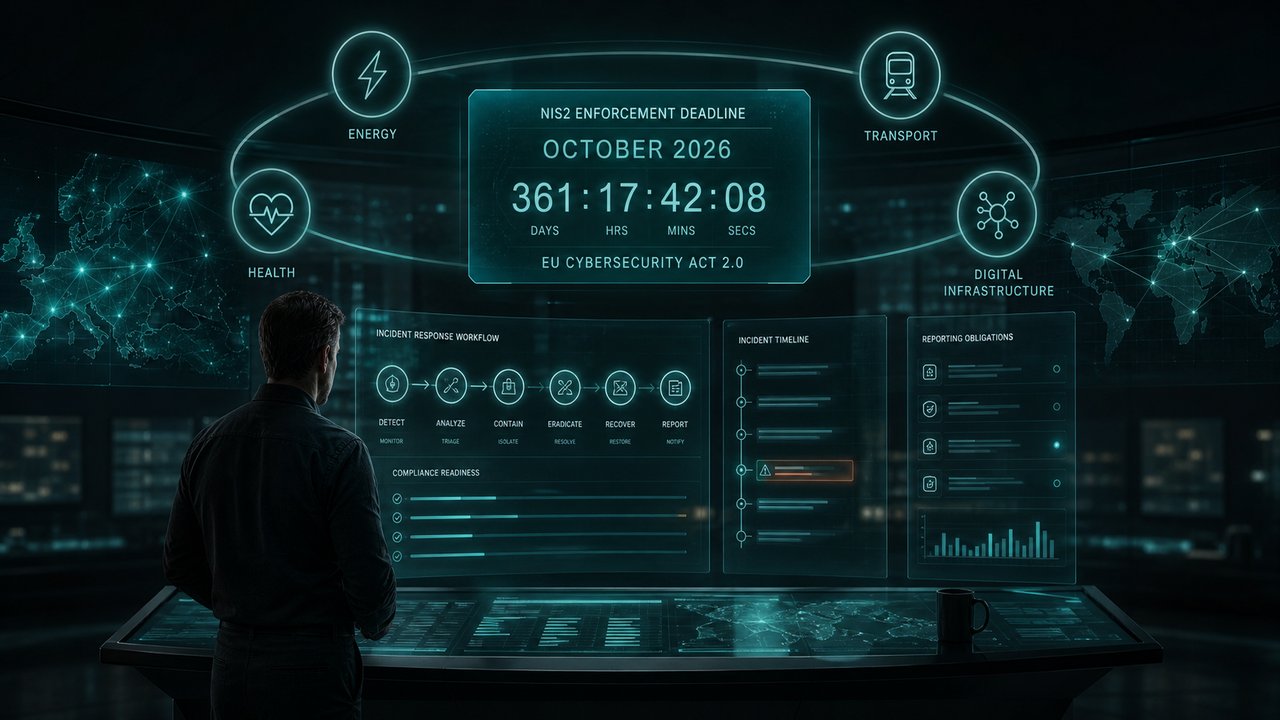
NIS2’s October 2026 deadline extends that enforcement posture to a far broader set of organizations than DORA’s financial sector scope. Energy, transport, health, digital infrastructure, public administration, manufacturing, and food sector organizations across EU member states face compliance obligations that, if missed, carry fines of up to €10 million or 2% of global annual turnover per violation, whichever is higher.
And overlaid on top of the October deadline: the EU’s January 2026 presentation of Cybersecurity Act 2.0 plans, adjusting NIS2 rules, updating certification frameworks, and changing ENISA’s incident reporting role, creating a second wave of regulatory change that organizations must track simultaneously.
For CISOs with any EU presence or EU customer exposure, this post provides a practical compliance status framework: what must be in place by October, what the first wave of enforcement actions revealed about regulator priorities, and how to use the Cybersecurity Act 2.0 proposals to plan 18 months ahead.
What Is NIS2 and Who Does It Apply To?
NIS2 (Network and Information Security Directive 2) is the EU’s foundational cybersecurity legislation, requiring covered organizations to implement risk management measures, incident reporting procedures, supply chain security controls, and governance frameworks for cybersecurity. It replaces the original NIS Directive with a significantly expanded scope.
NIS2 covers two categories of entities:
Essential entities: energy, transport, banking, financial market infrastructure, health, drinking water, wastewater, digital infrastructure (cloud, data centers, CDNs, DNS), ICT service management, public administration, and space.
Important entities: postal services, waste management, chemical manufacturing, food production, general manufacturing, digital providers (online marketplaces, search engines, social networks), and research organizations.
The critical implication: thousands of organizations that were not subject to EU cybersecurity regulation under NIS1 are now covered under NIS2. The October 2026 deadline is not a notification deadline. It is the point at which enforcement becomes active.
What the First Wave of Enforcement Actions Revealed
DORA enforcement began in January 2026, and the first supervisory cycle provided a preview of what NIS2 enforcement will prioritize. Regulators focused on four areas:
- Governance documentation: Can you demonstrate that your board has received and acknowledged cybersecurity risk reports? NIS2 specifically requires senior management accountability.
- Incident reporting completeness: Were incidents reported within the required 24-hour initial notification and 72-hour detailed report timeframes? Missing the window was the primary enforcement trigger in Q1 2026.
- Third-party risk management: Do you have documented supplier security assessments and contractual security requirements for critical third-party providers?
- Resilience testing: Can you demonstrate that recovery time objectives have been tested under simulated conditions, not just defined on paper?
The pattern is consistent with how GDPR enforcement matured: regulators start with procedural failures because they are the easiest to document and demonstrate.
NIS2 vs Cybersecurity Act 2.0: What Changes and When
| Requirement | NIS2 (October 2026) | Cybersecurity Act 2.0 (Proposed) |
| Scope | Essential and important entities in covered sectors | NIS2 adjustments, broader product scope |
| Incident reporting | 24h initial, 72h full, 1-month final report | ENISA role in reporting potentially expanded |
| Certification | Voluntary EU cybersecurity certification schemes | Updated certification framework |
| Fines | €10M or 2% global turnover | Under review |
| ENISA role | Coordination and guidance | Expanded reporting and oversight role |
Organizations should treat the Cybersecurity Act 2.0 proposals as a directional signal rather than a hard deadline, since EU legislative processes typically take 12 to 24 months from proposal to transposition. Planning for the direction, however, allows compliance programs to avoid rework.
The NIS2 Compliance Status Checklist
For CISOs assessing current posture against the October 2026 deadline:
Governance and accountability:
- Has your board formally approved a cybersecurity risk management policy?
- Are senior management responsibilities for cybersecurity defined and documented?
- Is there a documented cybersecurity training program for leadership?
Incident response and reporting:
- Do you have a documented incident response plan with defined roles?
- Is your incident detection capability sufficient to identify significant incidents within the 24-hour reporting window?
- Do you have an established contact point and documented process for reporting to the relevant national authority?
Supply chain security:
- Have you assessed the cybersecurity practices of critical suppliers?
- Do supplier contracts include minimum security requirements and audit rights?
Business continuity:
- Do you have tested backup and recovery procedures?
- Have you validated recovery time objectives under simulated failure conditions?
Technical controls:
- Do you have multi-factor authentication for all remote access?
- Is network segmentation implemented to limit lateral movement?
- Do you maintain an asset inventory with vulnerability management coverage?
How Peris.ai Accelerates NIS2 Compliance
How Peris.ai IRP Meets the Incident Reporting Timeline
NIS2’s 24-hour initial notification requirement is the most operationally demanding compliance obligation. Without automated incident detection and structured response workflows, meeting that window requires significant manual effort under time pressure, at exactly the moment when your team is dealing with an active incident.
Peris.ai IRP provides the automated incident detection, case population, and structured documentation that supports NIS2 reporting timelines. When XDR identifies a significant security event, IRP automatically creates a case with full forensic timeline, MITRE ATT&CK mapping, and severity classification. The documentation required for regulatory reporting is built during the response, not assembled afterward.
A leading finance company reduced analyst workload by 35% using Peris.ai IRP, with structured response workflows eliminating the manual correlation and documentation burden during incident handling.
BrahmaFusion: Automated Compliance Workflow Orchestration
BrahmaFusion enables automated orchestration of compliance-related workflows: regulatory notification routing, evidence collection for audits, board-level reporting generation, and supplier security assessment workflows. With over 100 integrations, BrahmaFusion connects the security operations layer to the compliance management layer, ensuring that evidence generated during incident response automatically populates the documentation required for NIS2 reporting.
Peris.ai Corporate Compliance Services
For organizations that need external support building NIS2-compliant security programs, Peris.ai provides corporate compliance advisory services. These engagements cover gap assessment against NIS2 requirements, documentation development for governance and incident response, and readiness testing to validate compliance posture before October 2026 enforcement.
Use Case: NIS2 Incident Reporting Under the 24-Hour Window
A manufacturing company in Germany, covered under NIS2 as an important entity, detects a network intrusion on a Tuesday morning.
- XDR identifies lateral movement at 09:14 and triggers a critical alert.
- IRP automatically creates a case with full telemetry, severity classification, and MITRE ATT&CK mapping by 09:17.
- BrahmaFusion triggers the NIS2 incident notification workflow: drafts the initial notification to the national competent authority, routes it for CISO review, and timestamps the regulatory clock.
- The CISO reviews and approves the notification by 10:45. It is submitted to the German Federal Office for Information Security (BSI) by 11:00, well within the 24-hour window.
- The 72-hour detailed report is automatically populated from IRP case data as the investigation progresses.
Compliance obligations met. Enforcement risk eliminated. Analyst attention focused on containment, not paperwork.
Benefits Table
| Benefit | Outcome |
| Automated incident detection and case creation | 24-hour reporting window achievable without manual effort |
| Structured IRP documentation | Regulatory report ready during response, not after |
| BrahmaFusion compliance workflow automation | Notification routing, evidence collection, board reporting automated |
| MITRE ATT&CK case mapping | Demonstrates technical competence to regulators |
| Corporate Compliance advisory services | Gap assessment and readiness validation before October deadline |
Conclusion
The organizations that receive NIS2 enforcement penalties in late 2026 and early 2027 will not be the ones that were attacked. They will be the ones that were attacked and could not demonstrate adequate controls, timely reporting, or documented governance. The October 2026 deadline is not a technical milestone. It is a legal liability trigger.
Peris.ai’s IRP, BrahmaFusion, and Corporate Compliance services give organizations the detection, documentation, and workflow automation to meet NIS2 obligations from day one of enforcement. Don’t wait for a breach to test your compliance posture. Visit Peris.ai to assess your readiness today.
FAQ
What is NIS2 and when does enforcement begin?
NIS2 is the EU’s updated cybersecurity directive covering essential and important entities across critical sectors. October 2026 marks the culmination of national transposition and the activation of enforcement, meaning penalties for non-compliance become enforceable from this point.
What are the NIS2 incident reporting timeframes?
Organizations must submit an initial notification within 24 hours of becoming aware of a significant incident, a full incident notification within 72 hours, and a final report within one month.
How much are NIS2 penalties?
For essential entities: up to €10 million or 2% of global annual turnover, whichever is higher. For important entities: up to €7 million or 1.4% of global annual turnover.
What is the EU Cybersecurity Act 2.0?
Presented by the EU in January 2026, Cybersecurity Act 2.0 proposes adjustments to NIS2 rules, updates to the European cybersecurity certification framework, and changes to ENISA’s role in incident reporting, representing the next wave of regulatory evolution beyond the October 2026 deadline.
What is the difference between NIS2 and DORA?
DORA (Digital Operational Resilience Act) applies specifically to financial entities and their ICT service providers, applying since January 2025. NIS2 covers a much broader set of sectors and entities and has a later enforcement timeline, but the two regulations overlap for financial sector organizations.
Leave a Reply