As 2024 has shown us, cybersecurity is constantly evolving, with AI-driven threats, sophisticated ransomware campaigns, and escalating supply-chain vulnerabilities marking a year of unprecedented challenges. As we enter 2025, understanding these dynamics is crucial for any organization aiming to safeguard its operations against these growing threats.
Review of 2024’s Key Cybersecurity Challenges
AI-Driven Threats:Impact: AI has escalated cyber threats by enabling more complex phishing campaigns and frauds, such as deepfakes, affecting 72% of Fortune 1000 companies—response: Adoption of AI-driven security measures, enhanced verification to combat deepfakes, and AI-centric employee training.
Supply-Chain and Open-Source Vulnerabilities:Impact: Notable breaches in major platforms disrupted operations globally, highlighting the risks in supply chains and open-source software. Response: Implement robust supply chain risk management (SCRM) strategies, conduct regular audits, and enforce the software bill of materials (SBOM) for better transparency.
Ransomware Evolution:Impact: A pivot to more targeted ransomware attacks, particularly against critical infrastructure, using double and triple extortion methods. Response: Enhanced endpoint protection, network segmentation, and adoption of Zero Trust frameworks to reduce ransomware impact.
Cloud Security Challenges:Impact: Significant breaches due to cloud misconfigurations and weak security controls. Response: Tightened cloud security measures, automated patching, and deployment of Cloud Security Posture Management (CSPM) tools.
Geopolitical Tensions:Impact: Increased state-sponsored cyber activities from countries like Russia and China, posing enhanced espionage and disruption risks. Response: Strengthening cyber threat intelligence (CTI) capabilities and enhancing collaboration with national cybersecurity agencies.
Strategic Cybersecurity Approaches for 2025
As the digital threat landscape expands, the following strategic approaches can fortify your organization’s cybersecurity posture:
Zero-Trust Security Enhancement: Deploy continuous authentication and micro-segmentation to minimize unauthorized access and lateral movement within networks.
Advanced AI-Driven Security Solutions: Leverage AI-enhanced SOC to accurately detect threats, reducing false positives and enabling predictive threat intelligence for preemptive defense.
Preparation for Quantum Computing Threats: Begin transitioning to quantum-resistant cryptographic standards to safeguard against future threats posed by quantum computing.
Robust Cloud Security Frameworks: Strengthen cloud environments with enhanced authentication protocols, secure API endpoints, and comprehensive CSPM tools.
Supply Chain Security Fortification: Enforce stringent cybersecurity standards among third-party vendors and continuously monitor for threats within the supply chain network.
Cultivating a Proactive Cybersecurity Culture: Regular training programs focused on emerging threats such as phishing and AI-manipulated attacks to build a security-first organizational mindset.
Looking Ahead: Building Resilience for 2025 and Beyond
The cybersecurity landscape of 2025 demands proactive and innovative defense strategies. By understanding the past year’s challenges and adopting advanced security measures, organizations can defend against and stay ahead of the evolving cyber threats.
For ongoing updates, expert insights, and cutting-edge cybersecurity solutions tailored to protect your business against the dynamic threats of the digital age, visit Peris.ai.
Your Peris.ai Cybersecurity Team #YouBuild #WeGuard
In an era where cyber threats are evolving rapidly, the significance of maintaining robust cybersecurity measures cannot be overstated. With the global cost of cybercrime projected to skyrocket to $23 trillion by 2027, according to the International Monetary Fund, businesses must prioritize advanced strategies like automated patch management to safeguard their digital landscapes.
The Necessity of Automated Patch Management
Challenges of Traditional Patch Management: Traditional methods, reliant on manual interventions, are becoming increasingly inadequate due to:
Manual Overhead: Labor-intensive and error-prone processes can delay critical updates.
Reactivity: Conventional patching often occurs post-exploitation, increasing risk exposure.
Bug Risks: Manual updates are susceptible to errors, potentially introducing new vulnerabilities instead of mitigating them.
Advantages of Automation in Patch Management: Automated patch management revolutionizes this essential task by:
Continuous Vulnerability Scanning: Automatically identifies and addresses security gaps, minimizing the exposure period.
Patch Prioritization: Intelligent systems assess and prioritize updates based on the severity and potential impact on the business.
Automated Testing and Rollbacks: Ensures new patches are tested and validated before full deployment, with quick rollback capabilities if issues arise.
Real-Time Alerts: Enhances system security with immediate notifications and status updates on patch processes.
Leveraging Machine Learning for Enhanced Patch Management
Optimization of Patch Processes: Ensures optimal patch timing and sequencing to reduce system downtime.
Adaptive Improvements: Continuously learns from previous patch management cycles, adapting strategies to counter new threats more effectively.
Implementing Automated Patch Management: A Step-by-Step Guide
Effective Implementation Strategies Include:
Assessment of Existing Protocols: Evaluate your current patch management practices to identify areas for automation integration.
Automated Scheduling: Establish automated routines for deploying patches during optimal times to minimize operational disruption.
Isolated Patch Testing: Utilize automation to conduct tests in controlled environments to confirm patch stability before widespread deployment.
Comprehensive Monitoring: Keep track of patching activities with detailed reporting for enhanced oversight and compliance.
Robust Rollback Mechanisms: Set up automatic rollbacks to swiftly revert problematic patches, ensuring system integrity and availability.
Future Outlook: Automation as the Standard in Patch Management
The shift towards automated patch management is a critical evolution in cybersecurity practices. By integrating advanced technologies like machine learning, businesses can achieve a proactive stance against cyber threats, enhancing their resilience against potential breaches and reducing both operational disruptions and financial liabilities.
For in-depth guidance on integrating automated patch management and other cutting-edge cybersecurity solutions, visit Peris.ai. Stay informed and fortified against the cyber challenges of tomorrow.
Your Peris.ai Cybersecurity Team #YouBuild #WeGuard
As artificial intelligence (AI) reshapes industry landscapes, it’s also being manipulated by cybercriminals to enhance their malicious activities. Hackers are increasingly turning to AI to generate sophisticated malware code, significantly lowering the barrier to entry for executing complex cyberattacks. Here’s an in-depth look at how AI is facilitating a new wave of cybersecurity threats.
AI in Malware Development: Understanding the Emerging Threat
AI-Generated Malware: Recent developments have seen an uptick in malware created with AI, which allows even novice hackers to execute advanced attacks. This technology enables the rapid creation of new malware variants, complicating the efforts of cybersecurity professionals to defend against them.
Widening the Hacker Pool: By automating parts of the malware creation process, AI tools are democratizing the abilities once reserved for highly skilled programmers. This results in an increased volume of malware attacks, as individuals with minimal coding expertise can now launch significant cyber threats.
Common Attack Vectors: Utilizing familiar programming languages like HTML, VBScript, and JavaScript, these AI-driven malware attacks are not only simple to deploy but also exceedingly difficult to detect and mitigate.
Deceptive Delivery Methods: Often disguised within seemingly innocuous downloadable files, such as ZIP archives, AI-generated malware can evade detection by unsuspecting users and some traditional antivirus programs.
Concerns for the Future of Cybersecurity
Proliferation of Malware: The ease of creating malware with AI tools may lead to a surge in cyberattacks, particularly those targeting everyday web users with less-targeted, more disruptive methods.
Enhanced Capabilities for Seasoned Hackers: For sophisticated cybercriminals, AI can streamline the development of malware campaigns, making these operations more efficient and increasing the frequency of attacks.
Evolving Risks: As AI-generated malware becomes more common, the potential for these programs to evade traditional security measures grows, necessitating newer, more advanced defensive strategies.
Strategies to Fortify Your Defenses Against AI-Driven Threats
Enhance Vigilance: Exercise caution when downloading files, especially from unfamiliar sources. Be particularly wary of ZIP files, which could be masking AI-generated malware.
Update and Strengthen Antivirus Solutions: Ensure your antivirus software is equipped to identify and combat the latest malware threats, including those spawned by AI technologies.
Conduct Regular System Scans: Frequent scans can help detect and isolate suspicious files or activities, potentially identifying threats before they cause damage.
Scrutinize Communications: Approach email attachments and links with skepticism, even if they appear to originate from trusted sources.
Stay Ahead of Trends: Keeping abreast of new developments in cybersecurity can help you anticipate and prepare for emerging threats powered by artificial intelligence.
Navigating the AI-Generated Malware Threat
The advent of AI-generated malware represents a significant shift in the cybersecurity landscape. As this technology continues to evolve, so too does the nature of the threats we face. It’s crucial for users and organizations alike to adopt comprehensive security measures, remain vigilant, and continuously update their defensive strategies to protect against these sophisticated cyber threats.
For further insights and continuous updates on navigating the complex world of cybersecurity, please visit our website at Peris.ai.
In the wake of the CrowdStrike crash, opportunistic scammers are taking advantage of the resulting confusion. These fraudsters are devising schemes to deceive users during this vulnerable time. Here’s a comprehensive guide to understanding their tactics and safeguarding yourself.
Key Insights
1. Exploiting Opportunities
Scenario: Scammers are capitalizing on the chaos following the CrowdStrike incident.
Impact: Users seeking to reschedule flights, access banking services, or resolve tech issues are prime targets.
Industries at Risk:
Travel: Airlines see an uptick in scams as customers attempt to rearrange travel plans.
Cybersecurity: Fraudulent actors pose as CrowdStrike support, offering harmful “fixes.”
General: The widespread impact of the crash means no sector is immune to potential scams.
2. Recognizing Scams
Red Flags: Requests for unusual personal information and communications riddled with poor grammar.
Verification: Double-check the origins of calls and messages, recognizing that scammers can convincingly mimic legitimate entities.
3. Resisting Quick-Fix Solutions
Caution: Avoid hastily providing personal details online or over the phone.
Validation: Dedicate time to confirm the authenticity of any service provider before proceeding.
️ Protective Measures to Counter Scams
URL Vigilance: Scrutinize links before clicking. Suspicious URLs often signal deceit.
Social Media Security: Look for verification badges to verify the authenticity of accounts, particularly those purporting to represent major companies.
Reporting: Promptly report any suspicious online behavior or content that appears fraudulent.
Information Security: Be skeptical of requests for sensitive information like social security numbers from supposed service providers.
Patience Pays Off: While responses from legitimate sources may be delayed, they are worth the wait compared to the risks of quick, unverified fixes.
️ Defending Your Data
Phishing and malware exploitation are rampant, particularly during times of widespread disruption, when attackers aim to exploit vulnerabilities and capitalize on the chaos. Events like the CrowdStrike crash necessitate heightened vigilance. It’s essential to verify sources meticulously and handle personal information with utmost caution.
Stay vigilant, stay secure. For more updates and comprehensive cybersecurity insights, visit Peris.ai Cybersecurity. Discover our extensive range of products and services designed to fortify your defenses against evolving cyber threats.
As cyber threats evolve, Magniber ransomware has resurfaced, targeting home users globally by encrypting devices and demanding ransoms. Here’s an in-depth look at Magniber, its methods, and effective precautions to safeguard against this persistent threat.
Understanding the Magniber Ransomware Campaign
Ransomware Overview:
Origins: Magniber was first identified in 2017, evolving from the notorious Cerber ransomware.
Distribution Tactics: It exploits Windows zero-day vulnerabilities, deceives users with fake software updates, and spreads through illicit software cracks and key generators.
Recent Surge in Attacks:
Increase in Activity: Since July 2024, there has been a noticeable spike in Magniber ransomware attacks.
Impact: Over 720 incidents have been reported, demonstrating its significant reach among individual users.
Encryption Tactics and Ransom Demands:
Encryption Technique: Magniber uses a potent encryption method, appending unique extensions like .oaxysw or .oymtk to encrypted files.
Ransom Instructions: Victims find a ransom note named READ_ME.htm on their device, which includes payment instructions accessible via a Tor website.
Ransom Costs: Demands typically start at $1,000, increasing to $5,000 if the ransom is not paid promptly within three days.
Decryption Challenges:
Past Solutions: In 2018, a decryptor was released by AhnLab, which has since become ineffective due to updates by the cybercriminals.
Current Status: As of now, no free decryption solutions are available for the latest strains of Magniber ransomware.
Protective Measures Against Magniber Ransomware
Avoid Unsafe Software Sources:
Risks of Illicit Downloads: Software cracks and key generators are high-risk sources for malware distribution. Refrain from downloading these to prevent ransomware infections.
Enhance Security Protocols:
Update Security Software: Regular updates to antivirus and anti-malware programs are essential to detect and thwart malicious attacks effectively.
Data Backup Strategies:
Routine Data Backups: Consistently back up your data to external drives or cloud storage. This redundancy can be crucial for restoring your information without succumbing to ransom demands.
Cybersecurity Awareness:
Stay Updated: Keep abreast of the latest cybersecurity threats and protective strategies to enhance your digital defenses.
️ Your Proactive Cybersecurity Stance
The revival of Magniber ransomware underscores the necessity of vigilant cybersecurity practices. By avoiding unauthorized downloads and maintaining up-to-date security measures, you can significantly mitigate the risk of falling victim to such attacks.
For individuals impacted by Magniber, a dedicated support topic is available, offering guidance and recovery suggestions.
Stay Informed, Stay Protected
For further updates on cybersecurity and detailed insights, visit our website at peris.ai.
In today’s digital world, cybersecurity threats are always changing. Organizations must be proactive to protect their valuable assets. The IBM Security Cost of a Data Breach Report 2024 shows the average cost of a data breach is USD 4.88 million.
Effective risk management is now a must, not just a luxury. A good risk management program helps spot, assess, and manage threats and vulnerabilities. It needs a modern asset inventory for a clear view of all IT assets. This helps in better identifying and controlling risks.
Key Takeaways
Proactive risk management is essential to stay ahead of evolving cyber threats
A comprehensive asset inventory is a critical component of a robust risk management program
Effective asset discovery helps organizations identify and prioritize vulnerabilities based on criticality
Maintaining an accurate asset inventory is crucial for regulatory compliance and efficient incident response
Importance of Effective Risk Management
In today’s digital world, companies face many cyber threats and rising data breach costs. Risk management is key to spotting, checking, and handling these threats. It’s vital to protect against the growing cost and damage of data breaches.
Rising Cyber Threats and Cost of Data Breaches
Cyber threats are getting smarter, and data breaches are causing more financial and reputational harm. Threats like malware, phishing, and ransomware can harm a company’s info, leading to big financial and reputation losses. Following cybersecurity standards and laws is important to avoid fines and show commitment to cyber security to stakeholders.
Robust Risk Management Program as a Necessity
A strong risk management program is crucial for companies to tackle threats and weaknesses. The cybersecurity risk management process includes finding assets, assessing risks, treating risks, and keeping an eye on things. With a solid risk management program, companies can shift from reacting to threats to being proactive, making them more resilient against cyber attacks.
Key Cybersecurity Frameworks Focus Areas NIST Cybersecurity Framework (NIST CSF) Identify, Protect, Detect, Respond, and Recover NIST 800-53 Controls 20 families of security and privacy controls NIST 800-171 Controls 11 families of security requirements for protecting sensitive federal information
By following cybersecurity frameworks and standards, companies show they’re serious about risk management and improve their security.
“Comprehensive asset management is essential for maintaining security, complying with regulations, and enhancing overall risk management in OT environments.”
Modern Asset Inventory: A Critical Component
A detailed asset inventory is key to a strong risk management plan. It gives a clear view of all IT assets, helping to spot and fix cyber threats. With new cyber threats emerging, having a current and accurate asset list is more important than ever.
An asset inventory should list all hardware and software, like servers and smartphones. Knowing what assets you have helps improve security and follow rules.
Old ways of finding assets don’t work well anymore, especially with cloud and remote work. New tools use AI to find and list all assets, giving a full view of risks.
Benefits of Effective Asset Discovery
Improved security controls coverage
Enhanced vulnerability management
Streamlined incident response investigations
Identification and isolation of rogue devices
Compliance with regulatory requirements
A good asset discovery tool should be easy to set up and update. It should also give detailed info and work with other systems.
“Many organizations think they have good asset management capabilities until after an incident reveals the contrary.”
Keeping an asset list up to date is vital for fighting cyber threats. Using modern tools and practices boosts a company’s security and resilience.
Asset Discovery: Identifying All Assets
Asset discovery is key to a good asset inventory solution. It finds and lists all IT assets in an organization, even hidden ones. This is vital in today’s fast-changing IT world, where things change a lot, with 5-15% changes every month.
Limitations of Consolidating Existing Asset Data
Just gathering data from asset systems doesn’t cover it all. It only shows what’s already known, missing hidden devices and shadow IT. This incomplete view can hurt a company’s risk management.
Automated Asset Discovery Tools
Now, companies use automated tools for better asset tracking. These tools scan and monitor to find all digital assets, even hidden ones. They keep the inventory updated, catching even the most hidden assets.
Good asset discovery is essential for strong risk management. It helps understand risks, focus on the most important assets, and improve security.
Comprehensive Risk Identification
Effective risk management starts with identifying all potential threats and vulnerabilities. This helps protect an organization’s assets. The first step is to find and document all digital assets, like devices, software, and data.
Keeping the asset list up to date is key for strong security.
Understanding Potential Threats and Vulnerabilities
Assessing vulnerabilities is vital to find weaknesses in an organization’s setup. This helps decide which threats to tackle first. Regular checks keep the security level high.
Knowing the threats helps organizations protect their digital assets.
Locating Unauthorized and Shadow IT Assets
Finding all assets, including hidden ones, is crucial. This ensures a complete list of IT assets. Knowing what’s important helps focus security efforts.
Knowing the details helps target security checks on the most at-risk assets.
Addressing hidden assets reduces shadow IT risks. Tools for finding assets keep the list current. Working together ensures everyone knows what to do.
“Comprehensive risk identification is the foundation of a robust risk management program. By understanding potential threats and vulnerabilities, organizations can proactively protect their digital assets.”
Identifying risks well is key to fighting cyber threats. It’s the first step in keeping digital assets safe. Regular updates to the asset list keep security strong.
Accurate Risk Assessment with Business Impact
Effective risk management starts with knowing what assets an organization has and how they support its functions. By listing all assets, like hardware, software, data, and people, companies can better understand the risks. This helps them see how cyber threats could affect their work.
Aligning Assets with Business Functions
A good asset inventory shows what technology a company uses and how it helps with business tasks. It helps leaders see how assets support different parts of the business. This makes it easier to figure out the impact of losing an asset, leading to better risk management.
Enhancing Third-Party Risk Management
Today, companies often work with many outside vendors. Knowing the risks of these partnerships is key to managing risks well. By keeping a detailed list of assets and their roles, companies can spot and manage risks from these partners better.
By linking assets to business functions and knowing the risks, companies can make better plans to protect themselves.
“Conducting a thorough cyber risk assessment is complex but vital for understanding and strengthening an organization’s cybersecurity posture.”
Prioritizing Risks Based on Criticality and Resilience
Managing risks well means focusing on the most important things first. This is based on how well an asset can handle threats and its role in the business. Knowing what makes an asset strong and what’s most important for the business helps teams decide where to put their efforts.
Factors Determining Asset Resilience
An asset’s resilience shows how well it can face and bounce back from threats. Its accessibility, hardness, and redundancy are key. How easy it is for threats to get to it, its built-in security, and if there are backups all play a part.
Identifying Critical Business Functions
Knowing what’s most important for the business is also key in managing risks. By linking assets to the business’s core, teams can see the big picture. This helps them decide where to focus to keep the business safe.
Assets that are very important but not very resilient should get the most attention. This way, the biggest threats are tackled first. By focusing on both resilience and importance, businesses can use their resources wisely and stay safe online.
Keeping an eye on how assets do and what’s most critical is essential for good risk management. As technology and threats change, businesses must stay alert and adjust their plans to stay ahead.
Effective Risk Mitigation Strategies
Today’s digital world needs proactive risk management. As technology grows, so does the attack surface. To protect, a mix of technical and non-technical controls is key.
Technical Mitigation Measures
Technical controls defend against cyber threats. External Attack Surface Management (EASM) helps by finding and managing online assets. It offers insights and keeps security up to date.
EASM gives a full view of the attack surface. It helps focus security efforts and finds vulnerabilities early. Key strategies include threat intelligence, testing, and constant monitoring.
Non-Technical Mitigation Measures
Non-technical controls are also vital. They help lower the chance of cyberattacks. Good controls protect data and help recover quickly from attacks.
They build trust and meet legal standards. Non-technical measures include training, planning, and a security-aware culture. They help spot and deal with threats efficiently.
Automating tasks like scanning saves IT time. A good Vulnerability Management program keeps improving security.
Combining technical and non-technical controls boosts cybersecurity. This way, organizations stay ahead of threats.
Continuous Monitoring and Updating
As IT environments change, keeping an up-to-date asset inventory is key. This ensures risk management stays current. Automated systems add new devices and remove old ones, keeping the inventory accurate. This helps the risk management program stay current, reducing the risk of using outdated information.
Maintaining an Accurate Asset Inventory
Keeping up with IT environment changes is crucial. Automated tools help spot new assets and track changes. They give a full view of the digital world, including web apps, cloud services, IoT devices, and network devices. This helps security and IT leaders fight cyber-attacks and manage risks.
Adapting to Changes in the IT Landscape
As the digital world grows, continuous monitoring and asset inventory updates are more important. Automated tools find changes online, helping spot vulnerabilities and apply security controls. Being quick to adapt is key for a strong cyber defense.
“Organizations that adopt the Continuous Threat Exposure Management (CTEM) model will be far less likely to be breached.” – Gartner
The CTEM model helps understand and manage attack surfaces. It includes planning, monitoring, validation, remediation, and response. Asset discovery tools are vital for this, helping organizations stay ahead in the digital world.
Conclusion
In today’s rapidly evolving digital landscape, effective risk management is no longer optional—it’s essential. A robust risk management strategy identifies, evaluates, and mitigates threats while maintaining a dynamic inventory of IT assets. This comprehensive approach empowers organizations to gain full visibility into their infrastructure, enhancing their ability to detect and address vulnerabilities.
The key to strong cybersecurity lies in early action and informed decision-making. By leveraging advanced technologies and maintaining an up-to-date asset inventory, businesses can proactively defend against cyber threats, safeguard critical assets, and build resilience in an increasingly interconnected world.
Take charge of your organization’s cybersecurity today. Visit Peris.ai to discover how our innovative solutions can empower your business to stay ahead of cyber risks and thrive in the digital age.
FAQ
What is the average cost of a data breach?
The IBM Security Cost of a Data Breach Report 2024 shows the average cost is USD 4.88 million.
Why is effective risk management essential for organizations?
Risk management is now a must, not a luxury. Cyber threats are getting smarter, and data breaches are costing more. A good risk management program helps spot and manage threats, keeping operations safe.
What is the role of a modern asset inventory in risk management?
A modern asset inventory gives a clear view of all IT assets. It’s key for identifying and managing risks. It helps organizations understand their security risks and make better decisions.
How does asset discovery differ from consolidating existing asset data?
Consolidating data from old systems doesn’t count as asset discovery. It only shows what’s already known. Automated tools find and document unknown assets, like unauthorized devices.
How does asset discovery support risk identification?
Asset discovery is vital for finding risks. You can’t protect what you don’t know exists. Good asset discovery tools find all assets, including hidden ones, for a solid risk management base.
What is the role of asset inventories in the risk assessment process?
Asset inventories are crucial for risk assessment. They show which assets support business functions and how they connect. This helps evaluate the impact of threats and manage third-party risks.
How do organizations prioritize risks based on asset criticality and resilience?
Risk management focuses on assets’ resilience and criticality. Resilience looks at accessibility and redundancy. Criticality rates an asset’s importance. High criticality and low resilience assets get top risk mitigation focus.
In an increasingly digital world, cybersecurity has become a top priority for organizations. As businesses rely more on technology to store and manage sensitive data, the risk of cyber threats and attacks continues to rise. This has led organizations to grapple with the dilemma of choosing between price and quality when it comes to implementing effective cybersecurity measures.
On one hand, organizations may be tempted to opt for cheaper solutions to minimize costs. However, compromising on quality can leave them vulnerable to cyberattacks and potential data breaches. On the other hand, investing in high-quality cybersecurity solutions may come at a higher price, but it offers the potential for better protection and risk mitigation.
When making decisions about cybersecurity, organizations must carefully evaluate the balance between cost and quality. They need to consider the potential financial and reputational impacts of not investing enough in security measures and the value they can gain by prioritizing cybersecurity. It requires a strategic approach that considers the organization’s specific needs and risk profile.
This article will explore the factors that organizations should consider when making the price vs. quality decision in cybersecurity. It will provide insights into the impact of cybersecurity threats on businesses and the value that organizations can gain from investing in robust security measures. By the end, you’ll have a better understanding of how to strike the right balance between price and quality to ensure effective organizational security.
Key Takeaways:
Cybersecurity is a top priority for organizations in an increasingly digital world.
The debate between price and quality in cybersecurity is an ongoing challenge for businesses.
Organizations must consider the potential financial and reputational impacts of not investing enough in security measures.
Investing in high-quality cybersecurity solutions offers better protection and risk mitigation.
A strategic approach is necessary to strike the right balance between price and quality in cybersecurity decision-making.
The Rising Cost of Cybersecurity Threats to Organizations
In today’s digital landscape, organizations are facing increasing cybersecurity threats that can have significant financial impacts. Cybercrime trends are evolving, with cybercriminals becoming more sophisticated in their attacks. This section will examine these rising cybersecurity threats and the financial consequences they impose on businesses.
Trends in Cybercrime and Financial Impacts on Businesses
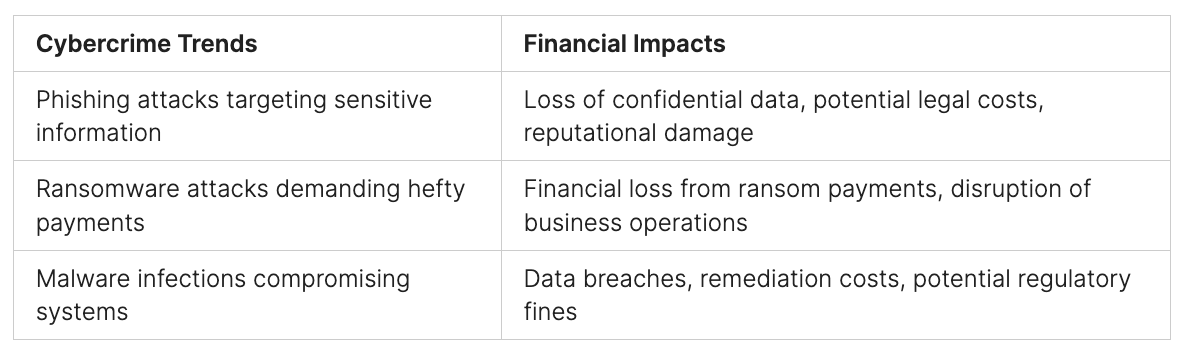
Cybercrime continues to evolve, presenting new challenges for organizations. Organizations are at risk of significant financial losses from data breaches to ransomware attacks due to cybercriminal activities.
These cybercrime trends pose significant financial risks to organizations of all sizes and industries. The costs associated with cybersecurity incidents go beyond immediate financial losses and can include reputational damage, legal expenses, regulatory penalties, and decreased customer trust.
As cyber threats become more advanced and frequent, organizations must allocate resources to combat these risks effectively. Investing in comprehensive cybersecurity measures and adopting proactive threat prevention strategies is crucial to mitigate the financial impacts of cybercrime.
Understanding the Value in Cybersecurity Investment
Investing in cybersecurity is crucial for organizations to protect their sensitive data and prevent cyberattacks. In today’s digital landscape, where threats are constantly evolving, organizations need to prioritize cybersecurity to safeguard their assets and maintain the trust of their stakeholders. Organizations can unlock several key benefits that contribute to their overall success and resilience by making strategic investments in cybersecurity.
One of the primary advantages of cybersecurity investment is the potential for a high return on investment (ROI). While it may seem costly to implement robust security measures, the long-term financial benefits outweigh the initial expenses. Effective cybersecurity measures can help organizations avoid costly data breaches, regulatory fines, legal fees, and reputational damage. By proactively protecting their data and systems, organizations can save significant resources in the event of a cybersecurity incident.
Furthermore, cybersecurity investment goes beyond financial gains. It also provides organizations with peace of mind, knowing that they have taken steps to safeguard their sensitive information and critical infrastructure. By mitigating the risks associated with cyber threats, organizations can focus on their core operations without constant anxiety about potential breaches or disruptions. This increased peace of mind enhances productivity and allows organizations to pursue growth opportunities without being weighed down by cybersecurity concerns.
Another benefit of cybersecurity investment is its ability to enhance the organization’s overall resilience and reputation. By safeguarding customer data and ensuring the privacy of sensitive information, organizations build trust and confidence among their customers and stakeholders. A strong cybersecurity posture can differentiate organizations from competitors, attract new customers, and retain existing ones, ultimately leading to increased customer loyalty and business growth.
“Investing in cybersecurity is not just about protecting against external threats; it’s about safeguarding the continuity and sustainability of the organization. The value lies in the peace of mind, financial savings, and trust gained through a proactive approach.”
In conclusion, the value of cybersecurity investment cannot be overstated. Organizations that prioritize cybersecurity reap the benefits of a strong ROI, enhanced peace of mind, and improved reputation. By recognizing cybersecurity’s value to their overall operations, organizations can make informed investment decisions that align with their business goals and objectives.
Cybersecurity Investment: Unlocking Value and Peace of Mind
Start Cybersecurity: Price vs. Quality, Which Wins for Organization?
In the ongoing debate of price vs. quality in cybersecurity, organizations are faced with the challenge of finding the right balance. While cost-cutting measures may seem appealing in the short term, compromising on the quality of cybersecurity can have severe consequences for organizational security. This section explores the business case for prioritizing quality in cybersecurity and highlights the potential risks of cutting costs in this critical area.
The Business Case for Prioritizing Quality in Cybersecurity
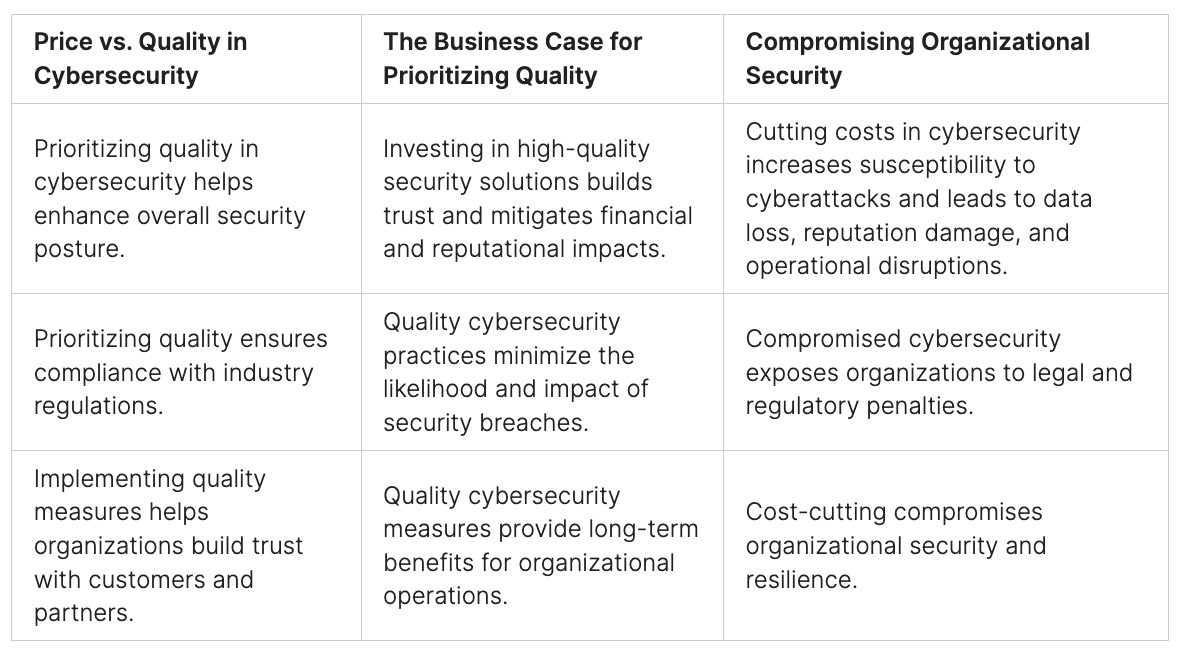
Investing in quality cybersecurity measures is essential for organizations to protect their sensitive data, systems, and reputation. High-quality security solutions and practices can help prevent cyberattacks, detect potential threats, and respond effectively to incidents. By prioritizing quality, organizations can:
Enhance their overall security posture
Ensure compliance with industry regulations
Build trust with customers and partners
Mitigate the financial and reputational impacts of security breaches
Ultimately, prioritizing quality in cybersecurity is a proactive approach that helps organizations minimize the likelihood and impact of cyberattacks, providing long-term benefits for their operations and stakeholders.
How Cutting Costs Can Compromise Organizational Security
In an effort to reduce expenses, some organizations may be tempted to cut costs in their cybersecurity budgets. However, cost-cutting measures in cybersecurity can have detrimental effects, leaving organizations vulnerable to cyber threats. Here are some of the risks associated with compromising on cybersecurity quality:
Increased susceptibility to cyberattacks
Loss or theft of sensitive data
Reputation damage and loss of customer trust
Legal and regulatory non-compliance penalties
Operational disruptions and financial losses
It is crucial for organizations to understand that the cost of recovering from a cybersecurity breach can far exceed the initial cost of implementing robust security measures. Therefore, cutting costs in cybersecurity is a short-sighted approach that can have severe consequences for organizational security and overall business resilience.
Quality in Cybersecurity: Certified Expertise vs. Cost Savings
When it comes to ensuring the quality of cybersecurity measures, organizations often need help with hiring certified cybersecurity experts or opting for cost-saving measures. While cost considerations are important for any organization, compromising on the quality of cybersecurity can have severe consequences that far outweigh the initial savings.
Certified cybersecurity experts bring a wealth of knowledge, skills, and experience to the table. Their expertise enables them to assess your organization’s unique security needs, identify vulnerabilities, and implement effective measures to mitigate risks. Organizations can benefit from their up-to-date knowledge of the evolving threat landscape and industry best practices by working with certified experts.
On the other hand, relying solely on cost-saving measures in cybersecurity can lead to significant gaps in your organization’s security defenses. These measures often involve using generic or outdated security solutions, relying on inexperienced staff, or neglecting critical aspects of cybersecurity. Such compromises can leave your organization vulnerable to cyberattacks, data breaches, and financial losses.
Striking a balance between quality and cost is crucial in cybersecurity investments. While it may be tempting to opt for cheaper options, organizations must consider the long-term impact of their choices. Investing in certified expertise ensures that your cybersecurity measures are tailored to your organization’s specific needs and aligned with industry standards.
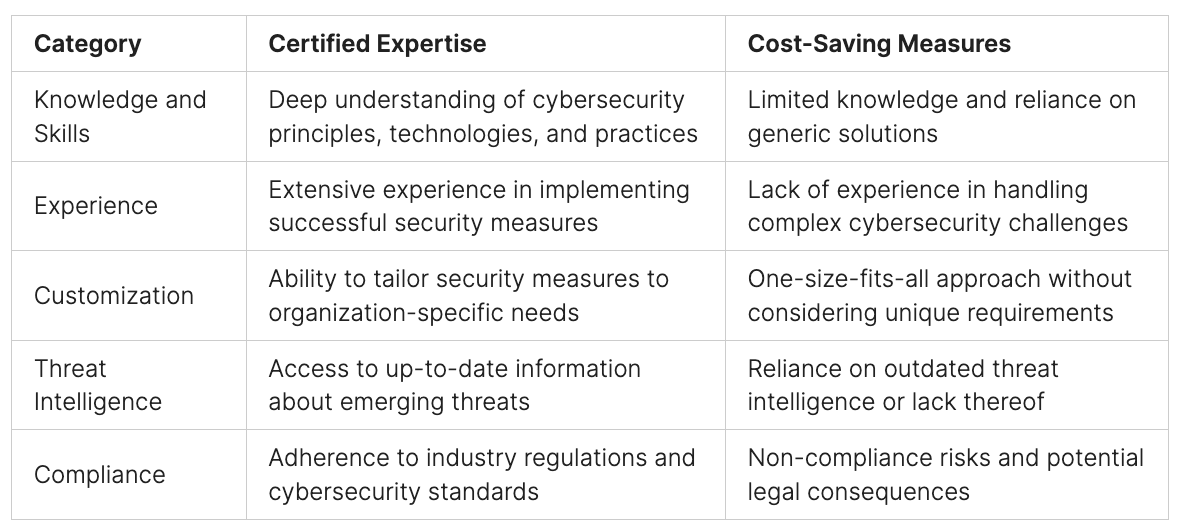
To visualize the importance of quality in cybersecurity, refer to the image below:
A Comparison of Certified Expertise and Cost-Saving Measures in Cybersecurity
This table clearly illustrates the advantages of investing in certified expertise over cost-saving measures. Certified cybersecurity experts provide the knowledge, skills, experience, and customization necessary to protect your organization effectively from evolving threats.
Organizations should carefully evaluate their cybersecurity investment strategies and prioritize quality to safeguard their systems, data, and reputation effectively. By leveraging certified expertise, organizations can optimize their cybersecurity efforts and minimize the risks associated with cyber threats.
Evaluating Cybersecurity Strategies: Balancing Cost and Effectiveness
In order to ensure optimal cybersecurity for organizations, it is essential to evaluate cybersecurity strategies on an ongoing basis. Evaluating cybersecurity strategies involves carefully balancing cost and effectiveness as organizations strive to protect their sensitive data and mitigate cyber threats within budgetary constraints.
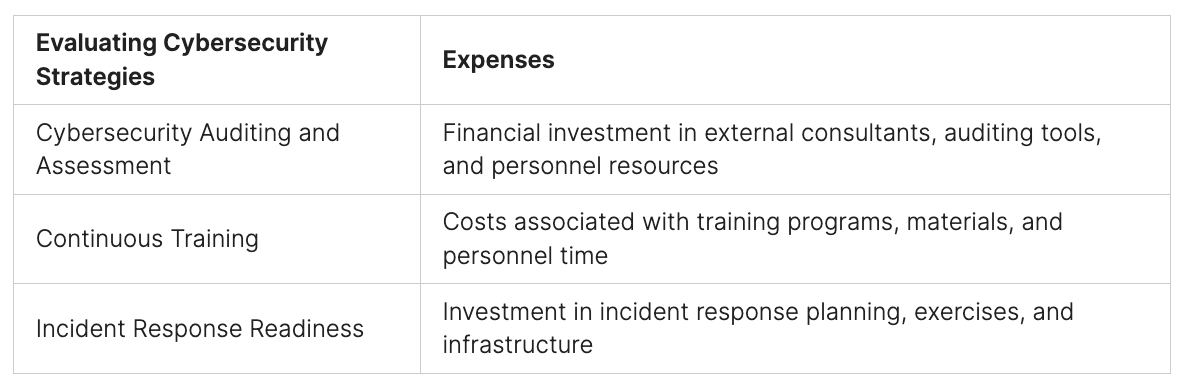
Cybersecurity Auditing and Assessment Expenses
Cybersecurity auditing and assessments play a critical role in evaluating the effectiveness of existing security measures and identifying potential vulnerabilities. However, conducting comprehensive cybersecurity audits can come with significant expenses. These expenses include hiring external consultants, investing in advanced auditing tools, and allocating personnel resources for the assessment process.
Despite the associated costs, cybersecurity auditing is an essential investment for organizations. By conducting regular audits, businesses can gain valuable insights into their security posture and identify areas that require improvement. This proactive approach allows organizations to address vulnerabilities and strengthen their cybersecurity defenses, ultimately reducing the risk of data breaches and other cyber incidents.
The Role of Continuous Training and Incident Response Readiness
Continuous training in cybersecurity is another crucial aspect of evaluating cybersecurity strategies. Regular training programs ensure that employees have the knowledge and skills to detect and respond to emerging cyber threats. By investing in continuous training, organizations can create a culture of cybersecurity awareness and empower their workforce to actively participate in maintaining a secure environment.
Additionally, incident response readiness is an integral part of effective cybersecurity strategies. Incident response encompasses the processes, technologies, and personnel necessary to promptly respond to and recover from cyber incidents. This readiness includes developing incident response plans, conducting tabletop exercises, and implementing incident response tools and infrastructure.
Organizations that prioritize continuous training and incident response readiness are better prepared to handle cyber threats swiftly and effectively. By investing in these readiness measures, businesses can mitigate the impact of incidents and potentially prevent them from escalating into major breaches.
Cybersecurity Readiness: Training and Incident Response Preparation
Expenses involved in
Measurable Outcomes: Assessing the ROI of Cybersecurity Measures
Measuring the return on investment (ROI) of cybersecurity measures plays a crucial role in helping organizations assess the effectiveness and value of their security investments. By evaluating the impact of these investments, organizations can make informed decisions to optimize their cybersecurity strategies. This section will discuss the methods and metrics that organizations can employ to assess the ROI of their cybersecurity measures.
Determining the Impact of Security Investments on Data Breach Costs
Data breaches can have severe financial repercussions for organizations. Understanding the impact of security investments on data breach costs is essential for organizations looking to evaluate their cybersecurity strategies comprehensively. By analyzing the correlation between the implementation of cybersecurity measures and the costs associated with data breaches, organizations can gain insights into the effectiveness of their security investments. This insight can help organizations identify areas where additional investments may be required or areas where cost-saving measures can be implemented without compromising security.
Cost-Benefit Analysis in Cybersecurity Decision-Making
Conducting a cost-benefit analysis is a critical component of effective cybersecurity decision-making. Organizations need to consider both the costs associated with implementing cybersecurity measures and the potential benefits they can provide. By evaluating the costs against the anticipated benefits, organizations can make informed decisions about the value of their cybersecurity investments. This analysis ensures that organizations allocate their resources efficiently and prioritize the implementation of cybersecurity measures that offer the best cost-benefit ratio.
Best Practices in Sourcing Quality Cybersecurity Solutions
Organizations must find the right cybersecurity solutions to enhance their security posture. When it comes to sourcing quality cybersecurity solutions, there are several best practices and guidelines that organizations should follow. By following these practices, organizations can ensure the selection of reliable and effective security solutions that meet their unique needs.
Evaluate Vendor Reputation: One of the first steps in sourcing quality cybersecurity solutions is to evaluate the reputation of potential vendors. Organizations should consider factors such as industry experience, customer reviews and testimonials, and certifications or accreditations showcasing a vendor’s cybersecurity expertise.
Conduct Due Diligence: Before you make a purchasing decision, it is important to conduct due diligence on potential cybersecurity vendors. This includes researching their track record, assessing their financial stability, and evaluating their data protection and privacy approach. It is also crucial to review any legal agreements or contracts thoroughly to understand the terms and conditions of the solutions.
Assess Solution Effectiveness: Organizations should thoroughly assess the effectiveness of cybersecurity solutions before making a final decision. This involves analyzing the features and functionalities of the solutions, understanding how they align with the organization’s specific security needs, and evaluating their ability to mitigate potential threats and vulnerabilities.
Consider Scalability: As organizations grow and evolve, their cybersecurity needs may change. It is important to consider the scalability of the cybersecurity solutions being sourced. Organizations should ensure that the solutions can accommodate future growth and can be easily integrated with existing security infrastructure.
Engage in Testing and Trials: To gain hands-on experience with potential cybersecurity solutions, organizations should engage in testing or trial periods whenever possible. This allows organizations to assess the solutions’ performance, usability, and compatibility in a real-world environment before committing to a long-term investment.
Implement Effective Procurement Processes: Establishing effective procurement processes is crucial for the successful sourcing of cybersecurity solutions. This involves defining clear requirements, establishing the evaluation criteria, conducting vendor screenings, and documenting the decision-making process. Organizations can ensure a transparent and well-informed procurement process by following a structured approach.
Sourcing Cybersecurity Excellence: Prioritizing Quality for Enhanced Protection
By following these best practices, organizations can source quality cybersecurity solutions that align with their security objectives and enhance their overall security posture. It is important for organizations to prioritize quality in cybersecurity procurement to safeguard their sensitive information and mitigate cyber threats effectively.
Cybersecurity for Smaller Organizations: Navigating Price and Quality Challenges
Small and medium-sized businesses (SMBs) face unique challenges when it comes to cybersecurity. Limited resources and budgets often make implementing comprehensive security measures difficult for these organizations. However, cybersecurity is a critical aspect of protecting sensitive data and ensuring the longevity of SMBs in an increasingly digital world.
SMBs must navigate the delicate balance between price and quality when it comes to cybersecurity. While cost-effective solutions may seem appealing, compromising the quality of security measures can leave organizations vulnerable to cyber threats. On the other hand, investing in high-quality security solutions may require a larger budget.
Accessible High-Quality Security Solutions for SMBs
Despite the challenges, there are accessible, high-quality security solutions available for SMBs. Many cybersecurity vendors offer tailored packages specifically designed for smaller organizations. These solutions provide robust protection without breaking the bank.
When choosing a security solution for an SMB, it’s important to look for providers that specialize in catering to smaller organizations. These vendors understand the unique needs and constraints of SMBs and can offer cost-effective but reliable security solutions.
Furthermore, cloud-based security solutions have gained popularity among SMBs. These solutions provide affordable access to advanced security features such as data encryption, threat detection, and real-time monitoring. Cloud-based solutions also minimize the need for dedicated hardware and technical expertise, making them more accessible for SMBs.
Case Studies: Successful Cybersecurity Models in the SMB Sector
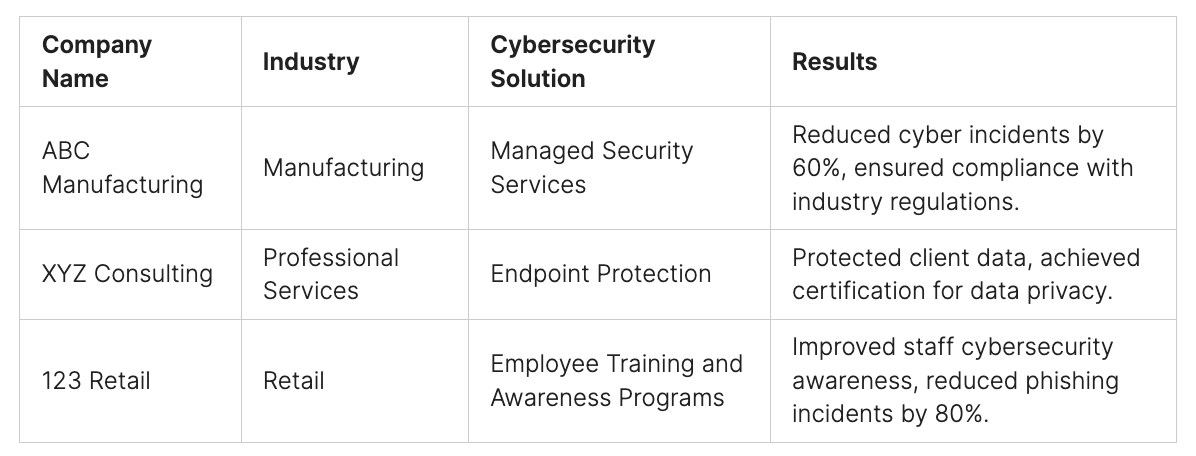
To inspire and guide SMBs in their cybersecurity efforts, here are a few case studies of successful cybersecurity models implemented in the SMB sector:
These case studies demonstrate that SMBs can achieve effective cybersecurity with the right strategies and solutions. By learning from successful models, SMBs can better navigate the price and quality challenges they face, ensuring the security of their organizations and the trust of their customers.
Conclusion
In today’s dynamic cybersecurity landscape, the balance between affordability and excellence is paramount for businesses. This article has delved into crucial considerations for organizations as they navigate their cybersecurity choices.
The escalating expense of cyber threats underscores the urgency for businesses to focus on superior security measures. With cybercriminals becoming more advanced and the financial repercussions for companies increasing, it’s more important than ever to invest in strong cybersecurity defenses to safeguard vital data.
While budgetary constraints are significant, skimping on cybersecurity can lead to dire outcomes, reinforcing the argument for prioritizing high-quality security solutions. The rationale for valuing quality in cybersecurity is compelling, highlighting the necessity for organizations to enhance their security investments.
To wrap up, striking the right balance between cost-effectiveness and quality is essential in cybersecurity. Organizations should make enlightened decisions, considering the risks, advantages, and potential returns on investment. Adopting a well-rounded strategy, assessing cybersecurity plans, and choosing top-notch solutions enable organizations to maintain robust security without straining their finances.
For a tailored solution that aligns with these principles, visit Peris.ai Cybersecurity. Discover how our approach can help your organization navigate cybersecurity challenges effectively and efficiently.
FAQ
What is the debate about price vs. quality in cybersecurity?
The debate revolves around whether organizations should prioritize price or quality when implementing cybersecurity measures.
What are the financial impacts of cybersecurity threats on businesses?
Cybersecurity threats can result in significant financial costs for businesses, including data breach expenses, financial fraud losses, and operational disruptions.
What is the value of investing in cybersecurity?
Strategic investments in cybersecurity can provide organizations with enhanced data protection, risk mitigation, regulatory compliance, and brand reputation preservation.
Why is prioritizing quality in cybersecurity important?
Prioritizing quality in cybersecurity ensures robust protection against evolving threats, reduces the risk of breaches, and safeguards organizational assets and reputation.
What are the risks of cutting costs in cybersecurity?
Cutting costs in cybersecurity can result in compromised security measures, increased vulnerability to cyberattacks, and potential data breaches with severe financial and reputational consequences.
What components should be part of a holistic cybersecurity strategy?
A holistic cybersecurity strategy should include risk assessments, threat prevention measures, incident response planning, and ongoing employee training.
Why is certified expertise important in cybersecurity?
Certified cybersecurity experts possess the necessary knowledge and skills to implement effective security measures, detect vulnerabilities, and respond to cyber threats in a timely manner.
What role do cybersecurity audits and assessments play in maintaining security?
Cybersecurity audits and assessments help identify vulnerabilities, improve security measures, and ensure organizations are continuously prepared to defend against cyber threats.
How can organizations measure the return on investment (ROI) of cybersecurity measures?
Organizations can assess the ROI of cybersecurity measures through metrics such as reduced data breach costs, minimized operational disruptions, and enhanced customer trust.
What are the best practices for sourcing quality cybersecurity solutions?
Best practices include conducting due diligence in evaluating vendors, considering the specific cybersecurity needs of the organization, and implementing reliable procurement processes.
What cybersecurity challenges do small and medium-sized businesses (SMBs) face?
SMBs often struggle with limited resources and budgets, making it challenging to prioritize cybersecurity. They require accessible, high-quality security solutions tailored to their unique needs.
Are there successful cybersecurity models implemented in the SMB sector?
Yes, there are case studies showcasing successful cybersecurity models in the SMB sector that provide effective and affordable security solutions for small organizations.
Cyber threats are common in today’s digital age. Employees can act as barriers to protect organizations. This strategy is called making a “human firewall.” How do companies help their staff defend against phishing attacks? The key is to use phishing simulation training.
Phishing simulations work like a soccer coach checking their team’s defense against penalty kicks. It’s about testing and improving practical skills and spotting where they need to improve. These simulations send fake phishing emails to employees who look real. This way, organizations can see how prone their staff is to these scams and offer the right training to boost their knowledge and reactions. The aim isn’t to shame those who get tricked. It’s about finding areas to strengthen and ensuring employees are ready for a real attack.
So, what’s the magic behind phishing simulation training’s success, and how can companies make the most of it? We’re about to unpack these questions.
Key Takeaways
Phishing simulation training equips employees as the “human firewall” against cyber threats.
Simulations operate on the same principle as a soccer coach testing defensive skills against penalty kicks.
The goal is to identify vulnerabilities and prepare the workforce for real-world phishing attacks.
Phishing simulations provide a hands-on, practical approach to evaluating and improving employee readiness.
Effective implementation involves following best practices and integrating with broader security awareness programs.
Understanding Phishing Simulations
Phishing simulations are like a soccer coach’s penalty kick test. The coach talks about strategy, but the best way to see if the team is ready is to do a penalty kick. This method helps the coach check the team’s readiness and spot improvement areas.
The Soccer Analogy: Practicing Defense Against Penalty Kicks
Phishing simulations are similar. They test and improve how well employees can spot and handle email-based threats. Security teams send fake phishing emails that look real, like asking for sensitive information or telling you to open a malicious attachment. The goal isn’t to blame those tricked but to find weak points in the company’s defense. This ensures that the team is better prepared for a real attack.
Simulating Phishing Attacks in a Controlled Environment
Organizations use phishing simulations to determine how likely their staff will be tricked and to train them to avoid it. The method is similar to a soccer coach’s test. It determines whether employees are prepared to face scams and find ways to improve.
Objectives of Phishing Simulations
Phishing simulation focuses on creating a strong employee barrier against malicious links and emails. Its goal is to make them good at spotting and reporting phishing, which lowers the chance of a successful phishing incident response. By doing these exercises often and through security awareness programs, companies can build a culture where everyone is alert to cybersecurity awareness, boosting email security.
How Phishing Simulations Work
Phishing simulations help check how well an organization deals with email threats. They also improve the company’s phishing simulation, awareness of cybersecurity, and training to fight against phishing. This process has a few important steps:
Planning and Targeting
First, the security team sets goals and the scope of the simulation. They decide how many employees to include, how tricky the phishing emails are, and what types of simulated attacks to use. They pick participants using set criteria or by random selection.
Response Monitoring and Data Collection
Next, the team watches how employees react to the fake phishing emails. They note who clicks links, opens attachments, or shares sensitive info. This info helps understand how likely employees are to fall for malicious links or suspicious emails.
Education and Feedback
Afterward, employees who interacted with the fake emails received help. They were not punished. Instead, they were sent to educational resources and given tips on spotting phishing emails. This built a culture of everyone looking out for security.
Analysis, Reporting, and Improvement
The security team analyzes the data to identify weak spots and those who need more training. Then, they create a detailed report for leaders and repeat the process to assess their progress in dealing with phishing threats.
This method helps organizations evaluate and boost their workers’ skills against email threats. It strengthens their security programs and improves their handling of phishing attacks.
Determining the Right Frequency
Choosing how often to do phishing simulations is key and varies by company. Many companies do these exercises once a month. This pace keeps what employees have learned fresh in their minds, stopping it from fading away quickly. It also ensures that employees stay energized by these activities and keep paying attention.
Striking the Balance: Monthly Simulations
For many, running phishing simulations once a month works well. This rhythm helps employees remember what they’ve learned each time and ensures they remember to watch out for new email threats. By constantly showing them what real threats are, organizations boost their training against phishing and help them spot dangerous emails quickly.
Adapting to Organizational Needs
Some companies might feel it’s best to run phishing simulations more often. But doing more than three a month could be too much. It can make employees not take these exercises seriously or feel overwhelmed.
The right frequency changes and should be checked regularly. This ensures that the training remains effective and stops real phishing attacks. Regular checks to see how well the security awareness programs work help decide how often to do these drills.
Phishing Simulation Myths and Realities
Phishing simulations are often based on incorrect assumptions, making their real value hard to see. Some think they make teams turn on each other. But, done right, they can improve our ability to spot digital trickery and help spread a mindset of caution and responsibility online.
Myth: Simulations Breed Mistrust and Uncertainty
At first, employees might see these simulations as needing more trust. They worry it’s just a way to catch them off guard. But, these drills show that the company cares deeply about everyone’s safety. It’s about building a stronger, safer team.
Myth: Simulations Increase Employee Vulnerability
People often guess that these drills make them easier targets for hackers. However, studies suggest that ongoing education cuts the risk of falling for these scams. It trains us to see through fake emails and keep our work safe. With the right practice, we get better at protecting ourselves.
Myth: Simulations Overburden IT Teams
Some worry that these drills put too much pressure on IT staff. But with new teaching methods like games and short lessons, it’s a manageable load. This kind of training is designed to be effective and easy to manage, making things smoother for tech staff.
Myth: Aim for a 0% Click-Through Rate
Thinking the aim is never to click on a fake email is not the right focus. The real goal is to get everyone to know the signs of a real threat. It’s about building a team ready to deal with online tricks. Perfect scores are nice, but the real win is improved skills and a watchful team.
Putting People First: Crafting Effective Simulations
For phishing simulations to work well, focusing on people is crucial. This means using ideas from psychology and behavior science to make simulations that work and respect employees. The main approaches are these:
Announce Instead of Surprise
Telling everyone about the phishing simulation before it happens helps a lot. This means talking about it a few weeks beforehand. Could you explain why it’s happening, what will happen, and who can answer questions?
Training Instead of Testing
Blaming employees can make them want to avoid learning from the simulation. It’s better if they can’t be identified during it. This way, they feel they can learn without someone watching over them, and they can learn more.
Phishing Simulation Best Practices
For the best results, organizations should stick to these top rules when doing phishing simulations:
Conduct a Baseline Assessment
Start with a baseline assessment. This should be done without telling employees. It clearly shows how likely employees are to fall for phishing attacks. This knowledge helps in future simulations.
Vary Phishing Templates and Timing
Please don’t send one phishing test to everyone. It might make employees wary. Instead, send various tests at different times. This gives a better view of employees’ actual awareness.
Implement Point-of-Click Learning
Please teach employees to be cautious when they click on a fake phishing email. This way, they will learn from their mistakes and discover why the email was dangerous.
Encourage Reporting of Suspicious Emails
Please ask employees to tell you about any phishing emails they spot. This will help you see how well the simulation works and where more training is needed.
Analyze Metrics and Optimize
Monitor metrics like who opens or clicks on phishing emails. Use this data to improve the simulations and training.
Integrate with Security Awareness Training
Include phishing in security awareness classes. This way, employees will keep up with new security threats and learn to protect themselves.
Phishing Simulation
Phishing simulation training is like a challenge to keep you safe online. It helps people spot fake emails that could harm them. The aim is for everyone to know how scammers work. This lessens the chance of anyone getting fooled by dangerous emails. It makes the team stronger and keeps the company safe.
Overview: Definition and Purpose
Training against phishing attacks is part of a solid plan to stay safe online. It turns employees into a strong defense line called the “human firewall.” Tests and teaches tactics in a controlled setting. This way, weak spots are found and fixed. A safety-first mindset is encouraged.
Simulating Real-world Phishing Tactics
This training shows many sneaky ways hackers use to fool people. It includes fake emails that look real, tricky links, and bad attachments. By mimicking real threats, it checks how well employees can spot and stop them.
The Phishing Simulation Process
The process starts by setting goals and creating realistic scenarios. Then, these scenarios are played out with the team. After that, the results are looked at closely. This helps in future training to improve at fighting against phishing. It’s all about getting stronger and smarter online.
Maximizing the Impact of Phishing Simulations
Helping organizations get the most out of their phishing tests requires a broad strategy. This strategy should include many training methods, regular simulations, and getting employees fully involved. When security teams use a mix of simulation tactics regularly and offer great feedback, employees learn a lot. They improve their understanding of phishing and how to fight against it.
Use a Wide Variety of Simulations
Phishing threats change constantly, and criminals use many tricks to break into email systems. Companies should test staff in different situations to prepare them. This means using emails with bad files, tricky website links, and well-planned schemes. Mixing these up lets workers experience various ways attackers might try to trick them.
Continuously Practice Simulations
Employees must practice often to become skilled at spotting and stopping phishing scams. It’s recommended that these phishing tests be run a few times every month. This keeps everyone sharp and ready, and they learn to always watch out for new threats.
Provide Constructive Feedback
When a fake phishing email fools someone, how it’s handled is key. The best method is to give feedback for learning, not blaming. This method makes people want to learn more and help protect the company better. It’s about building a culture where everyone works together to stop cyber threats.
Track Missed Simulations
How many simulations workers miss can tell much about the company’s safety. If lots are missed, it might mean a true cyber attack is more likely. In such cases, the security team should focus more on those areas. This can help tighten the company’s defenses against phishing.
Expected Results and Benefits
Setting up phishing simulation training can help organizations. They see better employee awareness and actions, which leads to less risk from phishing attacks. Also, it helps to create a strong security culture and easily meet security standards.
Improved Employee Awareness and Behavior
This training ensures employees know about phishing dangers. It reduces their chances of getting tricked by 80%, and employees become better at spotting and identifying suspicious emails.
Reduced Risk of Successful Phishing Attacks
With this kind of training, successful phishing attacks drop by 50%. Employees are trained to act as a ‘human firewall’ against these threats. This sharply reduces the company’s risk.
Strengthened Security Culture
This training helps foster a strong security culture. People have become active in protecting against online dangers, and companies with such a culture are better prepared against phishing.
Compliance with Security Standards
Training in phishing simulations aids in meeting security standards like GDPR and HIPAA. It makes organizations 70% more likely to satisfy these requirements. So, it’s good for overall compliance.
Conclusion
Phishing simulation training is essential for building a robust cybersecurity framework. It empowers employees to become “human firewalls” against phishing attacks. By simulating real-world scenarios, companies can test and enhance their staff’s response to phishing attempts, identify vulnerabilities, and target training where it’s most needed. This approach significantly raises awareness and promotes a culture of security.
It is crucial to stay updated with evolving threats. Continuous training on phishing risks ensures that employees remain vigilant and capable of identifying and reporting suspicious emails. This proactive defense strategy strengthens the organization’s security posture, combining knowledge and alertness to counter sophisticated threats.
In conclusion, effective phishing training is vital for transforming employees into frontline defenders. This proactive approach spreads security awareness and equips workers with the skills to detect and respond to threats early. By investing in phishing simulation training, organizations enhance their resilience against cyber threats and improve their cybersecurity readiness.
Empower your team with Phisland, our comprehensive phishing simulator. Visit Peris.aiCybersecurity to learn how Phisland can help your organization sail safely through phishing waters. Invest in Phisland today and equip your workforce with the skills to defend against cyber threats.
FAQ
What is the purpose of phishing simulation training?
Phishing simulation training aims to make employees the first line of defense. It checks their skill at spotting and reporting phishing emails. This training is like a soccer coach testing defenders against penalty kicks. It helps determine how ready people are in real situations and where they can improve.
How do phishing simulations work?
Phishing simulations use a step-by-step process. This includes making a plan, sending out fake emails, then seeing how people respond. After that, there’s training, feedback, and looking at how to get better. This method sends out emails that look like scams to see if people can tell it’s fake. It’s about teaching better ways to avoid falling for real scams.
What is the ideal frequency for phishing simulations?
Setting the right time to do phishing simulations needs thought. For many, doing one test each month fits well. This keeps what’s learned fresh and reminds everyone to be cautious about cyber threats.
What are some common myths about phishing simulations?
Some people believe myths about phishing simulations. They think it makes people distrust each other, more open to real scams, or too much work for the IT team. Yet, these simulations boost skills to defend against online threats. They can make teams stronger at spotting and avoiding phishing emails.
How can organizations ensure the success of phishing simulations?
Making phishing simulations work starts by putting people first. It’s key to give a heads-up before the test to avoid shock and excite people. Also, could you focus on training rather than just checking? This helps not to blame people but to make them learn at their own pace and from mistakes.
What are the best practices for implementing phishing simulations?
Good ways to conduct phishing tests include checking how much people already know. After that, mix up the emails and when you send them. Also, teach right when people click on a bad link. Plus, ask people to tell when they think an email is fake. Finally, could you monitor how well the training works and make it part of bigger security awareness lessons?
What are the benefits of effective phishing simulation training?
Doing phishing tests well has many pluses. It makes staff more alert and less likely to fall for scams. It also builds a strong security culture and helps companies follow safety rules better.
Email communication is integral to our digital lives, both personally and professionally. However, the same tool that connects us globally also makes us targets for cybercriminals. With cybercrime costs projected to hit $10.5 trillion annually by 2025, understanding the risks associated with email is more crucial than ever.
How Cybercriminals Exploit Email Addresses
Email addresses can be compromised through various means, including phishing scams, data breaches, or by purchasing them from the dark web. Once they have your email, hackers can:
Launch Phishing Attacks: Cybercriminals send deceptive emails mimicking legitimate sources like banks or familiar retail stores. Their goal is to trick you into providing sensitive information such as passwords or credit card numbers.
Email Spoofing: Hackers may send emails that appear to come from your email address to deceive your contacts or spread malware.
Access and Hack Other Accounts: Many users have the same password across multiple platforms. With access to your email, hackers can attempt to log into other accounts or reset passwords.
Impersonation: If hackers gain control over your email, they can impersonate you to commit fraud, spread malware, or tarnish your reputation.
Detecting and Responding to Email Compromise
Knowing your email has been hacked is the first step in mitigating potential damage. Signs of a hacked email may include:
Inability to log in.
Unexpected emails in your sent folder.
Altered account settings or unexpected password reset emails.
Strange messages appearing on linked social media accounts.
If you suspect your email has been compromised:
Change Your Password: Immediately update your password to a strong, unique passphrase.
Review Account Activity: Look for any unauthorized changes or linked applications and remove them.
Notify Your Contacts: Alert your contacts about the breach to prevent them from falling for scams sent from your account.
Enhance Security Measures: Consider enabling multi-factor authentication and updating your security software.
Protecting Your Email from Future Attacks
To safeguard your email address from scammers:
Use Strong, Unique Passwords: Combine uppercase, lowercase, numbers, and symbols.
Enable Multi-Factor Authentication: Adds an extra layer of security, making it harder for hackers to gain unauthorized access.
Regularly Update Security Software: Keep your devices secure with the latest antivirus software and security patches.
Monitor the Dark Web: Services that monitor the dark web can alert you if your personal information is found, allowing you to take proactive steps.
Conclusion
Emails play a vital role in our digital communications, but they also open doors for cybercriminals. By understanding the risks, recognizing the signs of a breach, and taking proactive security measures, you can protect your email and reduce the likelihood of significant damage.
For more insights into email security and to stay updated on the latest in protecting against cyber threats, visit Peris.ai Cybersecurity. Protect your digital identity and ensure your private information remains secure with our expert guidance and solutions.
In today’s world, keeping our digital lives safe is more important than ever. We need to protect our personal messages and money transfers from prying eyes. Cryptography, a mix of math and computer science, is key to this digital safety.
This ancient art of hiding and revealing messages has grown with time. Now, it’s vital for keeping our online chats and transactions safe. But why is cryptography so important for our digital safety? And how does it adapt to new tech and threats?
Key Takeaways
Cryptography is the foundation of digital security, safeguarding data confidentiality, integrity, and authentication.
The field of cryptography has a long history, dating back to ancient civilizations, and has continued to evolve to meet modern challenges.
Cryptographic algorithms, such as symmetric-key and asymmetric-key encryption, play a vital role in securing digital communications and transactions.
Cryptographic protocols like SSL/TLS and digital signatures ensure the protection of sensitive information in everyday digital activities.
Cryptography is essential in emerging technologies like blockchain and quantum computing, ensuring the continued security of our digital world.
The Importance of Cryptography in the Digital Age
In today’s world, data is key to our daily lives. The internet and computers have led to a huge increase in data. This has brought us closer together, sparking creativity and innovation. But, it has also made cybersecurity a big challenge. That’s why cryptography is vital for keeping our digital world safe.
The Pervasiveness of Data and the Need for Protection
Now, data is everywhere, making strong data protection and information security more important than ever. Cyber threats can harm individuals, businesses, and governments. This shows how crucial digital trust is in our digital lives.
Cryptography’s Role in Ensuring Confidentiality, Integrity, and Authentication
Cryptography is key to keeping our privacy and data safe. It encrypts data so only the right people can see it. This keeps it confidential. Cryptographic protocols also check the integrity of messages and prove who is sending them, ensuring authentication.
In short, cryptography is crucial for digital security. It protects our digital lives by keeping data safe and secure. As we use technology more, cryptography’s role in the digital age is more important than ever.
“Cryptography is the foundation of digital security, ensuring the confidentiality, integrity, and authentication of our data and communications in the digital age.”
The Fundamentals of Cryptography
Cryptography is the art and science of keeping data safe. It relies on two key parts: the algorithm and the key. The algorithm, or cipher, is a math function for encrypting and decrypting data. The key helps the cipher do these tasks.
Encryption and Decryption Algorithms
Cryptography has two main types: symmetric and asymmetric. Symmetric cryptography uses the same key for both encrypting and decrypting data. Asymmetric cryptography, or public-key cryptography, uses two different keys: one for encrypting and another for decrypting.
Symmetric and Asymmetric Cryptography
Symmetric-key cryptography is often used for keeping data secret because it’s fast and efficient. Asymmetric cryptography is used for key exchange, digital signatures, and verifying identity, since it doesn’t need a shared secret key.
Cryptographic algorithms, like DES and AES, help keep data safe, secure, and authentic. Hash functions, such as SHA-256 and MD5, turn data into fixed-size outputs to check data integrity and prevent tampering.
Cryptography is key for secure online transactions, digital signatures, password protection, and in military and intelligence fields. But, the rise of quantum computing could threaten current encryption methods. This means we need to keep improving cryptography to keep digital info safe.
Mathematical Foundations of Cryptography
Cryptography is all about keeping messages safe. It’s built on number theory, a branch of math. Things like prime numbers and modular math are key to making secure systems.
Algebraic structures like groups and rings are also crucial. They help create secure ways to send messages and sign documents online. This math is essential for keeping our digital info safe.
Elliptic Curve Cryptography
Elliptic curve cryptography (ECC) is a special part of math used in crypto. It uses curves to make secure keys. ECC is strong like RSA but uses shorter keys, which is great for devices with less power.
The link between cryptographic mathematics and our digital safety is strong. As tech gets better, we’ll need stronger crypto solutions. So, math like number theory and algebra will keep being key to secure online talks.
“Cryptography is the essential building block of independence for organisations and individuals in the digital age.” – Eric Schmidt, former CEO of Google
Public-Key Cryptography: Secure Communication Without Prior Interaction
In today’s digital world, public-key cryptography is key for safe talks between people who’ve never met. It uses two keys: a public key shared openly and a private key kept secret.
RSA, a top public-key method, uses number theory for safe data sharing. To send a secure message, one uses the recipient’s public key for encryption. Only the private key can open it, keeping messages safe. This method means you don’t need to share keys before talking, changing the game for secure communication and key exchange.
Finding a private key by chance is like finding a grain of sand in the universe. Random Number Generation (RNG) uses computer processes and more to make private keys hard to guess or copy.
In Bitcoin and other digital coins, elliptic curve cryptography (ECC) makes public keys hard to turn back into private ones. Bitcoin uses SHA-256 and RIPEMD-160 to make a unique wallet address from the public key.
SSL certificates started using public key cryptography in the 1990s for online safety. Now, public key cryptography is key for keeping online data safe.
Companies need special ways to keep private keys safe, like cold storage wallets and multi-sig wallets. These keep important info safe and build trust with customers online.
“Public-key cryptography has changed how we safely talk online, letting unknown people share sensitive info with confidence.”
Cryptography in Everyday Life
Cryptography is now a big part of our daily digital lives. It keeps our online activities safe. In e-commerce, it’s key for keeping our transactions secure. It protects things like credit card numbers and personal info. Apps like WhatsApp and Signal use end-to-end encryption to keep messages private, so only the intended people can read them.
E-Commerce and Online Transactions
E-commerce has made cryptography a must-have for secure online deals. Public-key cryptography is important for checking who sent a message and making sure it’s real. Tools like Pretty Good Privacy (PGP) add extra security to emails and files, making our digital chats safer.
Secure Communication and Messaging
Cryptographic methods are key to keeping our online chats and messages safe. Email encryption makes sure only the right people can read our messages. OpenPGP adds another layer of security to emails. Apps like WhatsApp and Signal use special codes to keep our messages safe and private.
“Cryptography is the foundation of digital security, ensuring the confidentiality, integrity, and authenticity of our online interactions and transactions.”
Cryptography is now a big part of our daily lives, keeping our data and messages safe. It helps with secure online shopping and private chats. Thanks to cryptography, we can trust and feel safe in our digital world.
Cryptography in Digital Security
In today’s digital world, cryptography is key to keeping data safe. Data encryption helps protect sensitive info by making it unreadable to others. Digital authentication checks who you are, making sure you’re who you say you are, for safe online talks and deals.
Data Protection and Encryption
Data encryption is a big part of keeping data safe. It turns plain text into code that only the right people can read. This keeps your data private, stops others from getting in, and keeps it safe while it’s moving or being stored.
Authentication and Digital Signatures
Digital authentication is key to making sure you’re really who you say you are online. Digital signatures use special codes to prove you’re talking to the right people, keeping out fakes and fraud. This tech is used in many places, like online banking and government services.
Data Integrity and Hash Functions
Cryptographic hash functions help keep data safe by checking if it’s been changed. They make a special code from your data, so you can tell if it’s been messed with. This is super important in fields like healthcare and finance, where keeping data right is crucial.
Cryptography is used in many areas, from the military to entertainment. As we use more technology, the need for data integrity, digital authentication, and data encryption grows. It’s a key tool against cybercrime and protecting important info.
“Cryptography is not just about privacy and secrecy, but also about ensuring the integrity and authenticity of digital information.”
Cryptography helps in many fields, from the military to entertainment. As technology gets better, the role of data integrity, digital authentication, and data encryption grows. It’s vital in fighting cybercrime and protecting important info.
Challenges and Future of Cryptography
The digital world is always changing, and the ways we keep our online secrets safe are facing big challenges. Quantum computing, a new tech with huge power, is a big worry for old encryption methods. This new tech could break many encryption methods very fast and efficiently.
Also, cyber threats are getting worse, making it vital to have strong cryptographic resilience. Companies need to keep up with new threats and be ready for quantum computing’s impact.
Quantum Computing and Its Impact
By 2024, quantum computing will start to be a real threat in the cybersecurity world. Quantum computers can do lots of calculations at once, solving hard problems much faster than old computers.
Evolving Cyber Threats and the Need for Robust Cryptography
To fight these threats, experts are working on quantum-resistant cryptography, or PQC. Big groups like NIST, ENISA, and NCSC are leading the way, making sure we have strong encryption.
Switching to quantum-resistant cryptography is tricky because it must be secure, fast, and work with current systems. In 2024, we’ll see more global work on these new encryption methods because we need to get ready for quantum threats.
Waiting to use quantum-resistant cryptography could leave companies open to big risks. Moving to these new standards is hard because they might be slower and need bigger keys, but they’re key for keeping data safe.
In 2024, companies and cybersecurity experts should start moving to quantum-resistant standards to keep data safe. Keeping an eye on quantum computing and joining in on discussions is important for updating security plans.
Conclusion
Cryptography is key to keeping our digital world safe from threats. As cyber threats grow and new tech like quantum computing comes, we need strong cryptography more than ever. By focusing on cryptography, governments and companies can strengthen their defenses and keep people safe in our digital world.
It’s important to find the right mix of policy, money, and advanced cryptography for digital security. With more of our lives online, we need strong cryptography to protect us. Companies that use encryption, authentication, and data integrity will be ready for cyber threats and keep their customers’ trust.
In the end, cryptography leads the way in fighting fast-changing digital threats. By using cryptography and staying ahead of new challenges, we can make a safer digital future. This future will support innovation, protect privacy, and make us trust the digital world more.
FAQ
What is the role of cryptography in digital security?
Cryptography is key to keeping digital info safe. It uses complex math to protect information. This ensures that digital messages and transactions stay private and secure.
What are the two fundamental components of cryptography?
Cryptography relies on two main parts: the algorithm and the key. The algorithm is a math function for encrypting and decrypting data. The key is a special piece of data that helps with the process.
What are the two main types of cryptography?
There are two main types of cryptography. Symmetric cryptography uses the same key for both encrypting and decrypting data. Asymmetric cryptography, or public-key cryptography, uses two different keys: one for encrypting and another for decrypting.
What is the role of number theory and algebraic structures in cryptography?
Number theory is vital in modern cryptography. It deals with prime numbers and other math concepts crucial for many algorithms. Algebraic structures help build cryptographic protocols, like Elliptic Curve Cryptography (ECC).
How does public-key cryptography enable secure communication between parties?
Public-key cryptography lets people communicate safely, even if they’ve never met. It uses a public key that anyone can see and a private key that’s kept secret. RSA, a well-known algorithm, uses math to keep data safe.
How is cryptography used in everyday life?
Cryptography is used in many parts of our lives. It keeps online shopping safe and protects messages in apps like WhatsApp and Signal. This ensures our privacy and keeps our communications secure.
What are the key challenges facing cryptography?
Cryptography faces big challenges, like quantum computing, which could break some encryption methods. Cyber threats also keep getting worse, targeting weak spots in cryptography. This means we need to keep improving our encryption methods.