Cloud computing has emerged as a foundational pillar, revolutionizing how businesses and individuals store and access their data. The allure of cloud technology lies in its ability to offer scalability, cost-efficiency, and seamless access to applications and information from anywhere in the world. However, as organizations increasingly rely on cloud infrastructure, their data security has become a critical concern. Data breaches have become all too common, making headlines and casting doubts on the safety of sensitive information stored in the cloud. This article delves into the risks associated with data breaches in a shared cloud environment and delves into effective strategies for securing your valuable data.
The proliferation of cloud computing has ushered in a new era of convenience and productivity. Still, it has also introduced unique challenges, particularly regarding safeguarding data from unauthorized access and breaches. While cloud service providers (CSPs) play a pivotal role in implementing robust security measures, the shared nature of the cloud infrastructure necessitates a shared responsibility model. As a cloud user, it is crucial to understand the potential risks and take proactive steps to fortify the security of your data.
By exploring the intricacies of data breaches in the cloud and examining effective security practices, this article aims to empower individuals and organizations with the knowledge to navigate the cloud landscape confidently. By understanding the risks and implementing the right security measures, you can ensure your data’s integrity, confidentiality, and availability in a shared cloud environment.
Understanding Data Breaches in the Cloud
A data breach refers to an unauthorized access or exposure of sensitive data. In a cloud environment, a data breach can occur when a malicious actor gains unauthorized access to stored data. This can happen for various reasons, including weak authentication mechanisms, vulnerabilities in the cloud infrastructure, or inadequate security practices by cloud service providers or users.
Cloud service providers (CSPs) play a crucial role in ensuring the security of data stored in the cloud. They are responsible for implementing robust security measures, such as encryption, access controls, and intrusion detection systems, to protect their customers’ data. However, the shared nature of the cloud introduces additional complexities, making it essential for cloud users to take proactive measures to secure their data.
Best Practices for Securing Data in the Cloud
1. Choose a Reliable Cloud Service Provider
Selecting a reputable and trustworthy cloud service provider is paramount. Consider their security certifications, compliance with data protection regulations, and track record in handling data breaches. Thoroughly review their security practices and ensure they align with your organization’s requirements.
2. Encrypt Your Data
Encrypting data before storing it in the cloud adds an extra layer of protection. This ensures that even if a data breach occurs, the stolen data remains unreadable without the encryption keys. Implement strong encryption algorithms and key management practices to safeguard your sensitive information.
3. Implement Strong Access Controls
Ensure that only authorized personnel have access to your data. Implement strong authentication mechanisms, such as two-factor authentication (2FA) or multi-factor authentication (MFA), to prevent unauthorized access. Regularly review and update access permissions based on the principle of least privilege, granting users the minimum level of access required to perform their duties.
4. Regularly Update and Patch Systems
Stay updated with the latest security patches and updates for your cloud infrastructure. Regularly patching your systems helps protect against known vulnerabilities and ensures that your cloud environment has the latest security features.
5. Monitor and Audit Activity
Implement robust monitoring and auditing practices to detect any unusual or suspicious activity in your cloud environment. Utilize intrusion detection and prevention systems (IDS/IPS) and security information and event management (SIEM) tools to identify potential threats and respond promptly to any security incidents.
6. Backup Your Data
Implement a regular backup strategy to create redundant copies of your data. This protects against accidental data loss, hardware failures, or ransomware attacks. Ensure that your backup data is securely stored and encrypted to maintain confidentiality.
7. Educate and Train Employees
Invest in comprehensive security awareness and training programs for your employees. Educate them about potential security risks, the importance of following security protocols, and how to identify and report suspicious activities. Establish clear policies and guidelines for data handling and security practices.
Conclusion
The importance of securing your data in the cloud cannot be overstated. The risks of data breaches are real and can have severe consequences for individuals and businesses alike. However, following best practices and implementing robust security measures can significantly reduce the likelihood of falling victim to a data breach.
First and foremost, carefully selecting a reliable cloud service provider is crucial. Take the time to evaluate their security practices, certifications, and track record in handling data breaches. This initial step sets the foundation for a secure cloud environment.
Next, prioritize the implementation of encryption and access controls. Encrypting your data ensures that even if a breach occurs, the stolen information remains unreadable without the encryption keys. Strong access controls, such as multi-factor authentication, add an extra defense against unauthorized access.
Furthermore, maintaining constant vigilance through monitoring and auditing is essential. Implement intrusion detection and prevention systems, and leverage security information and event management tools to identify potential threats and respond promptly to any security incidents. Regularly updating and patching your systems ensures your cloud environment stays fortified against known vulnerabilities.
Lastly, educating and training your employees about data security practices is paramount. Human error is often a weak link in the security chain, so providing comprehensive security awareness programs and establishing clear policies can help mitigate risks associated with accidental breaches.
In conclusion, securing your data in the cloud is an ongoing process requiring technical measures, careful decision-making, and employee education. By prioritizing data security, you can confidently leverage the benefits of cloud computing while safeguarding your sensitive information from data breaches.
To learn more about securing your data in the cloud and exploring comprehensive solutions, visit our website. Our experts are ready to assist you in protecting your valuable data and ensuring a secure cloud environment. Don’t leave your data vulnerable—take action today and fortify your cloud security to safeguard your most critical assets.
We find ourselves inhabiting an increasingly interconnected world where the looming specter of cyber attacks casts a growing shadow over every facet of society. No longer confined to rogue hackers or isolated incidents, cyber threats have transcended boundaries, threatening individual users, large corporations, and even governments globally. This modern era has witnessed technology’s relentless march forward, and in lockstep with progress, cybercriminals have refined and diversified their tactics. This shifting landscape necessitates a collective response, compelling computer systems and individuals to heighten their readiness in the face of these ever-evolving threats.
Once a harbinger of convenience and innovation, the digital realm has become a battleground where the stakes are higher than ever before. As technology continues to advance at an astonishing pace, so does the ingenuity of those seeking to exploit its vulnerabilities for personal gain, political motives, or sheer malicious pleasure. The ubiquity of interconnected devices, the proliferation of sensitive data, and the intricacies of modern life conducted through online channels have woven a complex tapestry that invites cyber threats at every turn. Consequently, we must delve deep into the heart of this evolving landscape of cyber dangers, understanding the nuances of these threats and equipping ourselves with practical strategies to fortify our cybersecurity defenses at both the organizational and personal levels.
The Evolving Cyber Threat Landscape
The digital age has ushered in remarkable advancements but has also given rise to a wide array of cyber threats. Cyber attacks come in various forms, including but not limited to malware, phishing, ransomware, and distributed denial of service (DDoS) attacks. These threats have evolved to become more sophisticated, stealthy, and damaging. Let’s delve into some key aspects of the evolving cyber threat landscape.
Ransomware: Ransomware attacks have become increasingly prevalent and financially devastating. Cybercriminals encrypt a victim’s data and demand a ransom for its release. In some cases, even paying the ransom does not guarantee data recovery.
Phishing: Phishing attacks involve deceptive emails or websites that trick individuals into revealing sensitive information, such as login credentials or credit card details. Phishing has become more convincing and difficult to detect.
IoT Vulnerabilities: The proliferation of Internet of Things (IoT) devices has expanded the attack surface. These devices often lack robust security measures, making them attractive targets for cybercriminals.
Supply Chain Attacks: Cybercriminals have shifted their focus to infiltrating supply chains, compromising trusted vendors or partners to gain access to their intended targets.
Advanced Persistent Threats (APTs): APTs are prolonged and targeted cyber attacks typically conducted by nation-state actors. They can remain undetected for extended periods, leading to significant data breaches.
Enhancing Cyber Attack Preparedness for Computer Systems
Organizations must adopt a proactive approach to enhance their cyber attack preparedness. This involves a combination of robust cybersecurity policies, up-to-date technologies, and employee education. Here are some key strategies to consider:
Risk Assessment: Regularly assess and identify vulnerabilities in your computer systems. Conduct thorough penetration testing to understand your system’s weaknesses from an attacker’s perspective.
Cybersecurity Policies: Develop and enforce comprehensive cybersecurity policies and protocols. These should cover data encryption, password management, incident response plans, and employee training.
Access Control: Implement strict access controls to limit the number of individuals with privileged access to critical systems. Regularly review and revoke access for employees who no longer require it.
Patch Management: Keep software and systems updated with the latest security patches. Cybercriminals often exploit known vulnerabilities that have not been patched.
Security Awareness Training: Train employees to recognize and respond to threats like phishing emails. A well-informed workforce can serve as a strong defense against cyber attacks.
Data Backup and Recovery: Regularly back up critical data and test the restoration process. This is crucial in case of ransomware attacks where data recovery without paying the ransom is possible.
Incident Response Plan: Develop a detailed incident response plan that outlines the steps to take in the event of a cyber attack. This plan should include communication procedures, containment strategies, and legal considerations.
Enhancing Cyber Attack Preparedness for Individuals
Cybersecurity isn’t solely the responsibility of organizations; individuals must also take measures to protect themselves online. Here are some practical steps for enhancing cyber attack preparedness at the personal level:
Strong Passwords: Use strong, unique passwords for each online account. Consider using a password manager to store and generate complex passwords securely.
Two-Factor Authentication (2FA): Enable 2FA wherever possible. This adds a layer of security by requiring something you know (password) and something you have (e.g., a smartphone) to access your accounts.
Email Vigilance: Be cautious when opening emails from unknown sources. Verify the legitimacy of links and attachments before clicking on them.
Software Updates: Keep your operating system, software, and apps updated with the latest security patches.
Secure Wi-Fi: Secure your home Wi-Fi network with a strong password and encryption. Avoid using public Wi-Fi for sensitive transactions.
Browsing Safety: Use reputable antivirus and anti-malware software. Be cautious when downloading files or clicking on pop-up ads.
Social Media Privacy: Review and adjust the privacy settings on your social media profiles to limit the information visible to the public.
Data Backups: Regularly back up your important files and documents to an external drive or cloud storage.
Education: Stay informed about current cybersecurity threats and best practices. Online resources and courses are readily available for those who wish to learn more.
Conclusion
It is a duty that extends beyond the boundaries of organizations and infiltrates the lives of individuals, underscoring the critical need to adapt in the face of an ever-evolving threat landscape. This dynamic landscape, where innovation and connectivity drive progress, has also become a fertile ground for cybercriminals to ply their trade with greater sophistication and audacity. As we reflect on the ramifications of these threats, it becomes evident that the adage, “An ounce of prevention is worth a pound of cure,” holds more accurate than ever before.
For organizations, the path forward necessitates a commitment to proactive security measures that span comprehensive cybersecurity policies, stringent access controls, and continuous employee education. Only through these concerted efforts can sensitive data be shielded and reputations fortified against the specter of cyber attacks. Simultaneously, individuals must assume an active role in their cyber defense. Adopting strong passwords, enabling two-factor authentication, and staying abreast of the latest cybersecurity practices are vital in safeguarding personal information and online identities.
The e-commerce sector is booming, but with this growth, cyber threats are a significant risk, aiming to hurt online retail protection and how much customers trust these platforms. High-profile breach attacks on various e-commerce sites have shown big security holes. Now, more than ever, there’s a massive need for strong e-commerce security. Penetration testing has become key to strengthening cybersecurity and customer trust in this digital age.
Key Takeaways
E-commerce security must be a top priority to protect against growing cyber threats.
Penetration testing is an essential practice for maintaining online retail protection.
Businesses can prevent cyber disasters by proactively identifying and addressing vulnerabilities.
Incorporating cybersecurity measures is vital to sustaining customer trust and loyalty.
Staying ahead of cybercriminals is a continuous effort that requires regular risk assessments and updates.
The Stakes of E-Commerce Security
Online shopping’s popularity has turned the digital market into a war zone. Here, e-commerce vulnerabilities are targeted by skilled hacker threats. Keeping an organization’s financial cybersecurity strong is crucial. It’s about safeguarding data and strengthening the IT infrastructure. This defense is against common dangers like DDoS attacks.
Mounting Cyber Threats Against Online Retailers
E-commerce is familiar with cyber threats. Looking closely at recent events shows a trend of specific attacks. These can cause big financial and reputation losses. There is spear phishing that tricks employees, big DDoS attacks that break systems, and harmful malware. All highlight the risks online stores face.
The Escalating Cyber Threats Facing Online Retailers
Real-Life Breaches Undermine Consumer Confidence
When shoppers hear about major breaches, it affects the whole industry. It shows how critical it is for e-commerce sites to have strong cybersecurity. These actions protect not only money but also the trust shoppers have in online shopping.
Understanding E-Commerce Penetration Testing
Penetration testing is key for digital protection. It uses the skills of ethical hacking pros to secure online stores. These experts act like hackers to find and fix weak spots in e-commerce sites.
They use advanced tools to check user accounts, payment systems, and apps. Even third-party vendors are examined. Their goal is to defend online businesses from various digital threats. This includes simple software issues and serious security flaws.
Penetration testing is more than fixing problems. It’s like being a detective in the cybersecurity world. It spots cyber risks early, stopping them before they become big problems. This helps protect customer data and keeps online shopping safe.
Component Security Risk Action by Ethical Hacker Benefit User Accounts Unauthorized access Simulate account breach attempts Strengthen authentication processes Payment Platforms Data interception Test encryption & transaction security Secure financial transactions Mobile Apps Exploitable vulnerabilities Assess for outdated software & flaws Ensure robust app security Third-party Vendors Supply chain breaches Evaluate external system integrations Minimize third-party risks
In today’s world, cyber threats are constantly changing. Staying ahead with ethical hacking and penetration testing is crucial. It’s not only about safety but also about building business strength. Such detailed checks lead to safer online shopping. This boosts customer trust and loyalty to your brand.
The Multifaceted Approach of Penetration Testing
Penetration testing is a key part of total cybersecurity strategies. It uses strong ethical hacking techniques to find vulnerabilities. This is essential for keeping e-commerce sites safe from new cyber threats.
Strategies to Uncover Vulnerabilities
Cyber experts use many strategies to find system flaws. They look for outdated software, which hackers often exploit. Mobile app security is also checked for vulnerabilities.
Strategies to Uncover and Mitigate Cyber Vulnerabilities
Stress-Testing Against Diverse Attack Vectors
Penetration testing means testing under various attack scenarios. This helps identify current and future threats. It ensures the system is strong against attacks, offering a solid defense.
Attack Vector Tactic Purpose SQL Injection Testing input fields for code injection vulnerabilities To prevent unauthorized access to database information Cross-Site Scripting (XSS) Assessing site for client-side script vulnerabilities To avoid the execution of harmful scripts on user browsers Distributed Denial of Service (DDoS) Evaluating network resilience against high traffic attacks To ensure uptime and reliability of online services Phishing Probing the effectiveness of security training and email filters To enhance staff awareness and reaction to deceptive emails
Ethical hacking techniques allow testers to mimic various cyber attacks. This in-depth testing is vital for quick vulnerability fixes and cybersecurity growth. Strengthening defenses helps protect the business and its customers.
Proactive Defenses with Penetration Testing
In our digital world, facing cyber threats is a daily battle. That’s why proactive cybersecurity is critical for online businesses. Penetration testing is key in this fight. It helps find weaknesses before hackers do. Through detailed checks of IT systems, companies can spot serious security holes. They can figure out how bad these could be and take steps to fix them.
Identification and Prioritization of Threats
Regular penetration tests are crucial for fighting cyber threats. They let businesses find and sort threats efficiently. This method makes sure that efforts are focused on the most vulnerable areas. Plus, focusing on data protection helps stop attacks. It also helps build trust with customers.
Improved Response and Recovery Protocols
Penetration testing does more than just spot problems. It also helps businesses get better at bouncing back from cyber-attacks. Creating strong recovery plans is at the heart of this. It means businesses can fight off threats and fix any damage fast. Including modern defense methods and ongoing staff training boosts security. It keeps both the company’s digital presence and its reputation safe.
Building Trust with Robust E-Commerce Security
At the heart of successful e-commerce is the ability to ensure a secure shopping experience. This is key to building consumer trust. It goes beyond stopping data breaches. It’s about showing a strong commitment to data privacy. This dedication helps build customer loyalty. It is crucial for an online retailer’s long-term success.
Secure Shopping, Loyal Customers: Building Trust Through Robust E-Commerce Security
Employ state-of-the-art encryption methodologies to safeguard sensitive customer information during transactions.
Implement rigorous transaction verification systems to prevent unauthorized access or fraudulent activities.
Minimize data retention, holding only what is necessary for business operations and customer service and doing so with the utmost respect for privacy laws.
Clear communication about security and privacy policies is vital for standout customer assurance. Customers feel more secure when they know how their data is protected. This trust is crucial.
Security Feature Impact on Customer Trust Impact on Data Privacy Advanced Encryption Enhances customer confidence in transactional security Protects data integrity from end to end Real-Time Monitoring Builds a reputation for proactive security Ensures immediate response to potential threats Privacy Policy Transparency Strengthens legal and ethical commitment towards customers Clarifies data usage and customer rights.
In summary, creating a secure shopping experience is a constant effort that demands careful attention and a focus on the customer. By prioritizing data privacy and consumer trust, companies can tackle cybersecurity challenges. They turn them into chances to show reliability and honesty.
Conclusion
In digital commerce, the inevitability of cyber-attacks makes cybersecurity not just an option but a necessity. It’s an integral component of modern business strategy, with penetration testing playing a pivotal role. This practice critically assesses e-commerce systems, uncovering vulnerabilities and fortifying digital trust—a vital element in protecting current operations and preparing for future threats.
The robustness of an e-commerce platform is often demonstrated by its resilience against cyber threats. Regular penetration testing is essential to ensure this strength is maintained and enhanced. It reassures customers that their data is secure, deepening their trust in the brand. Moreover, the benefits of penetration testing extend beyond mere defense; it elevates a brand’s reputation as a secure and reliable player in the digital marketplace.
Investing in penetration testing is, therefore, investing in the future viability of your e-commerce business. It enhances system security, fosters customer confidence, and facilitates business growth. Prioritizing cybersecurity is crucial to thriving in today’s dynamic and challenging digital environment—it safeguards your business and secures its continued success.
At Peris.ai Cybersecurity, we understand the critical importance of robust cybersecurity measures, particularly penetration testing, for e-commerce platforms. We invite you to explore our services and discover how we can help enhance your cybersecurity posture. Visit Peris.ai Cybersecurity to learn more about how our tailored solutions can protect your business and help it thrive in the competitive digital landscape. Secure your business’s future today with Peris.ai Cybersecurity.
FAQ
What is e-commerce penetration testing, and why is it crucial for online retail protection?
E-commerce penetration testing mimics cyber attacks on online retail sites to find and fix weak spots. It’s key for defending against digital dangers, keeping customer data safe, and preserving trust online.
How do cyber threats impact the security of e-commerce businesses?
Cyber threats can cause data leaks and financial loss and harm a retailer’s good name. They involve hacker attacks, DDoS disruptions, and more. All aim at the weak points in e-commerce systems and IT setups.
What are some common types of cyber risks assessed during e-commerce penetration testing?
Penetration tests check for issues like wrong software setup, injection flaws, and old systems. Ethical hackers play a big role in finding these risks. This keeps online shops safe.
What strategies are employed during penetration testing to uncover vulnerabilities?
In penetration testing, experts use ethical hacking, stress testing against attacks, and checking software and hardware for weak spots. This helps ensure online safety.
How does penetration testing help in the identification and prioritization of potential threats?
Penetration testing spots key weak points that attackers could use. This lets companies focus on stopping the biggest threats first. They beef up their cyber defenses accordingly.
What steps do businesses take to improve their response and recovery protocols through penetration testing?
Companies learn from penetration testing to improve their response and recovery. They update systems, use encryption, and train staff in cyber safety. This boosts data security and prepares them for possible attacks.
How does robust e-commerce security build customer trust?
Strong security measures, safe transactions, and a secure shopping space show shoppers that businesses care about their data. This builds trust and confidence in the business.
What are the long-term benefits of investing in cybersecurity and penetration testing for online retailers?
Investing in good cyber defense and regular testing keeps online shops resilient. It builds digital trust with customers. This supports a business’s overall success and future growth.
Accessing movies from illegal download sites might seem like a harmless shortcut to entertainment, but it exposes users to significant cybersecurity dangers, including sophisticated malware attacks. A notable example is the recently discovered Peaklight malware, which specifically targets users frequenting these illicit sites.
What is Peaklight?
Memory-based Malware: Peaklight is particularly nefarious because it operates directly within the RAM of your computer, eluding many traditional antivirus programs that scan hard drives for threats.
Infection Mechanism: The malware deploys via PowerShell scripts embedded within pirated movie downloads. Once activated, it can install additional harmful programs like Lumma Stealer and Hijack Loader, compromising personal data or granting cybercriminals remote access to the affected computer.
How Does Peaklight Infect Your Computer?
The infection process is alarmingly straightforward:
Download Deception: Users download a ZIP folder containing what appears to be a movie file but is actually a Windows shortcut (LNK) file.
Execution of Malware: Opening the LNK file triggers embedded JavaScript code, which runs secretly in the computer’s memory to launch the malicious Peaklight PowerShell script.
Further Infection: Peaklight then establishes a connection to a remote server from which it downloads more malware, escalating the potential damage by stealing sensitive information or further compromising the system.
Six Essential Practices to Safeguard Against Malware
To protect yourself from Peaklight and other malware threats, follow these cybersecurity best practices:
Avoid Pirated Content: Always use legitimate platforms for your digital content needs. Illegal download sites are hotbeds for malware disguised as legitimate files.
Regular Software Updates: Ensure your operating system and all applications are up to date. Regular updates include critical security patches that protect against vulnerabilities exploited by malware like Peaklight.
Robust Antivirus Protection: Utilize comprehensive antivirus software that includes real-time scanning capabilities, especially focusing on RAM. It should be capable of detecting and responding to unusual behaviors that indicate hidden malware.
Vigilance with Links and Files: Exercise caution when dealing with links or files from unknown sources. Verify the authenticity of any download, especially those contained within ZIP or other compressed files.
Strong Passwords and Two-Factor Authentication: Secure your online accounts with robust, unique passwords and enable two-factor authentication to add an extra layer of security.
Scrutiny of Compressed Files: Since malware often hides in compressed files like ZIP or RAR, always scan these with your antivirus software before opening them.
Cyber Risks Associated with Illegal Downloads
The allure of free access to movies can be tempting, but the risks of encountering malware like Peaklight are high. This malware exemplifies the severe threats associated with illegal downloads, highlighting the importance of adhering to legal and secure sources for digital content.
For the latest updates on cybersecurity threats and professional advice on safeguarding your digital presence, visit our website at Peris.ai. Remember, staying vigilant and proactive is key to protecting yourself online.
Stay vigilant, stay protected.
Your Peris.ai Cybersecurity Team #YouBuild #WeGuard
In the world of cybersecurity, two important metrics stand out: mean time to detect (MTTD) and mean time to remediate (MTTR). MTTD shows how long it takes for a SOC team to spot an IT issue or security breach. MTTR is about how long it takes to fix an issue once it’s found.
Focus on these metrics can really boost a company’s cybersecurity. By cutting down the time to detect and fix security problems, businesses can lessen the damage from security incidents and stop data breaches. But, if detection and fixing take too long, hackers can sneak around and steal important data.
Key Takeaways
MTTD and MTTR are critical KPIs for measuring SOC effectiveness
Prioritizing these metrics can improve overall cybersecurity
Reducing MTTD and MTTR can minimize the impact of security incidents
Education, training, and the right security platform can enhance threat detection and response
Centralized security data and collaboration are key to optimizing MTTD and MTTR
The Importance of Security Metrics
Security metrics are key for cybersecurity teams and organizations. They offer insights into how well incident response and remediation efforts are doing. This helps teams focus on improving security. They also let organizations compare their security with others and make sure they follow the rules.
Measuring Incident Management Effectiveness
Metrics like Mean Time to Detect (MTTD) and Mean Time to Remediate (MTTR) show how well a SOC is doing. MTTD tells us how fast teams find security issues. This helps improve how quickly they respond. MTTR shows how reliable the systems are and helps with planning and analysis.
Optimizing Teams and Talent
Security metrics help make SOC teams better. Metrics like Mean Time to Acknowledge (MTTA) show how fast teams start dealing with threats. This helps improve training and make sure teams have the right skills to fight new threats.
Ensuring Compliance
In places like finance, security metrics prove that security controls work well. They look at how fast issues are found, how quickly they’re fixed, and more. This shows if a company is ready for cybersecurity challenges and follows the rules.
“Cybersecurity metrics are crucial for managing vendor risks and demonstrating the seriousness of protecting sensitive information.”
In short, security metrics are vital for SOC teams and organizations. They help measure incident management, find areas for improvement, compare with others, ensure rules are followed, and improve team performance. By using these metrics, organizations can boost their cybersecurity and protect against new threats.
What is Mean Time to Detect (MTTD)?
Mean time to detect (MTTD) is a key metric in cybersecurity. It shows how long it takes to spot a security threat. Knowing MTTD helps companies see how well they handle security incidents.
To find MTTD, you add up the time to detect incidents and divide by the number of incidents. Better MTTD means faster response times, making incident handling more efficient.
MTTD is important because it shows how good a company’s security monitoring is. For example, Team A might detect 10 incidents in a month, taking 1000 minutes. Their MTTD is 100 minutes. Team B might detect 8 incidents in 1500 minutes, with an MTTD of 187.5 minutes.
By comparing these numbers, companies can see who’s doing better at finding threats.
Keeping threats from staying too long is also key. Long dwell times make security incidents more costly. Good MTTD management helps keep response times low, which is important.
Companies can use services like Arctic Wolf’s SOC for 24/7 monitoring. This helps lower MTTD and MTTR.
Improving MTTD and other security metrics helps companies stay safe. It also cuts down on the cost of security incidents.
What is Mean Time to Remediate (MTTR)?
Mean time to remediate (MTTR) is how long it takes a security team to fix a security issue. It shows how fast a system can get back to normal. MTTR can be about fixing, recovering, responding, or solving a problem. It includes finding, fixing, and stopping problems from happening again.
The Importance of MTTD and MTTR
MTTD (mean time to detect) and MTTR are key to knowing if a company’s security is working. If a breach happens, finding and fixing it fast can lessen damage. These metrics help see how well a system works, how reliable it is, and how users feel.
Quickly finding and fixing security issues builds trust with customers. To improve MTTD and MTTR, companies can learn about common threats, plan for incidents, scan for vulnerabilities, and use all-in-one security tools. Wiz CDR helps make monitoring, detection, and fixing faster in cloud settings.
“In the event of a security breach, quick detection and resolution can minimize the impact, limit data exposure, and reduce business losses.”
Common SOC Metrics
Security Operations Centers (SOCs) use many metrics to check their work. These metrics show how well teams find, look into, and fix security problems. Some key metrics include:
Mean Time to Investigate (MTTI)
MTTI shows how long it takes to start looking into a security issue after it’s found. It helps see how well the team responds to incidents and where they can get better.
Mean Time to Resolve (MTTR)
MTTR is the average time to fix a security issue, from start to finish. It’s key to see how good a team is at handling security problems and keeping them from getting worse.
Mean Time to Restore Service (MTRS)
MTRS is about how long it takes to get back to normal after a security issue. It’s very important for groups that need their systems and services to work all the time. It shows how strong their security is.
Number of Security Incidents
Keeping track of security incidents is key to knowing how secure an organization is. It helps teams spot patterns, focus on fixing problems, and see if their security works.
False Positive Rates (FPR) and False Negative Rates (FNR)
FPR and FNR show how good security alerts are. False positives waste time and resources, while false negatives mean threats are missed, which can harm the organization.
Cost of an Incident
The cost of a security issue includes direct and indirect costs, like fixing problems, lost work time, fines, and damage to reputation. Knowing the cost helps organizations see the financial hit of security breaches and why they should invest in security.
“Effective security operations rely on a comprehensive set of metrics to measure performance, identify areas for improvement, and demonstrate the value of security investments.”
Improving Security & SOC Metrics
Boosting security and SOC metrics is key for companies to get better at cybersecurity. They need to work on improving metrics like Mean Time to Detect (MTTD), Mean Time to Remediate (MTTR), and Mean Time to Attend and Analyze (MTTA&A). This helps them manage incidents better and cut down on security issues.
How to Improve MTTD
To better MTTD, companies should use strong monitoring and alerting systems. These systems can spot threats fast. Also, doing regular checks for vulnerabilities and training staff to spot and report odd activities helps. Making alerting more efficient and automating some steps can also speed up detection.
How to Improve MTTR
To improve MTTR, companies need to make their incident response smoother. This means better documentation, teamwork, and automating tasks. Using an operation-centric approach and looking at the whole malicious operation (MalOp) can also cut down on alerts needing human check.
How to Improve MTTA&A
To better MTTA&A, companies should have clear ways for reporting and analyzing incidents. Using automated tools for triage and analysis can quicken the investigation. Keeping incident response plans up to date and training security teams well are also key.
How to Reduce the Number of Security Incidents
To lower security incidents, start by checking for system vulnerabilities and fixing them fast. Teaching staff and customers about cyber threats and how to stay safe can also help. Being proactive in finding and fixing threats can also help reduce incidents.
By working on these areas, companies can improve their security and protect against cyber threats.
MTTR vs. MTTD: Which SOC Metric Holds the Key to Cybersecurity Success?
MTTD (Mean Time To Detect) and MTTR (Mean Time To Respond) are key metrics for SOC managers and leaders. They show how fast and well a company’s security works. This affects how successful a company’s cybersecurity is.
Both MTTD and MTTR are important, but finding the right balance is key. A low MTTD means threats are caught quickly, reducing risk. A low MTTR shows the security team acts fast, lessening damage from attacks.
To get better at cybersecurity, companies should work on both MTTD and MTTR. They might use new threat detection tools, make incident response smoother, and improve teamwork in the SOC. By focusing on these areas, companies can protect more, avoid big losses, and succeed in cybersecurity.
“Focusing on high-fidelity automated decisions is essential to improve SOC automation and efficiency.”
Finding the right balance between MTTD and MTTR is tricky. Companies need to think about their risks, industry needs, and tech use to decide what to focus on. By focusing on these key areas, businesses can improve their security and succeed in the changing threat world.
Establishing an Effective Measurement Framework
To get the most out of your Security Operations Center (SOC), you need a strong measurement framework. This approach helps your SOC meet your organization’s goals. It lets you see how well your cybersecurity plans are working.
Adopt a Proactive Approach
Start by picking the right SOC reporting metrics for your company. Look at things like Mean Time to Detect (MTTD), Mean Time to Acknowledge (MTTA), Mean Time to Contain (MTTC), and Mean Time to Resolve (MTTR). These metrics help you understand how well your SOC is doing and improve your security.
Agree on Measurable KPIs
Work with key people to set clear, measurable KPIs that match your security goals. These KPIs should have specific targets and deadlines. This way, you can see how you’re doing and find ways to get better. Good KPIs might include how many critical systems are exposed, how well employees avoid phishing, and how well leaders support cyber safety.
Choose the Right Tools
It’s important to use the right tools for measuring your SOC. Use data analytics, SIEM systems, and other tools to track your SOC’s performance. These tools should help you see things like how many intrusion attempts you face, your security ratings, and your vendors’ ratings.
Implement Regular Reporting
Make sure to report on your SOC’s performance regularly. You might want to do this weekly, monthly, or quarterly. Your reports should show important metrics, trends, and areas for growth. Also, track how well your employee training and patching are working to see real results.
By using a proactive, data-focused approach to measuring your SOC, you can gain valuable insights. This helps you improve your security operations and boost your overall cybersecurity.
The Role of AI in Enhancing SOC Metrics
AI has changed the game in Security Operations Centers (SOCs), making a big difference in key security metrics. With advanced AI and machine learning, SOCs can automate many security tasks. This leads to quicker detection of incidents, faster responses, and more accurate threat analysis.
AI helps reduce the time it takes to detect and fix security issues. AI systems quickly go through lots of data, find oddities, and alert teams right away. This means threats are caught and handled faster, helping to reduce the damage and costs of cyber attacks.
AI also makes it easier to see what’s happening with security incidents. It helps in making quick decisions and automates simple tasks like sorting and responding. This makes security work more efficient and lets people focus on important tasks.
Using AI in SOCs leads to better metrics like how well threats are stopped and how quickly issues are solved. These improvements make security stronger and more responsive. This helps protect against cyber threats and reduces the damage from security incidents.
As more cybersecurity jobs are needed, AI in SOCs becomes even more important. AI tools help automate security work. This helps fill the skills gap, makes security teams more efficient, and keeps up with new threats.
“Unsupervised Machine Learning is highlighted as an effective tool in raising anomalous alerts and detecting potential compromises, contributing to improved security posture and incident response efficiency.”
In summary, AI in SOCs is key to improving security metrics, managing incidents better, and making security stronger. As our world gets more connected and digital, using AI in SOCs is vital for protecting against new threats.
Conclusion
In today’s evolving threat landscape, reducing Mean Time to Detect (MTTD) and Mean Time to Remediate (MTTR) is essential for effective cybersecurity. Lower MTTD allows faster threat detection, while reducing MTTR ensures quicker incident responses, minimizing potential damage. With AI-driven automation and a strong measurement framework, security teams can streamline their response, making smarter, data-driven decisions to stay ahead of threats.
Brahma Fusion combines cutting-edge AI capabilities with seamless integrations to provide a robust Security Orchestration solution. Its continuous asset monitoring, automated responses, and advanced threat detection and analysis are designed to keep your organization resilient and compliant.
Strengthen your cybersecurity posture with Brahma Fusion. Visit Peris.ai to explore how our solutions can help you achieve faster detection, more efficient response times, and a proactive approach to digital defense.
FAQ
What are MTTD and MTTR and why are they important metrics for cybersecurity?
MTTD (Mean Time to Detect) is how long it takes to find an IT problem. MTTR (Mean Time to Remediate) is how long it takes to fix it. These metrics show how well a company’s security works. They help measure how fast problems are found and fixed.
How do SOC metrics enable security operations?
SOC metrics help teams and companies in many ways. They check if security efforts are working well. They help find areas to get better, compare with others, follow rules, plan team sizes, and improve training.
What is the significance of Mean Time to Detect (MTTD)?
MTTD is how long it takes to find an IT problem. It’s a key measure for checking if monitoring tools work well. It shows how good a company is at finding problems early.
What is the importance of Mean Time to Remediate (MTTR)?
MTTR is how long it takes to fix an IT problem. It’s very important because the less time a problem is around, the less damage it causes. Getting better at finding and fixing problems quickly is key to reducing losses.
What are some common SOC metrics used by security teams?
SOC teams use many metrics to measure their work. These include how long it takes to investigate and fix problems, how often systems fail, and how many incidents happen. They also look at false alarms and the cost of problems.
How can organizations improve MTTD, MTTR, and other SOC metrics?
To get better at finding problems, companies should use strong monitoring and alert systems. They should also check for weaknesses and teach employees to spot and report issues. To fix problems faster, they can improve how they share information and automate tasks. To handle problems quickly, they should have clear communication channels and use tools for quick analysis. To prevent problems, they should check for weaknesses, teach people about threats, and find and fix security issues early.
How can organizations establish an effective measurement framework for SOC metrics?
To measure SOC metrics well, companies should be proactive. They should pick metrics that match their goals. They should agree on clear KPIs to measure their success. Choosing the right tools and reporting regularly is key to keeping everyone informed and improving.
How can AI impact SOC metrics and operations?
AI can greatly improve SOC metrics and operations. AI tools can reduce risks, speed up responses, and improve how problems are handled. This leads to faster fixes, better visibility, and more effective threat responses.
In the ever-evolving landscape of cybersecurity, the practice of annually rotating pen test vendors is a topic of considerable debate. This approach, characterized by hiring different providers each year, is aimed at enhancing an organization’s security posture by leveraging fresh perspectives and diverse expertise. But is this strategy as effective as it’s presumed to be?
The Case for Annual Vendor Rotation
The logic behind rotating pen test vendors is rooted in the principle that no single provider can uncover all vulnerabilities. Different teams bring varied skill sets and methodologies to the table, potentially revealing new issues. Key advantages include:
Fresh Eyes: New providers may spot vulnerabilities that prior testers overlooked.
Methodological Diversity: Varying approaches can identify unique security flaws.
Benchmarking Opportunities: Insights from different vendors enable comprehensive security enhancements.
Competitive Edge: The prospect of securing future engagements encourages vendors to excel.
Challenges with Vendor Rotation
Despite its perceived benefits, the practice of rotating vendors annually is not without its challenges:
Inconsistency: Frequent changes can lead to discrepancies in testing and reporting, complicating long-term security assessments.
Onboarding Hurdles: Acclimating new vendors to your infrastructure requires time and resources, potentially diluting the effectiveness of each test.
Resource Allocation: The annual process of vendor selection and integration demands significant internal effort.
Increased Costs: The indirect expenses of constant vendor transitions can accumulate, impacting your cybersecurity budget.
Embracing PTaaS for Continuous and Comprehensive Security
Penetration Testing as a Service (PTaaS) emerges as a compelling alternative, offering a more streamlined and consistent approach to cybersecurity. Peris.ai Cybersecurity’s PTaaS solutions, such as Peris.ai Pandava, deliver continuous security monitoring and assessment, tailored to modern organizational needs. Key benefits include:
Reduced Overhead: Eliminate the need for annual vendor transitions, saving valuable time and resources.
Standardized Testing: Benefit from uniform methodologies that facilitate easier result comparison and trend analysis.
Frequent Assessments: Schedule regular tests without the logistical challenges of coordinating multiple vendors.
Diverse Expertise: Leverage a broad pool of skilled testers for in-depth and customized security evaluations.
Cost-Effectiveness: With PTaaS, avoid the financial and operational costs associated with yearly vendor changes.
Peris.ai Cybersecurity’s Innovative Approach
Peris.ai Cybersecurity introduces Peris.ai Pandava, a premier PTaaS offering that stands at the forefront of cybersecurity solutions. Our service encompasses:
Comprehensive Testing by Expert Analysts: Our team of seasoned testers employs a rich array of techniques to uncover and address vulnerabilities, ensuring your applications are scrutinized from every angle.
Consistent and Deep Security Insights: Through regular, methodical testing, we provide a thorough understanding of your security posture, evolving with your organization to address new threats proactively.
Seamless Integration with Agile and DevOps: Our services are designed to complement your development processes, enhancing security without disrupting workflow.
Real-Time Reporting for Immediate Action: Receive instant alerts on vulnerabilities, allowing for swift remediation and strengthening your defense posture.
Scalable Solutions Tailored to Your Needs: Whether you’re a startup or a large enterprise, our PTaaS model is designed to adapt to your specific requirements, ensuring optimal security at every stage of your growth.
Conclusion: Moving Beyond Traditional Pen Testing
While the traditional model of annual pen test vendor rotation has its merits, the dynamic nature of cyber threats calls for a more continuous and integrated approach. By choosing Peris.ai Cybersecurity’s PTaaS offerings, organizations can achieve a deeper, more consistent understanding of their vulnerabilities, enabling proactive defense mechanisms and fostering a culture of continuous improvement in cybersecurity practices.
In today’s world, cybercriminals launch ransomware attacks and steal critical data. They’re even causing trouble for governments. As these threats change, companies and governments also change their game plans. They’re using digital forensic experts to fight new cybercrimes.
But what exactly is the role of these experts in digital forensics? How do they find the evidence that solves cyber incidents? What skills and techniques do they use to track cyber attackers and hold them accountable? Let’s look closely at the world of digital forensic cybersecurity. We’ll see step by step how these pros crack cyber cases.
Key Takeaways
Digital forensics professionals collect, process, and analyze computer-related evidence to identify network vulnerabilities and combat cyber threats.
They employ specialized techniques to retrieve encrypted or deleted data, critical in solving cybercrimes.
Digital forensics is a crucial component of incident response, providing valuable insights into the nature and origins of cyber attacks.
Forensic investigators must adhere to strict legal and ethical standards to ensure the admissibility of their findings in court.
Emerging technologies like artificial intelligence and machine learning are enhancing the capabilities of digital forensic tools and techniques.
Unveiling the World of Digital Forensic Cybersecurity
Digital forensics is essential in cybersecurity, as it collects and analyzes digital evidence. It plays a vital role in fighting cyber threats and is linked to computer forensic science. It helps experts find hidden or deleted data to solve cybercrimes.
Understanding Digital Forensics in the Cybersecurity Landscape
Diving into digital forensics is crucial for those in incident response and threat detection. It gives deep insights into cyber threats. This knowledge helps professionals navigate digital realms and find key evidence, enabling them to craft better strategies to combat risks.
The Pivotal Role of Digital Forensics in Incident Response
Specialists in digital forensics are the first line against cyber threats. They use various methods to analyze data and trace attacks. This insight is crucial in responding to incidents quickly and effectively, reducing harm.
Collecting and Preserving Digital Evidence
In digital forensic cybersecurity, the first steps are essential: collecting and preserving digital evidence. Experts use special tools to get data from digital devices safely. This step ensures the data’s integrity, especially from random access memory (RAM).
Forensic Data Collection Techniques
Investigators collect digital evidence in many ways. For hard drives, they employ disk imaging software, which makes exact copies while maintaining the data’s integrity.
Another crucial method is live data acquisition. This lets them gather information from systems that are still running. It includes volatile memory and network data, which might disappear if they are shut down usually.
Maintaining Integrity: The Four Principles of Digital Evidence
Keeping digital evidence intact is vital in forensic investigations. Experts adhere to four principles from the Association of Chief Police Officers: not altering data, documenting all actions, ensuring continuity, and limiting access. These steps help ensure the evidence is trustworthy in court.
Secure data storage is equally vital in digital forensics. This secured data is the basis for thorough analysis, investigation, and prosecution of cybercriminals.
Digital Forensic Cybersecurity: Analysis and Investigation
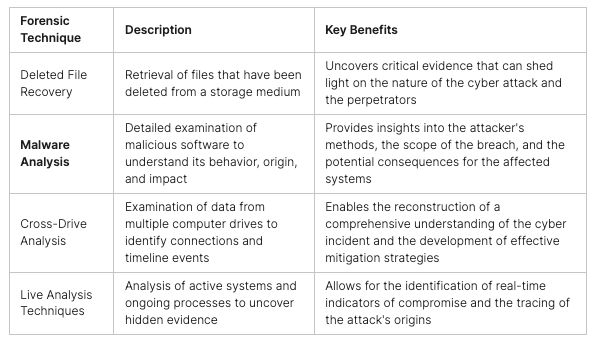
In digital forensics, experts dig deep into computer data, looking for clues that point to cybercrimes. These computer forensic specialists use top tech to analyze information from various drives. They find hidden or locked data. Tools like deleted file recovery help them put together the story. This shows how a cyber attack happened, how much information was leaked, and who did it.
Uncovering Hidden Data: Deleted File Recovery and Malware Analysis
Specialists in digital forensics have unique skills. They can find deleted files and check out malware. They can also put together scraps of data and unlock secrets, which helps them find critical clues about the cyber problem. Malware analysis is vital. It shows the hacker’s plan, how bad the information leak was, and its effect on computer systems.
Cross-Drive Analysis and Live Analysis Techniques
Digital forensics gurus use advanced methods to track cyber attacks. They combine information from different drives and check live systems, which helps them spot links, events on a timeline, and hidden proof. These skills help them fully understand cybercrime, and they then plan how best to stop something similar in the future.
The Legal Aspect: Reporting and Court Admissibility
When it comes to digital forensic cybersecurity, the law matters a lot. Those who investigate digital evidence have to keep thorough records, which helps the evidence stand up in court. They also make sure the whole process is traceable and proves what happened.
Documenting the Chain of Evidence
Forensic experts create detailed reports on their work. These reports show how data was collected and analyzed. They are critical for the evidence to be used in court. It means keeping a clear record of everything they do.
This ensures that the evidence is always handled correctly. Their reports ensure that details are kept. Keeping a solid record helps their findings be trusted in legal matters.
Adhering to Legal and Ethical Standards
Experts in computer forensics must follow strict rules in their field. They obey the guidelines set by the Association of Chief Police Officers (ACPO). This means they always keep the original data and document every move.
By sticking to these rules, forensic experts prove they’re reliable. They make their work more likely to be used in court. This keeps everything fair and trusted in the legal field.
Understanding tech and the law is crucial to digital forensic cybersecurity. Experts stay updated on new investigation methods and laws. This helps them work through cyber cases effectively and legally. They aim to make their findings reliable in court.
Specialized Fields in Digital Forensic Investigations
Digital forensic investigations cover many areas, each specifically tackling aspects of the field. These fields are vital for finding digital proof and stopping online dangers.
Network Forensics: Monitoring and Analyzing Traffic
Network forensics is critical in digital forensics. It focuses on watching and understanding computer traffic. By looking at data transfers, experts can spot legal evidence, find weak spots in security, and learn about cyber volleys. They use special tools to observe, understand, and dissect network data for a complete picture of digital incidents.
Mobile Device Forensics: Retrieving Data from Smartphones and Tablets
Today, mobile devices hold a wealth of clues for cyber cases. Mobile device forensics involves taking data from phones, tablets, and gadgets. Experts find key evidence for both law and civil cases using various methods, from unlocking phones to digging into app data.
Cloud Forensics: Navigating the Complexities of Remote Data
With more data on the cloud, a new field, cloud forensics, has become crucial. It faces challenges like data spread over vast networks and shared servers. Experts here build strategies to gather, save, and study cloud data. They also ensure that evidence stays solid in court cases.
Tools and Technologies: Powering Digital Forensic Cybersecurity
Digital forensics is constantly changing, thanks to many tools and technologies. These help forensic investigators with new cybersecurity threats. They use special software to check data and find deleted files. Plus, they have the latest hardware to get info from broken devices. All this tech is vital for solid digital forensic cybersecurity work.
Now, there are special tools that use artificial intelligence and machine learning. They can find patterns and spot strange things quickly, improving computer forensics and cyber investigations. With these tools, teams can deal well with attacks, like figuring out malware or finding network weak spots.
But it’s not just about programs. Special equipment helps, too, especially with data recovery and vulnerability assessment. These tools can extract information from broken or secured devices, allowing investigators to examine important information and better handle today’s cybersecurity issues.
The world of digital forensic cybersecurity is constantly advancing. As it does, tools and tech get better and more flexible. This means forensic experts need to keep up. They should know the latest to fight cybercrime and protect groups from attacks.
Overcoming Challenges in Digital Forensics
As technology progresses, digital forensics faces new and growing challenges. Investigators in digital forensic cybersecurity and related fields must tackle complex issues, which are essential for finding evidence and solving cybercrime.
Dealing with Advanced Malware and Encryption
Digital forensic experts are dealing with tougher malware. This malware hides or encrypts data, making it hard to access. To find and use key data, experts need special malware tools and skills. They also have to keep learning about the latest malware and updating their tactics.
Managing Data Volume and System Complexity
Data is growing, and systems are getting more complex. Experts must sort through tons of data from laptops, phones, and more. They need special tools and skills to handle this data without damaging it.
Addressing the Cryptography Dilemma
End-to-end encryption is a big issue for digital forensics and privacy. As encryption becomes more common, finding ways to access encrypted data is crucial. Experts must balance the need to find digital evidence while protecting privacy.
Digital forensics professionals must keep learning and use new tools. They also need to work with others in different fields. This teamwork and constant learning help solve cyber threats and bring offenders to justice.
The Future of Digital Forensic Cybersecurity
The digital world is always changing, and so is the need for digital forensics in cybersecurity. It’s going to play a bigger and more important part in fighting cyber threats. New tech like blockchain and quantum computing will create both problems and opportunities for these experts.
Emerging Technologies and Their Impact
Blockchain’s unique, secure way of working will make it hard for forensic pros to track cyber attacks. They’ll have to invent new methods to find evidence in this system. Plus, quantum computers might break our current security codes. This means digital forensic experts must change how they recover and analyze data to keep digital proof safe.
Increased Collaboration with Law Enforcement
The relationships between digital forensics and law enforcement will grow stronger. Fighting cybercrime needs a combined effort. Digital forensic experts will join forces with police to catch and prosecute cyber criminals. This teamwork aims to keep our digital world safe.
The future of digital forensic cybersecurity is exciting and crucial to our safety in the cyber world. New technologies and closer teamwork will change how we find and use digital evidence against complex cyber attacks.
Conclusion
Digital forensics has become an indispensable component of cybersecurity, playing a crucial role in detecting and combating cyber threats. Experts in this field employ meticulous methods to gather, analyze, and preserve digital evidence, which is essential for solving cyber crimes and safeguarding data.
As cyber threats continue to evolve and grow in complexity, the demand for skilled digital forensic experts has never been higher. These professionals are adept at uncovering hidden information, monitoring network activity, and tracing cyber attacks. Their expertise is vital in defending against cyber crimes, whether through analyzing network data or investigating digital devices.
The future of digital forensics in cybersecurity looks promising, with advancements in technology and enhanced collaboration with law enforcement agencies making significant strides. Forensic professionals continuously update their skills and tools to stay ahead of cyber threats, maintaining their crucial role in protecting our digital world.
For comprehensive solutions to enhance your cybersecurity posture and leverage the power of digital forensics, visit Peris.ai Cybersecurity. Explore our wide range of products and services designed to keep your organization secure in an ever-evolving cyber landscape. Secure your digital assets today with Peris.ai.
FAQ
What is the role of digital forensics in cybersecurity?
Digital forensics is key in cybersecurity. It helps find and fight cyber threats. By investigating, analyzing, and keeping digital evidence safe, experts in this field solve cyber crimes and ensure the safety of our digital world.
What are the fundamental principles of digital evidence preservation?
Forensic investigators follow four critical principles for preserving digital evidence. These principles are set by the Association of Chief Police Officers (ACPO). They include not changing data, documenting all actions, keeping things continuous, and limiting who can access the data.
It is really important to keep data safe in a secure place. This data is the backbone of any investigation and the legal steps that follow.
What are some of the specialized fields in digital forensic investigations?
Digital forensic investigations have several special fields, including network, mobile device, and cloud forensics. Network forensics examines computer network traffic. Mobile device forensics focuses on smartphones and tablets. Cloud forensics tackles the unique challenges of digital data in cloud systems.
What are the key challenges in digital forensics?
The field faces many challenges, like fighting advanced malware, which might hide or encrypt data. There’s also the issue of handling more data and complex technology. Plus, the rise of strong encryption makes things harder.
Investigators need to keep their skills sharp and stay up to date with tools to face new cybercrime challenges and find evidence effectively.
What is the future outlook for digital forensics in cybersecurity?
Digital forensics is set to become more critical in the fight against cyber threats. New challenges will come up with new tech like blockchain and quantum computing. Yet, these techs also offer new ways to solve crimes.
We can expect to see more teamwork between cybersecurity and law enforcement. They will join forces against the changing world of cybercrime.
Data breaches can have severe financial and reputational consequences for businesses. Organizations must understand the full scope of data breaches’ financial implications and economic consequences. In this article, we will explore the direct and indirect impacts of a data breach, shed light on the industries most affected, and discuss the factors contributing to the true cost of a data breach.
Unlocking the Hidden Costs: The Far-Reaching Impact of Data Breaches on Businesses
Key Takeaways:
The true cost of a data breach includes both direct and indirect impacts
Direct impacts refer to immediate financial consequences such as investigation expenses, legal fees, and potential fines
Indirect impacts encompass reputational damage, loss of customer trust, and decreased revenue
Industries such as healthcare, finance, and retail are particularly vulnerable to data breaches
Factors contributing to the true cost include breach size, data sensitivity, detection speed, and incident response effectiveness
Understanding the Direct Impacts of a Data Breach
Direct impacts of a data breach refer to the immediate financial consequences that organizations face as a result of a security incident. These impacts can be significant and include various expenses related to the breach. Some of the direct impacts include:
Investigation Costs: Organizations must allocate resources to investigate the breach, determine the extent of the damage, and identify the vulnerabilities that led to the incident.
Notification Expenses: Organizations are often legally required to notify affected individuals when a data breach occurs. This process can involve significant costs, including printing and mailing letters, setting up call centers, and managing customer inquiries.
Credit Monitoring Services: Organizations may offer credit monitoring services to affected individuals to mitigate the potential harm caused by a breach. These services can be expensive, especially if a large number of individuals are impacted.
Legal Fees: Data breaches can lead to legal implications, including potential lawsuits from affected individuals or regulatory fines. Companies may need to hire legal counsel to navigate these legal challenges, which can be costly.
Regulatory Fines: Depending on the industry and location, organizations may face regulatory fines for failing to protect sensitive data. These fines can vary in severity and can have a direct impact on the organization’s financial health.
The cost of a data breach can vary significantly depending on various factors. The size of the breach, the type of data compromised, and the industry sector all play a role in determining the financial impact.
Understanding the direct impacts of a data breach is crucial for organizations to assess the potential financial implications and prepare accordingly. By implementing robust security measures and investing in proactive cybersecurity strategies, businesses can mitigate the risk of data breaches and minimize the direct impacts they may face.
Strategic Preparedness: Mitigating Data Breach Risks with Proactive Cybersecurity
Exploring Indirect Impacts of a Data Breach
The indirect impacts of a data breach can have significant financial consequences for organizations. The repercussions of a data breach go beyond the immediate costs and can result in long-term damage to a company’s reputation, customer trust, brand value, and customer loyalty.
When a data breach occurs, it shakes the confidence of customers and erodes their trust in the affected organization. The loss of trust can lead to a decline in customer loyalty, as individuals may choose to take their business elsewhere, resulting in decreased revenue for the company. Additionally, a data breach’s negative publicity and brand damage can further impact a company’s bottom line.
“The financial impact of data breaches can be devastating,” says a cybersecurity expert. “Businesses that experience a data breach often struggle to regain customer confidence and may suffer from reduced revenue in the aftermath.” cybersecurity expert also emphasizes the importance of proactive measures to mitigate the indirect impacts of a data breach.
“A data breach not only has immediate financial implications but also poses long-term challenges for organizations. The indirect impacts, such as reputational damage and loss of customer trust, can have a lasting effect on a company’s financial health,” warns Cybersecurity Expert. “It is crucial for businesses to prioritize cybersecurity measures and have effective incident response plans in place to minimize the financial impact of data breaches.”
Overall, the indirect impacts of a data breach can have far-reaching financial consequences for organizations. By understanding these repercussions and implementing proactive cybersecurity measures, businesses can better protect themselves against the financial fallout of a data breach.
Beyond the Numbers: The Hidden Toll of Data Breaches on Reputation and Revenue
Table: Financial Impacts of Data Breaches
Financial Impacts of Data Breaches
Note: The table above highlights some of the key financial impacts that organizations may experience in the aftermath of a data breach.
Financial Implications of Data Breaches
Data breaches not only result in immediate financial costs for organizations but can also have long-term economic consequences. Beyond the expenses incurred during breach management, companies may face additional financial burdens associated with cybersecurity improvements and compliance requirements.
Following a data breach, organizations often invest in enhanced security measures and hire additional personnel to strengthen their defense against future attacks. These measures include implementing advanced threat detection systems, upgrading infrastructure, and conducting regular security audits. The costs associated with these initiatives can be substantial, impacting the organization’s overall financial health.
Financial Implications of Data Breaches
“The financial implications of data breaches go beyond the immediate costs. Organizations must be prepared to incur significant expenses in improving their cybersecurity posture and addressing compliance requirements. The impact can extend to insurance premiums and the stock market value of the company.” – Cybersecurity Expert
These financial implications underscore the importance of robust cybersecurity measures and effective incident response plans. By proactively addressing security vulnerabilities and investing in risk mitigation strategies, organizations can minimize the economic consequences of a data breach.
Industries Most Affected by Data Breaches
Data breaches pose a significant threat to businesses across various industries, but certain sectors are more vulnerable to these incidents than others. Understanding which industries are most affected can help organizations prioritize their cybersecurity efforts and allocate resources effectively. The healthcare, finance, and retail sectors are particularly attractive targets for cybercriminals due to the valuable personal information they hold.
In the healthcare industry, the theft of medical records can result in significant financial and reputational damage. These records contain sensitive data such as social security numbers, medical histories, and insurance details, making them valuable on the black market. Additionally, healthcare organizations often have complex IT environments and may face challenges implementing robust cybersecurity measures, making them more susceptible to data breaches.
The finance sector is another high-risk industry, as financial institutions store vast amounts of personal and financial data. Breaches in this sector can result in financial loss for both the organizations and their customers, as stolen financial information can be leveraged for fraudulent activities. The finance industry is also heavily regulated; data breaches can lead to severe penalties and reputational damage.
Retail businesses, particularly those operating online, are prime targets for data breaches. These organizations handle large volumes of customer data, including credit card information and personally identifiable information. A breach in the retail sector can lead to significant financial losses, lawsuits, and damage to brand reputation. Additionally, the interconnected nature of retail supply chains can make it challenging to secure the flow of data and protect against cyber threats.
Prime Targets: Industries at Risk – Cybersecurity Priorities
Table: Industries Most Affected by Data Breaches
Industries Most Affected by Data Breaches
Factors Contributing to the True Cost of a Data Breach
Data breaches can have significant financial implications for organizations, and several factors contribute to the true cost of such incidents. Understanding these cost drivers is essential for businesses to effectively manage the impacts of data breaches and allocate resources accordingly.
The Size and Scope of the Breach
The size and scope of a data breach play a crucial role in determining its financial consequences. Larger breaches that involve a significant number of compromised records and sensitive data can result in higher costs. This is due to the increased expenses associated with notifying affected individuals, providing credit monitoring services, and addressing potential legal and regulatory obligations.
The Sensitivity of Compromised Data
The sensitivity of the data compromised in a breach also impacts the cost. Highly sensitive information, such as financial or healthcare data, may require additional measures to mitigate the risk of identity theft or fraud. This can include offering more extensive credit monitoring services or providing specialized support for affected individuals.
The Number of Individuals Affected
The number of individuals affected by a data breach directly influences the cost: the more individuals involved, the greater the expenses associated with notifying and supporting them. Organizations must allocate resources to communicate effectively with affected parties and provide the necessary assistance to mitigate potential harm.
Impact on Data Breach Cost
Other factors, such as the speed of detection and containment and the effectiveness of the organization’s incident response plan, also play a role in determining the true cost of a data breach. Additionally, regional regulations and industry-specific compliance requirements can further impact the financial implications of these incidents.
By understanding and considering these factors, organizations can better assess their potential exposure to data breach costs, develop appropriate risk management strategies, and allocate resources effectively to prevent and mitigate the impacts of these incidents.
Crucial Factors in Calculating Data Breach Costs: Detection, Response, and Regulatory Compliance
Mitigating the Impact of Data Breaches
When it comes to data breaches, prevention is ideal, but mitigation is essential. While organizations may not be able to avoid data breaches completely, they can take proactive steps to minimize the impact and reduce the consequences. By implementing robust cybersecurity measures, conducting regular security audits, and training employees on best security practices, businesses can strengthen their defenses against potential breaches.
An effective incident response plan is also crucial in mitigating the impact of a data breach. This plan should outline the steps to be taken in the event of a breach, including quick detection and containment of the incident, notifying affected individuals promptly, and providing the necessary support and resources to mitigate further damage. The faster a breach is identified and contained, the less time hackers have to access and exploit sensitive data, minimizing the potential consequences.
Furthermore, organizations should prioritize transparency and communication during and after a data breach. Being open and honest with affected individuals, stakeholders, and the public can help maintain trust and credibility. Providing accurate information and guidance on actions individuals can take to protect themselves can also minimize the long-term impact on individuals and the organization.
By taking these proactive measures and having a well-defined plan, organizations can mitigate the impact of data breaches and minimize the potential consequences to their financial and reputational well-being.
Proactive Planning: Shielding Finances and Reputation from Data Breach Impact
The Importance of Data Breach Preparedness
In today’s digital landscape, data breaches have become a significant concern for businesses across industries. A data breach’s financial and reputational consequences can be severe, making data breach preparedness a critical priority for organizations. By implementing proactive measures and comprehensive security protocols, businesses can minimize the impact of data breaches and better protect sensitive information.
Preparation for data breaches starts with the development of robust data security policies. These policies should outline necessary security measures, such as encryption, access controls, and regular data backups. By encrypting sensitive data, businesses can add an extra layer of protection, ensuring that even if the data is stolen, it remains inaccessible to unauthorized individuals.
In addition to security policies, regular risk assessments are essential in identifying vulnerabilities and potential weak points in a company’s infrastructure. Organizations can proactively identify and address security gaps by conducting regular assessments, minimizing the risk of a data breach. These assessments should encompass network and system vulnerabilities, employee training, and risk mitigation strategies.
Lastly, a well-defined incident response plan is crucial for effective data breach management. This plan should outline the steps to be taken in the event of a breach, including communication protocols, internal and external stakeholders’ responsibilities, and steps to contain and mitigate the breach’s impact. Regular testing and updating of the incident response plan ensure that it remains effective and up to date.
Conclusion
In summary, the true cost of a data breach extends far beyond immediate financial burdens, encompassing enduring consequences that can profoundly affect an organization’s standing and financial stability. The direct ramifications of a data breach involve expenses like investigation costs, legal fees, and regulatory fines. Still, the indirect consequences, including damage to reputation, loss of customer trust, and reduced revenue, can be even more crippling.
It’s imperative for organizations to prioritize data breach preparedness to mitigate these impacts. This entails fortifying cybersecurity measures, conducting regular security assessments, and educating employees on best security practices. An effective incident response plan is vital in swiftly detecting and containing breaches, thereby minimizing direct and indirect repercussions.
Organizations must take proactive steps to safeguard sensitive data and uphold customer trust. They should develop comprehensive data security policies, consistently assess risks, encrypt sensitive data, and establish a well-defined incident response plan. In an era where data breaches are increasingly prevalent, safeguarding against such incidents should be a foremost concern for all businesses. We invite you to explore our website, Peris.ai Cybersecurity, to discover innovative solutions that can help fortify your data security, protect your reputation, and ensure long-term sustainability and success. Visit us today and secure more than just computers; secure society.
FAQ
What are the direct impacts of a data breach?
The direct impacts of a data breach include expenses related to investigating the breach, notifying affected individuals, providing credit monitoring services, legal fees, and potential regulatory fines.
What are the indirect impacts of a data breach?
The indirect impacts of a data breach include reputational damage, loss of customer trust, diminished brand value, and decreased customer loyalty.
How do data breaches affect the financial health of a company?
Data breaches can result in increased expenses for cybersecurity improvements, such as enhanced security measures and hiring additional personnel. They can also lead to higher insurance premiums and decreased stock market value.
Which industries are most vulnerable to data breaches?
Industries such as healthcare, finance, and retail are often targeted due to the valuable personal information they hold. Healthcare organizations, in particular, are attractive targets for cybercriminals because of the high value of medical records on the black market.
What factors contribute to the true cost of a data breach?
The size and scope of the breach, the sensitivity of the data compromised, the number of individuals affected, the speed of detection and containment, and the effectiveness of the organization’s incident response plan all contribute to the true cost of a data breach.
How can organizations mitigate the impact of data breaches?
Organizations can mitigate the impact of data breaches by implementing robust cybersecurity measures, conducting regular security audits and vulnerability assessments, training employees on best security practices, and implementing an effective incident response plan.
Why is data breach preparedness important?
Data breach preparedness is important because it allows organizations to develop comprehensive data security policies, conduct regular risk assessments, encrypt sensitive data, regularly backup data, and have a well-defined incident response plan. Being prepared helps minimize the impact of data breaches and facilitates effective recovery.
What is the overall cost of a data breach?
The overall cost of a data breach includes both direct and indirect impacts, which can have significant financial implications for organizations. Businesses must prioritize data breach preparedness and take proactive steps to protect against data breaches.
A new cybersecurity threat, identified as the Msupedge malware, has been detected in the Windows systems of a university in Taiwan, indicating a potential rise in targeted cyberattacks. This backdoor malware exploits a recently addressed vulnerability in PHP, showcasing the rapid adaptation and sophistication of cyber threat actors.
Key Developments in the Msupedge Malware Incident
Exploitation of CVE-2024-4577
Vulnerability Insight: CVE-2024-4577 is a severe PHP-CGI argument injection flaw affecting Windows systems configured to run PHP in CGI mode. This vulnerability permits unauthenticated attackers to execute arbitrary code on unpatched systems, leading to potential full system compromise.
Malware Deployment: Initial investigations suggest that Msupedge was deployed by exploiting the CVE-2024-4577 flaw, patched in June 2024. Systems that have not applied this critical update are at high risk.
Characteristics of Msupedge Malware
C&C Communication via DNS Tunneling: Uniquely, Msupedge communicates with its command-and-control server using DNS traffic, a method that wraps malicious data within DNS queries to evade detection.
Versatile Malware Commands: Msupedge can carry out various commands from creating and managing processes to downloading additional malicious payloads, indicating its high risk and versatility.
Steps to Combat the Msupedge Threat
Patch and Update Systems
Immediate Updates: Prioritize updating all PHP installations on Windows systems to the latest version to close off the CVE-2024-4577 vulnerability. Continuous software updates are crucial in defending against known exploits.
DNS Traffic Monitoring
Detect Anomalies: Implement advanced monitoring tools to spot unusual DNS traffic patterns. Such anomalies might signal the presence of DNS tunneling activities typical of Msupedge.
Incident Response Enhancement
Protocol Review: Assess and strengthen your incident response strategies to swiftly detect, contain, and mitigate breaches that could stem from this new malware or similar threats.
Educational Initiatives
Team Training: Increase awareness amongst your IT and security personnel about this specific threat and general security best practices, particularly focusing on the novel exploitation methods like DNS tunneling used by Msupedge.
Proactive Measures Against Emerging Cyber Threats
The quick exploitation of the CVE-2024-4577 flaw post-patch release underscores the necessity of timely patch management and the need for vigilant threat monitoring. Cybercriminals continue to advance their techniques, exploiting even the slightest delay in software updates.
To safeguard your systems effectively:
Stay current with the latest cybersecurity updates and patches.
Monitor your network for any signs of unusual activity.
Educate your teams continually about new cyber threats and defensive tactics.
For ongoing updates and expert cybersecurity insights, ensure to visit our website at peris.ai.
In today’s world, cyber threats are always changing. Companies have to work hard to keep their information and networks safe. SOC as a Service (SOCaaS) offers a smart way for them to do this. It gives them a way to boost their security without spending a lot of money. So, what is SOCaaS really, and how could it help your business? Let’s take a closer look at this approach to managed security services.
Key Takeaways
SOC as a Service (SOCaaS) is a type of cybersecurity service you pay for regularly. It gives you the expertise you need to watch out for, understand, and deal with cyber threats.
With SOCaaS, companies can let a third party keep their information secure. This third party is often a specialist service provider or a security company.
The main benefits of using SOCaaS are that it’s not expensive, you get expert help, your security is watched 24/7, and it can grow with your needs.
Companies use managed security services like SOCaaS to solve problems with their in-house security setups. These issues often include not having enough skilled security experts and the high cost.
To pick the best SOCaaS provider, you need to look at their agreements, what they offer in terms of security, how well they know the rules, and if they can work with your current security systems.
What is SOC as a Service (SOCaaS)?
SOC as a Service, called SOCaaS, is a cybersecurity service you pay for regularly. Companies get experts to watch, check, and deal with cybersecurity threats and incidents. It’s like leasing security help from another company instead of having your own team.
Outsourcing Security Operations to a Third Party
Organizations can use a SOC as a Service provider to watch for cybersecurity threats. This lets companies work on what they do best while knowing their security is in good hands.
A Subscription-Based Cybersecurity Service
SOCaaS works through a subscription. You pay a regular fee to get the service’s security features. It’s a smart choice for companies that don’t want to set up their own in-house security operations center (SOC).
Providing Expert Resources for Threat Detection and Response
This service is all about having cyber expert resources at your disposal. They’re focused on monitoring, analyzing, and responding to security issues. With their high-tech tools and know-how, they aim to stop attacks and limit damage if they happen.
How Does SOCaaS Work?
SOCaaS stands for SOC as a Service. It uses cybersecurity monitoring to fight off digital dangers. Businesses can get expert help by letting a remote SOC as a Service team handle their security.
Continuous Security Monitoring
SOCaaS keeps a close eye on a company’s network and systems. This team uses the latest tools to spot threats in real-time. They watch over everything to keep the company safe.
Threat Detection and Analysis
The SOCaaS team is smart at finding and understanding threats. They use tools like SIEM, smart algorithms, and up-to-date info to find cyber dangers. Then, they quickly work on stopping them.
Incident Response and Mitigation
If a threat is found, the SOCaaS experts jump in to help. They check what’s going on, stop the danger, and fix the problem. This swift action helps prevent any serious harm.
Choosing SOCaaS lets companies worry less about security. It helps them stay focused on what they do best. Meanwhile, their digital space is well-guarded against cyberattacks.
Key Components of SOCaaS
Effective SOC as a Service (SOCaaS) tools include the latest in security tech. They aim to keep companies safe from cyber dangers with SIEM and MDR among others. SOCaaS teams use these tools to constantly watch for threats and respond fast.
Security Information and Event Management (SIEM)
SIEM tools are key in SOCaaS, bringing together data from many sources. They look for oddities to catch and stop cyber threats. This early warning system lets SOCaaS experts tackle problems before they get serious.
Managed Detection and Response (MDR)
MDR offers a broad security approach, combining finding threats with quick reactions. It uses both tech and skilled people to keep a close eye on security. This all moves to deal with threats swiftly, keeping a company’s daily work safe.
Advanced Security Tools and Technologies
Providers use advanced tools like network traffic analysis and endpoint detection and response. They also employ behavior analysis tech to find and fight off complex cyber attacks. These cutting-edge solutions are their armor against ever-evolving threats.
Threat Intelligence and Analysis
Having the latest threat intelligence is crucial in the SOCaaS world. Providers are always on the lookout for new threats and ways to tackle them. They share what they learn with their teams to stay two steps ahead of cyber dangers.
The Critical Role of Up-to-Date Threat Intelligence in SOCaaS
Benefits of SOC as a Service (SOCaaS)
Embracing SOC as a Service (SOCaaS) can provide organizations with many advantages. These benefits greatly improve their cybersecurity. SOCaaS offers a cost-effective method, specialized expertise, and monitors threats all the time.
Cost-Effective Security Solution
Using SOCaaS lowers the costs of creating and running internal security centers. It allows companies to avoid the big expenses of having their security team and technology. Instead, they can use SOCaaS as a cost-effective option to get top-notch security without the big costs at the start or later on.
Access to Specialized Expertise
SOCaaS lets companies use specialized expertise not always found in their security teams. The security analysts in a SOCaaS provider are experts in spotting and handling threats quickly. They are good at what they do, and this means any cyber threats are found and tackled fast, preventing big problems.
24/7 Monitoring and Rapid Response
SOCaaS shines in its continuous, 24/7 monitoring and quick response features. Teams working for SOCaaS providers keep an eye on security issues all the time. They leap into action as soon as something seems off, making sure any threats are handled before real harm is done.
Scalability and Flexibility
SOCaaS gives organizations room to grow or change their security as needed. With a SOCaaS partner, companies can adjust their security levels quickly, as issues like more network traffic or new cyber threats arise. This gives them the power to keep their security strong, no matter the changes they face, without being held back by internal resource limits.
How SOCaaS Adapts to Evolving Security Needs of Organizations
Why Organizations Need Managed Security Services
Today, the threat of cyber-attacks is always rising. This is why many organizations see the need for managed security services. They help improve cybersecurity. With attacks becoming more complex and frequent, running an internal security operations center (SOC) is tough.
Challenges of In-House Security Operations
Setting up and running a SOC inside a company needs a lot of money. You have to invest in people, top-notch tech and have 24/7 eyes on your security. But getting and keeping skilled workers is hard because there aren’t enough of them. This uses up a company’s resources, taking away from other important goals.
Cost and Efficiency Considerations
For small and medium-sized organizations, having their own SOC is too costly. It’s also hard to do right. It takes a big financial and skill investment, exceeding what many businesses can manage. This is where MSSPs come in, offering a smarter choice. They work for many clients, spreading costs and specializing in security. This makes their services both effective and within reach.
Addressing the Cybersecurity Skills Gap
The lack of cybersecurity experts makes hiring and keeping them a challenge. Managed security services help. They connect organizations with a team of experts. This team brings a range of skills and top-level tools. So, businesses can rely on the latest security knowledge without the trouble of running a big team.
Cyber Threats Monitored by SOCaaS
Technology has become crucial for many organizations, but it also leads to more cyber threats. The good news is, SOC as a Service (SOCaaS) providers are there to spot and fight against these threats. They help organizations stay one step ahead in protecting themselves.
Advanced Persistent Threats (APTs)
Advanced Persistent Threats (APTs) are not your average cyberattacks. They’re sneaky and can go on for a long time without anyone noticing. Luckily, SOCaaS tools are on the lookout for these subtle dangers. They work to keep important data safe and guard against big financial hits.
Malware and Ransomware Attacks
Viruses, worms, and ransomware can harm an organization’s data and processes. SOCaaS uses the latest security technologies to quickly catch and stop these attacks. This quick action helps reduce the harm to a business.
Network Intrusions and Unauthorized Access
Getting into a network without permission is a huge risk for any organization. SOCaaS keeps a close eye on the network for any strange activity. This monitoring means they can step in fast to stop unauthorized access attempts.
Insider Threats and Phishing Attempts
Sometimes, the danger comes from people inside the company, who might be tricked into giving away important information. SOCaaS doesn’t just look at attacks from the outside. They use smart tools to see if anyone in the organization is up to no good, stopping scams and insider threats.
Choosing the Right SOCaaS Provider
Choosing a SOC as a Service (SOCaaS) vendor involves a careful assessment. You must look into how well they fit with your current security measures. This means checking their Service Level Agreements (SLAs), what security technology and capabilities they offer, their compliance expertise and support, and whether they can integrate with your security setup.
Service Level Agreements (SLAs)
Make sure the SOCaaS provider’s SLAs match your security needs and expectations. Check what they promise regarding response times, fixing incidents, and service availability. Also, know how they report incidents and communicate with you, plus the consequences if they don’t meet their SLAs.
Security Technologies and Capabilities
Look at the SOCaaS provider’s security tools, like their Security Information and Event Management (SIEM) system, Managed Detection and Response (MDR) services, and advanced threat tools. See how good they are at spotting, studying, and fighting off various cyber threats.
Compliance Expertise and Support
If your job is in a tightly regulated area, ensure your SOCaaS provider can offer needed compliance help and expertise. They should be able to aid in audits and policy making. Plus, they should show evidence of your security measures to meet the rules.
Integration with Existing Security Infrastructure
See how well the SOCaaS services can blend with your existing security systems. This includes those for networks, devices, and cloud. They should help give you a clear view of your security health and use various data sources to better spot and fight threats.
Managed SOC vs. In-House SOC
Today, businesses must choose between setting up their own security operations center (SOC) or using a managed SOC service. Each option has its benefits, depending on what the organization needs. It’s key to think about the resources and goals of the company.
A managed SOC is run by external experts (MSSPs), giving round-the-clock security and a team of skilled professionals. These experts are always learning about the newest threats and strategies. They make sure your systems are watched constantly and react fast to any dangers. This setup works well for those who don’t have enough resources or knowledge to keep a full-time security team in-house.
On the flip side, an in-house SOC lets a company control its security directly and make its safety plans. This is great for big companies that have the money, technology, and staff required for their SOC. With their own SOC, a company can better understand what threats it faces and create specific defenses against them.
The choice between a managed SOC and an in-house SOC depends on carefully thinking about the organization’s security needs and available resources. It’s about balancing the benefits of both approaches to meet the company’s specific goals. With the right choice, a company can improve its security and protect against many cyber threats.
Conclusion
In today’s increasingly complex digital landscape, SOC as a Service (SOCaaS) is an essential component in the fight against cyber threats. It enables companies to enhance their cybersecurity posture cost-effectively by leveraging state-of-the-art security operations centers, cutting-edge technology, and continuous monitoring.
By opting for managed security services, organizations gain access to top-tier security expertise and advanced tools, along with 24/7 monitoring that is challenging to maintain independently. This allows businesses to focus on their core operations with the confidence that their critical assets are being protected by skilled security professionals.
As cyber threats continue to escalate, adopting SOCaaS is crucial for safeguarding data and systems. Partnering with the right service provider can lead to improved security, more efficient use of resources, and a proactive stance against emerging threats.
Secure your business with our SOC 24/7 Service from Peris.ai Cybersecurity. Visit Peris.ai Bima SOC 24/7 to learn more about how our comprehensive security solutions can protect your organization and ensure you stay ahead in the ever-evolving cyber threat landscape.
FAQ
What is SOC as a Service (SOCaaS)?
SOC as a Service (SOCaaS) is like Netflix for cybersecurity. It’s a subscription model for expert cyber defense services. Companies get access to cyber experts who watch, analyze, and tackle online threats. This subscription means that firms can hand over their security duties to experts. They don’t have to build their in-house cybersecurity team.
How does SOCaaS work?
SOC as a Service shifts the job of watching for threats to a remote team. This team specializes in spotting dangers and reacting fast.
What are the key components of SOCaaS?
SOCaaS offers several important tools for protecting against cyber risks. This includes watching for threats, quickly responding to issues, securing endpoints, gathering intelligence on threats, using advanced security tech, and relying on experts.
What are the benefits of SOC as a Service (SOCaaS)?
SOCaaS brings a lot of advantages. It increases how quickly and effectively threats are dealt with. It provides top-notch security expertise. It helps to grow a company’s security efforts, saving costs, and allowing teams to focus on bigger cyber-strategy issues.
Why do organizations need managed security services?
Managed SOC services provide critical benefits. They offer top-notch security know-how and technology, along with constant monitoring. These are key for catching and handling online dangers in a timely and proactive manner.
What types of cyber threats are monitored by SOCaaS?
SOCaaS keeps an eye out for many online risks. This includes complex threats like APTs, as well as more common dangers like malware, network break-ins, and trickery by malicious insiders or phishing scams.
What should organizations consider when choosing a SOCaaS provider?
Picking a SOCaaS vendor is important for firms. They need to look at what the vendor can do. This means judging their skills and how well they fit with the company’s current security set-up.