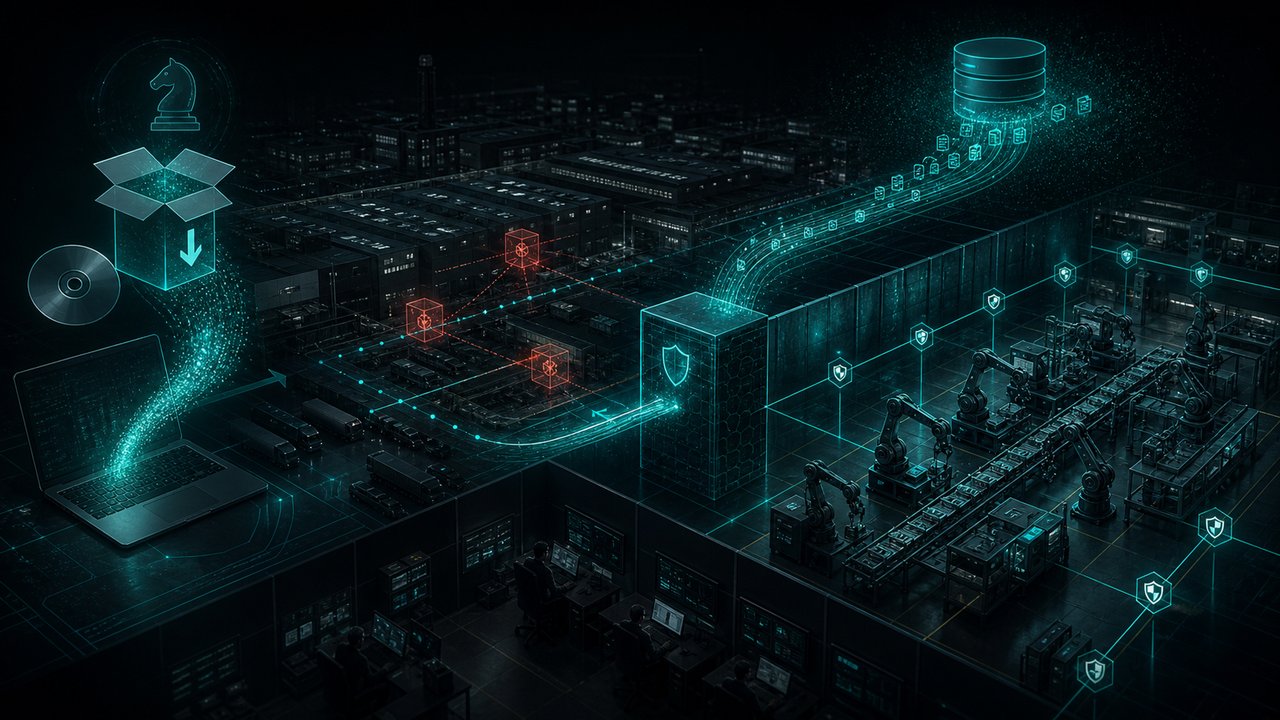
On May 11, 2026, the Nitrogen ransomware group listed Foxconn on its public leak site, claiming exfiltration of approximately 8TB of data spanning more than 11 million files. Foxconn confirmed disruption to North American operations the following day. Here is why manufacturers are the next major ransomware battleground.
Foxconn is not a small target. It is one of the largest electronics manufacturers on the planet, a supplier to Apple, Microsoft, and Sony, operating factories on multiple continents. If Nitrogen ransomware can penetrate Foxconn’s North American operations and walk out with 8TB of sensitive data, no manufacturer should consider itself safe.
This post examines how Nitrogen operates, why the manufacturing sector has become a primary target, and what security architecture prevents an EDR killer from disabling your defences before the encryption begins.
What Is Nitrogen Ransomware?
Nitrogen ransomware is a ransomware-as-a-service (RaaS) operation that gained significant attention in 2026 for its targeting of large manufacturing, industrial, and logistics organisations. The group maintains a public leak site, NitroBlog, where it lists confirmed victims and publishes exfiltrated data to pressure ransom payment.
Nitrogen’s defining technical characteristic is its use of EDR killers as a standard pre-attack preparation step. EDR killers are tools specifically designed to disable, crash, or evade endpoint detection and response software before the ransomware payload is deployed. Their inclusion in Nitrogen’s standard attack playbook reflects a sector-wide trend: Kaspersky’s 2026 International Anti-Ransomware Day report confirmed that EDR killers are now standard components of ransomware attack chains across the industry.
How Nitrogen Gets In: The Malvertising Initial Access Vector
Nitrogen does not rely on zero-day exploits for initial access. Its approach is more insidious: malvertising campaigns that deliver trojanized installers of legitimate, trusted software.
The tools commonly used as lures include:
- WinSCP (popular Windows file transfer tool)
- AnyDesk (remote desktop software widely used in manufacturing IT)
- Advanced IP Scanner (network administration tool)
- PuTTY (SSH client used by IT and OT teams)
An IT technician searching for a free download of WinSCP may land on a malvertised page serving a trojanized installer that looks identical to the legitimate version. The installer runs, the legitimate software installs correctly, and in the background Nitrogen’s initial access malware establishes persistence. The technician sees nothing unusual.
The Foxconn Attack: Timeline and Impact
- May 11, 2026: Nitrogen lists Foxconn on NitroBlog, claiming exfiltration of 8TB of data across more than 11 million files
- May 12, 2026: Foxconn publicly confirms disruption to North American operations, affecting facilities in Wisconsin and Texas
- Scope of data claimed: manufacturing specifications, supplier contracts, employee records, and operational data
The attack follows a pattern that Nitrogen has repeated across multiple manufacturing sector targets in 2026. The group increasingly favours encryptionless extortion, exfiltrating data and threatening to publish it rather than encrypting systems and demanding a decryption key.
Why Is Manufacturing a Ransomware Target?
Operational Technology Exposure
Modern manufacturing environments blend IT systems with OT (operational technology): industrial control systems, SCADA platforms, programmable logic controllers, and connected assembly-line equipment. These OT systems are often decades old, running software that cannot be updated without re-certifying the manufacturing process.
High Operational Cost of Downtime
A ransomware-induced shutdown of a manufacturing line costs thousands to tens of thousands of dollars per hour in lost production.
Interconnected Supply Chains
A breach at Foxconn has downstream implications for every organisation in its supply chain.
What Happens When EDR Is the First Casualty?
Nitrogen’s EDR killer deployment is specifically designed to neutralise your primary detection capability before the attack proceeds. When EDR is disabled:
- Endpoint behavioural detection goes dark
- The ransomware payload deploys without triggering the controls that should stop it
- Security teams receive no alerts until encryption is already underway
- Recovery scope expands dramatically because the attack was uncontained
Nitrogen Attack vs. Defended Environment
| Attack Stage | Undefended Environment | Peris.ai-Defended Environment |
| Malvertised installer download | No detection | BimaRed surfaces malvertising domain |
| EDR killer execution | EDR disabled, blind spot created | XDR network layer continues detecting |
| Lateral movement | Undetected across OT/IT boundary | NVM packet analysis detects anomalous traversal |
| Data exfiltration | 8TB exits unnoticed | XDR triggers BrahmaFusion isolation playbook |
| Ransomware payload | Encryption proceeds | Automated containment limits blast radius |
How Peris.ai Defends Manufacturing Environments
Our EDR provides behavioural detection on industrial endpoints and IT workstations. Critically, Peris.ai’s EDR is designed to resist EDR killer techniques through tamper-protection mechanisms.
Our XDR extends detection to the full manufacturing environment, including OT network segments. In a factory where industrial control systems share network infrastructure with corporate IT, XDR correlates telemetry across both layers.
Our NVM (Network Visibility Monitor) provides packet-level analysis of all traffic traversing the factory network. Nitrogen’s data exfiltration, typically multi-gigabyte transfers to external infrastructure, generates distinctive network traffic patterns that NVM detects and flags regardless of endpoint agent status.
BimaRed monitors the attack surfaces that Nitrogen exploits for initial access: internet-facing management interfaces, exposed OT systems, and vulnerabilities in IT administration tools.
BrahmaFusion ties the detection layers together with automated response playbooks. When XDR or NVM surfaces Nitrogen indicators, BrahmaFusion triggers network segmentation rules that isolate affected systems from OT infrastructure before encryption can spread to production lines.
Benefits at a Glance
| Benefit | Outcome |
| EDR with tamper protection | EDR killer techniques detected and resisted |
| XDR cross-layer visibility | OT/IT boundary lateral movement detected |
| NVM packet-level analysis | Large data exfiltration detected before completion |
| BimaRed attack surface monitoring | Malvertising domains and exposed assets surfaced early |
| BrahmaFusion automated segmentation | OT environments isolated before encryption spreads |
Final Thought
Nitrogen ransomware listed Foxconn on May 11, 2026. The group will list its next target soon. For manufacturing security teams, the question is not whether their sector is being targeted. It is whether their detection architecture will survive an EDR killer long enough to contain the attack.
Platforms like BrahmaFusion by Peris.ai, combined with XDR, NVM, and INDRA CTI threat intelligence, give manufacturing security teams the layered, agent-independent detection and automated response capability they need to stop Nitrogen and groups like it before the production line goes dark.
Frequently Asked Questions
What is Nitrogen ransomware?
Nitrogen is a ransomware-as-a-service operation that targets manufacturing, industrial, and logistics organisations. The group uses malvertising campaigns to deliver trojanized installers of legitimate tools, deploys EDR killers to disable endpoint detection, and increasingly uses encryptionless extortion by threatening to publish stolen data.
How did Nitrogen ransomware attack Foxconn?
On May 11, 2026, Nitrogen listed Foxconn on its leak site claiming 8TB of exfiltrated data across 11 million or more files. Foxconn confirmed disruption to North American operations including facilities in Wisconsin and Texas on May 12, 2026.
What is an EDR killer and how does it work?
An EDR killer is a tool designed to disable, crash, or evade endpoint detection and response software before a ransomware payload deploys. By neutralising the primary detection control, attackers create a window where encryption or exfiltration proceeds without triggering alerts.
Why does Nitrogen use malvertising as an initial access vector?
Nitrogen uses malvertised downloads of legitimate IT tools (WinSCP, AnyDesk, Advanced IP Scanner, PuTTY) because these tools are trusted and regularly downloaded by IT and OT teams in manufacturing environments.
How can manufacturers defend against EDR killer attacks?
Effective defence requires layered detection that operates independently of endpoint agents. This includes network-level visibility (NVM), cross-layer XDR that monitors OT/IT boundaries, EDR with tamper-protection capabilities, and automated isolation playbooks.
Leave a Reply