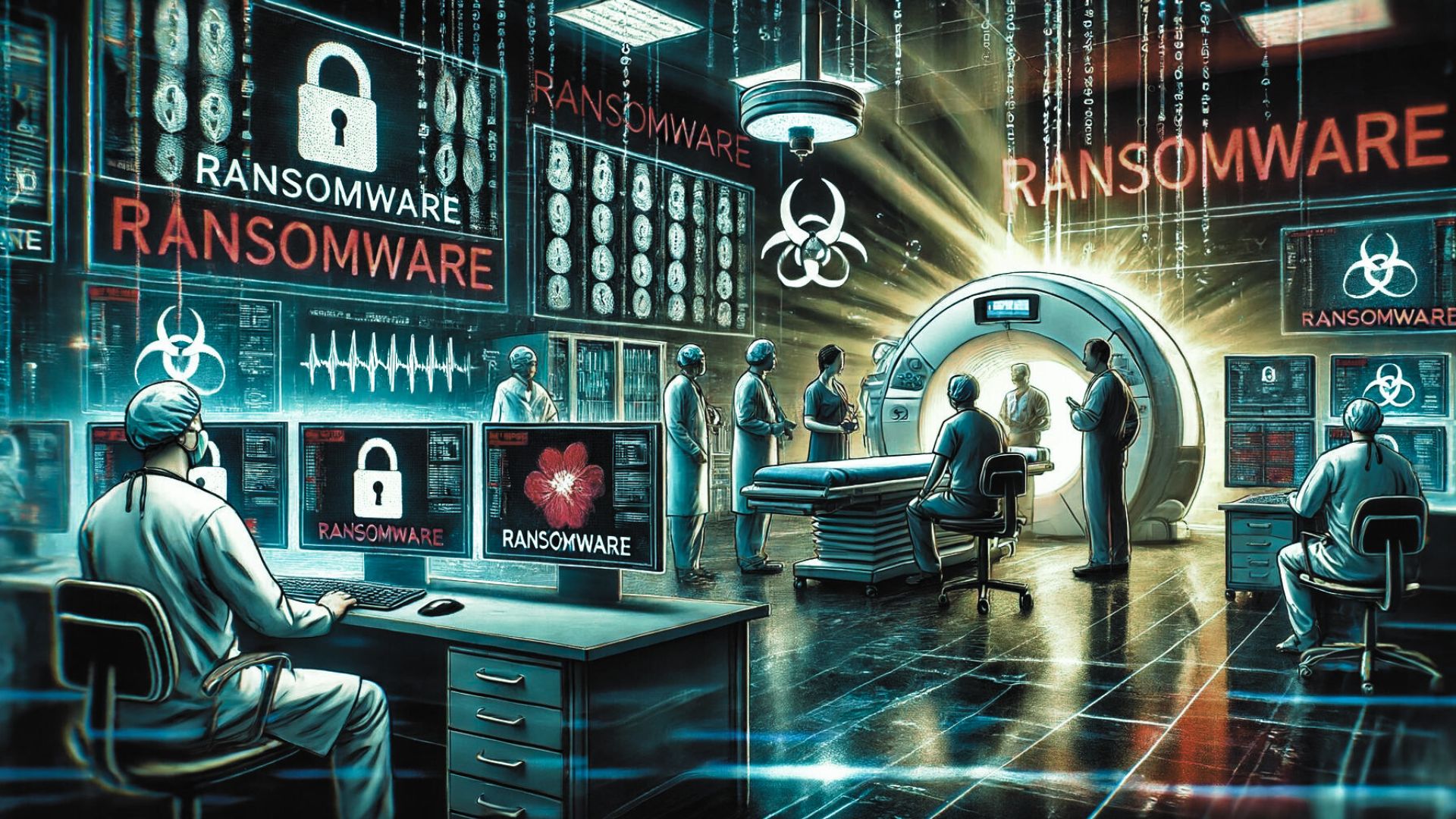
In May 2024, Ascension, a major healthcare provider, experienced a significant cybersecurity breach when an employee inadvertently downloaded a malicious file. This seemingly small mistake triggered a ransomware attack that had extensive repercussions across the organization’s operations.
How the Breach Happened
Initial Breach: The employee downloaded what they believed was a legitimate file, which turned out to be ransomware.
Systems Impacted: Critical systems such as the MyChart electronic health records, telecommunication systems, and the digital platforms for ordering tests, procedures, and medications were severely affected.
The Immediate Aftermath
Operational Disruption: To contain the attack, Ascension was forced to take numerous systems offline, switching to manual paper records—a significant step back from the digital efficiencies they usually operate with.
Service Delays: Non-urgent procedures and appointments were delayed or canceled, and emergency services had to be redirected to prevent critical care delays.
Extended Impact and Ongoing Recovery
Continued Service Disruption: Weeks after the attack, Ascension is still working diligently to restore full functionality to its health records systems, patient communication channels, and clinical ordering systems.
Data Compromise: Investigations revealed that threat actors accessed and extracted data from 7 out of approximately 25,000 servers. The compromised data included Protected Health Information (PHI) and Personally Identifiable Information (PII).
Ransomware Attribution
Black Basta Group: The attack has been attributed to the Black Basta ransomware group, known for its disruptive cyber activities targeting various sectors.
Recommendations for Strengthening Cybersecurity
Employee Vigilance: Enhance training programs to help employees identify phishing attempts and malicious files. Promote a security-first culture where verification of file sources is standard practice.
Advanced Technical Defenses: Deploy state-of-the-art endpoint protection solutions that preemptively identify and neutralize malicious downloads. Utilize network segmentation to limit the spread of potential breaches.
Incident Preparedness: Update and test incident response strategies regularly. Simulate different breach scenarios to ensure all personnel are prepared to act swiftly and effectively.
Data Protection Measures: Encrypt sensitive information and maintain regularly updated, secure backups of essential data to mitigate the damage from potential data breaches.
From Attack to Action
The Ascension incident is a potent reminder of the vulnerabilities that exist even within sophisticated IT infrastructures. It underscores the necessity of comprehensive security measures and continuous vigilance. Organizations must view cybersecurity as a critical component of their operational integrity, particularly in sectors as sensitive as healthcare.
For continued guidance on safeguarding your systems and to stay ahead of the latest cybersecurity trends, visit Peris.ai.
SIM swapping, also known as SIM jacking, is a malicious technique where hackers redirect your phone number to a SIM card they control. This allows them to intercept your calls, texts, and crucial two-factor authentication codes, potentially giving them access to your online accounts like email and banking.
How a SIM Swap Attack Works
SIM swapping tricks your cellular provider into transferring your existing phone number to a new SIM card controlled by the hacker. Different carriers have different security measures, but scammers often need sensitive information such as an address, password, or answers to security questions to impersonate you successfully. This information can be obtained through phishing, data breaches, or social engineering tactics like bribing someone inside the phone company.
Attack Methods:
Phishing Emails: Fake emails tricking you into giving up personal information.
Data Breaches: Hackers accessing your details through leaks.
In-Store or Call Center Fraud: Scammers pretending to be you in a store or over the phone.
Bribery: Insiders at phone companies are bribed to assist in the swap.
Protecting Against SIM Swap Attacks
Being aware of the threat and knowing the preventive measures is crucial. Here are some strategies to safeguard against SIM swapping:
Stay Vigilant Online
Be Wary of Links: Don’t click on suspicious links in emails, social media, or messaging apps. Always verify the source.
Update Software: Keep your browser and other software up-to-date for the latest security features.
Strong Passwords: Use complex and unique passwords for different accounts.
Secure Your Phone Accounts
Check with Your Provider: Ensure your carrier has strong security measures for SIM swaps.
Enable Two-Factor Authentication (2FA): Use authentication apps instead of phone numbers for 2FA wherever possible.
Recognizing a SIM Swap Attack
Detecting a SIM swap attack early can help mitigate the damage. Here are some signs:
Warning Signs:
No Service: Suddenly losing cell service without explanation.
Unusual Account Activity: Receiving alerts about suspicious activity or password changes you didn’t initiate.
Denied Access: Getting locked out of your accounts despite correct login details.
Unauthorized Transactions: Notices of bank transactions you didn’t authorize.
Steps to Take After a SIM Swap Attack
If you suspect a SIM swap attack, act quickly:
Immediate Actions:
Contact Your Carrier: Inform them of the unauthorized SIM swap and secure your number.
Change Passwords: Update your passwords for critical accounts and disable 2FA until your phone service is secure.
Alert Your Bank: Notify your financial institutions to prevent further unauthorized transactions.
Preventive Measures
Implementing robust security practices can significantly reduce the risk of SIM swap attacks.
Tips to Enhance Security:
Mobile Carrier Protections: Enable extra security features like account takeover protection or number transfer PINs provided by your carrier.
Account Alerts: Set up notifications for any changes in your bank and mobile accounts.
Personal Information Security: Be cautious about sharing personal details online and through calls.
Authentication Solutions: Use authentication apps or hardware keys like Yubikey for secure logins.
PIN Codes: Set strong PINs for your SIM card and phone accounts.
Biometric Authentication: Utilize facial recognition or fingerprint ID for added security.
Conclusion
SIM swapping is a serious threat, but by understanding how these attacks work and implementing effective security measures, you can protect your personal and financial information. Stay informed, stay vigilant, and take proactive steps to safeguard your digital identity.
For more cybersecurity tips and updates, visit Peris.ai.
Your Peris.ai Cybersecurity Team#YouBuild #WeGuard
Welcome to our insightful article on the 24/7 Danger Zone of cyber threats in organizations. In today’s digital age, where technology powers businesses’ core functions, cybersecurity vigilance has become an absolute necessity. Organizations must constantly be prepared for the ever-present cyber risks that can strike at any moment. This article explores organizations’ various threats and provides essential strategies to protect against them.
Cyber threats in organizations are a persistent and evolving danger. From sophisticated malware attacks to data breaches and ransomware, the consequences of a cyber incident can be severe, affecting both financial stability and reputational standing. It is crucial for organizations to prioritize cybersecurity measures and develop a proactive defense strategy that encompasses continuous monitoring and maintenance.
In the following sections, we will delve into the specific cyber risks organizations face, uncover factors that increase vulnerability to attacks and present real-world case studies to demonstrate the impact and consequences of cyber incidents. We will also explore tools, technologies, and cybersecurity solutions that can provide real-time protection and strategies for creating a culture of cybersecurity awareness within organizations.
With the ever-changing threat landscape, businesses must align IT and executive goals for effective cyber threat management. We will also discuss cyber incidents’ financial and reputational impact, conduct a cost analysis of major cybersecurity breaches, and examine the long-term consequences for affected organizations.
This article will present key takeaways and actionable insights that organizations can implement to enhance their cybersecurity practices. Join us on this journey into the 24/7 Danger Zone of cyber threats in organizations, and let’s strengthen our defenses against these ever-present risks.
Key Takeaways:
Constant cybersecurity vigilance is essential to protect organizations against evolving cyber threats.
Developing a proactive defense strategy through continuous monitoring and maintenance is crucial.
Factors that increase vulnerability to cyber attacks must be identified and addressed.
Cybersecurity awareness training and education can help build a strong defense against cyber threats.
Alignment between IT and executive goals is necessary for effective cyber threat management.
The Ever-Present Cybersecurity Threat Landscape
In today’s digital age, organizations face an ever-present cybersecurity threat landscape that can have devastating consequences. With the advancement of technology, cyber risks continue to evolve, posing significant challenges to the security and integrity of organizational systems and data.
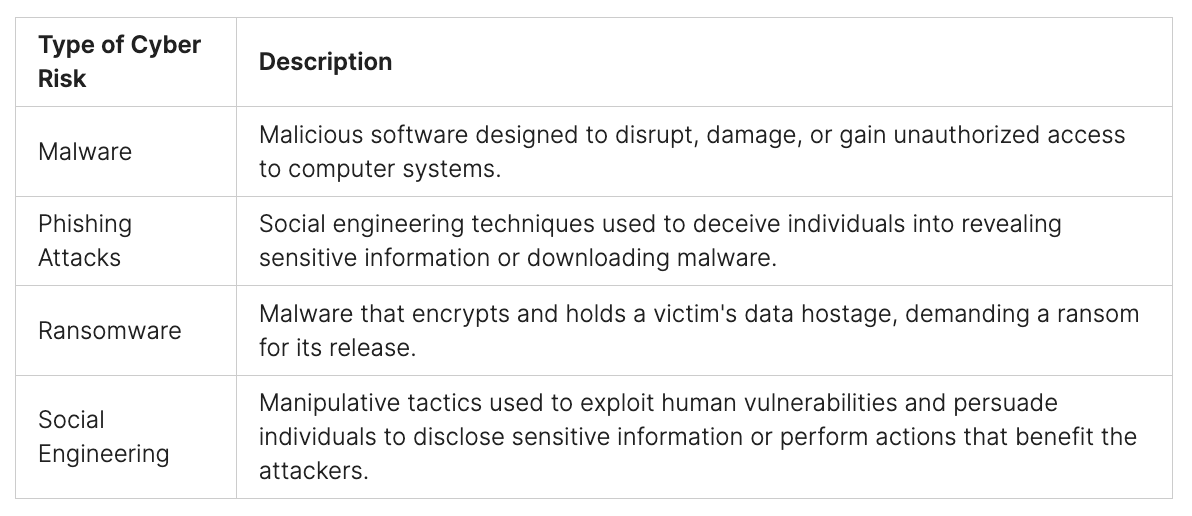
Cyber threats come in various forms, including malware, phishing attacks, ransomware, and social engineering. These threats exploit organizational vulnerabilities, targeting weaknesses in network infrastructure, software, and human behavior.
Organizations must stay vigilant and proactive in their cybersecurity efforts to combat cyber risks effectively. This requires understanding the evolving threat landscape and the potential vulnerabilities that can be exploited. By recognizing the risks, organizations can implement the necessary measures to mitigate and manage these threats.
“The digital era has brought forth a complex and dynamic cybersecurity threat landscape. Organizations must adapt to the evolving nature of cyber threats to protect their systems, data, and reputation.”
Organizational vulnerabilities can arise from outdated software, inadequate security protocols, lack of employee awareness, and limited resources allocated to cybersecurity. These vulnerabilities offer openings for cyber attackers to infiltrate and compromise sensitive information.
Organizations can prioritize investments in robust security measures, employee education and training programs, and ongoing risk assessments by understanding the ever-present cybersecurity threat landscape. This proactive approach enhances their resilience and ability to respond effectively to cyber threats, safeguarding their operations and reputation.
Understanding Organizational Cyber Risks
Cybersecurity is a top concern for organizations in today’s digital landscape. The repercussions of cyber attacks can be devastating, leading to financial losses, operational disruptions, and reputational damage. Organizations must understand the specific cyber risks they face to protect themselves and the factors that increase their vulnerability to cyber attacks.
Factors that Increase Vulnerability to Cyber Attacks
Organizations can be more exposed to cyber threats due to various vulnerability factors. These factors include:
Outdated and Unsupported Systems: Using outdated software and operating systems that no longer receive security updates leaves organizations susceptible to known vulnerabilities.
Weak Security Protocols: Inadequate security measures, such as weak passwords, lack of multifactor authentication, and improper access controls, make it easier for attackers to infiltrate an organization’s networks and systems.
Lack of Employee Awareness: Human error remains a significant contributor to successful cyber attacks. Employees who are unaware of common phishing techniques, malicious links, and social engineering tactics can inadvertently provide cybercriminals with access to sensitive information.
Third-Party Risks: Organizations often collaborate with third-party vendors and partners, creating potential entry points for cyber attackers. Weak security practices by these external entities can compromise the organization’s overall security.
Understanding these vulnerability factors allows organizations to identify their weak points and prioritize cybersecurity measures to mitigate potential risks.
Strengthening Defenses: Identifying Vulnerabilities for Better Security
Proactive Cyber Defense Strategies for Businesses
In today’s evolving cyber threat landscape, organizations must proactively defend against potential attacks. Implementing strong cybersecurity measures, conducting regular risk assessments, and staying up-to-date with the latest technologies are crucial for protecting sensitive data and maintaining business continuity.
Here are some essential proactive defense strategies that businesses can employ:
Secure Network Infrastructure: Organizations should establish secure network infrastructures by implementing firewalls, intrusion detection systems (IDS), and virtual private networks (VPNs) to safeguard against unauthorized access.
Continuous Monitoring: Regular monitoring of network traffic and system logs helps promptly identify any unusual activity or potential security breaches. This proactive approach allows organizations to intervene and mitigate risks before they escalate.
Employee Education and Training: Cybersecurity awareness and training programs for employees play a crucial role in mitigating risks. By educating employees about potential threats, phishing attacks, and safe browsing practices, organizations can significantly reduce the risk of human error leading to breaches.
Data Encryption: Encrypting sensitive data both in transit and at rest adds an extra layer of protection against unauthorized access. Robust encryption methods, such as the Advanced Encryption Standard (AES), should be implemented to secure data across various devices and platforms.
Regular Updates and Patching:Organizations must ensure that all systems, software, and applications are regularly updated with the latest patches and security fixes. Neglecting updates increases the risk of cyber attackers exploiting known vulnerabilities.
By adopting these proactive defense strategies, businesses can enhance their cybersecurity posture, minimize the risk of breaches, and protect valuable assets. Furthermore, organizations should continuously evaluate and refine their cyber defense strategies to adapt to evolving threats in the digital landscape.
24/7 Danger Zone: When Cyber Threats Strike in Organizations!
In today’s digital landscape, organizations face an ever-present and evolving threat to their cybersecurity. Cyber threats can strike at any time, making continuous cybersecurity critical for businesses to protect their sensitive data and safeguard operations. Organizations must maintain constant vigilance and readiness to respond to these threats, as they can have severe consequences when left unchecked.
One of the key challenges in combating cyber threats is the 24/7 nature of the danger. Hackers and malicious actors are constantly probing for vulnerabilities, seeking to exploit any weaknesses in an organization’s defenses. This means that organizations must be prepared to defend against cyber threats around the clock, ensuring that their cybersecurity measures are always up to date and effective.
Continuous cybersecurity is essential for organizations of all sizes and industries. By implementing rigorous security protocols, organizations can reduce their risk of falling victim to cyber threats, preventing disruption to operations, financial loss, and damage to their reputation.
As technology continues to advance and cyber threats become more sophisticated, organizations must prioritize continuous cybersecurity as a core part of their business strategy. Organizations can proactively defend against cyber incidents and safeguard their critical assets by staying ahead of emerging threats and maintaining robust security measures.
“Cybersecurity is not a one-time investment or a temporary fix. It requires constant attention and adaptation to stay ahead of the rapidly evolving threat landscape.”
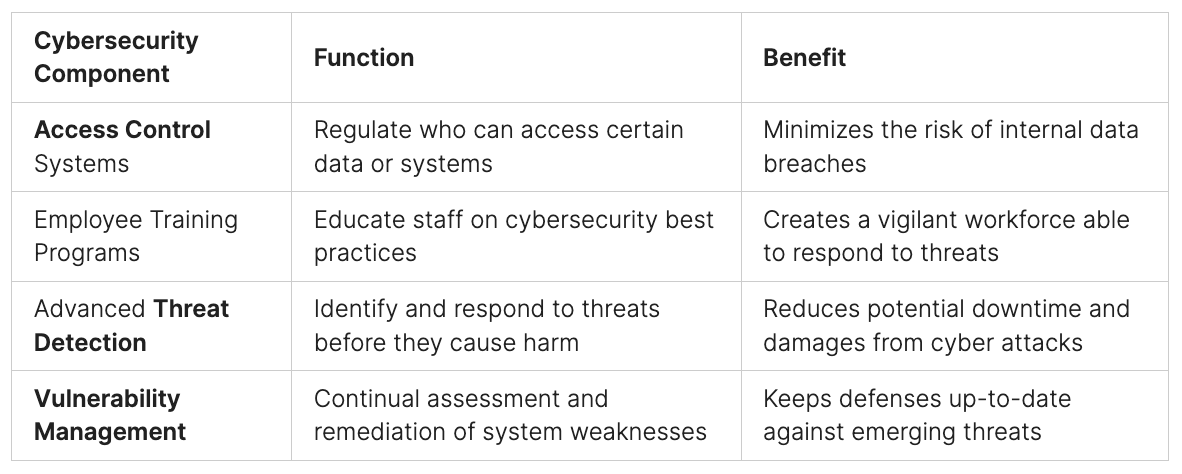
Continuous cybersecurity encompasses various elements, including regular security assessments, security system and protocol updates, employee training and awareness programs, and advanced threat detection technologies. By combining these measures, organizations can create a robust cyber defense posture that minimizes their vulnerability to cyber threats.
Building Cyber Resilience: The Components of Continuous Cybersecurity
This image represents the continuous nature of cybersecurity, symbolizing the need for organizations to have a 24/7 approach to protecting their digital assets.
The next section will explore the tools and technologies available for always-on cyber protection, highlighting real-time cybersecurity solutions and advancements in threat detection and response capabilities.
Always-On Cyber Protection: Tools and Technologies
In today’s rapidly evolving digital landscape, organizations face constant cyber threats that can disrupt operations, compromise sensitive data, and damage reputations. As the frequency and sophistication of cyber attacks increase, organizations must adopt proactive measures to ensure their cybersecurity defenses are always-on and capable of mitigating emerging threats.
Real-Time Cybersecurity Solutions
One of the key components of always-on cyber protection is the deployment of real-time cybersecurity solutions. These solutions utilize advanced technologies and techniques to detect, analyze, and respond to threats in real time, minimizing the potential damage caused by cyber incidents.
Real-time cybersecurity solutions leverage machine learning algorithms and artificial intelligence (AI) to continuously monitor network traffic, user behavior, and system vulnerabilities. By analyzing vast amounts of data and identifying anomalous activities, these solutions can swiftly detect and neutralize potential threats before they can cause significant harm.
Furthermore, real-time cybersecurity solutions provide organizations with actionable insights, enabling them to make informed decisions and respond effectively to evolving cyber threats. By harnessing the power of automation and threat intelligence, organizations can enhance their incident response capabilities and reduce the time required to detect and mitigate cyber attacks.
Advancements in Threat Detection and Response
Cybersecurity is constantly evolving, driven by technological innovations and an increasingly sophisticated threat landscape. Advancements in threat detection and response capabilities have further empowered organizations to bolster their always-on cyber protection strategies.
AI-driven cybersecurity systems are at the forefront of these advancements. By harnessing the power of machine learning and behavioral analytics, AI-driven systems can detect previously unknown and zero-day threats in real time. These systems continually learn from cyber attack patterns and adapt their defenses accordingly, ensuring organizations remain one step ahead of cybercriminals.
In addition to AI-driven systems, organizations are leveraging technologies such as endpoint detection and response (EDR) tools, security information and event management (SIEM) platforms, and threat intelligence solutions. These technologies provide real-time visibility into network activity, facilitate the correlation of security events, and enable proactive threat hunting.
Organizations can establish robust and resilient always-on cyber protection by harnessing the power of real-time cybersecurity solutions and leveraging advancements in threat detection and response capabilities. These tools and technologies form the backbone of an effective cybersecurity strategy, enabling organizations to stay one step ahead of cyber threats and safeguard their critical assets.
Creating a Culture of Cybersecurity Awareness
Organizations face an ever-increasing number of cyber threats in today’s digital landscape. Fostering a culture of cybersecurity awareness within the organization is crucial to protect against these threats effectively. This involves equipping employees with the necessary knowledge and skills to identify and respond to potential cyber risks.
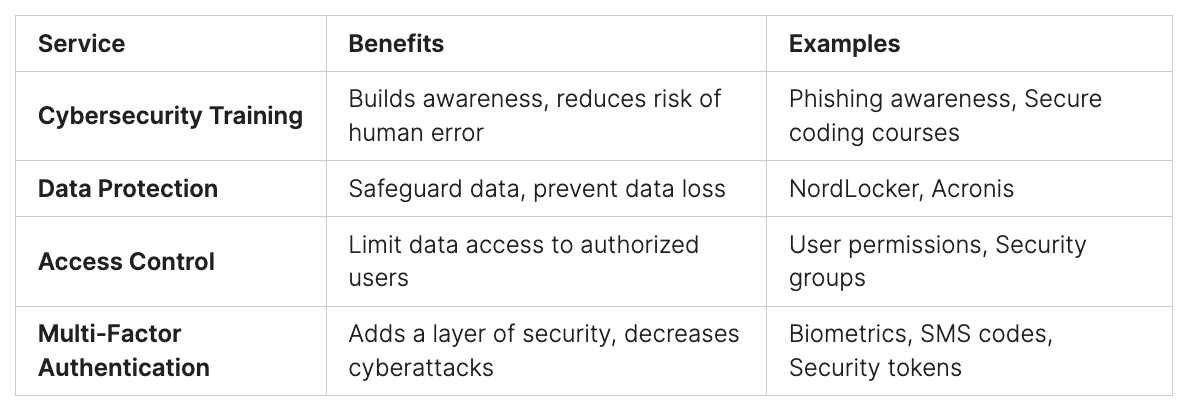
Employee training and education play a vital role in building a stronger defense against cyber threats. By providing comprehensive cybersecurity training, organizations can empower their employees to become the first line of defense. Training programs should cover topics such as recognizing phishing attempts, creating strong passwords, and understanding the importance of regular software updates.
However, cybersecurity awareness should not be limited to training programs alone. It should be integrated into the organizational culture, becoming a shared responsibility among all employees. This can be achieved by fostering an environment that encourages open communication about potential threats, promoting a sense of collective responsibility for cybersecurity.
Organizations can take several steps to promote cybersecurity awareness throughout the organization:
Conduct regular cybersecurity awareness campaigns to keep employees up to date with the latest trends and threats.
Establish clear policies and procedures for reporting potential security incidents, encouraging a proactive approach to cybersecurity.
Provide ongoing support and resources to employees, such as access to cybersecurity experts or tools.
Encourage employees to share best practices and success stories regarding cybersecurity, fostering a sense of community and collaboration.
By creating a culture of cybersecurity awareness, organizations can significantly reduce the risk of falling victim to cyber threats. It is not only the responsibility of IT departments; it requires the active participation of all employees. With a well-informed and vigilant workforce, organizations can fortify their defenses and mitigate the potential impact of cyber incidents.
Fostering Cybersecurity Culture: A Collective Defense Against Threats
Business Cyber Threat Management: Roles and Responsibilities
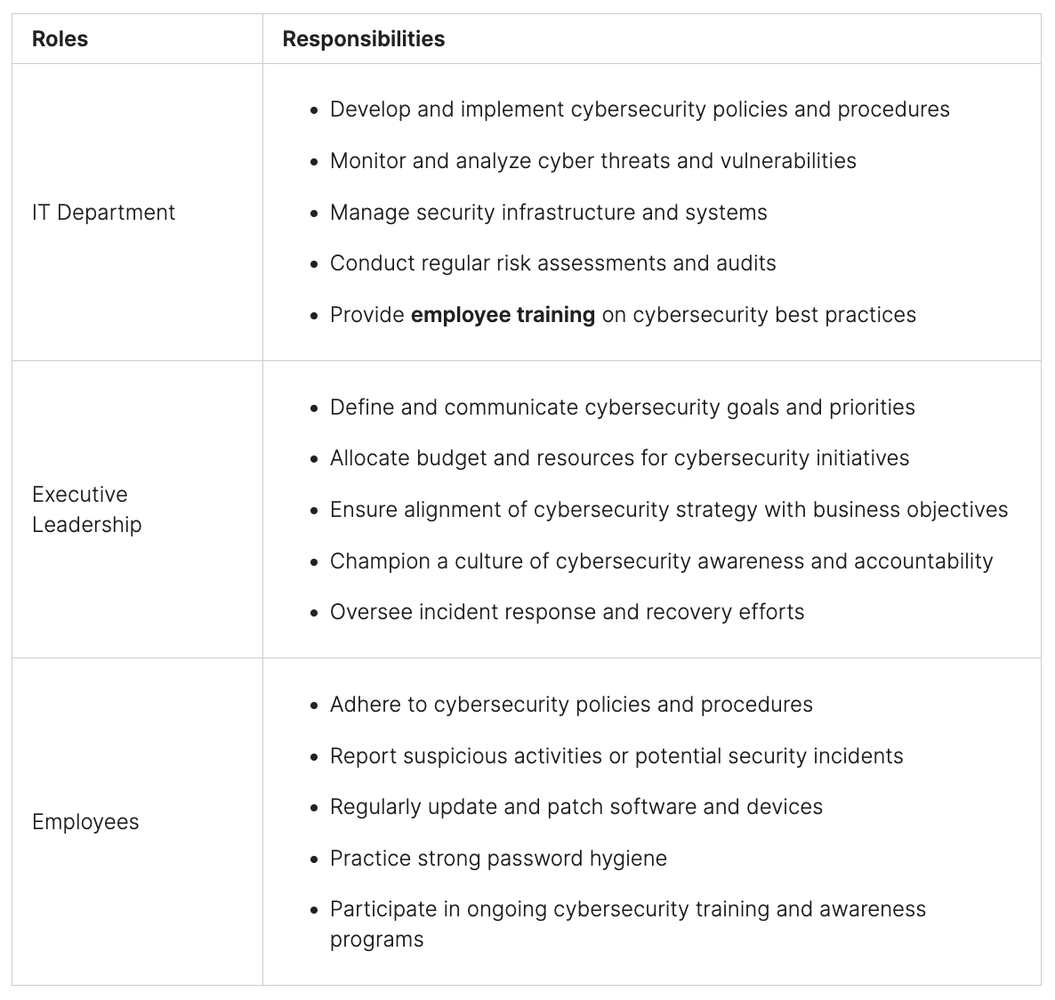
In order to effectively manage cyber threats within organizations, it is essential to understand the roles and responsibilities of the various stakeholders involved. This section explores the key aspects of cyber threat management and highlights the importance of alignment between IT and executive goals. Additionally, the significance of training employees to recognize and respond to cyber threats is emphasized.
Aligning IT and Executive Goals for Cybersecurity
Successfully managing cyber threats requires a strong alignment between the IT department and executive leadership. IT executives must work hand in hand with top management to develop and implement effective cybersecurity strategies. This alignment ensures that cybersecurity goals are in line with the overall business objectives and that the necessary resources are allocated appropriately.
By aligning IT and executive goals, organizations can prioritize cybersecurity initiatives, allocate budget and resources accordingly, and create a culture of cybersecurity awareness throughout the company. This collaboration enables a more cohesive approach to cyber threat management, leading to a stronger defense against potential threats.
Training Employees to Recognize and Respond to Cyber Threats
Employees play a crucial role in safeguarding organizations against cyber threats. By providing comprehensive training on cybersecurity best practices, organizations can empower their employees to be the first line of defense. Training programs should cover topics such as identifying phishing emails, practicing safe browsing habits, and recognizing social engineering techniques.
A well-trained workforce enhances the overall security posture of an organization. It reduces the risk of employees falling victim to cyber attacks and enables them to respond to potential threats promptly. Regular training sessions and ongoing awareness campaigns can significantly improve employees’ ability to mitigate cyber risks and protect sensitive data.
Continuous Cybersecurity: Monitoring and Maintenance
In the ever-evolving landscape of cyber threats, organizations must prioritize continuous monitoring and maintenance of their cybersecurity systems to ensure ongoing protection. Regular assessments, updates, and audits are crucial to identify vulnerabilities, address emerging risks, and maintain the effectiveness of cybersecurity measures.
Staying Vigilant: Continuous Monitoring for Cybersecurity Resilience
By establishing a comprehensive monitoring strategy, organizations can proactively detect and respond to potential security incidents, minimizing the impact of cyber threats. Continuous monitoring allows real-time visibility into network traffic, system behavior, and user activities, enabling rapid threat detection and mitigation.
Additionally, routine maintenance of cybersecurity systems is essential to keep pace with evolving threats and emerging technologies. This includes regular software updates, patch management, and vulnerability remediation. Organizations can significantly reduce their attack surface and enhance their overall cybersecurity posture by staying up-to-date with the latest security patches and ensuring system configurations align with best practices.
“Continuous monitoring and maintenance are the backbone of effective cybersecurity. It’s not enough to implement security measures and assume they will provide ongoing protection. Organizations need to actively monitor their systems, respond to new threats, and ensure their defenses are always up to date.” – Cybersecurity Expert
Moreover, regular audits and assessments help organizations identify potential gaps or weaknesses in their cybersecurity infrastructure. These evaluations provide insights into areas that require improvement, allowing organizations to prioritize resources and implement necessary changes to strengthen their defenses. By embracing a proactive monitoring, maintenance, and auditing approach, organizations can establish a robust cybersecurity framework that adapts to changing threat landscapes.
Continuous cybersecurity monitoring and maintenance are critical for detecting and preventing cyber threats and demonstrating due diligence and compliance with industry regulations. Implementing effective monitoring and maintenance practices ensures organizations remain vigilant and responsive to emerging risks, safeguarding their sensitive data and maintaining the trust of their stakeholders.
The Financial and Reputational Impact of Cyber Incidents
In today’s digital landscape, organizations face increasingly sophisticated cyber threats that can have significant financial and reputational consequences. This section explores the impact of cyber incidents on organizations, including the financial losses incurred and the long-term consequences that can affect their reputation.
Cost Analysis of Major Cybersecurity Breaches
Cybersecurity breaches can result in substantial financial losses for organizations. A cost analysis of major breaches reveals the extent of the financial impact. Organizations often incur expenses related to incident response, investigation, remediation, and legal proceedings. Additionally, there can be indirect costs such as reputational damage, loss of customers, and decreased market value.
These figures highlight the immense financial impact that cybersecurity breaches can have on organizations. The costs go beyond immediate financial losses and extend to long-term damage.
Long-Term Consequences for Affected Organizations
In addition to the immediate financial impact, cyber incidents can have long-term consequences that significantly impact an organization’s reputation and business operations. Some of the long-term consequences include:
Reputational Damage: A cybersecurity breach can erode customer trust and damage an organization’s reputation. It can lead to negative publicity, customer defection, and a decrease in brand value.
Loss of Customer Trust: Customers may lose confidence in an organization’s ability to protect their personal and financial information. This loss of trust can lead to a decline in customer loyalty and retention.
Regulatory Fines and Legal Consequences: Organizations that fail to protect customer data may face regulatory fines and legal actions. These consequences can further exacerbate the financial impact of a cyber incident.
Operational Disruptions: Cybersecurity breaches can disrupt normal business operations, causing system downtime, delays in service delivery, and loss of productivity. These operational disruptions can have significant financial implications.
These long-term consequences highlight cybersecurity breaches’ pervasive and lasting impact on organizations, emphasizing the need for robust preventive measures and incident response strategies.
Case Study Analysis: Cybersecurity in Action
This section will analyze a real-life cybersecurity case study showcasing successful defense strategies and valuable lessons learned. By examining the specific steps taken by an organization to protect against cyber threats, we can gain insights into effective cybersecurity practices that can be applied across industries.
To illustrate our analysis, consider the following scenario:
The cybersecurity team at XYZ Corp recognized the increasing sophistication of cyber threats and the growing risk of APT attacks. To mitigate these risks, they implemented a multi-layered defense system that combined various security measures:
Employee Training: XYZ Corp conducted comprehensive cybersecurity awareness training for all employees, emphasizing the importance of identifying phishing emails and adopting safe browsing habits.
Secure Email Gateway: An advanced secure email gateway was implemented to filter out malicious emails and prevent phishing attempts from reaching employee inboxes.
Endpoint Security:The organization installed robust endpoint security software on all devices, providing real-time protection against malware and other malicious activities.
Network Segmentation:XYZ Corp implemented network segmentation to isolate critical systems and minimize the potential impact of a breach.
Continuous Monitoring: The cybersecurity team established a 24/7 monitoring system to detect any unusual network activity and respond to incidents swiftly.
Incident Response Plan:An effective incident response plan was put in place, outlining the steps to be taken in the event of a cyber attack, ensuring a coordinated and rapid response.
As a result of these proactive defense strategies, XYZ Corp successfully defended against the APT attack, preventing sensitive data breaches and minimizing the impact on their business operations. This case study highlights the effectiveness of a multi-layered defense approach and the critical role of employee training in preventing cyber incidents.
Based on the lessons learned from this case study, organizations can implement the following key practices:
Provide regular cybersecurity awareness training to educate employees about potential threats and safe behaviors.
Implement a multi-layered defense system, combining secure email gateways, endpoint security, and network segmentation measures.
Establish a robust incident response plan to ensure a swift and coordinated response to cyber incidents.
Maintain continuous monitoring of networks to detect and respond to potential threats in real-time.
By adopting these best practices, organizations can strengthen their cybersecurity posture and effectively defend against evolving cyber threats.
Conclusion
In the ever-changing world of cyber threats, vigilance in cybersecurity is not just a recommendation—it’s a necessity. This article has underscored that the landscape of cybersecurity threats is in constant flux, and the fallout from cyber incidents can be severe. To combat these threats effectively, it’s imperative for organizations to adopt proactive defense strategies and foster a culture deeply rooted in cybersecurity awareness.
We’ve highlighted the critical importance of robust security measures, regular risk assessments, and keeping pace with the latest advancements in cybersecurity technology. It’s also vital for organizations to ensure IT and executive teams are in sync and to invest in comprehensive training programs that enable employees to identify and react to cyber threats skillfully.
Continuous monitoring and maintenance of cybersecurity systems are key to preserving their effectiveness over time. Understanding the financial and reputational impact of cyber incidents is crucial, as are the long-term effects they might engender. Learning from successful case studies and integrating these insights can significantly bolster an organization’s defensive posture against potential cyber risks.
In our current reality, where cyber threats loom large 24/7 danger zones, making cybersecurity a top priority is non-negotiable for organizations of all sizes. Adopting a proactive, vigilant stance, staying abreast of evolving threats, and investing in the right tools and technologies are fundamental steps towards enhanced protection against cyber threats and the preservation of valuable assets.
To strengthen your organization’s cybersecurity further, we invite you to explore the solutions offered by Peris.ai Cybersecurity. Our website provides a wealth of resources and innovative tools tailored to meet the unique cybersecurity needs of your organization. Visit us at Peris.aiCybersecurity to discover how we can help you stay one step ahead of cyber threats. Make cybersecurity your stronghold—partner with Peris.ai today.
FAQ
What are the main cybersecurity risks that organizations face?
Organizations face various cybersecurity risks, including data breaches, ransomware attacks, phishing scams, and insider threats. These risks can lead to financial loss, reputational damage, and regulatory penalties.
What factors increase an organization’s vulnerability to cyber attacks?
Outdated systems, weak security protocols, lack of employee awareness, and inadequate cybersecurity measures increase an organization’s vulnerability to cyber attacks. It is crucial to address these factors to minimize the risk of a successful cyber attack.
What are proactive cyber defense strategies?
Proactive cyber defense strategies involve implementing strong security measures, conducting regular risk assessments, staying updated with the latest cybersecurity technologies, and establishing incident response plans. These strategies help organizations effectively prevent, detect, and respond to cyber threats.
Why is continuous cybersecurity important for organizations?
Continuous cybersecurity is important because cyber threats can occur anytime, and organizations must be constantly vigilant and prepared. It ensures that organizations can detect and respond to threats in real-time and minimize potential damages.
What are some tools and technologies available for always-on cyber protection?
Real-time cybersecurity solutions provide instant threat detection and response. These solutions use advanced technologies like artificial intelligence (AI) and machine learning to identify and block threats. They continuously monitor network traffic, endpoints, and cloud environments to ensure comprehensive protection.
How can organizations create a culture of cybersecurity awareness?
Organizations can create a culture of cybersecurity awareness by providing regular employee training and education, promoting a strong security mindset, and encouraging reporting of suspicious activities. This helps employees understand their roles in protecting against cyber threats and fosters a proactive approach to cybersecurity.
What roles and responsibilities do various stakeholders have in managing cyber threats?
IT and executive leaders play crucial roles in managing cyber threats. IT departments are responsible for implementing and maintaining cybersecurity measures, while executives must provide strategic direction, allocate resources, and ensure alignment between IT and business goals. Additionally, all employees have a role in recognizing and reporting potential cyber threats.
Why is continuous monitoring and maintenance important for cybersecurity?
Continuous monitoring and maintenance help ensure the ongoing effectiveness of cybersecurity systems. Regular assessments, updates, and audits are necessary to identify vulnerabilities, address emerging threats, and make improvements to the security infrastructure.
What is the financial and reputational impact of cyber incidents on organizations?
Cyber incidents can have significant financial and reputational impacts on organizations. They can result in financial losses due to stolen funds, regulatory fines, legal expenses, and the cost of remediation. Reputational damage can lead to the loss of customer trust, decreased business opportunities, and long-term harm to the organization’s brand.
Can you provide a case study of a successful cybersecurity defense strategy?
Company X implemented a comprehensive cybersecurity defense strategy that included regular employee training, multi-factor authentication, encrypted communication channels, and continuous monitoring. As a result, they were able to detect and prevent a sophisticated phishing attack, protecting sensitive customer data and maintaining their reputation.
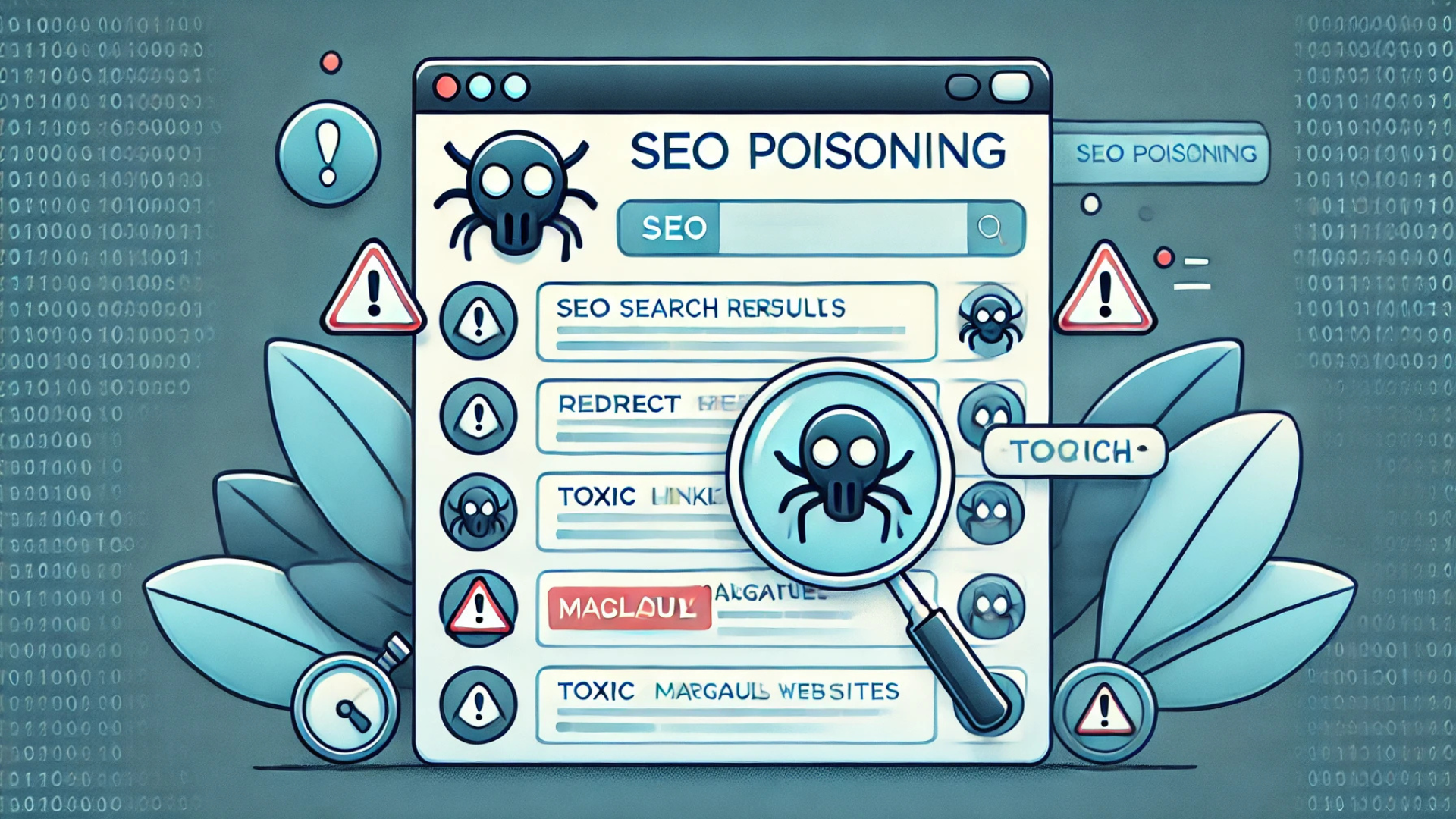
As we delve deeper into the digital age, cybersecurity threats continue to evolve with increasing sophistication. One of the emerging threats that is gaining notoriety is SEO Poisoning. This tactic deviates from traditional cyber threats such as phishing emails and malware-infested websites, instead manipulating search engine rankings to direct users unwittingly to malicious sites.
In this detailed overview, we will explore the mechanics behind SEO Poisoning, its effectiveness as a cyber threat, and strategic measures to safeguard against these covert attacks.
Understanding SEO Poisoning: The Cybercriminal’s New Weapon
SEO Poisoning, also known as Search Engine Poisoning, involves exploiting the mechanisms of Search Engine Optimization (SEO)—a legitimate strategy used by businesses to boost their website visibility on search engines like Google. Cybercriminals hijack this technique to promote malicious websites, leading users into traps that can result in the theft of sensitive data or the infection of devices with malware.
How SEO Poisoning Operates:
Niche Search Targeting: Cybercriminals target specific, less competitive search queries. These could range from legal inquiries about exotic pets to specialized technical support questions.
Manipulating Search Results: By optimizing malicious websites or links for these niche queries, hackers can position their traps at the top of search engine results, capturing the attention of unsuspecting users.
Trust Exploitation: Many users trust search engine results, assuming the top results are safe and verified, which is precisely what cybercriminals capitalize on.
The Efficacy of SEO Poisoning
What makes SEO Poisoning particularly effective is its ability to target curious users seeking quick answers, exploit the inherent trust in search engine results, and bypass conventional cybersecurity training that doesn’t typically cover this type of threat. The dynamic nature of SEO tactics makes these poisoned sites difficult to detect and block continuously.
Defensive Strategies Against SEO Poisoning:
Protecting against SEO Poisoning requires vigilance and a proactive approach to online safety:
Critical Evaluation of Search Results: Scrutinize the credibility of websites that appear in search results, especially for niche or unusual queries.
Enhanced Browser Security: Utilize built-in browser protections and external tools to check the safety of websites before engaging with them.
Education and Awareness: Expand cybersecurity training to include the risks and indicators of SEO Poisoning, emphasizing the importance of verifying online sources.
Cyber Hygiene Best Practices:
Verify Links: Always hover over a link to see the actual URL before clicking. Look out for typosquatting or unfamiliar domain names.
Adjust Browser Settings: Disable auto-downloads to prevent malicious sites from downloading files without consent.
Utilize Security Tools: Employ URL scanners and antivirus programs to check the safety of websites and files before interaction.
Why Staying Informed Matters
As cybercriminals continue to refine their strategies, understanding and anticipating emerging threats like SEO Poisoning is crucial for maintaining robust cybersecurity defenses. Awareness and proper security practices are your best defenses against these covert manipulations.
For further insights and proactive cybersecurity strategies, visit Peris.ai. Stay updated and secure with the latest in cyber defense tactics.
Your Peris.ai Cybersecurity Team #YouBuild #WeGuard
In the fast-paced and ever-changing realm of modern business, the significance of upholding ethical standards and adhering to regulations has reached unprecedented heights. With increasing scrutiny from stakeholders and an emphasis on corporate social responsibility, companies prioritizing ethical conduct cultivate trust among their stakeholders and establish a solid foundation for long-term success. This article delves into the critical importance of compliance and its challenges and presents strategies to empower businesses in effectively navigating the intricate landscape of ethics and regulations.
In an era characterized by heightened awareness and a demand for transparency, the consequences of non-compliance are more severe than ever before. The repercussions of failing to uphold ethical standards extend beyond mere legal consequences, encompassing reputational damage, financial losses, and a loss of public trust. Maintaining compliance has become essential to conducting business in today’s rapidly evolving landscape.
The primary objective of this article is to shed light on the profound significance of compliance in contemporary business practices. By exploring organizations’ challenges in achieving and sustaining compliance, we can gain valuable insights into the complexities involved. Furthermore, this article provides practical strategies and approaches that empower businesses to navigate the multifaceted realm of ethics and regulations with confidence and efficacy.
Understanding Compliance
Compliance refers to the adherence to laws, regulations, industry standards, and ethical guidelines that govern business operations. It ensures that organizations act responsibly, transparently, and in the best interests of their stakeholders. Compliance encompasses a wide range of areas, such as data privacy, anti-corruption, environmental sustainability, consumer protection, and employee rights. Neglecting compliance can lead to severe legal consequences, reputational damage, financial losses, and loss of public trust.
Challenges in Compliance
Complex Regulatory Environment: Businesses today face an increasingly complex web of regulations at the local, national, and international levels. Staying up-to-date with the ever-changing compliance landscape can be daunting.
Lack of Awareness: Many businesses struggle to understand the regulations that apply to their industry fully. Ignorance of compliance requirements can lead to unintentional violations and legal complications.
Resource Constraints: Small and medium-sized enterprises (SMEs) often lack the resources, expertise, and dedicated compliance teams to navigate compliance challenges effectively. Limited budgets can make it difficult to invest in compliance programs and training.
Cultural and Language Barriers: Companies operating globally must overcome cultural and language barriers when implementing compliance programs in different regions. Local customs, practices, and regulations vary, necessitating tailored approaches to meet compliance requirements.
Empowering Your Business Ethically
Commitment from Top Leadership: Ethical compliance begins with strong leadership commitment. Executives and board members must set the tone by fostering a culture of integrity, accountability, and ethical behavior throughout the organization. Clear policies and procedures should be established and communicated to all employees.
Robust Compliance Program: Developing a comprehensive compliance program is vital. It should include regular risk assessments, internal controls, monitoring mechanisms, and reporting systems to proactively identify, prevent, and address compliance issues. Such programs ensure employees understand their responsibilities and encourage them to report concerns or violations without fear of retaliation.
Employee Training and Awareness: Educating employees about compliance policies and regulations is crucial. Conduct regular training sessions to familiarize employees with ethical standards, potential risks, and how to handle ethical dilemmas. Foster a culture of open communication where employees feel comfortable seeking guidance and reporting concerns.
Effective Communication Channels: Establishing effective channels for reporting and addressing compliance issues is essential. Encourage employees to report suspected violations anonymously and provide protection against retaliation. Whistleblower hotlines, suggestion boxes, and regular feedback sessions can help create a safe environment for reporting concerns.
Continuous Monitoring and Auditing: Regular monitoring and auditing of business practices and processes can detect compliance gaps and deviations. Implementing internal and external audits and data analytics tools can help identify areas of improvement and prevent potential compliance breaches.
Collaboration with Regulatory Bodies: Engage with regulatory bodies and industry associations to stay informed about regulations and industry standards changes. Participate in relevant forums, conferences, and workshops to learn from industry peers and experts. Collaborative relationships with regulators can foster a better understanding of compliance expectations.
Technology and Automation: Leverage technology to streamline compliance processes and improve efficiency. Compliance management software, data analytics tools, and automation solutions can help identify risks, monitor compliance, and generate accurate reports. Automated reminders and workflows ensure timely action on compliance-related tasks.
Conclusion
Cracking the compliance code is paramount for empowering your business ethically in the modern business landscape. Prioritizing compliance enables organizations to build trust, mitigate risks, and achieve long-term success. Although the challenges of compliance may appear daunting, businesses can overcome them through a combination of strong leadership commitment, robust compliance programs, employee training, effective communication channels, continuous monitoring, collaboration with regulatory bodies, and the strategic use of technology.
Adhering to ethical standards and regulatory requirements safeguards businesses from legal consequences, elevates their reputation, and nurtures a culture of integrity. Compliance should be viewed as an opportunity to showcase responsible and ethical business practices, setting a positive example for employees, customers, and stakeholders. By instilling a strong compliance mindset within the organization, businesses can reinforce their commitment to ethical conduct and trust in their brand.
In today’s interconnected world, where information spreads rapidly and reputations can be built or shattered instantly, businesses cannot afford to overlook compliance. Embracing compliance as a strategic imperative empowers organizations to navigate the intricate compliance landscape while contributing to a sustainable and ethical business environment. By cracking the compliance code, businesses unlock their full potential, establish a solid foundation for growth, and pave the way for a successful and socially responsible future.
We invite you to visit our website to learn how to crack the compliance code and empower your business ethically and effectively. Explore our resources, tools, and solutions tailored to help businesses confidently navigate the complexities of compliance. Together, let us embark on a journey of ethical empowerment that protects our organizations, drives sustainable success, and positively impacts the world we operate in. Visit our website today and unlock the power of compliance for your business.
The digital world is always changing, with new tech popping up everywhere. Cyber threats are getting smarter, targeting people, companies, and governments. Endpoint Detection and Response (EDR) and Managed Endpoint Detection and Response (MEDR) are key in fighting these threats.
It’s important to know the difference between EDR and MEDR. Choosing the right one is vital for keeping your digital world safe. This is especially true in today’s fast-changing threat landscape.
Key Takeaways:
EDR solutions focus on endpoint-specific monitoring and threat detection, while MEDR encompasses advanced processes, threat hunting, and human expertise.
EDR solutions require organizations to have their own cybersecurity expertise, while MEDR providers bring specialized teams to handle threat detection, analysis, and incident response.
EDR is often a reactive approach, while MEDR services take a more proactive stance, actively monitoring and hunting for threats.
MEDR offers 24/7 monitoring and enables businesses to proactively protect their digital assets and sensitive data.
The decision to use EDR, MEDR, or both depends on an organization’s specific needs, resources, and budget.
Understanding Endpoint Security Threats
The Evolving Digital Landscape and Security Risks
More devices are connecting to cloud computing and IoT systems. This creates a bigger target for cyber threats. As devices grow, so do the ways attackers can get into a network. It’s key for companies to know these risks to plan better and defend themselves.
Potential Entry Points for Cyber Threats
Cloud and IoT use has opened up new ways for threats to get in. Companies need to watch these points closely to keep their data safe. A strong security plan can help fight off these new dangers.
Knowing the digital world and where threats can come from helps companies protect their endpoints.
What is Endpoint Detection and Response (EDR)?
Endpoint Detection and Response (EDR) is a key part of cybersecurity. It focuses on finding and handling suspicious activity from all devices on a network. EDR systems record what happens on the network and keep it in a central database. They use AI and ML to help experts sort and analyze the data, find what’s normal, and spot anything out of the ordinary that might be a threat.
Detecting and Reporting Suspicious Endpoint Activity
EDR tools watch over endpoint activity and spot any odd behavior that could mean a security issue. They look for things like unauthorized access, strange file changes, and odd network connections. By always watching, EDR systems can quickly spot and warn about potential threats. This lets security teams jump into action fast to deal with problems.
How EDR Protects Your Network
EDR does more than just find and report on odd activity. It also helps keep your network safe. EDR tools can stop or isolate infected devices, stopping malware from spreading. They also give security teams important details and context, helping them understand and tackle attacks effectively.
“EDR solutions are a critical component of modern cybersecurity, providing organizations with the tools and visibility they need to defend against evolving threats.”
Benefits of EDR Solutions
Endpoint Detection and Response (EDR) solutions are key in today’s digital world. They help security teams tackle threats fast with automated systems. EDR also keeps remote workforces safe by watching endpoints and spotting odd activity. Plus, they work well with other security tools, like Endpoint Protection Platforms (EPP), to protect against cyber threats.
Automated Response Systems
EDR shines with its automated response. It can quickly sort alerts, check big data, find security issues, and give threat info. This helps security teams act fast and right against threats.
Secure Your Remote Workforce
Remote work is common now, making endpoint security vital. EDR gives deep insight into many endpoints, like IoT devices and laptops. This lets teams watch and act on threats across the remote workforce.
Works in Conjunction with Other Security Products
EDR is made to work with other security tools. It teams up with EPP to make a strong defense against cyber threats. This combo gives better visibility, threat finding, and response skills.
“EDR solutions offer a powerful combination of real-time monitoring, endpoint data analytics, and automated response functionality to enhance an organization’s overall cybersecurity posture.”
EDR solutions bring many benefits, like automated response, remote workforce security, and integrated security. These tools help tackle today’s digital threats. By using EDR, companies can get stronger against cyber threats.
EDR vs. MEDR: What’s the Difference and Why it Matters
Endpoint Detection and Response (EDR) solutions are a strong tool against cyber threats. But, they need expert help to work best. Managed Endpoint Detection and Response (MEDR) solutions offer the needed analysis and support for network security.
EDR mainly watches over individual devices like computers and servers. It helps security teams spot threats and handle attacks. MEDR, on the other hand, looks at the whole network, giving a broader view of security.
EDR is good for small and medium-sized businesses. But, MEDR is better for big, complex networks with many devices. MEDR uses outside experts for better threat detection, solving the problem of finding skilled cybersecurity workers.
Choosing between EDR and MEDR depends on several things. These include how big the organization is, the network’s complexity, available resources, and budget. Both have their benefits. EDR improves threat detection with advanced tools. MEDR offers ongoing monitoring and expert help in cybersecurity.
As cyber threats grow, knowing the difference between EDR and MEDR is key. It helps organizations boost their cybersecurity and protect against digital risks.
Managed Endpoint Detection and Response (MEDR)
As the digital world keeps changing, companies face more cybersecurity challenges. More devices and remote work have made it harder to keep things safe. Managed Endpoint Detection and Response (MEDR) is a strong way to protect endpoints and lower security risks.
Key Features and Benefits of MEDR
MEDR uses advanced tech like AI and machine learning for real-time monitoring and threat detection. This helps businesses quickly find and stop security problems, keeping operations and data safe. It includes ongoing monitoring, detailed threat analysis, and fast incident response, all with the help of cybersecurity experts.
Real-time monitoring and detection of suspicious endpoint activity
Prompt incident response and remediation to minimize the impact of security breaches
Expert oversight and support from a dedicated cybersecurity team
Comprehensive coverage and tailored security policies to address unique business needs
MEDR is more focused and proactive than traditional security methods. It combines Endpoint Protection Platform (EPP) and Endpoint Detection and Response (EDR) to fight advanced threats like zero-day exploits and fileless malware.
MEDR’s focus on early detection, quick containment, detailed investigation, and complete threat removal is key for businesses that value uptime and data safety. With MEDR, companies can get help from a dedicated cybersecurity team to improve their security and handle digital landscape changes.
“MEDR solutions offer proactive defense, comprehensive coverage, and strategic response, empowering businesses to stay ahead of the curve in the face of escalating cybersecurity threats.”
Limitations of MEDR in Complex Security Environments
Managed Endpoint Detection and Response (MEDR) solutions are great for protecting endpoints. But, they struggle in today’s connected world. Threats can move easily through networks, cloud services, and even use user behaviors. This makes MEDR’s focus on endpoints not enough for today’s complex threats.
Another big issue is MEDR’s limited view of an organization’s security. It mainly looks at endpoint security. But it misses the big picture of networks, cloud, and user activities. This makes it hard to catch and stop threats that move between different areas.
Remote work and cloud services have made security even harder. Traditional MEDR solutions can’t keep up with these changing environments. Threats can dodge traditional defenses and hit endpoints and cloud services.
To overcome these challenges, organizations might want to look into more advanced solutions. Managed Extended Detection and Response (MXDR) offers a better way to handle threats. It gives a more complete view and works across different areas of the IT infrastructure.
What is Managed Extended Detection and Response (MXDR)?
MXDR is a top-notch security solution that goes beyond traditional endpoint detection. It covers networks, cloud environments, and user behavior. It uses advanced analytics and threat intelligence to fight off complex cyber threats.
MXDR’s Enhanced Capabilities
MXDR uses AI and ML to boost its detection and response abilities. It analyzes huge amounts of data from different sources to spot and stop threats fast. It also automates how it handles incidents, helping organizations respond quickly and well.
The Need for MXDR in Modern Cybersecurity
Cyber threats are getting more complex and varied, making old security methods not enough. With more people working from home, endpoint security is harder to manage. The Internet of Medical Things (IoMT) is also growing fast, adding to the security challenges.
Cloud Service Providers, especially Microsoft, are leading in Extended Detection and Response (XDR). Microsoft’s strong presence in key areas gives it an edge.
“MXDR integrates security across various IT components, offering advanced analytics and threat intelligence, proactive threat hunting, and automated response and remediation capabilities.”
Choosing Between MEDR and MXDR
Organizations face a choice between Managed Endpoint Detection and Response (MEDR) and Managed Extended Detection and Response (MXDR) for endpoint security. It’s important to understand what each offers to protect against cyber threats.
Feature Comparison: MEDR vs. MXDR
MEDR mainly focuses on protecting endpoints. It includes real-time monitoring, anomaly detection, and response for devices like desktops, laptops, and mobile phones. On the other hand, MXDR offers a broader view. It combines data from endpoints, networks, cloud services, and user behavior analytics for a unified security solution.
MXDR offers advanced analytics, automation, and threat intelligence. This makes it a stronger defense against today’s cyber threats.
The choice between MEDR and MXDR depends on your security needs, resources, and IT environment complexity. If you need broad protection, MXDR might be better. For a focus on endpoint security, MEDR could be the way to go.
The Evolution of Endpoint Security Solutions
The world of endpoint security has changed a lot because of new cyber threats. Now, we need protection, detection, and response to keep our IT safe. It all started with simple anti-virus software. Then, we moved to Endpoint Protection Platforms (EPP) that use smarter ways to fight threats.
Next, Endpoint Detection and Response (EDR) solutions came along. They help find and fix problems after a breach. Today, most companies use a mix of EPP and EDR to stay safe from all kinds of threats.
Managed Endpoint Detection and Response (MEDR) is becoming more popular. It’s like EDR but managed by experts. It’s great for companies that can’t handle it on their own. But, bigger companies might choose to manage it themselves.
Choosing between EDR and MEDR depends on a few things. You need a Security Operations Center (SOC) and the right skills. EDR helps find and deal with advanced threats fast. It also keeps your company in line with rules and regulations.
In short, endpoint security has grown a lot. It started with simple anti-virus and now we have EPP, EDR, and MEDR. These updates help protect us from new threats.
“EDR solutions empower security teams to instantly comprehend attacks and boost their response capabilities, crucial in a rapidly evolving cyber threat landscape.”
Conclusion
As cybersecurity changes, companies must review their endpoint security plans. Both Endpoint Detection and Response (EDR) and Managed Endpoint Detection and Response (MEDR) are strong. But Managed Extended Detection and Response (MXDR) is more flexible and effective against today’s threats.
It’s key to understand the value of proactive threat hunting and the limits of passive alerting tools. A good security solution must tackle advanced threats, limited resources, and compliance issues. Companies should look into MXDR for its 24/7 monitoring and active defense across various devices.
Choosing MXDR can boost a company’s cybersecurity efforts. It helps in catching critical incidents and protecting valuable assets. The decision between MEDR and MXDR is vital for an organization’s security in the ever-changing digital world.
FAQ
What is Endpoint Detection and Response (EDR)?
EDR tools and techniques help find and report on suspicious activity from network endpoints. They record network activity and store it in a central database. AI and machine learning help analyze this data.
What are the benefits of EDR solutions?
EDR solutions have many benefits. They include automated response systems and the ability to monitor remote workforces. They also work with other security products for a stronger defense against cyber threats.
What is Managed Endpoint Detection and Response (MEDR)?
MEDR solutions protect endpoint devices with advanced technology and expert oversight. They offer real-time monitoring, sophisticated threat detection, and quick incident response. Cybersecurity experts help manage and respond to security incidents.
What are the limitations of MEDR?
MEDR provides strong protection for endpoints but has limitations. It may not be enough against threats that move across networks and cloud services. It also doesn’t address threats that exploit user behaviors.
What is Managed Extended Detection and Response (MXDR)?
MXDR goes beyond MEDR by offering a more complete defense against cyber threats. It integrates security across networks, cloud services, and user behavior. It uses advanced analytics and threat intelligence for proactive threat hunting and automated response.
How do MEDR and MXDR differ?
MEDR mainly focuses on endpoints, while MXDR covers endpoints, networks, cloud services, and user behavior. MXDR’s broad approach and advanced analytics make it a stronger defense against today’s cyber threats.
Amidst this age of technological prowess, where digital threads weave together the fabric of business operations, external exposure management has ascended to the realm of paramount importance. In a landscape perpetually rife with digital interconnections and interdependencies, an organization’s attack surfaces, akin to an intricate tapestry, represent the sum total of potential entry points accessible to both legitimate users and malicious agents. The alarming escalation of cyber threats in frequency and complexity has sounded a clarion call for businesses to embrace vigilance and sculpt comprehensive and resilient strategies that safeguard their digital sanctums. This exposé ventures beyond the surface, delving deep into the intricate nuances of external exposure management, unveiling its cardinal components, and providing a navigational compass for organizations to traverse the labyrinthine domain of modern cybersecurity, thereby ensuring the impregnability of their digital endowments.
Understanding External Exposure Management
External exposure management refers to the proactive identification, assessment, and mitigation of vulnerabilities present in an organization’s attack surfaces. An attack surface encompasses all points of entry that malicious actors could potentially exploit. These entry points could include web applications, APIs, network infrastructure, cloud services, and connected devices.
External exposure management involves understanding the organization’s digital footprint from an attacker’s perspective. It aims to minimize the potential avenues of attack by identifying and addressing weaknesses before they can be exploited. This approach starkly contrasts traditional security methods focusing solely on fortifying the perimeter without considering the broader attack surface.
Key Components of External Exposure Management
Asset Discovery and Inventory: The first step in managing external exposure is comprehensively understanding an organization’s digital assets. This involves thorough asset discovery to identify all systems, applications, and services accessible outside the organization’s network. Maintaining an accurate inventory helps assess potential risks and track changes over time.
Vulnerability Assessment: Once the assets are identified, a vulnerability assessment is conducted to pinpoint weaknesses in those assets. This assessment involves using automated tools to scan for known vulnerabilities, misconfigurations, and outdated software. Regular vulnerability assessments are essential to stay ahead of emerging threats and ensure timely remediation.
Threat Intelligence: Staying informed about the latest cyber threats is crucial for effective external exposure management. Threat intelligence involves gathering information about potential attackers, their tactics, techniques, and procedures (TTPs), and the vulnerabilities they commonly exploit. This knowledge enables organizations to prioritize their security efforts and allocate resources where they are most needed.
Patch Management: Vulnerabilities discovered during the assessment phase must be patched promptly. Timely patching helps close security gaps and reduce the window of opportunity for attackers. An effective patch management process ensures that critical security updates are applied without disrupting essential business operations.
Configuration Management: Misconfigured systems and applications can create significant security vulnerabilities. Configuration management involves ensuring that all software, systems, and services are properly configured according to security best practices. Regular reviews and audits are essential to maintain a secure configuration over time.
Web Application Security: Web applications often serve as attractive targets for attackers. Implementing secure coding practices, regular security testing, and web application firewalls (WAFs) can help protect these crucial components of the attack surface.
Access Control and Authentication: Controlling access to external-facing systems is vital for reducing the attack surface. Strong authentication mechanisms, multi-factor authentication (MFA), and the principle of least privilege should be implemented to restrict unauthorized access.
Holistic Approach: External exposure management is most effective when approached holistically. It should be an ongoing process that involves multiple teams, including cybersecurity, IT operations, and development. Collaboration between these teams ensures that security measures are seamlessly integrated into the organization’s processes.
Automation: Given the complexity of modern IT environments, manual management of external exposure is often impractical. Automation is crucial in streamlining asset discovery, vulnerability assessment, and patch management processes. Automated tools can help identify vulnerabilities more quickly and allow organizations to respond promptly.
Regular Monitoring and Incident Response: Continuous monitoring of the attack surface is essential to detect and respond to threats in real time. Organizations should establish robust incident response plans that outline steps to take in case of a security breach. Regular testing of these plans through simulated exercises helps ensure readiness.
Employee Training and Awareness: Human error remains a significant factor in security breaches. Comprehensive employee training programs are essential to educate staff about security best practices, phishing awareness, and the importance of adhering to security policies.
Third-Party Risk Management: Organizations often rely on third-party vendors and partners, increasing the attack surface indirectly. Assessing the security practices of third parties and ensuring they meet the organization’s standards is critical for overall security posture.
The Benefits of Effective External Exposure Management
Implementing a robust external exposure management strategy offers several significant benefits to organizations:
Reduced Risk: By identifying and addressing vulnerabilities proactively, the risk of successful cyberattacks is significantly reduced.
Enhanced Reputation: Effective external exposure management demonstrates a commitment to cybersecurity, which can enhance an organization’s reputation and foster trust among customers and partners.
Regulatory Compliance: Many industries have specific regulatory requirements for data protection and cybersecurity. A comprehensive external exposure management strategy helps organizations comply with these regulations.
Cost Savings: Preventing security breaches through proactive measures is often more cost-effective than dealing with the aftermath of an attack.
Business Continuity: A secure attack surface contributes to business continuity by minimizing disruptions caused by security incidents.
In summation
The relentless march toward digitalization and the pervasive expansion of online frontiers propel the notion of external exposure management into the realm of absolute necessity. In an era where a seamless digital tapestry interconnects businesses across the globe, the vulnerabilities and potential entry points that comprise an organization’s attack surface assume unprecedented significance. This, coupled with the incessant crescendo of cyber threats, paints a compelling portrait of urgency that necessitates steadfast action and the orchestration of multifaceted strategies to erect formidable fortifications around the digital citadels we have meticulously built.
The importance of safeguarding these virtual bastions through vigilant external exposure management cannot be overstated. The convergence of proactive identification, rigorous assessment, and resolute mitigation of vulnerabilities forms the bedrock upon which the defense against an ever-evolving threat landscape is erected. With each passing day, the arsenal of cyber adversaries swells with novel stratagems and techniques, necessitating a dynamic and all-encompassing approach to security. Adopting a holistic stance, whereby every facet of an organization’s digital footprint is scrutinized and fortified, assumes a mantle of paramount significance.
However, the journey toward impregnable cyber resilience is not one that organizations need to embark upon alone. An array of cutting-edge solutions and strategies beckon, poised to escort businesses through the intricate terrain of external exposure management. To explore these avenues further and uncover tailored approaches that suit the unique contours of your organization’s digital architecture, we invite you to navigate to our website. There, you will find a repository of insights, tools, and resources illuminating the path toward safeguarding your attack surfaces. In a world where digital perimeters expand ceaselessly and cyber threats lurk ominously, the choice to fortify and preserve your digital assets rests within your grasp. Seize the opportunity today – visit our website and embark on a journey toward fortified digital resilience.
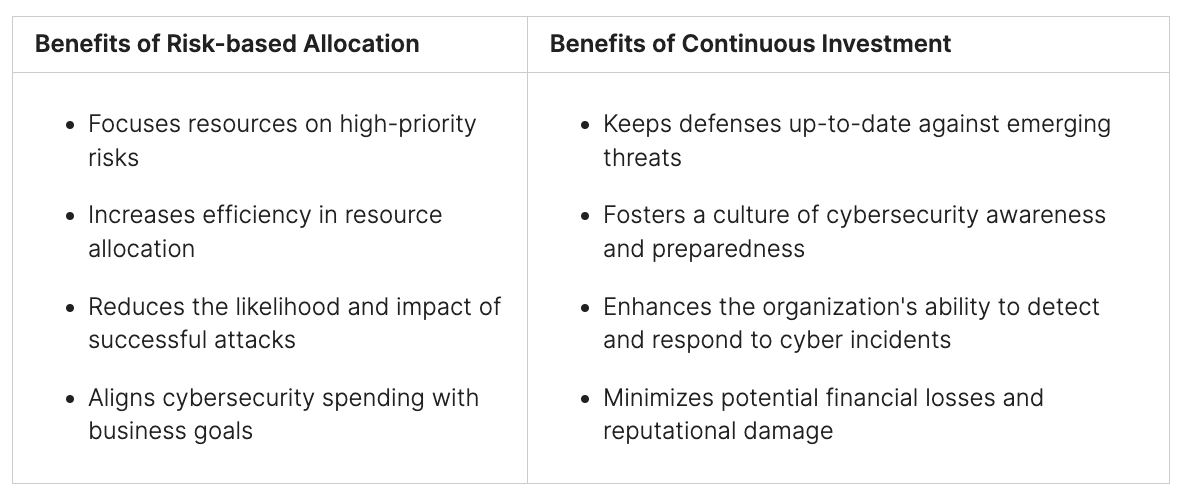
When it comes to cybersecurity, it is crucial for organizations to have a dedicated budget separate from other departmental expenses. This ensures that sufficient resources are allocated to protect against cyber threats and maintain the security of sensitive data.
Cybersecurity budgeting requires a strategic approach to separate cybersecurity expenses from other financial obligations. By doing so, organizations can prioritize the protection of their systems and data, mitigating the potential risks associated with cyber threats.
Key Takeaways:
Allocate a separate budget specifically for cybersecurity to ensure adequate resource allocation.
Strategically separate cybersecurity expenses from other departmental expenses to prioritize security.
Effective budgeting for cybersecurity requires a thorough understanding of the organization’s specific needs and risks.
Creating a comprehensive financial plan and projecting future security needs is essential for successful cybersecurity budgeting.
Balancing cybersecurity with other business priorities is crucial for the overall success of the organization.
Understanding the Importance of Dedicated Cybersecurity Funding
Cyber threats are becoming increasingly prevalent, with organizations facing a growing number of data breaches, ransomware attacks, and other malicious activities. To effectively safeguard against these threats, it is crucial to have dedicated funding specifically allocated for cybersecurity. By prioritizing and investing in cybersecurity, organizations can protect their sensitive data, maintain customer trust, and safeguard their overall operations.
The Rising Costs and Implications of Cyber Threats
The cost of cyber threats is on the rise, and the implications of a successful attack can have severe consequences for an organization. From financial losses due to data breaches to reputational damage and legal liabilities, the impact of cyber threats can be devastating. As the sophistication and frequency of cyber attacks continue to escalate, organizations need to stay one step ahead by allocating the necessary financial resources to combat these threats effectively.
Separating Cybersecurity from IT: Strategic Focus on Protection
Traditionally, organizations have viewed cybersecurity as part of their broader IT budget. However, an effective cybersecurity strategy requires a distinct focus and dedicated funding separate from IT expenditures. By separating cybersecurity from IT, organizations can strategically prioritize and allocate resources to proactively address cyber threats. This approach enables a more targeted and comprehensive cybersecurity program that aligns with the organization’s overall risk profile and strategic objectives.
Unveiling Cybersecurity’s Independence: A Strategic Investment for Resilience.
Assessing Your Organization’s Cybersecurity Needs
Before creating a cybersecurity budget, it is important to assess your organization’s specific cybersecurity needs. This involves evaluating your current cybersecurity posture and identifying potential risks. Also, it is crucial to figure out the scope of the cybersecurity measures required to protect your organization effectively. This section will guide you through the process of assessing your cybersecurity needs.
Evaluating Current Cybersecurity Posture and Risks
One of the first steps in assessing your organization’s cybersecurity needs is to evaluate your current cybersecurity posture. This involves examining your existing security infrastructure, policies, and practices to identify any weaknesses or vulnerabilities. Consider conducting a comprehensive security assessment or engaging an external cybersecurity expert to provide an objective evaluation. By understanding your current cybersecurity posture, you can better prioritize and allocate resources to strengthen your defenses.
Furthermore, it is essential to assess the specific risks that your organization faces. This includes identifying potential threats and vulnerabilities that could compromise your systems or data. Conduct a thorough risk analysis to determine the likelihood and potential impact of each risk. This analysis will help you prioritize your cybersecurity efforts and allocate resources to address the most critical areas of concern.
Identifying the Scope of Required Cybersecurity Measures
Once you have evaluated your current cybersecurity posture and identified the risks your organization faces, it is very important to identify the scope of the cybersecurity measures required to take care of these risks. This involves determining the specific actions and controls needed to protect your organization’s assets.
Consider the following areas when identifying cybersecurity measures:
Network security: Evaluate the security of your network infrastructure, including firewalls, intrusion detection systems, and secure remote access.
Endpoint security: Assess the security measures in place for devices such as computers, laptops, smartphones, and tablets.
Data protection: Determine the methods and technologies used to safeguard sensitive data, including encryption, access controls, and backups.
Security awareness training:Evaluate the effectiveness of employee training programs in promoting good security practices and reducing the risk of human error.
Incident response: Establish procedures and protocols for detecting, responding to, and recovering from cybersecurity incidents.
By identifying the scope of required cybersecurity measures, you can develop a comprehensive plan that addresses your organization’s unique security needs and minimizes the risk of cyber threats.
Creating a Comprehensive Financial Plan for Cybersecurity
Building a robust and effective cybersecurity strategy requires more than just implementing security measures. It also entails creating a comprehensive financial plan that considers the projected costs associated with safeguarding your organization’s digital assets. By accurately predicting security costs, you can allocate resources effectively and ensure the long-term sustainability of your cybersecurity initiatives.
Projecting the Budget: Predicting Cost for Future Security Needs
One crucial aspect of creating a financial plan for cybersecurity is predicting the budget needed to address future security needs. This involves assessing the current threat landscape, as well as understanding the potential risks and vulnerabilities that your organization may face in the coming months or years.
To accurately project your cybersecurity budget, consider the following:
Perform a thorough risk assessment: Identify the potential cybersecurity risks that your organization may encounter, both internally and externally. This includes evaluating the likelihood of specific threats and the potential impact they may have on your business operations.
Map out your security roadmap: You can develop a strategic plan that outlines the security measures and initiatives you intend to implement to mitigate identified risks. Determine the associated costs for each initiative, including training, technology solutions, and ongoing monitoring and maintenance.
Please take a look at industry trends and compliance requirements: Stay informed about evolving technology trends and regulatory obligations within your industry. These factors may influence your cybersecurity budget as new threats emerge or compliance standards evolve.
Engage with cybersecurity experts: Seek guidance from cybersecurity professionals who can provide insights into industry best practices and cost projections. They can help you develop a realistic budget based on your organization’s unique requirements.
By considering these factors and engaging in proactive planning, you can create a financial plan that accounts for the predicted security costs and aligns with your organization’s cybersecurity goals.
Allocating Resources: How to Budget Specifically for Cybersecurity Separate from Other Departmental Expenses?
Establishing a separate budget for cybersecurity requires careful resource allocation to ensure adequate funding is available. Allocating resources effectively specifically for cybersecurity is crucial in enhancing the security posture of your organization without compromising other financial obligations. By following these strategies, you can prioritize cybersecurity and protect your organization from potential cyber threats while maintaining a balanced budget.
Balancing Act: Strategically Funding Cybersecurity for Robust Protection.
Examining Cost Allocation Models for Cybersecurity Expenditure
In order to effectively budget for cybersecurity, it is important to understand different cost allocation models. By examining these models, organizations can determine the most suitable approach for allocating funds to cybersecurity initiatives.
Fixed vs. Variable Cybersecurity Costs: Planning Accordingly
When allocating costs for cybersecurity, it is crucial to distinguish between fixed and variable expenses. Fixed costs are those that remain constant regardless of the level of cybersecurity activity, such as the salaries of dedicated cybersecurity staff or the licensing fees for security software. On the other hand, variable costs fluctuate based on the level of cybersecurity activity, such as the costs of incident response services or the expenses incurred during a security breach.
Planning for fixed costs involves accurately forecasting the expenses that will remain constant over time. This requires considering factors such as ongoing investments in cybersecurity personnel, software licenses, and hardware infrastructure. By establishing a baseline for fixed costs, organizations can ensure the continuous availability of essential cybersecurity resources.
Variable costs, on the other hand, can be more challenging to budget for as they can vary based on the severity and frequency of cybersecurity incidents. Organizations must conduct a thorough risk assessment to identify potential vulnerabilities and determine the potential costs associated with incident response, recovery, and mitigation measures. Developing contingency plans and setting aside funds specifically for variable cybersecurity costs can help organizations effectively respond to unforeseen incidents without compromising other financial obligations.
Investment in Cybersecurity as a Percentage of IT Spend
One way to determine the appropriate level of investment in cybersecurity is to consider it as a percentage of the overall IT spend. This approach ensures that organizations allocate a proportional amount of resources to cybersecurity based on their overall technology investments and risk exposure.
Industry benchmarks suggest that organizations should allocate approximately 10% of their IT budget to cybersecurity. However, the specific percentage may vary depending on the organization’s risk profile, industry, and regulatory requirements. Organizations operating in highly regulated sectors, such as healthcare or finance, may need to allocate a higher percentage of their IT spending to cybersecurity to meet compliance standards and protect sensitive data.
It is important for organizations to regularly review and reassess their investment in cybersecurity as a percentage of IT spending, considering changes in the threat landscape, emerging technologies, and evolving business priorities. By consistently monitoring and adjusting the allocation of resources, organizations can ensure that they maintain an appropriate level of cybersecurity investment that aligns with their risk appetite and strategic objectives.
Funding Allocation: Balancing Cybersecurity With Other Business Priorities
When it comes to cybersecurity, organizations often face the challenge of balancing their security needs with other critical business priorities. It is essential to allocate funding in a way that addresses cybersecurity risks while supporting the overall success of the organization.
Prioritizing Allocation Based on Risk Assessment
One approach to funding allocation for cybersecurity is based on a risk assessment. By conducting a thorough evaluation of potential risks and vulnerabilities, organizations can identify areas of highest priority. Allocating more resources to these areas helps mitigate the most significant threats and strengthens the organization’s overall security posture.
Targeted Investments: Mitigating Risks through Strategic Cybersecurity Allocation.
Ensuring Continuous Investment in Cyber Defenses
Cybersecurity is an ongoing battle, with new threats emerging regularly. To effectively protect against these evolving risks, organizations must commit to continuous investment in cyber defenses. This includes allocating funds for regular updates to security infrastructure, training and awareness programs, and proactive monitoring systems. By maintaining consistent investment in cyber defenses, organizations can stay one step ahead of cybercriminals and reduce the risk of successful attacks.
By striking a balance between risk-based allocation and continuous investment in cyber defenses, organizations can effectively manage their cybersecurity needs while still addressing other critical business areas. This strategic approach enables organizations to achieve a strong security posture that protects their sensitive data and supports their long-term success.
Incorporating Cybersecurity Budget into Overall Business Strategy
Cybersecurity is not just a standalone department but an integral part of an organization’s overall business strategy. It is essential to recognize that cybersecurity should be considered as a critical component that aligns with the broader strategic plan. By incorporating the cybersecurity budget into the overall business strategy, organizations can ensure that adequate resources are allocated to protect against cyber threats and maintain the security of sensitive data.
Board-Level Engagement and Support for Cybersecurity Initiatives
To successfully incorporate the cybersecurity budget into the overall business strategy, board-level engagement and support are crucial. It is imperative for the board of directors to actively participate in cybersecurity discussions, providing guidance and oversight. By involving the board in cybersecurity initiatives, organizations can demonstrate the importance of cybersecurity and gain the necessary support to implement effective security measures.
Board-level support also ensures that the cybersecurity budget is adequately allocated and aligned with the organization’s risk appetite and overall strategic objectives. Boards should actively review and approve the cybersecurity budget, understanding the potential financial impact of cyber threats and the need for proactive protection.
Integrating Cybersecurity in Business Continuity and Recovery Planning
In addition to board-level support, integrating cybersecurity in business continuity and recovery planning is vital. Cybersecurity should not be seen as a separate entity but as an integral part of the organization’s ability to withstand and recover from cyber incidents. By integrating cybersecurity into business continuity and recovery planning, organizations can ensure a holistic approach to resilience.
When developing business continuity and recovery plans, it is essential to consider the potential impact of cyber threats and include appropriate response measures. This integration ensures that cybersecurity measures are aligned with the organization’s overall recovery objectives and helps minimize disruptions and damages resulting from cyber incidents.
By incorporating the cybersecurity budget into the overall business strategy, gaining board-level engagement and support, and integrating cybersecurity into business continuity and recovery planning, organizations can strengthen their cybersecurity posture and effectively protect against evolving cyber threats.
Fortifying Defenses: Uniting Strategy, Support, and Resilience in Cybersecurity.
Maintaining Financial Flexibility for Unforeseen Cybersecurity Needs
When it comes to cybersecurity, organizations must always be prepared for unexpected incidents that could compromise their security. No matter how well they budget for cybersecurity, emergency security breaches can still occur, requiring swift and effective responses. This is why maintaining financial flexibility is crucial to address unforeseen cybersecurity needs.
Establishing a Reserve Fund for Emergency Security Breaches
One effective strategy for maintaining financial flexibility is to establish a reserve fund specifically for emergency security breaches. This reserve fund serves as a dedicated pool of resources that can be accessed when unforeseen cyber incidents arise.
By setting aside a portion of the cybersecurity budget for this reserve fund, organizations can ensure they have the necessary financial means to respond effectively in the face of emergency security breaches. This includes covering the costs associated with incident response, remediation, and recovery, as well as any potential legal or regulatory obligations that may arise.
Having a reserve fund for emergency security breaches provides peace of mind, allowing organizations to respond swiftly and mitigate potential damages without jeopardizing their overall cybersecurity posture or depleting resources allocated for other essential business operations.
Establishing a reserve fund for emergency security breaches demonstrates a proactive approach to cybersecurity, emphasizing the importance of preparedness and financial readiness. It showcases the organization’s commitment to safeguarding sensitive data and protecting against cyber threats, even in the face of unexpected incidents.
Preparedness Pays Off: Building Reserves for Cybersecurity Emergencies.
Benefits of Establishing a Reserve Fund for Emergency Security Breaches
Financial readiness to address unforeseen cybersecurity incidents
Swift and effective response to mitigate potential damages
Avoidance of depleting resources allocated for other business operations
Demonstrates a proactive approach to cybersecurity
Highlights commitment to safeguarding sensitive data
Measuring the ROI of Cybersecurity Investments
When it comes to cybersecurity, organizations must be able to measure the return on investment (ROI) of their cybersecurity investments. This not only helps justify cybersecurity expenses but also demonstrates the value of these investments to the organization as a whole.
Tracking cybersecurity spending and linking it to measurable business outcomes is crucial for determining the effectiveness of cybersecurity initiatives. By quantifying the benefits of cybersecurity investments, organizations can make informed decisions and optimize their cybersecurity budget.
One effective strategy for tracking cybersecurity spending is to align it with specific business outcomes. By identifying key performance indicators (KPIs) related to cybersecurity, organizations can monitor and evaluate the impact of their investments. This allows for better decision-making and resource allocation, ensuring that cybersecurity initiatives are aligned with business objectives.
Cybersecurity investments should not be seen as purely defensive measures. They can also directly contribute to positive business outcomes. For example, a robust cybersecurity program can enhance customer trust, protect the organization’s reputation, and even open new business opportunities.
By understanding the business outcomes that can be achieved through cybersecurity investments, organizations can strengthen their justification for cybersecurity expenses. This enables them to secure the necessary resources to implement effective cybersecurity measures and safeguard their digital assets.
Overall, measuring the ROI of cybersecurity investments is essential for tracking cybersecurity spending, justifying cybersecurity expenses, and aligning cybersecurity initiatives with business outcomes. It empowers organizations to make informed decisions, optimize their cybersecurity budget, and enhance their overall security posture.
Conclusion
In today’s dynamic cyber landscape, adapting cybersecurity budgets is critical for organizations to effectively combat evolving threats. The realm of cyber risks is ever-changing, introducing new challenges and technologies regularly. Regular budget assessments empower organizations to allocate resources strategically, ensuring readiness to tackle these evolving complexities.
Adapting budget allocations empowers swift resource reallocation to the areas needing immediate attention. It enables proactive measures against emerging threats by investing in vital tools, technology, and training, fortifying the cybersecurity infrastructure. This proactive stance minimizes vulnerabilities, bolstering defenses against cyberattacks.
Investing in cyber resilience is an enduring asset for organizations. A robust cybersecurity framework not only shields sensitive data and vital systems but also upholds the organization’s integrity and customer trust. Prioritizing cyber resilience with dedicated resources minimizes financial and reputational fallout from potential cyber incidents.
As threats evolve, it’s imperative for organizations to recognize cybersecurity as a continuous investment rather than a one-time cost. Constantly evaluating and adjusting cybersecurity budgets enables staying ahead of emerging threats, maintaining robust security measures, and protecting digital assets.
Take the next step in fortifying your cybersecurity. Visit Peris.ai Cybersecurity today to explore innovative solutions that adapt to evolving threats, ensuring your organization’s resilience in the face of cyber challenges.
FAQ
Why is it important to budget specifically for cybersecurity, separate from other departmental expenses?
By having a dedicated budget for cybersecurity, organizations can ensure sufficient resources are allocated to protect against cyber threats and maintain the security of sensitive data.
What are the rising costs and implications of cyber threats?
Cyber threats, such as data breaches and ransomware attacks, are increasing in frequency and sophistication, posing significant financial and reputational risks to organizations.
Why is it necessary to separate cybersecurity from IT?
Separating cybersecurity from IT allows organizations to strategically focus on protection, ensuring that proper resources and attention are devoted specifically to safeguarding against cyber threats.
How can I assess my organization’s cybersecurity needs?
Start by evaluating your current cybersecurity posture and identifying potential risks. Then, determine the scope of the cybersecurity measures required to effectively protect your organization.
How do I create a comprehensive financial plan for cybersecurity?
Project the budget by predicting the costs associated with implementing cybersecurity measures. This will help make sure your organization is adequately prepared to address current and future security needs.
How can I allocate resources specifically for cybersecurity separate from other departmental expenses?
Careful resource allocation is key. By establishing a separate budget for cybersecurity and considering the impact on other departmental expenses, you can ensure adequate funding is available for cybersecurity initiatives.
What are the different cost allocation models for cybersecurity expenditure?
There are fixed and variable cybersecurity costs. Understanding these models allows organizations to plan and budget accordingly for cybersecurity expenses.
How should I prioritize funding allocation for cybersecurity?
Prioritize funding based on risk assessment, ensuring that investments in cyber defenses align with the level of potential threats. Continuously investing in cybersecurity is crucial for ongoing protection.
How can I incorporate the cybersecurity budget into my organization’s overall business strategy?
Ensuring board-level engagement and support for cybersecurity initiatives is essential. Additionally, integrating cybersecurity into business continuity and recovery planning can enhance overall resilience against cyber threats.
Why is it important to maintain financial flexibility for unforeseen cybersecurity needs?
Unexpected cybersecurity incidents can occur at any time. By establishing a reserve fund specifically for emergency security breaches, organizations can respond swiftly and effectively to mitigate potential damages.
How can I measure the return on investment (ROI) of cybersecurity investments?
Track cybersecurity spending and link it to measurable business outcomes. This allows organizations to justify cybersecurity spending and optimize their cybersecurity budget based on quantifiable benefits.
What should I consider when reviewing and adjusting the cybersecurity budget over time?
It is crucial to regularly review and adjust the cybersecurity budget to address evolving risks and technologies. Additionally, investing in cyber resilience can provide long-term value and enhance the overall security posture.
Cloud computing is becoming more common, making cloud security a big issue. Almost 80% of companies face a data breach in 18 months. Data breaches are the biggest risk for companies, and many don’t use basic security tools like encryption.
To keep your cloud safe, it’s key to get advice from a cloud security expert. They can teach you about the best ways to secure your cloud and offer solutions that meet strict standards.
Using cloud security best practices, like encryption and access control, can lower the risk of data breaches. A cloud security specialist can create custom solutions to protect your data.
By focusing on cloud security, you can lower the risk of data breaches. This ensures your cloud environment is safe. Is your cloud secure? Find out by asking a cloud security specialist.
Key Takeaways
Cloud security is a top concern, with nearly 80% of companies experiencing at least one data breach within an 18-month period.
Implementing cloud security best practices, such as encryption and access control, can significantly reduce the risk of data breaches.
A cloud security specialist can provide tailored solutions to protect your data and ensure compliance with regulatory requirements.
Cloud security best practices and secure cloud solutions are essential for mitigating the risk of data breaches.
Ask a cloud security specialist to assess your cloud environment and provide guidance on cloud security best practices and secure cloud solutions.
By prioritizing cloud security, you can ensure the integrity of your cloud environment and protect your data from breaches.
Cloud security specialists play a critical role in ensuring the security of cloud environments and protecting against data breaches.
The Growing Challenges of Cloud Security in Today’s Digital Landscape
More companies are moving to the cloud, but cloud security risks are a big worry. Cloud security breaches are on the rise. It’s key for companies to follow cloud security compliance rules. Cloud security consulting offers expert advice on how to keep the cloud safe.Some important stats show why cloud security matters:
59% of organizations say security and compliance are big hurdles to faster multi-cloud adoption.
52% struggle with technical issues like seeing and controlling policies in multi-cloud setups.
49% lack the resources needed to set up cloud security.
With these challenges, it’s vital for companies to focus on cloud security. They should think about getting help from cloud security consulting services. This ensures that their data is safe and meets legal standards.By understanding and tackling cloud security challenges, companies can reduce cloud security risks. This way, they can keep their cloud environment safe and secure.
Why Your Organization Needs a Cloud Security Assessment
Keeping data safe in the cloud is a big deal for companies. A cloud security assessment is key to protecting cloud environments. Recent stats show that 75% of breaches are due to misconfigurations, making regular checks vital.Cloud security experts are essential for spotting risks and fixing them. They help keep your data safe, which is critical for any business.A cloud security assessment finds and fixes security risks before they happen. It can cut down on attack surfaces by 30% and speed up response times by 40%. This is important because 66% of IT pros don’t fully trust their cloud security.
Identifying misconfigurations and vulnerabilities
Ensuring compliance with industry standards and regulations
Protecting data in the cloud from unauthorized access
Improving incident response time and reducing recovery times
Companies can keep their cloud data safe by teaming up with cloud security experts and doing regular assessments. This protects their information and lowers the chance of security breaches.
The Role of a Cloud Security Specialist in Protecting Your Data
A cloud security specialist is key in keeping your data safe. They must know how to spot and fix security problems. Gartner says that by 2025, most cloud security failures will be caused by human mistakes. This shows how important a cloud security specialist is in keeping your data safe.
Cloud security services and solutions are vital in fighting off threats. These threats include zero-day exploits and insider threats. A cloud security specialist must keep up with new threats and know how to protect your data. They do this by using Identity and Access Management (IAM) and encrypting your data.
A cloud security specialist watches network activities and alerts you to possible breaches. They also make sure your data follows laws like GDPR and HIPAA. They need to know a lot about cloud security to keep your data safe.
Certification and Qualification Requirements
To do their job well, a cloud security specialist needs the right certifications. They should have CompTIA Security+ and CISSP. They also need experience in cloud security services and solutions.
Real-World Case Study: Manufacturing Firm Prevents Data Breach
A recent case study of a manufacturing firm shows the value of cloud security best practices and secure cloud solutions. These measures helped the firm protect its data and avoid a breach. Thanks to cloud security services, they kept their sensitive information safe.The firm chose to invest in cloud security best practices and secure cloud solutions due to rising cloud security threats. About 45% of security incidents come from the cloud. The cost of a data breach has also jumped to $4.88 million in 2024.Key advantages of cloud security best practices and secure cloud solutions include:
Improved data protection
Reduced risk of security incidents
Compliance with regulatory requirements
Partnering with a cloud security expert and using cloud security services helps keep data safe. This includes regular audits, risk checks, and monitoring for compliance.
The table below outlines the benefits of cloud security best practices and secure cloud solutions:
Essential Components of a Complete Cloud Security Strategy
A complete cloud security strategy is key to fighting cloud security risks and following cloud security rules. It involves setting up different measures to guard cloud spaces from threats. Cloud security consulting aids in crafting and applying effective cloud security plans.Key parts of a full cloud security strategy include access control, encryption, and following rules. These parts work together to keep cloud spaces safe and sound. By focusing on cloud security consulting and following rules, companies can lower the chance of cloud security breaches. This ensures the safety of important data.Regular security checks and ongoing monitoring are also vital. They help spot and fix weaknesses quickly. This keeps companies ahead of new cloud security dangers and ensures their security plans work well. By being proactive in cloud security, companies can reduce the risk of security issues. They also keep the trust of their stakeholders.
By adding these key components to their cloud security plans, companies can tackle cloud security risks well. Cloud security consulting offers important advice and support. It helps companies create and apply detailed cloud security strategies that fit their specific needs.
Is Your Cloud Really Secure? Ask a Cloud Security Specialist for These Key Assessments
To keep your cloud safe, it’s key to get expert advice. A cloud security specialist can check your cloud’s security. They can also help you follow the best practices and use secure solutions.Recent stats show that 50% of cyberattacks in 2024 hit cloud vulnerabilities. This shows how critical a strong cloud security plan is. A specialist can review your cloud and suggest ways to improve. They might recommend things like least privilege access and automated monitoring tools.Some important things to ask a cloud security specialist include:
Evaluating your cloud security posture and identifying possible vulnerabilities
Checking if you meet rules like GDPR and HIPAA
Following cloud security best practices and using secure solutions
Doing regular security checks and risk assessments
By getting these assessments, you can make sure your cloud is secure. This lets you relax and focus on your business.
Implementing Cloud Security Best Practices: A Step-by-Step Approach
Protecting data and applications in the cloud is key for organizations. Over 90% of companies say moving to the cloud brings new security risks. To tackle these risks, using cloud security services is vital. This includes initial security audits and strategies to lower risks.A secure cloud solution gives organizations the tools and knowledge to safeguard their data. Cloud security consulting helps in applying best practices like encryption and access control. By following these steps, organizations can reduce data breach and cyber attack risks by about 70%.
Initial Security Audit Process
The first step in cloud security is the security audit process. It’s about finding and checking for security risks and weaknesses in the cloud. Cloud security services like vulnerability assessments and penetration testing help spot these issues.
Risk Mitigation Strategies
Having strategies to reduce risks is also important. These strategies include controls and countermeasures to deal with security risks. Cloud security consulting helps create and apply these strategies, like encryption and access control.
Keeping the cloud environment secure is an ongoing task. Organizations use cloud security services for monitoring and incident response. This ensures they can handle security threats quickly. By following these steps, organizations can keep their cloud environments safe and reduce the risk of attacks.
The Cost of Not Having Professional Cloud Security Support
Companies without proper cloud security face high costs. These include data breaches and not meeting rules. The price of not having cloud security help can be very high. Some companies pay over $3 million for security breaches.About 94% of businesses have had a big cloud security problem in the last year. Those using more than one cloud are 50% more likely to get hacked. Cloud security risks can be lessened by getting professional help and following rules.Not having cloud security support can lead to several costs. These include:
Financial losses from security breaches
Damage to reputation
Loss of customer trust
Not following rules
Getting professional cloud security help can lower the risk of data breaches. It also makes sure companies follow the rules. By focusing on cloud security, companies can keep their data safe and avoid high costs from security issues.Measuring the Success of Your Cloud Security ProgramTo make sure your cloud security program works well, you need to measure its success. Use cloud security services that give you important performance indicators and metrics. This way, you can see where you need to get better and improve your cloud security plan.Cloud security consulting is key to a strong cloud security strategy. It includes regular checks and monitoring. This means doing vulnerability scans, checking multi-factor authentication, and following rules like GDPR and HIPAA.Some important metrics to watch include:
Incident response time
Compliance achievement
Security ROI
Tracking these metrics helps you know if your cloud security program is working. It lets you make smart choices to boost your cloud security.Investing in cloud security services and solutions keeps your data safe. With cloud security consulting, you can create a solid cloud security plan. This ensures your cloud infrastructure is secure and follows the rules.
Conclusion: Securing Your Cloud Infrastructure for the Future
As businesses continue migrating to the cloud, securing cloud infrastructure is more critical than ever. With the average cost of a data breach reaching USD 4.88 million, organizations must take proactive security measures to prevent financial and reputational damage.Businesses can safeguard sensitive data and reduce risks by implementing cloud security best practices, including regular security assessments, encryption, and compliance monitoring. Industries like finance, healthcare, and government must meet strict regulatory requirements, making secure cloud solutions essential for avoiding costly penalties.The cloud security market is rapidly growing, underscoring the increasing need for strong protection strategies. Investing in AI-driven security, continuous monitoring, and expert cloud security solutions ensures that your data remains secure against evolving threats. Is your cloud really secure? Protect your business with Peris.ai’s cloud security solutions. Visit https://www.peris.ai/ to strengthen your cybersecurity posture today.
FAQ
What is the importance of cloud security in today’s digital landscape?
Cloud security is key today because it keeps sensitive data safe. It also makes sure we follow the law. A cloud security expert can help create custom solutions to keep data safe and follow the rules.
What are the growing challenges of cloud security?
Cloud security faces many challenges. These include risks, compliance issues, and the need for expert advice. Threats, vulnerabilities, and big breaches show that we need strong security measures.
Why is a cloud security assessment necessary for my organization?
A cloud security assessment is vital to find and fix weaknesses. It keeps cloud environments safe. Cloud security experts can do a detailed check and suggest ways to improve, following best practices.
What is the role of a cloud security specialist in protecting my data?
A cloud security specialist is key in keeping data safe and following the law. They need the right skills and certifications to spot and fix security issues. They offer cloud security services and set up secure solutions.
How can I prevent a data breach in my cloud environment?
To avoid a data breach, follow cloud security best practices and use secure solutions. This includes access control, encryption, and following the law. Use cloud security services to watch over and keep your cloud safe.
What are the essential components of a complete cloud security strategy?
A good cloud security strategy includes access control, encryption, and following the law. It also involves consulting and assessing risks. These steps ensure that cloud environments are secure and data is protected.
How can I measure the success of my cloud security program?
Track important metrics to see if your cloud security program is working. Look at security ROI and compliance, and use cloud services to improve your strategy. This keeps your cloud environment safe.
What is the cost of not having professional cloud security support?
Without professional cloud security, you face big risks. This includes data breaches and not following the law. It can cost a lot and harm your reputation, showing the need for expert advice and risk assessment.
How can I ensure the security of my cloud infrastructure for the future?
To keep your cloud infrastructure secure, focus on cloud security. Do regular assessments and follow best practices. Ask a cloud security expert for advice and recommendations on how to improve.
Your financial well-being hinges on robust cybersecurity solutions in today’s digital landscape. Businesses in Indonesia are increasingly recognizing the imperative nature of data protection and network security, with global data breach costs soaring to alarming figures. A partnership with a cybersecurity company isn’t just optional—it’s a strategic necessity. Cybersecurity extends beyond mere defense against threats; it’s an investment in your company’s continuity and reputation.
Employing comprehensive threat detection, vulnerability management, and security consulting tactics enables your enterprise to confront the complexities of cyber threats head-on. By choosing the right cybersecurity solutions provider, you are safeguarding your organization’s most valuable assets from the perils of the digital age.
Key Takeaways
Understand the imperative role of cybersecurity in protecting your business’s financial health.
Learn why robust data protection and network security are non-negotiable in today’s digital economy.
Recognize the importance of integrated cybersecurity services in preventing costly data breaches.
Discover how vulnerability management contributes to maintaining a strong defense against cyber threats.
Realize the value of security consulting from a reputable cybersecurity solutions provider in shaping security strategy.
Identify how partnering with the right cybersecurity company can ensure the safety and longevity of your business.
The Critical Role of Cybersecurity Solutions
Today’s digital landscape necessitates robust cybersecurity solutions for the well-being of businesses in Indonesia and beyond. As you focus on your company’s growth and success, understanding the intrinsic value of safeguarding your digital assets becomes crucial. This section explores the multifaceted nature of cybersecurity and its financial ramifications for your business.
What Are Cybersecurity Solutions?
When we speak of cybersecurity solutions, we refer to a comprehensive set of tools, strategies, and educational initiatives to protect your organization’s digital infrastructure. These range from basic access control to sophisticated threat detection systems, ensuring your data’s integrity and resilience against unauthorized access.
Why Cybersecurity Is a Financially Wise Strategy
The judicious investment in cybersecurity goes beyond mere risk aversion—it’s a fiscally prudent move. With the growing sophistication of cyber threats, preemptive data protection and network security are crucial. Although implementing these measures incurs expense, failing to do so can lead to far greater financial loss, eroding your fiscal stability and customer trust.
The Staggering Cost of Data Breaches
The consequences of insufficient cybersecurity measures are startlingly evident when one examines the average cost of a data breach: an alarming $4.3 million in losses. Such numbers paint a stark picture of the potential financial devastation, emphasizing how cybersecurity is not merely an operational detail but a critical pillar of your company’s sustainability and profitability.
Implementing Essential Cybersecurity Services
As the cyber threat landscape evolves, it is imperative that organizations in Indonesia strengthen their defenses with key cybersecurity services. These foundational services protect against digital threats and foster an organizational culture of security awareness and vigilance.
Cybersecurity Training for Employees
Fostering a secure environment begins with comprehensive cybersecurity training for your employees. From basic security awareness to advanced technical instruction, equipping your team with the knowledge to identify and respond to cyber threats is critical in safeguarding your company’s digital assets.
Data Protection Measures and Techniques
Data is at the heart of every organization, making data protection an essential practice. With the implementation of secure cloud services, you ensure that sensitive information is encrypted and stored safely, mitigating the risks associated with data breaches and cyber incursions.
Access Control and Multi-Factor Authentication
Implementing stringent access control measures is paramount to maintaining the integrity of your systems. Multi-factor authentication (MFA), a simple yet highly effective security step, requires multiple credentials to verify user identities, offering an additional layer of defense against unauthorized access.
Advanced Cybersecurity Company Solutions for Businesses
As your business grows and the value of your data increases, stepping up your cybersecurity is imperative. Advanced solutions are no longer optional but essential for a robust security posture. These solutions provide a strategic foundation for protecting your enterprise against sophisticated cyber threats and ensure business continuity.
Network Protection and Firewall Implementation
At the core of advanced cybersecurity is network protection. Incorporating firewalls is one of the most fundamental and necessary steps you can take. A well-implemented firewall filters incoming and outgoing network traffic, reducing the risk of cyber attacks. Coupled with Virtual Private Networks (VPNs), which encrypt your data for secure remote access, these measures establish a formidable barrier against unauthorized intrusions, preserving the sanctity of your network.
Innovative Endpoint Protection Strategies
Endpoints are often the front line in the battle against cyber threats. The shift to remote work has only heightened the need for robust endpoint protection. Solutions from cybersecurity leaders like Crowdstrike and Sophos employ advanced algorithms to monitor and analyze endpoint behaviors, flagging any suspicious activity that could indicate a breach. This goes beyond traditional antivirus applications to provide a deeper level of defense, ensuring your endpoints are not the weak link in your security chain.
Adapting to Evolving Threat Detection Techniques
In today’s dynamic cybersecurity landscape, evolving threat detection techniques are crucial. Employing platforms that integrate Endpoint Protection Platforms (EPP), Endpoint Detection and Response (EDR), and Extended Detection and Response (XDR) offer a multi-layered approach. These systems adapt in real time to new threats, enabling your business to remain one step ahead of cybercriminals. Deploying these sophisticated technologies equips you with the capacity to detect, respond to, and recover from cyber incidents more efficiently than ever before.
Choosing the Right Cybersecurity Solutions Provider
When the task at hand is to safeguard your organization against an array of digital threats, selecting a cybersecurity solutions provider becomes pivotal. You are tasked with finding a partner that not only comprehends the intricacies of cybersecurity services but also aligns with the unique contours of your company’s requirements. This means understanding the specific types of data you manage, appreciating the nuances of risk to which you are exposed, gauging the level of protection you aim to achieve, and matching these with the budget you have allocated for cybersecurity defenses.
In Indonesia, where digital advancement rapidly escalates, the prevalence of particular vulnerabilities and cybersecurity certifications can greatly influence your choice of provider. It is essential that they skillfully manage vulnerability management, delivering a system that tracks and prioritizes alerts effectively. Moreover, the solution must be scalable, integrating seamlessly with pre-existing systems and complying with local and international regulations.
Providers of cybersecurity services should also offer continuous, reliable customer support. This goes beyond the provision of defensive tools—it encompasses a guiding hand throughout the process of strengthening your cybersecurity posture. Moving forward, your provider should equip you with an array of tools, including but not limited to antivirus software, firewalls, Intrusion Detection and Prevention Systems (IDPS), Virtual Private Networks (VPNs), and cloud security solutions. These tools form the bedrock of organizational digital defense.
The significance of security consulting cannot be overstressed, as it brings to the table expertise and insights that are integral to crafting a strategic security framework. Hence, a provider skilled in consultancy adds immense value, guiding you through the arduous landscape of cyber threats and solutions. As you consider these pointers, remember that investing in a partnership that encourages a forward-looking approach to cybersecurity is the surest way to protect your organization.
Conclusion
As we navigate through the accelerating digital era, the emphasis on advanced vulnerability management strategies and forming alliances with proficient cybersecurity firms becomes increasingly critical for guiding your business safely into the future. Embracing comprehensive security consulting and state-of-the-art threat detection technologies goes beyond merely addressing current challenges; it’s about fortifying your organization against the unforeseeable twists and turns in the landscape of cyber threats. With a focus on growth and resilience, it’s time to delve into the emerging trends and practices poised to bolster your organization’s defenses.
Looking Ahead: The Evolution of Vulnerability Management
The path forward for vulnerability management is unmistakably geared towards proactive defenses. As the nature of cyber threats becomes more complex, the strategies to counteract these threats must also advance. The integration of artificial intelligence (AI) and machine learning (ML) into security systems heralds a new era where potential breaches can be predicted and prevented before they manifest. This paradigm shift towards anticipatory threat management promises to revolutionize organizational security infrastructures worldwide, including in markets like Indonesia, by offering not just reactive solutions but predictive safeguards.
The Value of Security Consulting for Future-Proofing
Security consulting transcends the traditional boundaries of a service; it represents a crucial investment in your business’s future resilience and success. Partnering with esteemed security consultants grants access to bespoke strategies and insights, tailored to meet the unique security demands of your organization. This collaborative approach lays down a robust groundwork for a defense system that is both comprehensive and attuned to the nuanced threats of the digital age. It’s a proactive step towards not only protecting your current assets but securing a path for sustained growth and defense against the cyber challenges of tomorrow.
Strategies for Maintaining a Competitive Edge in Cybersecurity
Adaptation, innovation, and collaboration are key to maintain a lead in the cybersecurity race. Aligning with a cybersecurity partner that offers cutting-edge threat detection while also staying abreast of technological progress is crucial. Embrace a culture of continuous education and adaptation, creating an environment where security awareness and preventive measures are ingrained in every aspect of your operations. The digital landscape may be relentless, but equipped with the right strategies and the support of a visionary cybersecurity firm, your journey through it can be navigated with assurance and foresight.
For organizations looking to elevate their cybersecurity posture and prepare for the future with confidence, Peris.ai Cybersecurity stands ready to assist. With our Peris.ai Ganesha Workshop & Training, alongside a suite of advanced security solutions, we’re dedicated to enhancing your cyber resilience. Visit Peris.ai Cybersecurity to explore how our expertise can secure your digital journey today and into the future.
FAQ
What Are Cybersecurity Solutions?
Cybersecurity solutions encompass a variety of tools, strategies, and services designed to protect organizations from cyber threats. This includes threat detection, data protection, network security, vulnerability management, and security consulting services, among other things. They provide the necessary defenses to maintain the confidentiality, integrity, and availability of an organization’s information systems.
Why Is Investing in Cybersecurity a Financially Wise Strategy?
Investing in cybersecurity is financially prudent as it helps mitigate risks associated with data breaches, which on average can cost organizations $4.3 million. Cybersecurity measures protect a company’s digital assets, and the expense incurred for data protection and network security is generally far less than the financial implications following a cyber incident. Hence, it is crucial to a business’s strategic planning and operational budget.
How Costly Are Data Breaches, and What Is Their Impact?
Data breaches can have a staggering financial impact on businesses, with global averages reaching $4.3 million in losses. These incidents lead to direct financial damage and can inflict reputational harm, loss of customer trust, legal consequences, and operational disruptions, highlighting the critical role of robust cybersecurity solutions in risk management.
Why Is Cybersecurity Training for Employees Important?
Cybersecurity training for employees is essential because it creates an informed workforce capable of recognizing and responding to cyber threats. Educating employees about phishing, secure coding practices, and other security essentials aids in fortifying the first line of defense against cyberattacks and reducing the risk of human error.
What Data Protection Measures and Techniques Should Be Implemented?
Organizations should implement various data protection measures, such as secure cloud backup solutions that encrypt and store data offsite and robust access control systems. Techniques like using multi-factor authentication (MFA) are fundamental in significantly reducing the risk of unauthorized access and potential breaches.
How Does Multi-Factor Authentication Contribute to Access Control?
Multi-factor authentication enhances access control by requiring users to provide multiple verification forms before accessing sensitive systems or information. This method is effective in preventing unauthorized access and can thwart a significant percentage of cyberattacks that exploit weak or stolen user credentials.
What Entails Network Protection and Firewall Implementation?
Network protection and firewall implementation involve setting up systems that monitor and control incoming and outgoing network traffic based on predetermined security rules. Firewalls are a barrier between secure internal networks and untrusted external networks, whereas network protection strategies ensure safe data exchanges and prevent unauthorized infiltrations.
What Are Innovative Endpoint Protection Strategies?
Innovative endpoint protection strategies include the deployment of sophisticated security software like Endpoint Protection Platforms (EPP), Endpoint Detection and Response (EDR), and Extended Detection and Response (XDR). These solutions monitor endpoint devices for suspicious activities, employ advanced algorithms to detect threats, and provide comprehensive defense mechanisms against cyberattacks.
How Is The Industry Adapting to Evolving Threat Detection Techniques?
The industry adapts to evolving threat detection techniques by integrating cutting-edge technologies such as Artificial Intelligence (AI), machine learning, and behavioral analysis into cybersecurity tools. These advancements enable proactive threat detection, facilitating quicker responses and adaptation to the continuously changing cyber threat landscape.
How Do I Choose the Right Cybersecurity Solutions Provider?
Choosing the right cybersecurity solutions provider involves evaluating your organization’s specific needs, the types of data you handle, your risk profile, your desired level of protection, and your budget. Look for providers that offer scalability, and user-friendly solutions, integrate well with existing systems, aid in compliance with regulations, and provide dependable support. Additionally, verify the providers’ industry certifications and their ability to prioritize and track vulnerability alerts effectively.
What Are the Future Trends in Vulnerability Management?
Future trends in vulnerability management point towards an increased emphasis on proactive strategies that identify and mitigate potential vulnerabilities before they are exploited. This involves more sophisticated vulnerability scanning technologies, greater integration with threat intelligence platforms, and the use of predictive analytics to foresee and prepare for emerging threats.
How Can Investing in Security Consulting Provide Long-Term Benefits?
Investing in security consulting can provide long-term benefits by helping organizations devise strategic, comprehensive cybersecurity plans. Security consultants offer expertise and insights into best practices, evolving threats, and regulatory compliance. They aid in aligning a company’s cybersecurity measures with their business objectives, thus strengthening the overall security posture and resilience against cyber threats.
What Can Organizations Do to Stay Ahead of Cyber Threats?
Organizations can stay ahead of cyber threats by adopting a proactive security stance, regularly updating and patching systems, employing advanced threat detection and response solutions, and continuously educating their workforce on security awareness. Partnering with a reputable cybersecurity company for expert guidance and integrating the latest security technologies are also critical steps in maintaining a robust defense against current and future cyber challenges.